Secured Installment Note Template

Free Word download • Edit online • Save & share with Drive • Export to PDF

3 pages25–30 min to fillDifficulty: ComplexSignature requiredLegal review recommended
Learn more ↓
FreeSecured Installment Note Template

At a glance

What it is
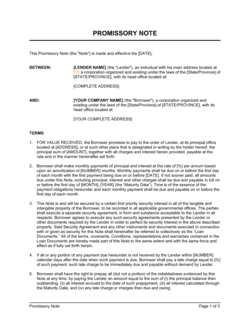
A Secured Installment Note is a legally binding debt instrument in which a borrower promises to repay a specific principal amount plus interest in fixed periodic installments, and pledges specific collateral as security for repayment. This free Word download covers the full repayment schedule, interest rate, collateral description, default triggers, and lender remedies in a single document you can edit online and export as PDF for execution.
When you need it
Use it when lending or borrowing money in a structured transaction where the lender requires collateral — such as equipment financing, business acquisition loans, real property loans, or private intercompany advances — and both parties need an enforceable, documented repayment schedule.
What's inside
Parties and principal amount, interest rate and calculation method, installment payment schedule, collateral description and security interest, prepayment terms, default triggers and cure periods, acceleration clause, lender remedies, and governing law. A promissory note and security agreement are combined into one instrument for straightforward secured lending.

What is a Secured Installment Note?

A Secured Installment Note is a legally binding debt instrument in which a borrower makes a written, enforceable promise to repay a specific principal amount plus interest in scheduled periodic installments — most commonly monthly — and simultaneously pledges identified collateral to the lender as security for that repayment obligation. Unlike a simple promise to pay, the security interest gives the lender a priority claim over the pledged asset that survives the borrower's insolvency and can be enforced without a court judgment in most jurisdictions. The document functions as both the payment contract and the security agreement, consolidating both obligations into a single executed instrument suitable for private business lending, equipment financing, seller-financed acquisitions, and intercompany loans.

Why You Need This Document

Lending or borrowing without a secured installment note exposes both parties to serious, concrete risk. A lender who advances funds on a handshake or an informal email becomes an unsecured creditor — last in line if the borrower files for bankruptcy, and without a defined schedule to enforce timely repayment. A borrower who signs a vague or incomplete note may face an acceleration demand at any time, with no cure period and no agreed dispute-resolution mechanism. Without a perfected security interest documented in writing and supported by a UCC-1 filing, the collateral provides no practical protection: a bankruptcy trustee can disregard an unperfected lien and treat the lender as unsecured. This template gives lenders an enforceable priority claim, gives borrowers a clear and predictable repayment schedule, and gives both parties a defined framework for handling default — reducing the dispute risk that turns private lending arrangements into costly litigation.

Which variant fits your situation?

If your situation is…Use this template
Unsecured loan where no collateral is pledgedUnsecured Promissory Note
Short-term loan repaid in a single lump sum at maturityDemand Promissory Note
Seller financing the purchase of a business with installmentsBusiness Purchase Agreement with Seller Financing
Mortgage-style loan secured by commercial real estateCommercial Mortgage Note
Equipment purchase financed over 24–60 monthsEquipment Financing Agreement
Loan between related companies requiring arm's-length documentationIntercompany Loan Agreement
Consumer installment loan subject to state lending regulationsConsumer Loan Agreement

Common mistakes to avoid

❌ Not perfecting the security interest with a UCC-1 filing

Why it matters: An unperfected security interest is unenforceable against a bankruptcy trustee or a subsequent creditor who perfects first. The lender becomes an unsecured creditor with no priority claim to the collateral.

Fix: File a UCC-1 financing statement in the borrower's state of organization within 5 business days of execution. Set a calendar reminder to renew it before the 5-year lapse date.

❌ Vague or overbroad collateral description

Why it matters: A description like 'all assets' without specifics may fail the UCC sufficiency test for certain asset classes and can be challenged by a bankruptcy trustee or competing secured creditor.

Fix: Identify collateral by category and unique identifier — asset type, serial number, account number, or legal description — and cross-reference the same language in both the note and the UCC-1 filing.

❌ Setting an interest rate above the state usury ceiling

Why it matters: In most US states, a usurious interest rate causes the excess interest — and in some states the entire interest provision — to be void. In a handful of states, the entire note is unenforceable.

Fix: Research the applicable state's usury limit before drafting. For rates above 10% per annum, confirm whether the borrower's entity type or the lender's license status affects the applicable ceiling.

❌ Omitting the deficiency judgment right

Why it matters: If collateral sells for less than the outstanding balance after default, the lender has no contractual basis to recover the shortfall without an explicit deficiency right — leaving a potentially significant loss unrecoverable.

Fix: Include explicit language authorizing the lender to pursue the borrower personally for any deficiency remaining after collateral liquidation, and confirm the governing state permits deficiency judgments for this asset class.

❌ Executing the note after funds are already disbursed

Why it matters: In several jurisdictions, a note signed after the lender advances funds may lack adequate consideration, making the security interest and restrictive covenants potentially unenforceable.

Fix: Execute all documents — the note, any security agreement, and the UCC-1 authorization — before or simultaneously with the disbursement of loan proceeds.

❌ No covenant requiring the borrower to maintain collateral insurance

Why it matters: If the collateral is destroyed, stolen, or damaged and the borrower carries no insurance, the lender holds a security interest in a worthless asset with no practical recourse beyond an unsecured deficiency claim.

Fix: Require the borrower to maintain property and casualty insurance on the collateral for at least its full replacement value and name the lender as loss payee throughout the loan term.

The 10 key clauses, explained

Parties and Principal Amount

In plain language: Identifies the lender and borrower as legal entities and states the exact dollar amount being lent.

Sample language
For value received, [BORROWER LEGAL NAME] ('Borrower'), a [STATE] [ENTITY TYPE], promises to pay to the order of [LENDER LEGAL NAME] ('Lender'), the principal sum of $[AMOUNT] USD, together with interest as set forth herein.

Common mistake: Using trade names instead of registered legal entity names. If the borrower defaults, enforcing a note against the wrong legal entity can delay or void recovery entirely.

Interest Rate and Calculation Method

In plain language: States the annual interest rate, whether it is fixed or variable, and how interest accrues — typically on the outstanding principal balance using a 365-day year.

Sample language
Interest shall accrue on the unpaid principal balance at the rate of [X]% per annum, calculated on the basis of a 365-day year, from the date of this Note until the principal is paid in full.

Common mistake: Omitting the calculation basis (365-day vs. 360-day year). A 360-day basis yields slightly more interest and can create a dispute if not explicitly agreed upon.

Installment Payment Schedule

In plain language: Defines the amount of each payment, the payment frequency, the first payment date, and the maturity date when all remaining amounts are due.

Sample language
Borrower shall repay this Note in [NUMBER] consecutive monthly installments of $[AMOUNT] each, beginning on [DATE] and continuing on the [DAY] of each month thereafter, with a final payment of all remaining principal and accrued interest due on [MATURITY DATE].

Common mistake: Setting a payment schedule without attaching an amortization table. Without the table, both parties may calculate the principal/interest split differently, creating accounting discrepancies.

Collateral Description and Security Interest

In plain language: Identifies the specific asset(s) pledged as security, grants the lender a security interest in that collateral, and authorizes the lender to file a UCC-1 financing statement.

Sample language
To secure repayment, Borrower hereby grants Lender a first-priority security interest in the following collateral: [DESCRIPTION OF COLLATERAL] ('Collateral'). Borrower authorizes Lender to file a UCC-1 financing statement or equivalent to perfect this security interest.

Common mistake: Describing collateral vaguely — 'all business assets' without specifics. Overly broad descriptions may not be perfected under UCC Article 9 and can be challenged by a bankruptcy trustee or competing creditor.

Prepayment

In plain language: States whether the borrower may repay the loan early, and whether a prepayment penalty applies.

Sample language
Borrower may prepay this Note in whole or in part at any time without penalty, provided that any partial prepayment shall be applied first to accrued interest and then to outstanding principal.

Common mistake: Leaving prepayment terms silent. Courts in some jurisdictions imply a right to prepay; in others, the lender can block early payoff. Silence creates a dispute when the borrower wants to refinance.

Default and Cure Period

In plain language: Defines what constitutes a default — including missed payments, bankruptcy, and covenant breaches — and gives the borrower a defined window to cure before remedies are triggered.

Sample language
An Event of Default occurs if: (a) Borrower fails to make any payment within [10] days of its due date; (b) Borrower commences or has commenced against it a bankruptcy or insolvency proceeding; or (c) Borrower breaches any material representation or covenant herein. Lender shall provide written notice of default, and Borrower shall have [15] calendar days to cure.

Common mistake: Setting no cure period at all. An immediate default trigger with no notice requirement is considered harsh by courts in most jurisdictions and can result in the acceleration clause being deemed unenforceable.

Acceleration

In plain language: Allows the lender to declare the entire remaining principal and accrued interest immediately due upon an uncured default.

Sample language
Upon an Event of Default that remains uncured after the applicable cure period, Lender may, at its sole discretion, declare the entire unpaid principal balance and all accrued interest immediately due and payable, without further notice or demand.

Common mistake: Making acceleration automatic rather than discretionary. Automatic acceleration can inadvertently trigger cross-default provisions in the borrower's other debt instruments, complicating recovery.

Lender Remedies

In plain language: Lists the lender's options upon default, including repossessing and selling the collateral, pursuing a deficiency judgment for any shortfall, and recovering legal costs.

Sample language
Upon default, Lender may: (a) take possession of and sell the Collateral in a commercially reasonable manner; (b) pursue a deficiency judgment against Borrower for any balance remaining after application of collateral proceeds; and (c) recover reasonable attorneys' fees and costs of collection.

Common mistake: Omitting a deficiency judgment right. If collateral value is less than the outstanding balance — common with depreciating equipment — the lender has no contractual basis to recover the shortfall without this clause.

Representations and Covenants

In plain language: The borrower warrants that it has authority to enter the note, that the collateral is free of prior liens, and agrees to maintain and insure the collateral during the loan term.

Sample language
Borrower represents that: (a) it has full authority to execute this Note; (b) the Collateral is free of all prior liens and encumbrances except as disclosed; and (c) Borrower shall maintain the Collateral in good condition, keep it insured for full replacement value, and not transfer or encumber it without Lender's prior written consent.

Common mistake: No covenant requiring the borrower to maintain collateral insurance. Uninsured collateral that is destroyed or damaged leaves the lender with a security interest in a worthless asset.

Governing Law and Dispute Resolution

In plain language: Specifies which jurisdiction's law governs the note and how disputes are resolved — court litigation or binding arbitration.

Sample language
This Note shall be governed by and construed in accordance with the laws of the State of [STATE], without regard to conflict-of-law principles. Any dispute arising hereunder shall be resolved in the state or federal courts located in [COUNTY/CITY], and the parties consent to personal jurisdiction therein.

Common mistake: Selecting a governing state with no connection to the transaction or the parties. Courts sometimes decline to apply a chosen law that has no reasonable relationship to the transaction, creating uncertainty about which rules apply.

How to fill it out

  1. 1

    Identify both parties using their full legal names

    Enter the lender's and borrower's registered legal entity names, not trade names or DBAs. Include entity type (LLC, corporation, individual) and state of formation or residence.

    💡 Pull entity names from your state's business registry or the borrower's formation documents to ensure they match exactly — errors here can complicate enforcement.

  2. 2

    Set the principal amount, interest rate, and effective date

    Enter the exact dollar amount being lent, the fixed or variable annual interest rate, and the date the note takes effect. Confirm the rate does not exceed the applicable state usury limit.

    💡 Check the usury ceiling in the governing state before finalizing the rate — many states cap interest rates for non-institutional lenders, and exceeding them voids the interest provision.

  3. 3

    Build and attach the amortization schedule

    Calculate the periodic installment amount using a standard amortization formula or spreadsheet. Attach the full amortization table as an exhibit showing principal, interest, and remaining balance for each payment period.

    💡 Include the amortization table as Exhibit A and reference it explicitly in the payment schedule clause — this eliminates any ambiguity about how each payment is applied.

  4. 4

    Describe the collateral with precision

    Identify the collateral by type, serial number, VIN, legal description, or other unique identifier. Attach a collateral schedule if multiple assets are pledged. Confirm the borrower holds clear title with no prior liens.

    💡 Run a UCC lien search on the borrower in the filing jurisdiction before closing to confirm there are no prior security interests that would subordinate your lien.

  5. 5

    Set default triggers and the cure period

    Define each default event — missed payment, insolvency, unauthorized transfer of collateral — and specify the number of days the borrower has to cure after written notice. Typically 10–15 days for payment defaults and 30 days for covenant breaches.

    💡 Longer cure periods feel borrower-friendly but give you time to receive certified mail confirmation of notice before the period begins — shortening the cure with a vague notice method defeats the purpose.

  6. 6

    Define prepayment rights and any penalty

    Choose whether prepayment is permitted freely, subject to a yield-maintenance fee, or restricted during an initial lockout period. State explicitly how prepayments are applied (interest first, then principal).

    💡 For equipment loans under 5 years, a no-penalty prepayment right is market standard and makes the note easier to refinance if the borrower's situation improves.

  7. 7

    Execute the note and file a UCC-1

    Both parties sign the note; the borrower's signature should be witnessed or notarized if required by the governing state. The lender should file a UCC-1 financing statement in the correct jurisdiction within 5 business days of execution to perfect the security interest.

    💡 File the UCC-1 in the state where the borrower is organized (for entities) or domiciled (for individuals) — not where the collateral is physically located, unless the collateral is real property or fixtures.

Frequently asked questions

What is a secured installment note?

A secured installment note is a written promise to repay a specific loan amount in fixed periodic payments — typically monthly — with interest, backed by collateral the lender can seize if the borrower defaults. It combines the payment schedule of a promissory note with a security interest in identifiable assets, giving the lender a priority claim over other unsecured creditors if the borrower becomes insolvent.

What is the difference between a secured installment note and an unsecured promissory note?

An unsecured promissory note is a borrower's plain promise to repay, with no collateral attached. If the borrower defaults, the lender must obtain a court judgment and then attempt to collect from whatever assets are available. A secured installment note gives the lender a pre-agreed right to specific collateral — meaning repossession and sale can begin without a court judgment in most US states and many other jurisdictions. The collateral generally allows the lender to offer a lower interest rate.

What collateral can be used to secure an installment note?

Personal property — equipment, vehicles, inventory, accounts receivable, and intellectual property — is secured under Article 9 of the UCC in the United States. Real property (land and buildings) requires a mortgage or deed of trust instead of, or in addition to, a UCC filing. Financial assets such as brokerage accounts and cash deposits can also serve as collateral under a pledge or control agreement. The collateral must be described with sufficient specificity in both the note and any UCC-1 financing statement.

Do I need to file a UCC-1 to make a secured installment note enforceable?

The note itself is enforceable between the parties whether or not a UCC-1 is filed. However, without a UCC-1 filing, the security interest is "unperfected" — meaning it has no priority over a bankruptcy trustee, a subsequent lien creditor who files first, or a buyer of the collateral in the ordinary course of business. Perfection through a UCC-1 filing is essential for the lender's collateral rights to survive a borrower bankruptcy.

What happens when a borrower defaults on a secured installment note?

After the cure period expires, the lender may typically accelerate the entire outstanding balance and exercise remedies against the collateral. In most US states, the lender can repossess personal property collateral without a court order if it can do so without breaching the peace, then sell the collateral in a commercially reasonable manner. Any proceeds are applied to costs, then interest, then principal. If a shortfall remains and the note includes a deficiency clause, the lender may pursue the borrower for the balance.

Is a secured installment note the same as a mortgage?

No. A mortgage (or deed of trust) is a security instrument used exclusively for real property. A secured installment note in the standard commercial sense secures personal property under Article 9 of the UCC. When real estate is the collateral, the transaction typically involves both a promissory note (the payment obligation) and a separate mortgage or deed of trust (the security instrument recorded in the land records).

Can a secured installment note be prepaid early?

Only if the note explicitly permits prepayment. Some notes include a prepayment penalty — often called a yield-maintenance fee — that compensates the lender for interest income lost by early repayment. Others allow free prepayment at any time. If the note is silent on prepayment, the answer varies by jurisdiction: most US states imply a right to prepay, but lenders in some states can contractually prohibit it. Always address prepayment expressly in the document.

What interest rate can a secured installment note charge?

The permissible rate depends on the governing state's usury laws and the nature of the parties. Many US states exempt commercial loans between businesses from usury ceilings entirely; others cap rates for non-bank lenders at 10–25% per annum regardless of the parties' status. Federal law preempts state usury limits for nationally chartered banks. Always verify the applicable ceiling before fixing the rate, particularly for loans to individuals or in states with strict consumer-lending statutes.

Do I need a lawyer to prepare a secured installment note?

For straightforward equipment or business loans between commercial parties at arms' length, a high-quality template is usually sufficient for amounts under $100,000. Engage a lawyer when the loan exceeds $250,000, involves real property, crosses international borders, is part of a business acquisition, involves a regulated lending activity, or when the borrower's financial condition makes default a realistic near-term scenario. A 1–2 hour review typically costs $300–$700 and is worthwhile for any secured transaction with material risk.

How this compares to alternatives

vs Unsecured Promissory Note

An unsecured promissory note is a plain payment promise with no collateral. If the borrower defaults, the lender must sue, obtain a judgment, and then compete with other creditors to collect. A secured installment note gives the lender a pre-agreed right to specific collateral — priority in bankruptcy and a faster recovery path. Use the unsecured version only for small amounts or between parties with high mutual trust.

vs Loan Agreement

A loan agreement is a comprehensive bilateral contract covering representations, conditions precedent, financial covenants, reporting obligations, and events of default in full detail — typically used for larger, more complex credit facilities. A secured installment note is a streamlined single-document instrument suitable for straightforward private loans under $500,000 where a full credit agreement would be disproportionately complex.

vs Commercial Mortgage

A commercial mortgage secures a loan specifically against real property and must be recorded in the land registry to create enforceable priority. A secured installment note under the UCC governs personal property collateral filed through a UCC-1 financing statement. When real estate is the collateral, a mortgage or deed of trust is required either instead of or in addition to a promissory note.

vs Equipment Lease Agreement

An equipment lease transfers the right to use equipment for a defined period in exchange for periodic lease payments, but ownership remains with the lessor. A secured installment note finances the purchase of equipment with the borrower taking title immediately and the lender holding a security interest. Leasing preserves the borrower's capital and may have off-balance-sheet treatment; the installment note builds ownership equity with each payment.

Industry-specific considerations

Equipment Finance and Leasing

Equipment serial number or VIN identifies collateral precisely; depreciation schedules inform both amortization terms and collateral valuation covenants throughout the note term.

Commercial Real Estate

Used alongside a mortgage or deed of trust for private bridge loans and mezzanine financing; maturity dates are typically 12–36 months with a balloon payment at term end.

Manufacturing

Machinery and production equipment serve as collateral; covenants typically require the borrower to maintain equipment to manufacturer specifications and carry machinery breakdown insurance.

Professional Services

Used in firm acquisitions where the seller accepts structured installment payments secured by the acquired firm's accounts receivable or client contracts as a practical substitute for external financing.

Retail and E-commerce

Inventory financing secured by stock in trade; advance rates are typically 50–65% of inventory cost value, with a covenant requiring the borrower to maintain minimum inventory levels.

Technology / SaaS

IP assets — patents, software, and domain portfolios — serve as collateral; requires careful collateral description and a covenant against licensing or transferring the IP without lender consent.

Jurisdictional notes

United States

Security interests in personal property are governed by UCC Article 9. The lender must file a UCC-1 financing statement in the borrower's state of organization (for entities) or domicile (for individuals) to perfect the security interest. State usury laws vary significantly — several states have no ceiling for commercial loans between entities, while others cap non-bank lenders at 10–16% per annum. California, New York, and Texas each have distinct commercial lending rules worth checking before execution.

Canada

Security interests in personal property are governed by provincial Personal Property Security Acts (PPSAs), which function similarly to UCC Article 9. The lender must register a financing statement in the province where the borrower is located. Interest rate disclosure requirements under the Interest Act apply to written instruments — partial-period rate statements must be expressed as an annual rate or the criminal rate cap (currently 35% effective annual rate under the Criminal Code) may apply. Quebec uses a distinct hypothec regime under the Civil Code.

United Kingdom

Security interests granted by UK companies over personal property are typically created by way of a fixed or floating charge and must be registered at Companies House within 21 days of creation under the Companies Act 2006, or they are void against a liquidator and creditors. The Financial Services and Markets Act 2000 may require lenders to be FCA-authorized if lending is carried out by way of business to consumers. Consumer Credit Act 1974 imposes additional requirements for loans to individuals.

European Union

Security interest regimes vary considerably by member state — Germany uses a Sicherungsübereignung (title transfer as security), France uses a nantissement, and the Netherlands uses a pandrecht. There is no unified EU equivalent of the UCC, so cross-border secured lending within the EU requires analysis of each relevant national law. Consumer loans across the EU are subject to the Consumer Credit Directive, which mandates standard annual percentage rate disclosure and a 14-day withdrawal right for qualifying consumer borrowers.

Template vs lawyer — what fits your deal?

PathBest forCostTime
Use the templatePrivate commercial loans under $100,000 between businesses for equipment or working capital with clearly identified collateralFree30–60 minutes
Template + legal reviewLoans of $100,000–$500,000, seller-financed business acquisitions, or transactions involving complex or high-value collateral$300–$7001–3 days
Custom draftedLoans exceeding $500,000, real property collateral, regulated lending, cross-border transactions, or borrowers in financial distress$1,500–$5,000+1–3 weeks

Glossary

Principal
The original amount of money borrowed, before interest or fees are added.
Security Interest
A lender's legal right to take and sell specific collateral if the borrower fails to repay the debt.
Collateral
An asset pledged by the borrower to the lender as security for a loan — the lender may seize it upon default.
Amortization
The process of spreading loan repayment over a schedule of fixed installments, each covering both principal reduction and interest.
Acceleration Clause
A provision that makes the entire outstanding loan balance immediately due and payable upon a defined default event.
Default
A borrower's failure to meet any material obligation under the note — typically a missed payment, insolvency, or breach of a covenant.
Cure Period
A defined number of days after a default notice within which the borrower may correct the default before the lender exercises remedies.
UCC Financing Statement (UCC-1)
A public filing under the Uniform Commercial Code that gives notice to third parties of a lender's security interest in personal property collateral.
Per Annum Interest Rate
The annual rate of interest applied to the outstanding principal balance, stated as a percentage and used to calculate each installment's interest component.
Prepayment Penalty
A fee charged to the borrower for repaying some or all of the principal ahead of schedule, compensating the lender for lost future interest.
Maturity Date
The date on which the final installment is due and all remaining principal and accrued interest must be fully repaid.
Recourse
The lender's right to pursue the borrower's personal or other assets beyond the pledged collateral if the collateral's value is insufficient to cover the outstanding debt.

Part of your Business Operating System

This document is one of 3,000+ business & legal templates included in Business in a Box.

  • Fill-in-the-blanks — ready in minutes
  • 100% customizable Word document
  • Compatible with all office suites
  • Export to PDF and share electronically

Create your document in 3 simple steps.

From template to signed document — all inside one Business Operating System.
1
Download or open template

Access over 3,000+ business and legal templates for any business task, project or initiative.

2
Edit and fill in the blanks with AI

Customize your ready-made business document template and save it in the cloud.

3
Save, Share, Send, Sign

Share your files and folders with your team. Create a space of seamless collaboration.

Save time, save money, and create top-quality documents.

★★★★★

"Fantastic value! I'm not sure how I'd do without it. It's worth its weight in gold and paid back for itself many times."

Managing Director · Mall Farm
Robert Whalley
Managing Director, Mall Farm Proprietary Limited
★★★★★

"I have been using Business in a Box for years. It has been the most useful source of templates I have encountered. I recommend it to anyone."

Business Owner · 4+ years
Dr Michael John Freestone
Business Owner
★★★★★

"It has been a life saver so many times I have lost count. Business in a Box has saved me so much time and as you know, time is money."

Owner · Upstate Web
David G. Moore Jr.
Owner, Upstate Web

Run your business with a system — not scattered tools

Stop downloading documents. Start operating with clarity. Business in a Box gives you the Business Operating System used by over 250,000 companies worldwide to structure, run, and grow their business.

Free Forever Plan · No credit card required