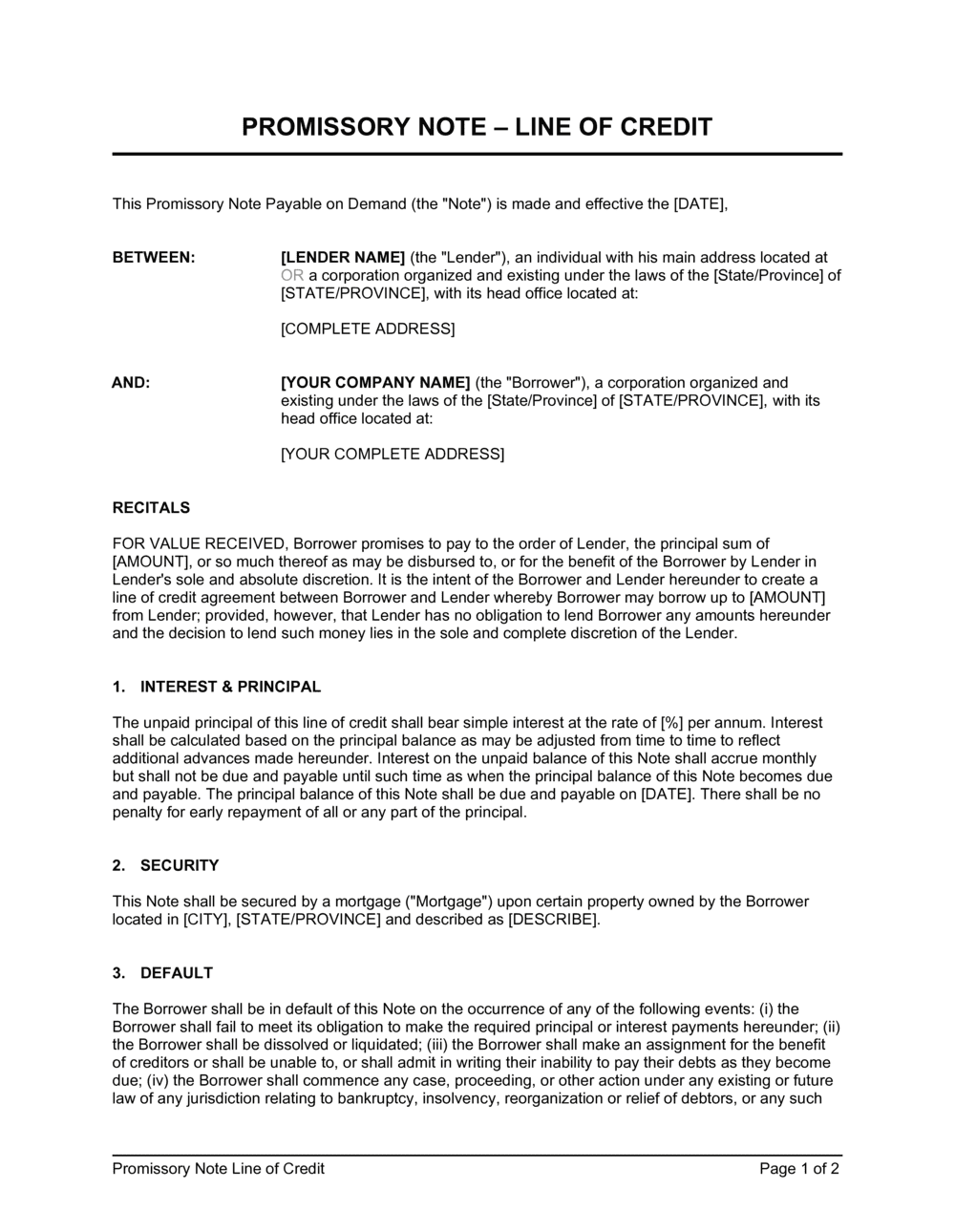
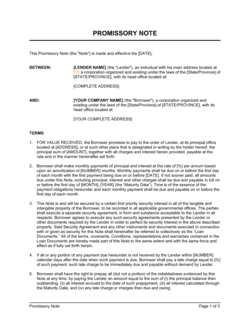
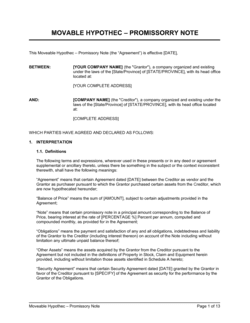
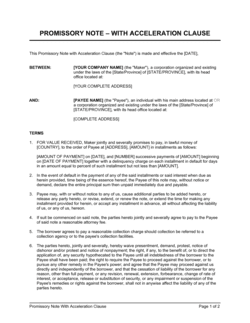
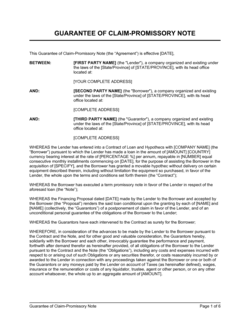
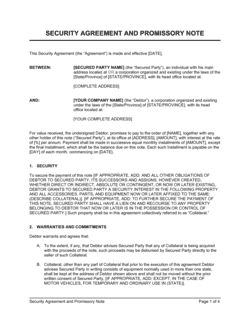
A Promissory Note Line of Credit is a legally binding instrument in which a lender commits to extend a revolving or open-end credit facility up to a defined maximum, and the borrower promises to repay all drawn amounts with interest under stated terms. This free Word download gives you a structured, attorney-reviewed starting point you can edit online and export as PDF to formalize a business or personal lending arrangement.
When you need it
Use it when a lender and borrower agree to a flexible draw facility — rather than a single lump-sum loan — so the borrower can access funds repeatedly up to a credit limit and repay on a defined schedule. It is commonly used between businesses and private lenders, between related companies, or when a bank requires a signed note to back a revolving credit product.
What's inside
Credit limit and draw mechanics, interest rate and calculation method, repayment schedule, maturity date, default and cure provisions, acceleration clause, governing law, and signature blocks for both parties.
What is a Promissory Note Line of Credit?
A Promissory Note Line of Credit is a legally binding open-end debt instrument in which a lender commits to advance funds up to a defined maximum credit limit on a revolving basis, and the borrower unconditionally promises to repay all drawn amounts plus accrued interest under the stated terms. Unlike a standard promissory note — which documents a single lump-sum disbursement — this instrument allows the borrower to draw, repay, and redraw repeatedly throughout the facility's term, with interest accruing only on the outstanding principal balance at any given time. It functions as the formal legal evidence of both the lender's commitment and the borrower's repayment obligation, and is recognized as a negotiable instrument in most common-law jurisdictions under legislation such as UCC Article 3 in the United States and the Bills of Exchange Act in Canada and the United Kingdom.
Why You Need This Document
Operating a revolving credit facility without a signed promissory note exposes both parties to serious financial and legal risk. For the lender, an undocumented advance is treated as a gift or a capital contribution in tax and insolvency proceedings — meaning the lender loses priority over other creditors and may owe tax on deemed distributions. For the borrower, the absence of agreed draw procedures, interest terms, and a maturity date creates ambiguity that a lender can exploit by demanding repayment on short notice. Without a default and cure clause, a single missed payment could trigger immediate collection action with no opportunity to correct the shortfall. This template establishes the credit limit, draw mechanics, interest calculation method, repayment schedule, and default remedies in a single enforceable document — giving both parties a clear record of their obligations and a defined framework for resolving disputes before they escalate.
Which variant fits your situation?
If your situation is…
Use this template
Single fixed-amount loan with one repayment schedule
❌ No minimum draw amount or advance notice requirement
Why it matters: Without these controls, the borrower can demand any amount at any time, preventing the lender from planning liquidity and making the facility operationally unmanageable.
Fix: Set a minimum draw of at least $[X] and require written notice at least 2–5 business days before each requested disbursement.
❌ Omitting whether prepayment restores available credit
Why it matters: For a revolving facility, this is the defining mechanical feature. Leaving it out creates immediate disputes when the borrower attempts to redraw after a repayment.
Fix: Add an explicit sentence stating that prepaid principal restores Available Credit dollar-for-dollar, up to the Credit Limit.
❌ No cure period before acceleration
Why it matters: Automatic acceleration on a single missed payment is disproportionate, commercially unusual, and may be unenforceable in jurisdictions that apply a reasonableness standard to acceleration clauses.
Fix: Include a monetary-default cure period of at least 5 business days and a non-monetary cure period of 30 days, triggered by written notice from the lender.
❌ Interest rate exceeds the applicable usury ceiling
Why it matters: A usurious rate voids the interest clause in many states — and in some jurisdictions (e.g., some civil-law countries) voids the entire note. The lender loses the right to collect any interest, not just the excess.
Fix: Confirm the rate against the applicable usury statute before execution. For commercial loans, verify whether the state exempts loans above a certain threshold from its usury cap.
❌ Using a governing-law clause disconnected from both parties' locations
Why it matters: Courts in California, for example, apply California usury and disclosure rules regardless of a conflicting governing-law clause when one party is a California resident or the loan is made in California.
Fix: Select a governing law that has a real connection to at least one party or where the funds are disbursed. Confirm local mandatory rules do not override the chosen law.
❌ Signing after the first draw has been disbursed
Why it matters: In most jurisdictions, consideration for the note must flow concurrently with or after execution. A note signed after funds have already been advanced may be challenged as unsupported by consideration.
Fix: Always execute the note before disbursing the first advance. If funds were advanced informally first, document the existing obligation in a separate recitals clause and obtain independent consideration for the note.
The 10 key clauses, explained
Parties, Credit Limit, and Commitment
In plain language: Identifies the lender and borrower as legal entities and states the maximum aggregate amount the lender commits to advance under the facility.
Sample language
This Promissory Note Line of Credit ('Note') is entered into as of [DATE] by and between [LENDER LEGAL NAME] ('Lender') and [BORROWER LEGAL NAME] ('Borrower'). Lender agrees to make advances to Borrower from time to time in an aggregate principal amount not to exceed [CREDIT LIMIT] (the 'Credit Limit').
Common mistake: Using trade names instead of registered legal entity names. If the lender or borrower entity name does not match public records, enforcement through courts or insolvency proceedings becomes complicated and slower.
Draw Mechanics and Request Procedure
In plain language: Specifies how the borrower requests a draw — minimum draw amount, notice period, the form of the draw request, and how funds are disbursed.
Sample language
Borrower may request advances by written notice to Lender no fewer than [X] business days prior to the requested disbursement date. Each advance shall be in a minimum amount of $[MINIMUM DRAW]. Lender shall disburse approved advances to Borrower's account ending in [ACCOUNT LAST FOUR] within [X] business days of approval.
Common mistake: Omitting a minimum draw amount and advance notice requirement. Without these, the borrower can demand draws of any size at any time, creating cash-flow management problems for the lender.
Interest Rate and Calculation
In plain language: States the interest rate, whether fixed or variable, the day-count convention for calculating interest, and when interest accrues.
Sample language
Outstanding principal shall bear interest at a rate of [X]% per annum ([RATE]%). Interest shall accrue daily on the basis of a 365-day year (or 366-day year in a leap year) and shall be calculated on the actual number of days elapsed.
Common mistake: Failing to specify the day-count convention (365 vs. 360 days). A 360-day year convention increases the effective interest cost by approximately 1.4% and must be disclosed explicitly to avoid usury or disclosure disputes.
Repayment Schedule
In plain language: Defines when and how the borrower repays drawn amounts — interest-only during the draw period, minimum monthly payments, or full repayment at maturity.
Sample language
Borrower shall pay accrued interest monthly on the [DAY] of each calendar month during the Draw Period. All outstanding principal and accrued unpaid interest shall be due and payable in full on the Maturity Date of [DATE].
Common mistake: Setting an interest-only payment schedule with no principal reduction requirement, then failing to include a maturity date. This creates an indefinite obligation with no clear repayment horizon, which courts in some jurisdictions treat as a demand obligation.
Maturity Date and Draw Period
In plain language: Sets the date after which no new draws may be requested and the date by which all amounts must be repaid.
Sample language
No advances shall be made under this Note after [DRAW PERIOD END DATE] (the 'Draw Period End Date'). All outstanding principal and accrued interest shall be due and payable in full on [MATURITY DATE] (the 'Maturity Date').
Common mistake: Conflating the draw period end date with the maturity date. If draws stop when the note matures, the borrower has no wind-down period to arrange repayment — causing technical default on day one of the repayment period.
Prepayment
In plain language: States whether the borrower may repay early without penalty, whether prepayment restores available credit, and any prepayment fee.
Sample language
Borrower may prepay all or any portion of the outstanding principal at any time without penalty. Any prepaid principal shall restore the Available Credit under this Note by an equal amount, subject to the Credit Limit.
Common mistake: Omitting whether prepayment restores available credit. For a revolving facility this is the key mechanical distinction from a term loan — leaving it out creates disputes about whether the borrower can redraw after repaying.
Default and Cure
In plain language: Lists events that constitute a default — missed payments, insolvency, misrepresentation — and gives the borrower a defined cure window before the lender can accelerate.
Sample language
Each of the following shall constitute an Event of Default: (a) Borrower fails to pay any amount due within [X] days of the due date; (b) Borrower becomes insolvent or makes an assignment for the benefit of creditors; (c) Borrower makes a material misrepresentation in any draw request. Borrower shall have [X] days written notice to cure a monetary default before Lender may exercise remedies.
Common mistake: No cure period for payment defaults. Without a cure window, a single late payment triggers immediate acceleration — a disproportionate remedy that courts sometimes decline to enforce and that destroys the commercial relationship.
Acceleration
In plain language: Gives the lender the right to declare all outstanding amounts immediately due upon an uncured default event.
Sample language
Upon the occurrence of an uncured Event of Default, Lender may, at its option, declare the entire outstanding principal balance and all accrued interest immediately due and payable without further notice or demand.
Common mistake: Writing an automatic acceleration clause with no lender discretion. Automatic acceleration removes the lender's flexibility to work with a borrower in temporary distress and can trigger cross-default provisions in the borrower's other agreements unintentionally.
Governing Law and Dispute Resolution
In plain language: Specifies which jurisdiction's laws govern the note and how disputes are resolved — litigation, arbitration, or mediation.
Sample language
This Note shall be governed by and construed in accordance with the laws of the State of [STATE], without regard to its conflict-of-law principles. Any dispute shall be resolved by binding arbitration administered by [AAA / JAMS] in [CITY, STATE], except that Lender may seek injunctive or equitable relief in any court of competent jurisdiction.
Common mistake: Choosing a governing law with no connection to either party's location. Several states — including California and New York — will apply local usury and disclosure laws regardless of a contrary governing-law clause.
Waivers and Entire Agreement
In plain language: Documents that the borrower waives presentment, demand, protest, and notice of dishonor, and that the note represents the entire agreement between the parties on this credit facility.
Sample language
Borrower hereby waives presentment, demand for payment, notice of dishonor, protest, and all other notices or demands in connection with this Note. This Note constitutes the entire agreement of the parties with respect to the credit facility described herein and supersedes all prior negotiations, representations, and agreements.
Common mistake: No integration clause. Without it, prior emails or term sheets can be introduced to vary the note's terms — a particular risk when the credit line was negotiated informally before the note was drafted.
How to fill it out
1
Enter the legal names and addresses of both parties
Use the full registered legal name of the lender and borrower — not trade names or DBAs. Include each party's state of formation and principal place of business.
💡 Cross-reference the borrower's state filing to confirm the exact entity name before signing; a misspelled entity name can complicate collection if the note goes to default.
2
Set the credit limit and minimum draw amount
Enter the maximum aggregate principal amount the lender will advance and the minimum amount per draw request. These numbers should reflect the lender's cash-flow capacity and the borrower's actual funding needs.
💡 A minimum draw of 5–10% of the credit limit is standard for private lines — it prevents administrative burden from small, frequent draws.
3
Define the interest rate and day-count convention
State whether the rate is fixed or variable. If variable, tie it to a published benchmark (e.g., the Wall Street Journal Prime Rate) plus a stated spread. Specify whether interest accrues on a 365-day or 360-day year.
💡 Confirm the stated rate does not exceed the usury ceiling in the governing jurisdiction before signing — state usury limits for commercial loans range from 10% to 25% per annum or may not apply above certain loan amounts.
4
Set the draw period end date and maturity date
Choose a draw period during which the borrower may request advances, then set a maturity date at least 60–90 days after the draw period ends to give the borrower time to arrange repayment.
💡 For multi-year facilities, consider an annual renewal mechanism rather than a fixed maturity — this lets the lender reassess creditworthiness each year without drafting a new note.
5
Specify the repayment structure
Decide whether payments during the draw period are interest-only, minimum principal plus interest, or discretionary. State the exact day of the month payments are due and the account to which they are made.
💡 Interest-only during the draw period is most common for revolving lines — it maximizes available credit — but add a minimum principal paydown requirement if the borrower's credit risk is elevated.
6
List default events and the cure period
Enumerate every event that triggers a default — missed payments, insolvency, change of control, misrepresentation — and set a cure period of 5 to 15 days for monetary defaults and 30 days for non-monetary defaults.
💡 A cure period of fewer than 5 business days for payment defaults is often viewed by courts as commercially unreasonable and may reduce the clause's enforceability.
7
Choose governing law and confirm usury compliance
Select the state or jurisdiction whose law will govern the note. Confirm the interest rate and any fees do not violate that jurisdiction's usury statute for the loan type and amount.
💡 New York and Delaware are the most lender-friendly jurisdictions for commercial promissory notes — both have well-developed case law and predictable enforcement.
8
Execute before any funds are advanced
Both parties must sign the note before the first draw is disbursed. Have signatures witnessed or notarized if required by the governing jurisdiction or if collateral is involved.
💡 Send the fully executed PDF to both parties immediately after signing and retain the original in a secure document repository — a lost original creates enforceability questions in some jurisdictions.
Frequently asked questions
What is a promissory note line of credit?
A promissory note line of credit is a binding legal instrument in which a lender commits to advance funds up to a defined credit limit on a revolving basis, and the borrower promises to repay all drawn amounts with interest under the stated terms. Unlike a standard promissory note that documents a single lump-sum loan, a line-of-credit note allows the borrower to draw, repay, and redraw repeatedly throughout the facility's term, up to the credit limit at any given time.
What is the difference between a promissory note and a line of credit promissory note?
A standard promissory note documents a single fixed advance — the full loan amount is disbursed at once and repaid on a set schedule. A promissory note line of credit is an open-end instrument that authorizes multiple advances up to a maximum limit; the outstanding balance fluctuates as the borrower draws and repays. The key distinction is flexibility: the borrower accesses only what is needed and replenishes available credit by making repayments, making it better suited for working capital and ongoing operational funding needs.
Does a promissory note line of credit need to be notarized?
In most US states, notarization is not required for a promissory note line of credit to be legally enforceable between the parties. However, if the note is secured by real property and the security instrument needs to be recorded, the associated deed of trust or mortgage will typically require notarization. Some international jurisdictions — and certain US states for commercial loans above a threshold — may impose additional formality requirements, so confirm the rules in the governing jurisdiction before execution.
Can a promissory note line of credit be used between related companies?
Yes — intercompany lines of credit are one of the most common uses of this instrument. However, the terms must reflect arm's-length commercial rates and conditions to avoid tax recharacterization as a dividend or capital contribution. Tax authorities in the US, Canada, and most EU member states require that intercompany loans carry a market interest rate and be documented with a signed note before the first advance. Failure to do so can result in the deemed distribution of the advanced amounts as taxable income to the borrower's shareholders.
What interest rate should I use in a promissory note line of credit?
The rate must comply with the usury ceiling of the governing jurisdiction for the loan type and amount. For US commercial lines of credit between businesses, many states exempt loans above a certain threshold (often $25,000–$100,000) from usury limits entirely. A common benchmark for private commercial lines is the Wall Street Journal Prime Rate plus a spread of 1–4 percentage points. For intercompany loans, the IRS Applicable Federal Rate (AFR) sets the minimum rate to avoid imputed interest. Always confirm compliance before signing.
What happens if the borrower defaults on a line of credit promissory note?
Upon an uncured default, the lender may invoke the acceleration clause to declare all outstanding principal and accrued interest immediately due. The lender can then pursue collection through litigation, seek summary judgment on the note (which is generally straightforward given its negotiable-instrument status), garnish bank accounts, or — if the note is secured — foreclose on the collateral. The note's governing law determines the procedural steps, statutes of limitation, and any required pre-litigation notices.
How is interest calculated on a revolving line of credit note?
Interest accrues daily on the actual outstanding principal balance — not the full credit limit. If the borrower has drawn $50,000 against a $200,000 line at 8% per annum on a 365-day basis, the daily interest cost is $50,000 × 0.08 / 365 = approximately $10.96 per day. As the borrower repays principal, the accruing interest decreases; as additional draws are made, it increases. The note should specify whether accrued interest is paid monthly or capitalized.
Is a promissory note line of credit the same as a loan agreement?
They serve a similar economic purpose but are different instruments. A promissory note is a negotiable instrument — a written promise to pay — that can in principle be transferred to a third party. A loan agreement is a bilateral contract that sets out the full commercial terms of a lending relationship but is generally not negotiable. In practice, many sophisticated lending transactions use both: a loan agreement governs the relationship and covenants, while a promissory note evidences the debt and can be held as collateral or pledged to a senior lender.
Can the credit limit on a promissory note line of credit be increased?
Yes, but a credit limit increase typically requires a written amendment signed by both parties, or a new note replacing the original. The note should include an amendment clause that specifies the form required for any modification — oral modifications are generally unenforceable for credit instruments, and a no-oral-modification clause makes that explicit.
Do I need a lawyer to draft a promissory note line of credit?
For straightforward private lines of credit between businesses in a single jurisdiction, a high-quality template is a suitable starting point. Legal review is advisable when the credit limit exceeds $100,000, when the note is secured by real or personal property, when the parties are in different countries, when the borrower is a regulated entity, or when the lender intends to pledge or sell the note. A lawyer can confirm usury compliance, draft appropriate security documentation, and tailor default remedies to the specific risk profile of the transaction.
A standard promissory note documents a single, fixed-amount advance disbursed in one payment and repaid on a fixed schedule. A line-of-credit note allows multiple draws up to a revolving limit throughout the term. Use a standard note for a one-time loan; use a line-of-credit note when the borrower needs ongoing access to flexible capital.
A loan agreement is a comprehensive bilateral contract covering covenants, representations, conditions precedent, and lender rights in detail — typically used for larger, bank-structured financings. A promissory note line of credit is a more concise negotiable instrument better suited to private and intercompany arrangements. For deals above $500,000 or with covenant packages, a loan agreement is more appropriate.
A secured promissory note attaches specific collateral — real estate, equipment, or receivables — as security for repayment, giving the lender priority over that asset in a default. An unsecured line-of-credit note relies solely on the borrower's promise to pay. Use the secured version when the credit limit is large or the borrower's creditworthiness requires collateral support.
A convertible promissory note gives the lender the option to convert outstanding principal and interest into equity at a defined trigger — typically a future financing round or maturity. A line-of-credit note is a pure debt instrument with no equity component. Use a convertible note when the lender is an early-stage investor who wants equity upside; use a line-of-credit note when the arrangement is purely a lending transaction.
Industry-specific considerations
Real Estate Investment
Revolving draw facilities for acquisition and rehabilitation costs, with the credit limit sized to the combined purchase price and renovation budget of a defined property pipeline.
Professional Services
Working capital lines used to fund payroll and operating costs between client invoice issuance and payment receipt, with draws timed to the firm's billing cycle.
Manufacturing
Inventory financing lines that allow manufacturers to draw against the credit limit to fund raw material purchases, with repayment triggered by the sale of finished goods.
Technology / SaaS
Intercompany lines of credit between a parent company and operating subsidiaries to fund product development or international expansion between equity funding rounds.
Jurisdictional notes
United States
Promissory notes are governed by UCC Article 3 as negotiable instruments in all 50 states. Usury limits vary significantly by state — New York caps unlicensed lender rates at 16% for civil usury and 25% for criminal usury, while many states exempt commercial loans above $25,000–$100,000 entirely. California's usury law does not apply to loans made by licensed lenders or certain exempt parties. Always confirm the applicable ceiling before setting the interest rate.
Canada
Canadian promissory notes are governed by the federal Bills of Exchange Act and applicable provincial law. The Criminal Code prohibits effective interest rates above 60% per annum on any loan. Provincial consumer protection legislation may impose additional disclosure and cooling-off requirements when the borrower is an individual. Quebec's Civil Code imposes distinct rules on negotiable instruments and requires that loan documents be in French for provincially regulated transactions.
United Kingdom
Promissory notes in the UK are governed by the Bills of Exchange Act 1882. Consumer credit lines are regulated by the Financial Conduct Authority under the Consumer Credit Act 1974, which imposes licensing, disclosure, and right-of-withdrawal requirements. Business-to-business credit facilities are generally exempt from consumer credit regulation. Post-Brexit, UK rules have diverged from EU requirements and are now set independently by the FCA.
European Union
Consumer credit agreements in the EU are governed by the Consumer Credit Directive (2008/48/EC) and its 2023 revision, which mandates standardized pre-contractual disclosures, an annual percentage rate (APR) calculation, and a 14-day withdrawal right for consumer borrowers. Business lending is not subject to the Directive but may be regulated at the member-state level. GDPR applies to the processing of any personal data in connection with the loan documentation and KYC process.
Template vs lawyer — what fits your deal?
Path
Best for
Cost
Time
Use the template
Private lines of credit between businesses or individuals in a single jurisdiction, with a credit limit below $100,000 and no collateral
Free
30–45 minutes
Template + legal review
Lines of credit above $100,000, intercompany facilities, or when usury compliance in the governing state requires verification
$300–$800
2–5 days
Custom drafted
Secured facilities, cross-border transactions, regulated borrowers, or notes that will be pledged or sold to a third party
$1,500–$5,000+
1–3 weeks
Glossary
Credit Limit
The maximum aggregate principal amount the borrower may draw under the line at any one time.
Draw
A single advance of funds requested by the borrower against the available credit facility.
Revolving Credit
A credit structure that allows the borrower to draw, repay, and redraw funds repeatedly up to the credit limit throughout the term.
Open-End Note
A promissory note that does not fix a single disbursement amount but allows multiple advances up to a stated maximum.
Maturity Date
The date on which all outstanding principal and accrued interest under the line of credit become due and payable in full.
Acceleration Clause
A provision allowing the lender to declare the entire outstanding balance immediately due upon the occurrence of a default event.
Default
A failure by the borrower to meet any material obligation under the note — typically missed payments, breach of covenants, or insolvency — that triggers the lender's remedies.
Cure Period
A defined window — often 5 to 15 days — during which the borrower may correct a default before the lender may accelerate or enforce remedies.
Per Annum Interest Rate
The annual percentage rate applied to the outstanding principal balance to calculate interest charges, typically stated as a fixed rate or a benchmark rate plus a spread.
Available Credit
The credit limit minus the current outstanding principal balance — the amount the borrower may still draw at any given time.
Prepayment
The borrower's voluntary repayment of principal before it is contractually due, which under most line-of-credit structures replenishes available credit.
Part of your Business Operating System
This document is one of 3,000+ business & legal templates included in Business in a Box.
Fill-in-the-blanks — ready in minutes
100% customizable Word document
Compatible with all office suites
Export to PDF and share electronically
Related templates
You might also need these contracts and agreements:
From template to signed document — all inside one Business Operating System.
1
Download or open template
Access over 3,000+ business and legal templates for any business task, project or initiative.
2
Edit and fill in the blanks with AI
Customize your ready-made business document template and save it in the cloud.
3
Save, Share, Send, Sign
Share your files and folders with your team. Create a space of seamless collaboration.
Save time, save money, and create top-quality documents.
★★★★★
"Fantastic value! I'm not sure how I'd do without it. It's worth its weight in gold and paid back for itself many times."
Managing Director · Mall Farm
RW
Robert Whalley
Managing Director, Mall Farm Proprietary Limited
★★★★★
"I have been using Business in a Box for years. It has been the most useful source of templates I have encountered. I recommend it to anyone."
Business Owner · 4+ years
MF
Dr Michael John Freestone
Business Owner
★★★★★
"It has been a life saver so many times I have lost count. Business in a Box has saved me so much time and as you know, time is money."
Owner · Upstate Web
DM
David G. Moore Jr.
Owner, Upstate Web
Run your business with a system — not scattered tools
Stop downloading documents. Start operating with clarity. Business in a Box gives you the Business Operating System used by over 250,000 companies worldwide to structure, run, and grow their business.