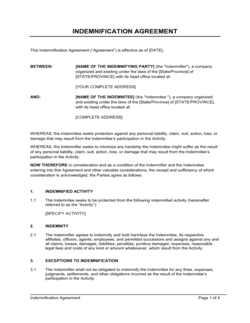
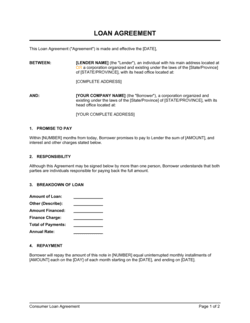
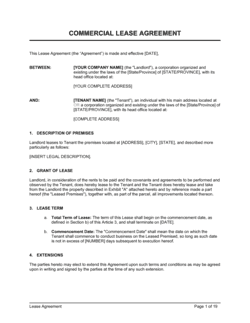
Personal Guarantee Template

Free Word download • Edit online • Save & share with Drive • Export to PDF

2 pages20–30 min to fillDifficulty: StandardSignature requiredLegal review recommended
Learn more ↓
FreePersonal Guarantee Template

At a glance

What it is
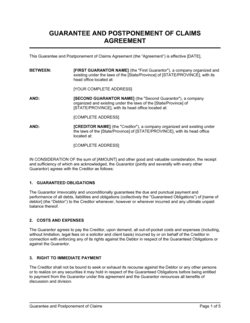
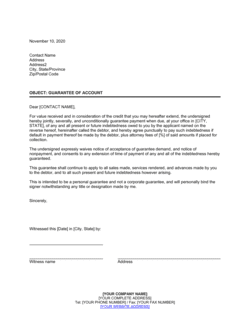
A Personal Guarantee is a legally binding undertaking in which an individual — typically a business owner, director, or principal — agrees to be personally responsible for the debts and obligations of a company if the company itself fails to perform. This free Word download gives you a structured, creditor-ready template you can edit online and export as PDF to satisfy lender, landlord, or supplier requirements.
When you need it
Use it when a bank, landlord, or key supplier requires a principal's personal commitment before extending credit, approving a lease, or opening a trade account for a small business or newly formed entity without sufficient credit history.
What's inside
Guarantor and creditor identification, the underlying obligation being guaranteed, the scope of liability (limited vs. unlimited), waiver of defenses, notice and demand provisions, governing law, and signature blocks for the guarantor and a witness or notary where required.

What is a Personal Guarantee?

A Personal Guarantee is a legally binding undertaking in which an individual — typically a business owner, director, or company principal — agrees to be personally liable for the debts and obligations of their company if the company itself fails to pay or perform. By signing a personal guarantee, the individual sets aside the liability protection that an LLC or corporation normally provides, giving the creditor direct recourse against personal assets such as bank accounts, investment portfolios, and real property. Lenders, landlords, and suppliers require personal guarantees when the borrowing entity lacks sufficient credit history, assets, or operating track record to satisfy the creditor on its own merits.

Why You Need This Document

Whether you are the creditor requiring one or the business owner being asked to sign, a poorly drafted or misunderstood personal guarantee creates serious financial exposure. For creditors, an ambiguous guarantee — one that omits a continuing-guarantee clause, lacks a clear demand provision, or fails to specify governing law — can be difficult or impossible to enforce at the moment it matters most. For guarantors, signing without understanding whether the guarantee is limited or unlimited, whether it covers future obligations, or whether it can be released can result in personal liability that far exceeds what was originally contemplated. This template gives both parties a clear, structured starting point — identifying the parties and the underlying obligation precisely, setting out the scope of liability in plain terms, and including waiver, subrogation, and release clauses that reflect standard commercial practice. Using a properly prepared template reduces the risk of ambiguity, speeds up creditor review, and ensures the document holds up if enforcement becomes necessary.

Which variant fits your situation?

If your situation is…Use this template
Guarantor's liability is capped at a specific dollar amountLimited Personal Guarantee
Guarantor's liability covers all present and future obligations with no capUnlimited Personal Guarantee
Multiple principals each guarantee a defined share of the debtSeveral Guarantee (Pro-Rata)
Multiple guarantors are each fully liable for the entire debtJoint and Several Guarantee
Guarantee is tied to a commercial real estate leaseLease Personal Guarantee
Guarantee supports an SBA 7(a) or 504 loan specificallySBA Loan Personal Guarantee
Guarantee releases automatically once the principal debt is paid in fullContinuing Guarantee with Release Clause

Common mistakes to avoid

❌ Signing an unlimited guarantee without attempting to negotiate a cap

Why it matters: An unlimited guarantee exposes every personal asset — home, savings, retirement accounts — to collection if the business defaults. The cap a creditor will accept is often negotiable, especially when the guarantor has other collateral to offer.

Fix: Before signing, propose a specific dollar cap equal to the initial loan or lease amount, or negotiate a burn-down schedule tied to the outstanding balance. Many commercial lenders will accept a partial limitation rather than lose the deal.

❌ Not reading whether the guarantee is 'continuing'

Why it matters: A continuing guarantee attaches to every future obligation the company incurs with the creditor — meaning a line of credit that is paid off and re-drawn repeatedly keeps the guarantor liable indefinitely, well beyond the original transaction.

Fix: If you intend to guarantee only a specific transaction, add explicit language limiting the guarantee to that transaction and its direct renewals, and excluding any new facilities or credit extensions.

❌ Failing to obtain a written release after the debt is repaid

Why it matters: Paying off the underlying loan or lease does not automatically discharge a continuing guarantee — a creditor could argue that future obligations reactivate it, leaving the guarantor exposed to liability they believed had ended.

Fix: Request a formal written release from the creditor within 30 days of final payment. Do not accept verbal assurances; the release must be signed by an authorized representative of the creditor.

❌ Ignoring spousal consent requirements

Why it matters: In community-property states (Arizona, California, Texas, Washington, and others), jointly held marital assets may be reachable by a creditor even if only one spouse signed the guarantee — unless a spousal consent or waiver is properly executed.

Fix: Confirm the marital property laws of your state of residence before signing. If community-property rules apply and marital assets are at stake, have a lawyer advise on whether a spousal consent addendum is required.

The 10 key clauses, explained

Parties and recitals

In plain language: Identifies the guarantor by full legal name, the principal debtor (the company), and the creditor, and states the commercial reason the guarantee is being given.

Sample language
This Personal Guarantee is entered into as of [DATE] by [GUARANTOR FULL LEGAL NAME] ('Guarantor'), residing at [ADDRESS], in favor of [CREDITOR LEGAL NAME] ('Creditor'), in connection with the [LOAN AGREEMENT / LEASE / CREDIT FACILITY] dated [DATE] between [COMPANY LEGAL NAME] ('Company') and Creditor.

Common mistake: Using a nickname or trade name instead of the guarantor's full legal name as it appears on government-issued ID — creating an identity mismatch that can impede enforcement.

Guarantee of payment and performance

In plain language: States that the guarantor unconditionally guarantees that the company will pay all amounts owed and perform all obligations under the underlying agreement, and that if the company fails to do so, the guarantor will.

Sample language
Guarantor unconditionally and irrevocably guarantees to Creditor the prompt payment when due of all amounts owed by Company under the [AGREEMENT NAME], and the full and timely performance of all obligations of Company thereunder.

Common mistake: Limiting the guarantee to payment only, inadvertently excluding performance obligations — leaving the creditor without recourse if the company breaches a non-monetary covenant.

Scope of liability (limited vs. unlimited)

In plain language: Defines whether the guarantor's exposure is capped at a fixed dollar amount or extends to the entire debt, including interest, fees, and enforcement costs.

Sample language
Guarantor's liability under this Guarantee shall [not exceed $[MAXIMUM AMOUNT] in the aggregate / be unlimited and shall include all principal, accrued interest, late fees, and reasonable attorneys' fees and collection costs incurred by Creditor].

Common mistake: Agreeing to an unlimited guarantee without negotiating a cap — even a partial cap (e.g., 12 months of rent) materially limits personal exposure and is often acceptable to creditors.

Continuing guarantee

In plain language: Specifies that the guarantee applies to all present and future obligations of the company to the creditor, not just the obligation in existence at signing.

Sample language
This Guarantee is a continuing guarantee and shall apply to all existing and future indebtedness and obligations of Company to Creditor, regardless of the form, nature, or time of incurrence of such obligations.

Common mistake: Not reading whether the guarantee is continuing before signing — a continuing guarantee can bind the guarantor to obligations the company incurs years after execution.

Waiver of defenses and notices

In plain language: The guarantor waives specific rights — such as requiring the creditor to first sue the debtor, or to provide notice before calling the guarantee — that would otherwise give the guarantor procedural protection.

Sample language
Guarantor waives: (a) notice of acceptance of this Guarantee; (b) notice of the creation or modification of any obligation of Company; (c) demand, presentment, protest, and notice of dishonor; and (d) the right to require Creditor to first proceed against Company or any collateral before enforcing this Guarantee.

Common mistake: Waiving all defenses without retaining the right to dispute the underlying debt amount — leaving the guarantor with no ability to challenge an inflated or miscalculated demand.

Subrogation and reimbursement

In plain language: Grants the guarantor the right to pursue the company for repayment after the guarantor has paid the creditor, but subordinates that right to the creditor's full recovery.

Sample language
Upon payment in full by Guarantor of all obligations guaranteed hereunder, Guarantor shall be subrogated to the rights of Creditor against Company; provided, however, that Guarantor shall not exercise any such right until Creditor has been paid in full.

Common mistake: Omitting the subordination proviso — a guarantor who pursues the debtor before the creditor is fully repaid can trigger a breach of the guarantee agreement itself.

Demand and enforcement

In plain language: Specifies how and when the creditor may call on the guarantee — typically by written demand to the guarantor — and that payment is due within a stated number of days of that demand.

Sample language
Upon written demand from Creditor following a default by Company, Guarantor shall pay all amounts due under this Guarantee within [10] business days of receipt of such demand, without set-off, deduction, or withholding.

Common mistake: No stated timeline for payment after demand — without one, 'reasonable time' is determined by a court, which introduces cost and delay into what should be a straightforward enforcement.

Representations and warranties

In plain language: The guarantor confirms they have the legal capacity to enter the guarantee, are not insolvent, and have received adequate consideration (typically the benefit derived from the credit extended to the company).

Sample language
Guarantor represents and warrants that: (a) Guarantor has full legal capacity to execute this Guarantee; (b) Guarantor is not currently insolvent; (c) execution of this Guarantee does not violate any agreement to which Guarantor is a party; and (d) Guarantor has received adequate consideration for entering into this Guarantee.

Common mistake: Omitting a solvency representation — if the guarantor is already insolvent at signing, the guarantee may be voided as a fraudulent conveyance under applicable insolvency law.

Governing law and dispute resolution

In plain language: Specifies which jurisdiction's law governs the guarantee and how disputes are resolved — typically the creditor's preferred jurisdiction, which may differ from where the guarantor resides.

Sample language
This Guarantee shall be governed by and construed in accordance with the laws of the State of [STATE], without regard to conflict-of-law principles. Guarantor consents to the exclusive jurisdiction of the courts of [STATE / COUNTY] for any dispute arising under this Guarantee.

Common mistake: Agreeing to a governing law in a jurisdiction where the guarantor has no assets — giving the creditor a judgment it cannot practically enforce.

Release and termination

In plain language: States the conditions under which the guarantor's obligations are fully discharged — most commonly, full repayment of the underlying debt — and requires a formal written release from the creditor.

Sample language
This Guarantee shall terminate and Guarantor shall be fully released upon the irrevocable payment in full of all obligations of Company to Creditor under the [AGREEMENT NAME] and the issuance of a written release by Creditor to Guarantor.

Common mistake: Assuming the guarantee expires automatically when the loan is repaid — without a written release clause, a creditor could argue that future obligations reactivate a continuing guarantee.

How to fill it out

  1. 1

    Identify all parties by full legal name

    Enter the guarantor's full legal name and residential address, the company's registered legal name and jurisdiction of formation, and the creditor's full legal name and address. These must match exactly what appears on the underlying loan, lease, or credit agreement.

    💡 Request the creditor's exact legal entity name from their letterhead or corporate registry — a name mismatch can create enforceability questions in the event of a dispute.

  2. 2

    Reference the underlying agreement precisely

    Insert the exact name, date, and identifying number of the agreement being guaranteed — e.g., 'Loan Agreement dated [DATE], Loan No. [XXXXXX].' If guaranteeing a lease, include the property address and lease commencement date.

    💡 If the underlying agreement is amended after the guarantee is signed, confirm in writing whether the guarantee extends to the amended terms — most continuing guarantees do, but confirming avoids later disputes.

  3. 3

    Choose and complete the scope of liability clause

    Decide whether the guarantee will be limited (capped at a specific dollar amount) or unlimited (covering the full debt plus interest, fees, and costs). Delete the inapplicable bracketed option and fill in the cap amount if using a limited guarantee.

    💡 If the creditor insists on an unlimited guarantee, negotiate for a burn-down provision — the cap reduces automatically as the principal balance is paid down.

  4. 4

    Review and tailor the waiver of defenses clause

    Read every defense being waived carefully. Consider retaining the right to dispute the calculation of the amount owed, even if you agree to waive procedural defenses such as notice and demand requirements.

    💡 At minimum, negotiate to keep the right to offset any amounts the creditor owes the company against the guaranteed obligation — some creditors will accept this carve-out.

  5. 5

    Set the demand payment timeline

    Enter the number of business days (typically 5 to 15) within which the guarantor must pay following a written demand. Ensure this timeline is realistic given how quickly you could liquidate assets if called.

    💡 A 10-business-day window is generally accepted by commercial creditors and gives the guarantor time to arrange funds without appearing uncooperative.

  6. 6

    Confirm the governing law and venue

    Enter the state, province, or country whose law will govern the guarantee, and the specific court or arbitration venue where disputes will be resolved. If the creditor insists on their jurisdiction, verify you have assets there or can effectively litigate remotely.

    💡 If the creditor is in a different state, negotiate for the courts of your home state or at least a mutually convenient federal court — forum shopping by creditors is common.

  7. 7

    Execute with proper formalities

    Both the guarantor and a creditor representative must sign and date the guarantee. Some lenders and jurisdictions require a witness signature or notarization — check the creditor's requirements and applicable law before the signing meeting.

    💡 If a spouse or domestic partner may have an interest in assets being exposed to guarantee liability, some creditors require the spouse to also sign or provide a spousal consent — confirm this in advance.

  8. 8

    Retain a fully executed copy and file it securely

    The guarantor should retain an original or certified copy of the signed guarantee. File it with your personal financial records and note the related debt's maturity date so you can confirm the guarantee is formally released upon repayment.

    💡 Diarize the loan or lease maturity date and follow up with the creditor for a written release within 30 days of final payment — do not assume the guarantee terminates automatically.

Frequently asked questions

What is a personal guarantee?

A personal guarantee is a legally binding commitment by an individual — typically a business owner or company director — to be personally responsible for the debts or obligations of their company if the company fails to pay or perform. It converts a business obligation into a personal one, giving the creditor direct recourse against the guarantor's personal assets such as savings, investments, and real property.

When is a personal guarantee required?

Creditors most commonly require a personal guarantee when the borrowing entity is a small business or newly formed company with limited credit history, minimal assets, or no established revenue. Banks typically require it for business loans and lines of credit. Landlords request it for commercial leases signed by an LLC or corporation. Suppliers may require it before opening net-terms trade accounts. In short, any time a creditor cannot rely solely on the company's balance sheet for repayment.

What is the difference between a limited and an unlimited personal guarantee?

A limited personal guarantee caps the guarantor's liability at a specific dollar amount — for example, $150,000 or 12 months of lease payments. An unlimited personal guarantee covers the entire outstanding balance plus accrued interest, late fees, attorneys' fees, and collection costs, with no ceiling. Guarantors should always attempt to negotiate a limit; many creditors will accept a cap rather than lose the transaction.

Does a personal guarantee affect my personal credit?

The guarantee itself does not appear as a tradeline on your personal credit report unless the creditor calls on it after a default. If the creditor pursues collection, obtains a judgment, or reports the delinquency, it can significantly damage your personal credit score. Some lenders perform a personal credit check at origination, which generates a hard inquiry. Review the creditor's disclosure carefully to understand what reporting they conduct.

Can a personal guarantee be revoked?

A guarantee tied to a specific transaction cannot typically be revoked unilaterally after it is signed — the guarantor remains bound until the underlying debt is repaid and a formal release is issued. A continuing guarantee that covers future obligations may sometimes be revoked as to new obligations not yet incurred, depending on the contract language and applicable jurisdiction. Any revocation must be in writing and delivered to the creditor in accordance with the notice provisions of the guarantee.

What happens when a personal guarantee is called?

When the company defaults on the underlying obligation, the creditor issues a written demand to the guarantor. The guarantor typically has a short window — often 5 to 15 business days — to pay the amount demanded. If the guarantor fails to pay, the creditor can pursue legal action, obtain a personal judgment, and execute against the guarantor's personal assets, including bank accounts, investment accounts, and real estate, subject to any exemptions under applicable state or provincial law.

Are personal guarantees enforceable?

Personal guarantees are generally enforceable when properly executed — both parties have signed, the guarantor had legal capacity, and adequate consideration exists (typically the credit extended to the company). Courts have voided guarantees on grounds including fraud, duress, material misrepresentation by the creditor, and — in some jurisdictions — failure to explain the nature of the document to a guarantor who did not speak the language of the contract. Consider consulting a lawyer before signing any guarantee you do not fully understand.

What personal assets can a creditor reach under a personal guarantee?

Subject to applicable exemptions, a creditor holding a judgment on a personal guarantee can typically reach bank and investment accounts, business interests, vehicles, and real property. Most jurisdictions protect a homestead exemption (ranging from $25,000 to unlimited depending on the state or province), retirement accounts up to certain limits, and basic personal property. The scope of collectible assets varies significantly by jurisdiction — a lawyer can advise on your specific exposure before you sign.

Do I need a lawyer to sign a personal guarantee?

For a straightforward, single-transaction limited guarantee tied to a small business loan or standard commercial lease, a high-quality template reviewed carefully is often sufficient for most business owners. Engaging a lawyer is strongly advisable when the guarantee is unlimited, continuing, or covers a large obligation; when you are in a community-property state; when multiple guarantors are involved with joint-and-several liability; or when the creditor is presenting a heavily one-sided form agreement. A 1–2 hour lawyer review typically costs $300–$600 and can identify negotiating points that meaningfully reduce your personal exposure.

What is the difference between a personal guarantee and an indemnity?

A personal guarantee is a secondary obligation — the guarantor promises to pay if the company fails to pay. An indemnity is a primary obligation — the indemnifier promises to cover the creditor's loss regardless of whether the company is liable. Indemnities are harder to defend against because the indemnifier cannot rely on defenses available to the principal debtor. Many commercial guarantee documents combine both, so review the exact wording rather than relying on the document title alone.

How this compares to alternatives

vs Corporate Guarantee

A corporate guarantee is provided by a parent company or affiliate entity rather than by an individual, keeping the principals' personal assets out of the transaction. Creditors accept corporate guarantees when the guaranteeing entity has substantial assets and creditworthiness. A personal guarantee is required when the company itself — or its parent — lacks the credit profile to satisfy the creditor on its own.

vs Promissory Note

A promissory note is a direct, primary commitment by the borrower to repay a specific debt — the borrower and the obligor are the same party. A personal guarantee is a secondary obligation in which the guarantor backs up someone else's (the company's) debt. In most loan transactions, both documents are executed together: the note governs the debt, and the guarantee secures it against the individual.

vs Indemnity Agreement

An indemnity agreement creates a primary obligation to cover another party's loss, independent of whether the indemnified party is at fault or liable. A personal guarantee is secondary — the guarantor is only called upon if the principal debtor defaults. Because indemnities are primary obligations, they are generally harder to contest and expose the indemnifier to broader liability than a guarantee.

vs Letter of Credit

A standby letter of credit is a bank instrument that guarantees payment to a creditor if specified conditions are met, without requiring the creditor to pursue the debtor first. A personal guarantee relies on an individual's personal creditworthiness and assets rather than a bank's. Letters of credit are more liquid for creditors but cost the applicant bank fees; personal guarantees cost nothing to issue but depend entirely on the guarantor's financial condition at the time of default.

Industry-specific considerations

Commercial Real Estate

Landlords routinely require a personal guarantee from the principals of LLC or corporate tenants, often capped at 12 to 24 months of base rent, as a condition of executing a commercial lease.

Banking and Lending

SBA regulations require a personal guarantee from any individual owning 20% or more of a borrowing entity for all SBA 7(a) and 504 loans, with no dollar cap.

Wholesale and Distribution

Suppliers extending net-30 or net-60 trade credit to new or small-business buyers frequently require a principal's personal guarantee to open the account and set the credit limit.

Franchising

Franchisors typically require franchisees to provide a personal guarantee covering royalty payments, marketing fund contributions, and lease obligations assigned from the franchisor.

Jurisdictional notes

United States

Personal guarantee law varies by state. In community-property states — including Arizona, California, Nevada, and Texas — a creditor may be able to reach jointly held marital assets unless a spousal consent or waiver is executed. The SBA mandates personal guarantees from all 20%-or-greater owners for SBA 7(a) and 504 loans. Some states cap attorneys' fees recoverable under a guarantee, and homestead exemptions vary widely — from $25,000 in some states to unlimited in Florida and Texas.

Canada

Guarantees are governed by provincial contract law, and several provinces — including Ontario — require guarantees to be evidenced in writing and signed by the guarantor to be enforceable. In Quebec, a guarantee (cautionnement) follows the Civil Code of Quebec and must not be for a greater amount than the principal obligation. Courts in Ontario and British Columbia have shown willingness to void guarantees where the creditor failed to explain the nature of the document to an unsophisticated guarantor.

United Kingdom

Under the Statute of Frauds 1677, a guarantee must be in writing and signed by the guarantor to be enforceable in England and Wales. Courts distinguish carefully between guarantees (secondary obligations) and indemnities (primary obligations), as different defenses apply to each. The Unfair Contract Terms Act 1977 and consumer protection regulations may limit the enforceability of guarantee terms in consumer-facing contexts. Creditors extending guarantees to company directors in small businesses should take care to avoid undue influence claims.

European Union

Guarantee law is primarily a matter of member state law, with significant variation across jurisdictions. In Germany, a personal guarantee (Bürgschaft) must be in writing under §766 BGB; courts have voided guarantees where the guarantor was a close family member with no economic interest in the transaction and the terms were financially devastating. In France, the Civil Code requires that the guarantor write out a specific handwritten statement acknowledging the nature and extent of their commitment. GDPR applies to the processing of the guarantor's personal financial data held by the creditor.

Template vs lawyer — what fits your deal?

PathBest forCostTime
Use the templateBusiness owners providing a standard limited guarantee for a single loan or commercial lease where the liability cap is clearly definedFree20–30 minutes
Template + legal reviewGuarantors in community-property states, unlimited guarantees, or guarantees covering obligations above $250,000$300–$6001–3 days
Custom draftedComplex multi-party transactions, joint-and-several guarantees with multiple principals, or cross-border guarantees subject to multiple jurisdictions$1,000–$3,500+1–2 weeks

Glossary

Guarantor
The individual who signs the personal guarantee and agrees to be personally liable if the principal debtor (the company) defaults.
Principal Debtor
The company or entity whose obligations are being guaranteed — the party that owes the underlying debt or performance obligation.
Creditor
The party to whom the guarantee is given — typically a bank, landlord, or supplier extending credit to the business.
Unlimited Guarantee
A guarantee in which the guarantor's personal liability covers the full outstanding balance with no dollar cap, including interest, fees, and collection costs.
Limited Guarantee
A guarantee in which the guarantor's liability is capped at a specified dollar amount or a defined percentage of the total obligation.
Continuing Guarantee
A guarantee that covers not just a single transaction but all present and future obligations the principal debtor incurs with the creditor, until formally revoked.
Joint and Several Liability
A structure in which each of multiple guarantors is individually liable for the entire debt, allowing the creditor to pursue any one of them for the full amount.
Waiver of Defenses
A clause by which the guarantor gives up the right to raise certain legal defenses — such as lack of notice or the creditor's failure to pursue the debtor first — before the guarantee can be called.
Subrogation
The guarantor's right, after paying the creditor, to step into the creditor's shoes and pursue the principal debtor for reimbursement.
Demand Provision
A clause specifying that the creditor may call on the guarantee immediately upon the debtor's default, without first exhausting remedies against the debtor.
Indemnity
An obligation by which the guarantor agrees to compensate the creditor for any loss arising from the debtor's default, distinct from but often paired with the guarantee itself.
Release
A formal discharge of the guarantor's obligations, typically issued by the creditor once the underlying debt is repaid in full or a negotiated settlement is reached.

Part of your Business Operating System

This document is one of 3,000+ business & legal templates included in Business in a Box.

  • Fill-in-the-blanks — ready in minutes
  • 100% customizable Word document
  • Compatible with all office suites
  • Export to PDF and share electronically

Create your document in 3 simple steps.

From template to signed document — all inside one Business Operating System.
1
Download or open template

Access over 3,000+ business and legal templates for any business task, project or initiative.

2
Edit and fill in the blanks with AI

Customize your ready-made business document template and save it in the cloud.

3
Save, Share, Send, Sign

Share your files and folders with your team. Create a space of seamless collaboration.

Save time, save money, and create top-quality documents.

★★★★★

"Fantastic value! I'm not sure how I'd do without it. It's worth its weight in gold and paid back for itself many times."

Managing Director · Mall Farm
Robert Whalley
Managing Director, Mall Farm Proprietary Limited
★★★★★

"I have been using Business in a Box for years. It has been the most useful source of templates I have encountered. I recommend it to anyone."

Business Owner · 4+ years
Dr Michael John Freestone
Business Owner
★★★★★

"It has been a life saver so many times I have lost count. Business in a Box has saved me so much time and as you know, time is money."

Owner · Upstate Web
David G. Moore Jr.
Owner, Upstate Web

Run your business with a system — not scattered tools

Stop downloading documents. Start operating with clarity. Business in a Box gives you the Business Operating System used by over 250,000 companies worldwide to structure, run, and grow their business.

Free Forever Plan · No credit card required