Request for Customer Feedback Template

Free Word download β€’ Edit online β€’ Save & share with Drive β€’ Export to PDF

1 pageβ€’15–20 min to fillβ€’Difficulty: Standard
Learn more ↓
FreeRequest for Customer Feedback Template

At a glance

What it is
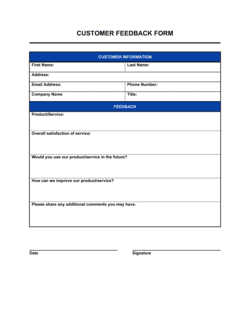
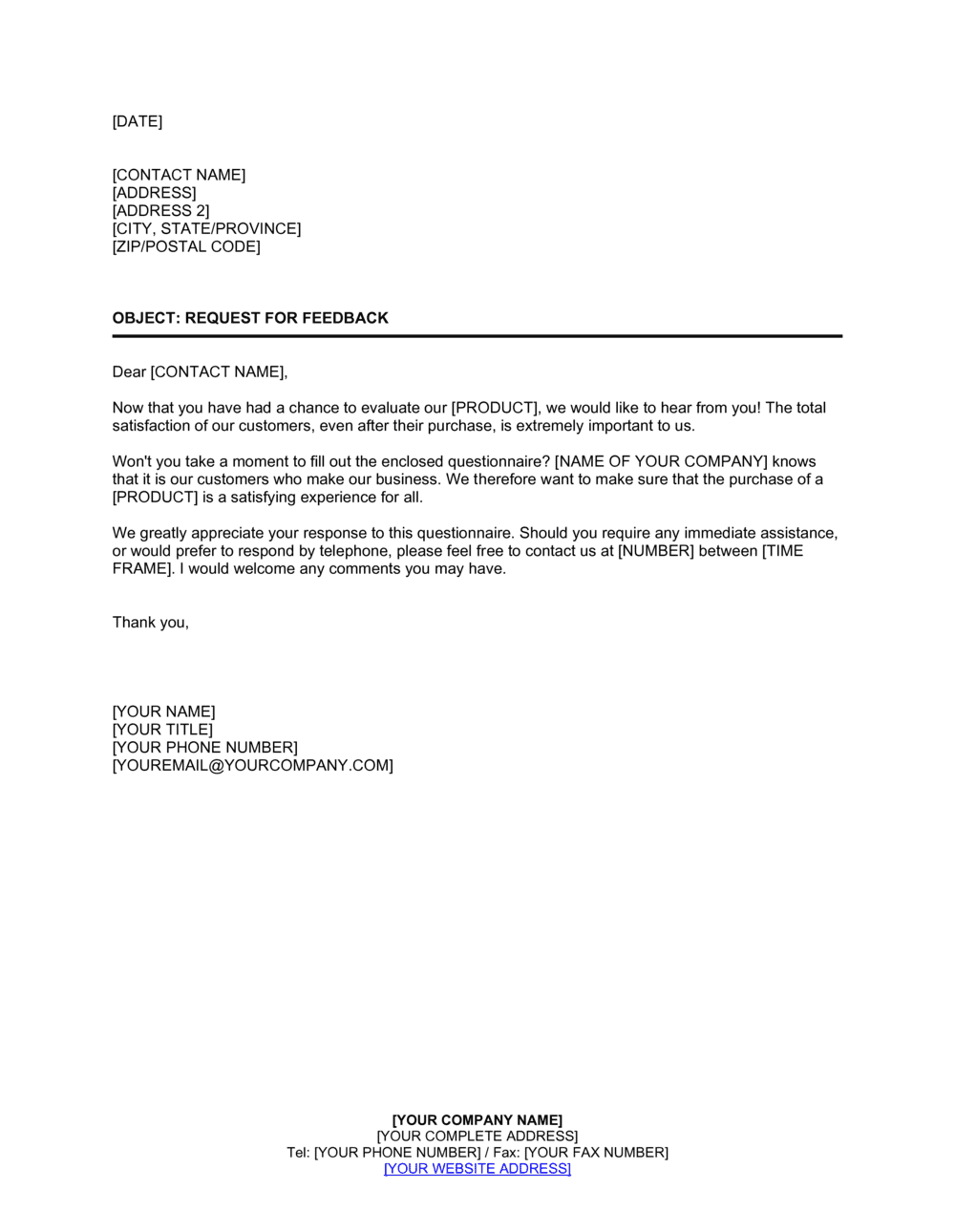
A Request For Customer Feedback is a formal business letter sent to a client or customer after a purchase, project completion, or service interaction asking them to share their experience and opinions. This free Word download gives you a polished, editable letter you can personalize and send β€” or attach to a survey form β€” in under ten minutes.
When you need it
Send it after delivering a product or completing a service engagement when you want structured input on quality, satisfaction, and areas for improvement. It is also used at regular intervals β€” quarterly or annually β€” to track how customer sentiment evolves over time.
What's inside
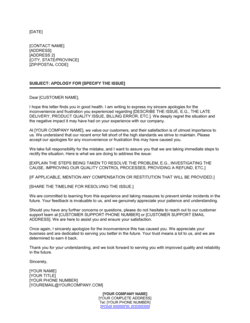
A professional salutation and opening, a clear explanation of why you are requesting feedback, specific guidance on how the customer can respond, an honest acknowledgment of the time their response requires, and a courteous closing with your contact details and signature block.

What is a Request For Customer Feedback?

A Request For Customer Feedback is a formal business letter sent to a customer or client after a purchase, service delivery, or project completion asking them to share their experience, rate the quality of what they received, and identify areas for improvement. Unlike a generic mass-email blast, a well-structured feedback request letter addresses the customer by name, references their specific interaction, and explains concretely how their input will be used. The result is a written communication that treats the customer as a partner in service improvement rather than a data point in a satisfaction metric.

Why You Need This Document

Businesses that never ask for feedback do not eliminate bad experiences β€” they simply stop hearing about them. Customers who encounter a problem and receive no invitation to share it are significantly more likely to leave quietly and tell others about their dissatisfaction than to raise it directly. A consistent, professional feedback request letter creates an accessible channel for that input, giving you the chance to identify service gaps before they become churn statistics. It also demonstrates to customers that their opinion is valued and acted on, which builds loyalty independently of whether they bother to respond. This template gives you a ready-to-send letter you can personalize in minutes and adapt for any post-interaction scenario β€” from a single high-value client engagement to a recurring post-purchase workflow.

Which variant fits your situation?

If your situation is…Use this template
Requesting feedback immediately after a product purchasePost-Purchase Feedback Request
Gathering input at the end of a consulting or service projectPost-Project Client Feedback Letter
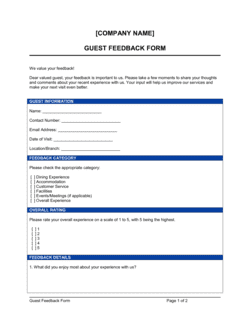
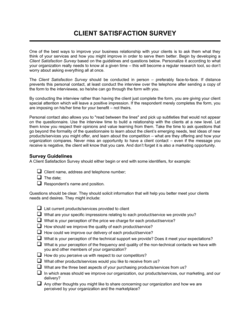
Sending a structured multi-question survey with a cover letterCustomer Satisfaction Survey
Asking a satisfied customer for a public review or testimonialTestimonial Request Letter
Following up on a complaint to confirm the issue has been resolvedCustomer Complaint Response Letter
Requesting annual feedback from a long-term B2B clientAnnual Client Review Letter
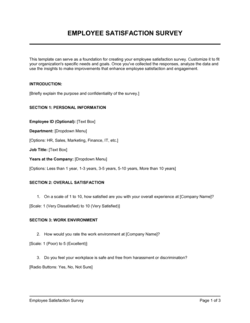
Conducting internal employee feedback on customer-facing processesEmployee Satisfaction Survey

Common mistakes to avoid

❌ Sending the request too long after the interaction

Why it matters: Customers asked about an experience from three months ago often cannot remember the details β€” responses become vague and the data is less useful for making specific improvements.

Fix: Set a calendar trigger or CRM automation to send the feedback request within 5–7 days of purchase or project completion.

❌ Using a generic, unpersonalized salutation

Why it matters: Letters addressed to 'Valued Customer' are immediately identified as mass mailings and are discarded or ignored at a much higher rate than personalized ones.

Fix: Always address the letter to the individual by name using a mail merge or by editing the template directly for each recipient.

❌ Failing to explain what happens with the feedback

Why it matters: Customers who do not believe their input will be read or acted upon have no incentive to spend time completing the request, particularly for open-ended questions.

Fix: Add one specific sentence describing who reviews responses and what kind of changes past feedback has prompted.

❌ Offering no response deadline

Why it matters: Without a specific date, customers file the request away with good intentions and never return to it β€” response rates drop significantly compared to letters with a clear deadline.

Fix: State a date two to three weeks from the letter date and include a brief, polite reminder that responses received by that date help you plan improvements for the current quarter.

The 8 key clauses, explained

Date, recipient address, and reference line

In plain language: The standard letter header identifying when the letter was written, who it is addressed to, and what it is about.

Sample language
[DATE] | [CUSTOMER FULL NAME] | [COMPANY NAME] | [ADDRESS] | Re: Request for Feedback on Your Recent Experience with [YOUR COMPANY NAME]

Common mistake: Omitting the reference line. Without it, recipients who receive multiple pieces of mail do not immediately know the letter's purpose and are more likely to set it aside.

Salutation

In plain language: A personalized greeting that addresses the customer by name rather than a generic opener.

Sample language
Dear [CUSTOMER FIRST NAME],

Common mistake: Using 'Dear Valued Customer' or 'To Whom It May Concern.' Generic salutations signal a mass mailing and reduce the likelihood the customer will take the time to respond.

Opening paragraph β€” context and purpose

In plain language: States who you are, references the specific interaction or purchase, and explains clearly why you are writing.

Sample language
Thank you for choosing [COMPANY NAME] for [PRODUCT / SERVICE] on [DATE]. We are writing to ask for a few minutes of your time to share your thoughts on that experience.

Common mistake: Starting with a lengthy company history or promotional statement. The customer needs to understand the purpose of the letter within the first two sentences or they will stop reading.

Explanation of why feedback matters

In plain language: A brief, honest statement explaining how the customer's input will be used β€” to improve service, train staff, or develop products β€” so the request feels worthwhile rather than perfunctory.

Sample language
Your feedback directly informs how we train our team and improve our [PRODUCT / SERVICE]. Every response is reviewed by our [ROLE], and we make specific changes based on what we hear from customers like you.

Common mistake: Using vague language like 'your feedback is important to us' without explaining what you actually do with it. Specificity builds trust and increases response rates.

Instructions for how to respond

In plain language: Clear, step-by-step guidance on what the customer should do β€” complete an attached form, visit a survey link, reply by email, or call a specific number.

Sample language
To share your feedback, please [complete the enclosed form and return it in the prepaid envelope / visit [SURVEY URL] / reply directly to this letter]. The [survey / form] takes approximately [X] minutes to complete.
Acknowledgment of the customer's time

In plain language: A genuine, brief acknowledgment that you are asking for something and that you respect the customer's time.

Sample language
We recognize that your time is valuable, and we are grateful for any input you are willing to share. As a thank-you, we would like to offer you [INCENTIVE β€” e.g., a 10% discount on your next order / entry into our quarterly draw].

Common mistake: Skipping the time acknowledgment entirely. Customers who feel their effort is taken for granted are less likely to respond and may form a negative impression of the request.

Deadline or response window

In plain language: A specific date by which you would appreciate a response, which creates gentle urgency without being demanding.

Sample language
We would be grateful to receive your feedback by [DATE β€” typically 2–3 weeks from the letter date]. If you have any questions, please do not hesitate to contact [CONTACT NAME] at [EMAIL / PHONE].

Common mistake: Omitting a response deadline. Open-ended requests are easy to defer indefinitely; a specific date prompts action.

Closing and signature block

In plain language: A professional closing that thanks the customer again, signs off with the sender's name, title, and contact details.

Sample language
Thank you again for your time and for being a valued customer of [COMPANY NAME]. Sincerely, [SENDER FULL NAME] | [TITLE] | [COMPANY NAME] | [PHONE] | [EMAIL]

Common mistake: Closing without restating the contact details. The customer may want to call or email directly rather than use the survey β€” remove that friction by including full contact information in the signature.

How to fill it out

  1. 1

    Add the date, recipient address, and reference line

    Enter today's date, the customer's full name and mailing or email address, and a short reference line that identifies the product or service the feedback relates to.

    πŸ’‘ Send the letter within 7 days of the completed interaction while the experience is still fresh in the customer's memory.

  2. 2

    Personalize the salutation with the customer's name

    Replace the placeholder with the customer's first name. If you are sending to a business contact, use their professional title and last name on first correspondence.

    πŸ’‘ If you are using a mail-merge tool to send at volume, test the merge field on a single record before sending the full batch to catch formatting errors.

  3. 3

    Reference the specific interaction in the opening paragraph

    Name the product purchased, service rendered, or project completed and include the date or order number. Specificity signals to the customer that this is not a generic mass mailing.

    πŸ’‘ For service businesses, reference the name of the team member who delivered the work β€” it makes the letter feel personal and gives the customer a concrete point of reference.

  4. 4

    Explain concretely what you do with feedback

    Replace generic phrases like 'your feedback is important' with a specific statement about how responses are reviewed and acted upon β€” for example, 'Our operations manager reviews all responses weekly and we share results with staff in our monthly team meeting.'

    πŸ’‘ If you have already acted on past customer feedback, mention one specific change. This proves the loop is real, not performative.

  5. 5

    Specify exactly how to respond

    Choose one primary response channel β€” an attached paper form, an online survey link, a reply email, or a phone number β€” and provide clear instructions. Do not offer more than two options or the customer will be paralyzed by choice.

    πŸ’‘ Online surveys with five or fewer questions have significantly higher completion rates than longer forms. Link to it directly rather than asking customers to navigate to your website.

  6. 6

    Set a response deadline and add the closing

    Enter a specific date two to three weeks out. Close with your full name, title, company name, phone number, and email address.

    πŸ’‘ A polite one-line follow-up reminder sent halfway through the response window can double your response rate without feeling pushy.

Frequently asked questions

What is a request for customer feedback letter?

A request for customer feedback letter is a formal written communication a business sends to a client or customer asking them to share their experience with a product, service, or interaction. It typically explains why the feedback is being requested, how to respond, and how long the process will take. It may stand alone or accompany a structured survey form.

When should I send a customer feedback request?

Send it within 5–7 days of the completed transaction or interaction while the experience is still clear in the customer's mind. For ongoing service relationships, periodic requests β€” quarterly or at contract renewal β€” help track satisfaction over time. Sending too late produces vague, low-quality responses that are harder to act on.

Should I offer an incentive in a feedback request letter?

An incentive β€” a small discount, a gift card entry, or a free resource β€” can meaningfully increase response rates, particularly for cold or infrequent customers. However, it is not required, especially for engaged customers who already have a positive relationship with your business. If you use one, keep it modest; large incentives can bias responses toward positive ratings.

How long should a customer feedback request letter be?

One page is the standard length. A letter that runs longer than one page reduces the likelihood the customer will read it fully and respond. Aim for three to five short paragraphs: opening context, why you are asking, how to respond, acknowledgment of their time, and a closing.

What is a good response rate for a customer feedback request?

Response rates vary by channel and relationship. Personalized letters or emails sent to existing customers typically yield 20–40% response rates. Generic mass-mailed requests without personalization often fall below 10%. Factors that improve rates include personalization, a clear deadline, a short survey, and a follow-up reminder at the midpoint of the response window.

Can I use this letter to request an online review or testimonial?

Yes, with a minor adjustment. Add a paragraph directing the satisfied customer to your preferred review platform β€” Google, Trustpilot, or an industry-specific site β€” and include the direct URL. Keep the primary focus of the letter on gathering feedback for internal improvement; if the secondary ask for a public review feels like the real purpose, the letter loses credibility.

What is the difference between a feedback request letter and a customer satisfaction survey?

A feedback request letter is the cover communication that explains the purpose and invites the customer to participate. A customer satisfaction survey is the structured questionnaire that captures the actual responses. The two are often paired β€” the letter accompanies or links to the survey β€” but the letter can also stand alone if you simply ask for a written or verbal reply rather than a formal questionnaire.

Do I need to follow up if the customer does not respond?

One polite follow-up is appropriate and typically doubles response rates without damaging the customer relationship. Send it roughly halfway through your stated response window β€” for example, one week after the initial letter if your deadline is two weeks out. Keep the follow-up short: one or two sentences referencing the original request and the deadline.

How this compares to alternatives

vs Customer Satisfaction Survey

A customer satisfaction survey is a structured multi-question form with rating scales and open-ended fields. A feedback request letter is the written communication that accompanies or introduces that survey β€” or that solicits open-ended written feedback directly without a formal form. Use the letter when the relationship is personal or high-value; use the survey when you need quantified, comparable data across a large customer base.

vs Customer Complaint Response Letter

A complaint response letter is reactive β€” it addresses a specific grievance already raised by the customer. A feedback request letter is proactive β€” it invites input before a problem escalates. Sending a feedback request after resolving a complaint can confirm the issue has been resolved to the customer's satisfaction and rebuild trust.

vs Thank You Letter to Customer

A thank-you letter expresses appreciation for a purchase or relationship without asking for anything in return. A feedback request letter makes a specific ask. The two can be combined β€” open with thanks, transition to the feedback request β€” but a pure thank-you letter carries more goodwill if feedback collection is not the primary goal.

vs Client Satisfaction Survey

A client satisfaction survey is typically used for B2B service relationships and is more detailed, covering project management, communication, and outcomes. A customer feedback request letter is broader and simpler, suited to any customer type. For complex B2B engagements, the survey provides more actionable data; for transactional B2C interactions, the letter format is faster and more proportionate.

Industry-specific considerations

Professional Services

Sent at project close to measure satisfaction with deliverables, timelines, and the working relationship β€” results feed directly into quality improvement and business development.

Retail and E-commerce

Triggered automatically after order delivery to capture product quality ratings, packaging experience, and shipping speed β€” high-volume use makes templating and automation essential.

Healthcare

Patient satisfaction letters must comply with HIPAA privacy requirements and are often tied to CMS quality metrics that affect reimbursement rates.

Hospitality and Food Service

Post-stay or post-visit feedback letters help identify service inconsistencies across locations and provide content for staff coaching sessions.

Template vs pro β€” what fits your needs?

PathBest forCostTime
Use the templateAny business sending feedback requests to individual customers or small client listsFree10–15 minutes per letter
Template + professional reviewHealthcare providers or regulated industries where patient/client communication must meet specific compliance standards$50–$150 for a compliance or communications review1–2 days
Custom draftedEnterprise customer experience programs integrating feedback letters with CRM automation, NPS tracking, and multi-channel follow-up workflows$500–$2,000 for copywriting and CRM setup1–2 weeks

Glossary

Net Promoter Score (NPS)
A single-question loyalty metric that asks customers how likely they are to recommend your business on a 0–10 scale, categorizing them as Promoters, Passives, or Detractors.
Customer Satisfaction Score (CSAT)
A rating β€” typically 1 to 5 β€” that measures how satisfied a customer was with a specific interaction, product, or service.
Voice of the Customer (VoC)
A research process that captures customers' stated expectations, preferences, and complaints to inform product and service improvements.
Closed-Ended Question
A survey question with a fixed set of response options β€” such as a rating scale or yes/no β€” that is easy to quantify and analyze.
Open-Ended Question
A question that invites a free-text response, allowing customers to describe experiences in their own words without predefined choices.
Response Rate
The percentage of recipients who complete and return a feedback request, calculated as responses received divided by total requests sent.
Feedback Loop
The process of collecting customer input, acting on it, and communicating the resulting changes back to the customers who provided it.
Churn Risk
The likelihood that a customer will stop purchasing from or subscribing to a business within a defined period, often surfaced through low satisfaction scores.
Touchpoint
Any interaction between a customer and a business β€” a purchase, support call, or delivery β€” at which feedback can meaningfully be collected.
Anonymized Feedback
Responses collected without identifying information attached, encouraging more candid opinions from customers who might otherwise hold back.

Part of your Business Operating System

This document is one of 3,000+ business & legal templates included in Business in a Box.

  • Fill-in-the-blanks β€” ready in minutes
  • 100% customizable Word document
  • Compatible with all office suites
  • Export to PDF and share electronically

Create your document in 3 simple steps.

From template to signed document β€” all inside one Business Operating System.
1
Download or open template

Access over 3,000+ business and legal templates for any business task, project or initiative.

2
Edit and fill in the blanks with AI

Customize your ready-made business document template and save it in the cloud.

3
Save, Share, Send, Sign

Share your files and folders with your team. Create a space of seamless collaboration.

Save time, save money, and create top-quality documents.

β˜…β˜…β˜…β˜…β˜…

"Fantastic value! I'm not sure how I'd do without it. It's worth its weight in gold and paid back for itself many times."

Managing Director Β· Mall Farm
Robert Whalley
Managing Director, Mall Farm Proprietary Limited
β˜…β˜…β˜…β˜…β˜…

"I have been using Business in a Box for years. It has been the most useful source of templates I have encountered. I recommend it to anyone."

Business Owner Β· 4+ years
Dr Michael John Freestone
Business Owner
β˜…β˜…β˜…β˜…β˜…

"It has been a life saver so many times I have lost count. Business in a Box has saved me so much time and as you know, time is money."

Owner Β· Upstate Web
David G. Moore Jr.
Owner, Upstate Web

Run your business with a system β€” not scattered tools

Stop downloading documents. Start operating with clarity. Business in a Box gives you the Business Operating System used by over 250,000 companies worldwide to structure, run, and grow their business.

Free Forever PlanΒ Β·Β No credit card required