Individual Charge Account Denial Template

Free Word download • Edit online • Save & share with Drive • Export to PDF

1 page20–25 min to fillDifficulty: StandardSignature requiredLegal review recommended
Learn more ↓
FreeIndividual Charge Account Denial Template

At a glance

What it is
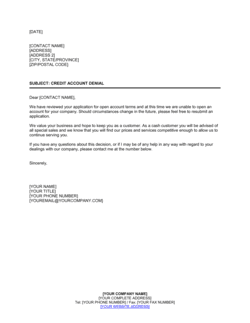
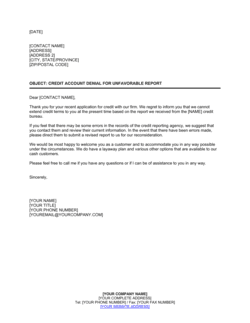
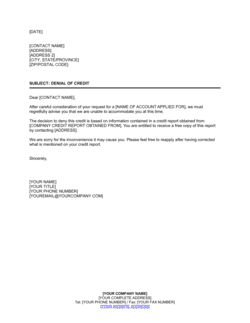
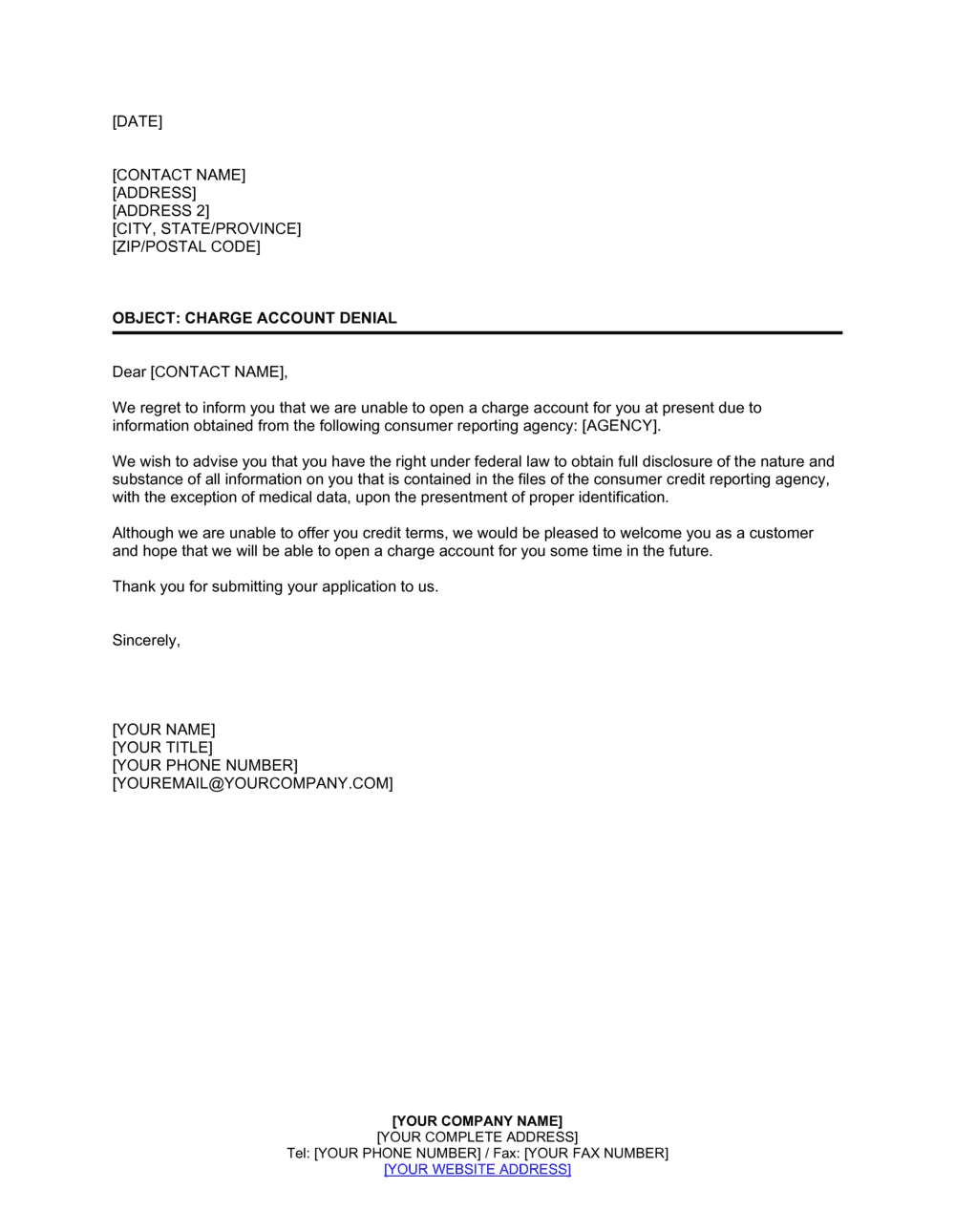
An Individual Charge Account Denial is a formal written notice an organization sends to an individual applicant to communicate that their request to open a charge account has been declined. This free Word download meets the adverse action disclosure requirements commonly imposed by consumer credit laws, allowing you to state the denial reason codes, reference any consumer reporting agency used, and inform the applicant of their rights — all in a single compliant letter you can edit online and export as PDF.
When you need it
Issue this notice within the legally required timeframe — typically 30 days from the application decision — whenever an individual's charge account application is denied in whole or in part based on creditworthiness, identity verification failure, or other underwriting criteria. Using it protects the issuing organization from adverse action violations under applicable consumer protection laws.
What's inside
Applicant identification, decision date, specific denial reason codes, name and contact details of any consumer reporting agency consulted, a statement of the applicant's right to request a free credit report, a dispute rights notice, the creditor's contact information, and an authorized signature block.

What is an Individual Charge Account Denial?

An Individual Charge Account Denial is a formal written notice a creditor or retailer issues to an individual applicant to communicate that their application to open a charge account has been declined. More than a simple rejection letter, it is a legally required adverse action disclosure that must state the specific reasons for the denial, identify any consumer reporting agency whose data contributed to the decision, and inform the applicant of their rights — including the right to a free copy of their credit report and the right to dispute inaccurate information. In the United States, these obligations are governed by the Fair Credit Reporting Act and the Equal Credit Opportunity Act; equivalent frameworks apply in Canada, the UK, and the EU.

Why You Need This Document

Declining a charge account application without issuing a compliant adverse action notice exposes your organization to statutory damages of $100 to $1,000 per violation under the FCRA, plus potential class-action liability capped at $500,000 or 1% of net worth — regardless of whether the denial itself was justified. Regulators do not require that the decision be wrong, only that the required disclosures were made correctly and on time. Beyond regulatory risk, an unsigned or vague denial letter that omits reason codes or CRA contact details creates an implied invitation for disputes, reapplications, and complaints that a properly structured notice would have resolved cleanly. This template gives small businesses, retailers, and finance teams a compliant, ready-to-use document that meets FCRA and ECOA requirements, protects the organization in a regulatory examination, and treats applicants with the transparency the law requires.

Which variant fits your situation?

If your situation is…Use this template
Denying a charge account based solely on a credit bureau reportIndividual Charge Account Denial (Credit Report Basis)
Denying a business entity rather than an individual applicantBusiness Credit Application Denial Letter
Approving an account but at a lower credit limit than requestedAdverse Action Notice — Counter-Offer
Denying an existing account renewal or credit limit increaseCredit Limit Decrease or Account Closure Notice
Declining a loan or line of credit rather than a charge accountLoan Application Denial Letter
Notifying an applicant of identity verification failureIdentity Verification Failure Notice
Communicating a conditional approval with additional requirementsConditional Credit Approval Letter

Common mistakes to avoid

❌ Missing the 30-day notice deadline

Why it matters: The FCRA requires adverse action notices to be sent within 30 days of the decision. Late notices expose the creditor to statutory damages of $100–$1,000 per violation plus actual damages and attorney fees in a private lawsuit.

Fix: Build a tickler or workflow trigger into your credit decisioning process that automatically flags the notice deadline on the same day the application is declined.

❌ Listing fewer denial reasons than actually applied

Why it matters: Courts and the CFPB have found that citing only one generic reason — such as 'insufficient credit history' — when multiple factors drove the decision is a material FCRA violation, undermining the applicant's ability to understand and correct their situation.

Fix: Document all contributing adverse factors at the time of the credit decision and include up to four in the notice, ranked by significance.

❌ Omitting the consumer reporting agency's contact details

Why it matters: Without the CRA's name, address, and phone number, the applicant cannot exercise their right to a free report or file a dispute — a direct FCRA violation regardless of whether the omission was intentional.

Fix: Store the full contact details for every CRA you use in your denial letter template so they populate automatically with each letter generated.

❌ Paraphrasing the mandatory ECOA disclosure

Why it matters: Regulation B requires specific language in adverse action notices. A creditor who shortens or rephrases the required disclosure has technically failed to comply, even if the general meaning is preserved.

Fix: Pull the ECOA notice language directly from current CFPB guidance or Regulation B Appendix C and paste it verbatim into the template without alteration.

❌ Sending the notice to an outdated or incorrect address

Why it matters: An adverse action notice sent to the wrong address is legally equivalent to no notice at all — the applicant never received their rights disclosure, and the creditor cannot demonstrate compliance.

Fix: Verify the mailing address against the application form at the time of denial, not against older records in the customer database.

❌ Using an unsigned or undated letter

Why it matters: An unsigned adverse action notice lacks the authority needed to trigger the statutory notice period and can be challenged as procedurally deficient in any FCRA dispute or regulatory examination.

Fix: Establish a sign-off protocol requiring an authorized credit manager or compliance officer to sign and date every denial letter before it leaves the organization.

The 8 key clauses, explained

Applicant Identification and Decision Date

In plain language: Identifies the individual applicant by name and address, states the type of account applied for, and records the date the denial decision was made.

Sample language
Dear [APPLICANT FULL NAME], Thank you for your application dated [APPLICATION DATE] for a [ACCOUNT TYPE] charge account with [COMPANY NAME]. After careful review, we regret to inform you that your application has been declined as of [DECISION DATE].

Common mistake: Using a generic salutation like 'Dear Applicant' instead of the individual's name. Under the ECOA, the notice must be addressed to the specific applicant, and impersonal letters can signal non-compliance to regulators.

Statement of Denial

In plain language: Clearly communicates the decision to deny the charge account application and confirms it is a final decision rather than a request for additional information.

Sample language
We are unable to approve your request to open a charge account at this time. This decision is based on the criteria described below and is not a request for further documentation unless otherwise stated.

Common mistake: Leaving the denial ambiguous by using language like 'we cannot process your application at this time,' which implies the door is open. A clear, unambiguous denial statement starts the regulatory notice clock and protects the creditor.

Specific Denial Reason Codes

In plain language: Lists the exact reasons the application was declined, using standardized reason codes where applicable, so the applicant understands precisely which factors drove the decision.

Sample language
Your application was declined for one or more of the following reasons: [REASON CODE 1 — e.g., Insufficient credit history]; [REASON CODE 2 — e.g., Derogatory public record or collection filed]; [REASON CODE 3 — e.g., Debt-to-income ratio too high].

Common mistake: Providing only one vague reason when multiple factors contributed. FCRA and ECOA require disclosure of the principal reasons — typically up to four — and listing only one when others existed exposes the creditor to regulatory challenge.

Consumer Reporting Agency Disclosure

In plain language: Identifies the consumer reporting agency whose report was used in the decision, along with the agency's name, address, and toll-free phone number, as required by the FCRA.

Sample language
Our decision was based in whole or in part on information obtained from the following consumer reporting agency: [CRA NAME], [CRA ADDRESS], [CRA TOLL-FREE NUMBER]. This agency did not make the decision to deny your application and cannot explain the specific reasons for the denial.

Common mistake: Omitting the statement that the CRA did not make the decision. Without this language, applicants may incorrectly direct disputes to the creditor rather than the CRA, creating unnecessary legal exposure.

Right to Free Credit Report

In plain language: Notifies the applicant of their statutory right to request a free copy of their consumer credit report from the referenced agency within 60 days of receiving the denial notice.

Sample language
You have the right to obtain a free copy of your consumer report from [CRA NAME] if you request it within 60 days of receiving this notice. You may also obtain a free report at www.annualcreditreport.com.

Common mistake: Citing the 60-day window without including the annualcreditreport.com reference or the agency's direct contact details. FCRA amendments require creditors to provide enough information for applicants to act on their rights without additional research.

Right to Dispute Inaccurate Information

In plain language: Informs the applicant of their right to dispute inaccurate or incomplete information directly with the consumer reporting agency and to have incomplete or inaccurate information corrected.

Sample language
You have the right to dispute the accuracy or completeness of any information provided by [CRA NAME]. For questions about the accuracy of your report, contact [CRA NAME] directly at the address or phone number listed above.

Common mistake: Confusing the dispute rights notice with an invitation to appeal the credit decision. Make clear the dispute process is with the CRA, not the creditor, to avoid creating an implied internal review obligation.

Non-Discrimination Statement

In plain language: Confirms that the denial was made without regard to race, color, religion, national origin, sex, marital status, age, or other protected characteristics under the ECOA.

Sample language
The Federal Equal Credit Opportunity Act prohibits creditors from discriminating against credit applicants on the basis of race, color, religion, national origin, sex, marital status, age (provided the applicant has the capacity to enter into a binding contract), or because the applicant has in good faith exercised any right under the Consumer Credit Protection Act.

Common mistake: Paraphrasing the ECOA notice rather than including the full required language. The ECOA specifies the exact disclosure; a shortened version may not satisfy the statutory requirement.

Creditor Contact Information and Signature

In plain language: Provides the creditor's name, mailing address, and contact details, and includes an authorized signature to give the notice legal weight and a clear point of contact for follow-up questions.

Sample language
If you have questions about this decision, please contact us at: [COMPANY NAME], [ADDRESS], [PHONE NUMBER], [EMAIL ADDRESS]. Sincerely, [AUTHORIZED SIGNATORY NAME], [TITLE], [COMPANY NAME].

Common mistake: Leaving the signature block unsigned or using a generic department stamp. Regulators and courts treat unsigned adverse action notices as procedurally deficient, which can void any protections the notice was intended to establish.

How to fill it out

  1. 1

    Enter applicant's full name, address, and application date

    Fill in the applicant's legal name and mailing address exactly as submitted on the application. Record the original application date and the official decision date separately.

    💡 The decision date, not the mailing date, starts the statutory notice clock under the FCRA — confirm your process delivers the letter within 30 days of the decision.

  2. 2

    State the type of charge account applied for

    Specify the account product by name — e.g., 'in-store revolving charge account,' 'net-30 trade account,' or 'employee purchase account.' This ties the denial to a specific application and prevents ambiguity in your records.

    💡 Match the account name exactly as it appears in your application form so the applicant can cross-reference their records without confusion.

  3. 3

    Select and list the specific denial reason codes

    Choose up to four principal adverse action reason codes that reflect the actual factors in the decision. Use standardized codes from the CRA's reason code library where available, then translate each code into plain-English language for the applicant.

    💡 Using four reason codes when only two truly applied can create legal exposure — list only the factors that genuinely contributed to the adverse decision.

  4. 4

    Complete the consumer reporting agency disclosure block

    Enter the full legal name, street address, and toll-free telephone number of every CRA whose report was reviewed. Add the statement confirming the CRA did not make the denial decision.

    💡 If you used more than one CRA, list all of them — omitting a CRA that contributed to the decision is a separate FCRA violation.

  5. 5

    Include the free credit report and dispute rights language

    Copy the required statutory language for both the 60-day free report right and the dispute rights notice. Do not abbreviate or paraphrase the mandatory disclosures — use the full text required by the FCRA.

    💡 Consider including the annualcreditreport.com URL and the CRA's website as well — applicants who can easily access their report are less likely to attribute inaccuracies to your decision-making process.

  6. 6

    Add the ECOA non-discrimination statement

    Insert the full Equal Credit Opportunity Act disclosure as prescribed by Regulation B. Do not substitute a paraphrase or a shortened version.

    💡 The CFPB publishes the exact required text for the ECOA notice — copy it verbatim from the current regulatory guidance rather than from an older template version.

  7. 7

    Complete the creditor contact block and obtain authorized signature

    Enter the company's official name, mailing address, direct phone number, and email. Have an authorized officer or credit manager sign the letter before dispatch.

    💡 Keep a signed copy in your application file — regulators and plaintiffs' attorneys will request the exact document sent, not a template.

  8. 8

    Dispatch within the statutory window and retain proof of mailing

    Send the notice by first-class mail within 30 days of the adverse action decision. Retain a dated copy and, for higher-risk accounts, use certified mail with return receipt.

    💡 A log entry noting the applicant name, decision date, mailing date, and tracking number is your first line of defense in any FCRA audit or complaint.

Frequently asked questions

What is an individual charge account denial letter?

An individual charge account denial letter is a formal written notice a creditor sends to an individual applicant to communicate that their request to open a charge account has been declined. It is also called an adverse action notice and must include the specific reasons for the denial, the identity of any consumer reporting agency consulted, and the applicant's rights under applicable consumer credit laws. In the United States, these letters are legally required under the Fair Credit Reporting Act and the Equal Credit Opportunity Act.

Is a charge account denial letter legally required?

Yes, in the United States, creditors are generally required under the FCRA and ECOA to provide a written adverse action notice within 30 days of declining a credit application. The notice must state the specific reasons for the denial and identify any consumer reporting agency whose report was used. Failure to send a compliant notice exposes the creditor to statutory damages, regulatory enforcement, and private lawsuits. Similar obligations exist in Canada, the UK, and the EU under their respective consumer credit frameworks.

What must be included in a charge account denial letter?

A compliant denial letter must include the applicant's name and address, the decision date, the specific reasons for the denial expressed as reason codes or plain-English descriptions, the name and contact details of any consumer reporting agency whose report was used, notice of the applicant's right to a free credit report within 60 days, notice of dispute rights, the full ECOA non-discrimination statement, and the creditor's name, address, and authorized signature.

How soon must a charge account denial letter be sent?

Under the FCRA, a creditor must notify the applicant of an adverse action within 30 days of receiving a completed application, or within 30 days of making the adverse decision if the application was previously pending. The 30-day clock starts on the decision date, not the mailing date. Sending by first-class mail is sufficient, but retaining proof of mailing is strongly recommended for compliance documentation.

How many denial reasons should the letter include?

Creditors should list up to four principal reasons that most significantly influenced the adverse decision. Listing fewer than the actual number of contributing factors is a compliance risk — the FCRA requires disclosure of the specific reasons, and a single generic reason when multiple factors applied is considered a material deficiency. Do not list more reasons than genuinely contributed, as this can create confusion or imply a weaker applicant profile than the file supports.

What happens if the denial was not based on a credit report?

If the denial was based entirely on information from the applicant's own application — such as insufficient income or failure to meet minimum employment duration — and no consumer report was used, the ECOA still requires a statement of specific reasons, but the FCRA's CRA disclosure requirements do not apply. The letter should still state the denial reasons clearly and include the ECOA non-discrimination notice. Consult Regulation B for the exact requirements when no consumer report is involved.

Can an applicant appeal a charge account denial?

There is no statutory right of appeal for a credit denial; the adverse action process is a disclosure mechanism, not an appeal pathway. However, most creditors have an informal reconsideration process. If an applicant believes the denial was based on inaccurate credit report information, they should first dispute the information directly with the consumer reporting agency. Once corrected, they can reapply and the creditor must evaluate the updated file.

Does a denial letter create any liability for the creditor?

A properly drafted and timely delivered denial letter generally protects the creditor by demonstrating compliance with FCRA and ECOA requirements. The liability risk runs in the opposite direction — failing to send the notice, sending it late, or omitting required disclosures exposes the creditor to statutory damages of $100–$1,000 per violation in individual actions and up to $500,000 or 1% of net worth in class actions under the FCRA. Sending a compliant notice is the primary compliance defense available to creditors.

Do small businesses need to use an adverse action notice for charge account denials?

Yes, if the business extends credit to individuals and uses a consumer report — even informally, through a background-check service — in the decision, the FCRA's adverse action requirements apply regardless of the company's size. The ECOA applies to any creditor that regularly extends credit. Small businesses often underestimate this obligation, which is why using a compliant template and establishing a consistent notice process is important even for low-volume credit programs.

How this compares to alternatives

vs Loan Application Denial Letter

A loan denial letter declines a request for installment or term debt — a mortgage, personal loan, or business loan — with a defined repayment schedule. A charge account denial declines revolving open-end credit with no fixed repayment term. Both require FCRA adverse action notices, but loan denials may carry additional disclosure requirements under TILA and the Home Mortgage Disclosure Act depending on the product type.

vs Business Credit Application Denial Letter

A business credit denial is issued to a commercial entity rather than an individual consumer. FCRA consumer protections and ECOA individual disclosure requirements do not apply in the same way to business-to-business credit decisions. Charge account denial letters are specifically structured around individual applicant rights; using the wrong template for a business applicant either over-discloses or creates unnecessary obligations.

vs Credit Limit Decrease Notice

A credit limit decrease notice is an adverse action notice sent to an existing account holder whose available credit has been reduced. An individual charge account denial applies to new applicants who have never held the account. Both require adverse action disclosures if a consumer report contributed to the decision, but the triggering event, relationship context, and tone of each letter differ substantially.

vs Conditional Credit Approval Letter

A conditional approval letter offers credit subject to specific additional conditions — providing a co-signer, submitting additional income documentation, or accepting a lower initial limit. A denial letter communicates a firm negative decision. Sending a conditional approval when the intent is a denial can imply an ongoing credit relationship and muddy the adverse action timeline under the FCRA.

Industry-specific considerations

Retail

In-store revolving charge accounts require FCRA-compliant denials at point of application; retailers processing high volumes benefit from templated reason-code libraries tied to their credit scoring system.

Financial Services

Banks and consumer finance companies face the highest regulatory scrutiny on adverse action notices, with CFPB examiners specifically reviewing reason code accuracy and timeliness during fair lending examinations.

Healthcare

Medical providers offering payment plan accounts or healthcare credit programs must issue compliant denials when patients are declined, including any CRA data used in affordability assessments.

Professional Services

Law firms, accounting practices, and consultancies offering extended billing terms or house accounts to individual clients must issue adverse action notices when credit checks result in denials.

Jurisdictional notes

United States

The FCRA (15 U.S.C. § 1681m) requires adverse action notices within 30 days when a consumer report is used. The ECOA (Regulation B) mandates disclosure of specific reasons and the non-discrimination statement. The CFPB enforces both laws and publishes model adverse action forms — using them creates a safe harbor. State laws in California, New York, and others may impose additional or overlapping notice requirements.

Canada

Canada's federal Personal Information Protection and Electronic Documents Act (PIPEDA) and provincial consumer protection statutes require that individuals be notified when credit is denied based on credit bureau data, and that they be informed of their right to access and correct their credit file. Alberta, British Columbia, and Quebec have substantially similar provincial privacy laws. Quebec's Law 25 imposes additional transparency obligations relevant to automated credit decisioning.

United Kingdom

The UK Consumer Credit Act 1974 and the FCA's Consumer Credit sourcebook (CONC) require lenders to notify applicants of a credit denial and to inform them when a credit reference agency report was used. The UK GDPR requires disclosure of meaningful information about automated decision-making, including profiling, when the denial results from solely automated processing. Applicants have the right to request human review of automated credit decisions.

European Union

The EU Consumer Credit Directive requires creditors to inform consumers promptly when a credit application is declined and to identify any credit reference database consulted. GDPR Article 22 grants individuals the right to explanation and human review when a credit decision is made solely by automated means. Member states including France, Germany, and the Netherlands have implemented additional local requirements — particularly around the obligation to explain automated scoring outcomes in plain language.

Template vs lawyer — what fits your deal?

PathBest forCostTime
Use the templateSmall businesses and retailers issuing standard charge account denials based on consumer credit reportsFree10–15 minutes per letter
Template + legal reviewOrganizations establishing a new charge account program or processing more than 50 denials per year$300–$800 for a compliance attorney review of the template and process3–5 business days
Custom draftedBanks, consumer finance companies, and regulated lenders subject to CFPB examination or operating in multiple jurisdictions$1,500–$5,000+ for full adverse action program design and legal review2–4 weeks

Glossary

Adverse Action
A decision by a creditor to deny credit, reduce a credit limit, or change the terms of an account unfavorably — triggering mandatory written notice under applicable consumer credit laws.
Charge Account
A revolving credit arrangement allowing an account holder to make purchases up to a pre-approved limit and pay the balance in full or over time, typically without a physical card.
FCRA (Fair Credit Reporting Act)
A US federal law governing how consumer reporting agencies collect and use credit information, and requiring creditors to notify applicants when a consumer report contributed to an adverse action.
ECOA (Equal Credit Opportunity Act)
A US federal law prohibiting credit discrimination on the basis of race, color, religion, national origin, sex, marital status, age, or receipt of public assistance.
Consumer Reporting Agency (CRA)
A company — such as Equifax, Experian, or TransUnion — that collects and sells consumer credit data used by creditors in underwriting decisions.
Adverse Action Notice
The required written communication to an applicant explaining the specific reasons credit was denied or terms were changed unfavorably, along with the applicant's rights.
Reason Code
A standardized numeric or text code assigned by a consumer reporting agency or creditor to describe a specific factor that negatively affected a credit decision.
Free File Disclosure
The mandatory statement informing a denied applicant of their right to obtain a free copy of their consumer credit report from the agency referenced in the decision.
Dispute Rights
An applicant's statutory right to challenge inaccurate or incomplete information in their consumer credit report directly with the reporting agency.
Underwriting Criteria
The specific financial standards — minimum credit score, debt-to-income ratio, employment history — a creditor uses to evaluate whether to extend credit.
Permissible Purpose
A legally recognized reason under the FCRA allowing a creditor to access an individual's consumer credit report, including evaluating a credit application.

Part of your Business Operating System

This document is one of 3,000+ business & legal templates included in Business in a Box.

  • Fill-in-the-blanks — ready in minutes
  • 100% customizable Word document
  • Compatible with all office suites
  • Export to PDF and share electronically

Create your document in 3 simple steps.

From template to signed document — all inside one Business Operating System.
1
Download or open template

Access over 3,000+ business and legal templates for any business task, project or initiative.

2
Edit and fill in the blanks with AI

Customize your ready-made business document template and save it in the cloud.

3
Save, Share, Send, Sign

Share your files and folders with your team. Create a space of seamless collaboration.

Save time, save money, and create top-quality documents.

★★★★★

"Fantastic value! I'm not sure how I'd do without it. It's worth its weight in gold and paid back for itself many times."

Managing Director · Mall Farm
Robert Whalley
Managing Director, Mall Farm Proprietary Limited
★★★★★

"I have been using Business in a Box for years. It has been the most useful source of templates I have encountered. I recommend it to anyone."

Business Owner · 4+ years
Dr Michael John Freestone
Business Owner
★★★★★

"It has been a life saver so many times I have lost count. Business in a Box has saved me so much time and as you know, time is money."

Owner · Upstate Web
David G. Moore Jr.
Owner, Upstate Web

Run your business with a system — not scattered tools

Stop downloading documents. Start operating with clarity. Business in a Box gives you the Business Operating System used by over 250,000 companies worldwide to structure, run, and grow their business.

Start free · No credit card required