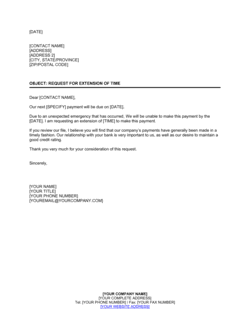
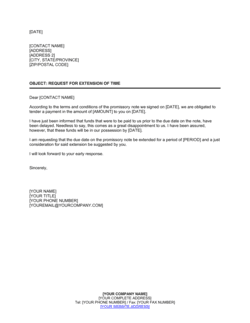
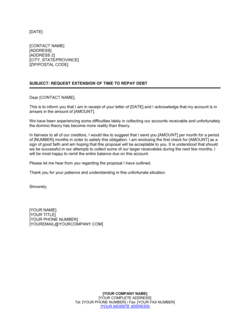
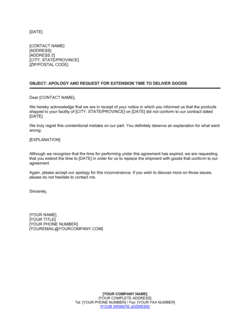
Denial of Request for Extension of Time Template

Free Word download • Edit online • Save & share with Drive • Export to PDF

1 page20–30 min to fillDifficulty: StandardSignature requiredLegal review recommended
Learn more ↓
FreeDenial of Request for Extension of Time Template

At a glance

What it is
A Denial of Request for Extension of Time is a formal written document in which one party to a contract or obligation officially rejects the other party's request for additional time to perform, deliver, or comply. This free Word download gives you a professionally drafted, legally grounded letter you can edit online and export as PDF to send to contractors, vendors, tenants, counterparties, or opposing counsel.
When you need it
Use it when a counterparty has submitted a written or verbal request for more time — to complete a project, deliver goods, respond to a legal notice, or meet a contractual milestone — and you have decided to deny that request and hold the original deadline firm. It is also used in litigation and regulatory contexts to formally reject an opposing party's motion for additional time.
What's inside
The template covers the identity of both parties, a reference to the original agreement and deadline, a specific acknowledgment of the extension request received, the grounds for denial, the confirmed original deadline, the consequences of non-performance, and a signature block creating a documented, timestamped record of the decision.

What is a Denial of Request for Extension of Time?

A Denial of Request for Extension of Time is a formal written document in which one contracting party officially rejects another party's request for additional time to perform an obligation, deliver a product or service, or comply with a legal or contractual requirement. It does more than simply say "no" — it creates a timestamped, documented record that the original deadline was never modified, that the denying party communicated its position clearly, and that any subsequent failure to perform constitutes a breach subject to the remedies specified in the underlying agreement. The document references the original contract, acknowledges the request received, states unambiguous grounds for denial, reaffirms the controlling deadline, and puts the requesting party on notice of the specific consequences they face if they miss it.

Why You Need This Document

Failing to issue a formal, written denial when a deadline extension request arrives can be as damaging as granting one by mistake. Courts and arbitrators have repeatedly found that silence, vague responses, or informal communications — "let's talk about it," or "we'll see what we can do" — constitute implied consent to the extension, stripping the denying party of its right to enforce the original deadline and pursue liquidated damages or termination. Without a documented denial, you may also lose the ability to recover cover costs when you procure replacement services, argue bad faith when the requesting party cites your inaction, or terminate the contract for cause rather than convenience. A properly structured denial letter — issued promptly, signed by an authorized representative, and delivered by a tracked method — closes all of these gaps and positions you to enforce your contractual rights from a legally defensible foundation. This template gives you that foundation in under 30 minutes.

Which variant fits your situation?

If your situation is…Use this template
Denying a construction subcontractor's request for a project schedule extensionDenial of Request for Extension of Time (Construction)
Rejecting a vendor or supplier's request for a delivery deadline extensionDenial of Request for Extension of Time (Vendor)
Formally refusing a tenant's request for extended time to vacateDenial of Request for Extension of Time (Lease)
Opposing counsel's motion for additional time in a legal proceedingOpposition to Motion for Extension of Time
Denying a grant applicant's request for an extended submission deadlineDenial of Request for Extension of Time (Grant)
Rejecting a counterparty's request to extend a contract performance periodDenial of Contract Extension Request
Granting a partial extension with conditions rather than a full denialConditional Grant of Extension of Time

Common mistakes to avoid

❌ Using ambiguous or hedged denial language

Why it matters: Phrases like 'we cannot accommodate your request at this time' have been interpreted by courts as conditional refusals, leaving open the implication that a future request might succeed — undermining the finality of the denial.

Fix: Use direct language: 'Your request for an extension of time is denied. The original deadline of [DATE] remains in effect and is not modified by this letter.'

❌ Providing no grounds for the denial

Why it matters: A denial without stated reasons is difficult to defend in arbitration or litigation and may be characterized as arbitrary or made in bad faith, particularly in jurisdictions that imply a duty of good faith in contract performance.

Fix: Cite at least two specific contractual provisions or factual reasons supporting the denial — the time-is-of-the-essence clause, the absence of force majeure, or the requesting party's own delay.

❌ Omitting a reservation of rights clause

Why it matters: Without an explicit reservation, the denial letter — by specifying certain remedies — can be construed as implicitly waiving all others not mentioned, limiting your options if the matter escalates.

Fix: Always include standard reservation-of-rights language confirming that nothing in the letter waives any right or remedy available under the agreement or applicable law.

❌ Delivering the denial without creating a delivery record

Why it matters: If the requesting party later claims they did not receive the denial, and you have no proof of delivery, the original deadline may be contested or the requesting party may argue they relied on a deemed extension.

Fix: Send the denial by certified mail, courier with delivery confirmation, or email with a read receipt — and retain proof of delivery in your contract file alongside the signed letter.

❌ Having an unauthorized person sign the denial

Why it matters: A denial signed by someone without actual or apparent authority to bind the company can be challenged as not representing the company's official position, potentially allowing the requesting party to argue no valid denial was ever issued.

Fix: Confirm the signatory has authority under your company's signing policy or resolution before execution — for significant contracts, this typically means a director, officer, or designated contract manager.

❌ Threatening remedies not available under the contract

Why it matters: Claiming liquidated damages that the contract does not provide, or threatening termination without a contractual right to do so, exposes the denying party to a counterclaim for breach or bad-faith dealing.

Fix: Review the contract's remedies section before drafting the consequences clause and include only remedies the agreement expressly grants — add 'and any other remedies available at law or equity' as a catch-all.

The 10 key clauses, explained

Parties and Agreement Reference

In plain language: Identifies the sending and receiving parties by their full legal names and references the original contract, purchase order, or legal proceeding to which the denial relates.

Sample language
This letter is addressed to [REQUESTING PARTY FULL NAME] ('Requesting Party') by [DENYING PARTY FULL NAME] ('Company') in connection with [CONTRACT NAME / PROJECT TITLE], dated [CONTRACT DATE] ('Agreement').

Common mistake: Referencing only a project name without citing the contract date or number — this creates ambiguity about which agreement governs and weakens the denial's legal footing if disputed.

Acknowledgment of Extension Request

In plain language: Confirms that the Company received the extension request, states the date it was received, and summarizes what was requested — without admitting that the request was justified.

Sample language
The Company acknowledges receipt of your written request dated [REQUEST DATE], in which you requested an extension of [X days / weeks] to [PERFORM OBLIGATION] under the Agreement, originally due on [ORIGINAL DEADLINE DATE].

Common mistake: Omitting the date the request was received — this creates a gap in the timeline that a requesting party can exploit to argue the denial was untimely or that silence implied consent.

Statement of Denial

In plain language: Clearly and unambiguously states that the extension request is denied and that the original deadline remains in full force and effect.

Sample language
After careful review of your request and the circumstances described therein, the Company hereby denies your request for an extension of time. The original deadline of [ORIGINAL DEADLINE DATE] remains in effect and is not modified by this or any prior communication.

Common mistake: Using hedged language such as 'we are unable to accommodate your request at this time' — courts and arbitrators have read such phrasing as leaving open the possibility of a future extension, undermining the finality of the denial.

Grounds for Denial

In plain language: States the specific reasons why the request is being denied — contractual, factual, or legal — giving the requesting party a clear basis and protecting the denying party if the matter is later disputed.

Sample language
The Company denies the request on the following grounds: (a) the Agreement contains a 'time is of the essence' clause at Section [X]; (b) no force majeure event within the meaning of Section [Y] has occurred; and (c) the delay is attributable to [REQUESTING PARTY]'s failure to [SPECIFIC ACT].

Common mistake: Providing no grounds at all, or vague grounds like 'business reasons.' A denial without stated reasons is harder to defend in arbitration or court and may be read as arbitrary or bad-faith conduct.

Reaffirmation of Original Deadline

In plain language: Restates the exact original deadline date and the specific obligation due by that date, eliminating any ambiguity about what performance is expected and when.

Sample language
You are hereby notified that [DELIVERABLE / OBLIGATION] must be completed and delivered to the Company no later than [ORIGINAL DEADLINE DATE AND TIME] in accordance with Section [X] of the Agreement.

Common mistake: Failing to restate the deadline explicitly and simply referring to 'the original terms' — if the original contract date is disputed, a vague reaffirmation provides no independent evidence of the agreed deadline.

Consequences of Non-Performance

In plain language: Puts the requesting party on notice of the specific remedies the denying party intends to pursue — liquidated damages, termination, procurement of replacement services — if the deadline is missed.

Sample language
In the event [REQUESTING PARTY] fails to [PERFORM OBLIGATION] by [ORIGINAL DEADLINE DATE], the Company reserves all rights under the Agreement and applicable law, including the right to assess liquidated damages of $[AMOUNT] per day of delay and to terminate the Agreement for cause.

Common mistake: Threatening remedies that are not actually available under the contract — for example, claiming liquidated damages when the contract specifies only actual damages — which exposes the denying party to a bad-faith claim.

Reservation of Rights

In plain language: Explicitly preserves all of the denying party's legal and contractual rights, preventing the denial letter itself from being construed as a waiver of any remedy.

Sample language
Nothing in this letter shall be construed as a waiver of any right, remedy, or obligation of the Company under the Agreement or applicable law. The Company expressly reserves all rights and remedies available to it, whether at law or in equity.

Common mistake: Omitting the reservation of rights clause — without it, a court may find that the written denial, by specifying certain remedies, implicitly waived others not mentioned.

Instructions for the Requesting Party

In plain language: Directs the requesting party on what to do next — proceed with performance, contact a specific representative, or submit documentation — giving them a clear path forward and reducing the risk of further delay.

Sample language
You are directed to proceed with [OBLIGATION] immediately and to contact [COMPANY REPRESENTATIVE NAME] at [EMAIL / PHONE] no later than [DATE] to confirm your plan for timely completion.

Common mistake: Leaving the requesting party with no next step — a denial letter that simply says 'no' with no direction can generate follow-up inquiries that further delay resolution.

Governing Law and Dispute Resolution

In plain language: Confirms which jurisdiction's law governs the interpretation of the denial and specifies how disputes arising from it will be resolved.

Sample language
This letter and all matters arising from it shall be governed by the laws of [STATE / PROVINCE / COUNTRY]. Any dispute shall be resolved in accordance with the dispute resolution provisions of the Agreement, including [arbitration / mediation / litigation] in [VENUE].

Common mistake: Omitting this clause from the denial letter when the original contract includes a governing law provision — the absence creates a gap that opposing counsel can use to argue that the denial is governed by a different or more favorable jurisdiction.

Signature Block and Dating

In plain language: Provides the denying party's authorized signatory name, title, and date of signing, creating a formal, timestamped record of the decision.

Sample language
Sincerely, [AUTHORIZED SIGNATORY NAME] | [TITLE] | [COMPANY LEGAL NAME] | Date: [DATE]

Common mistake: Having an unauthorized person sign the denial — if the signatory lacks actual or apparent authority to bind the company, the denial may be challenged as not representing the company's official position.

How to fill it out

  1. 1

    Identify both parties and the underlying agreement

    Enter the full legal names of both the requesting party and the denying company. Reference the specific contract, purchase order, or proceeding by its title, number, and execution date.

    💡 Pull the exact legal entity names from the original contract signature block — using a trade name instead of the registered entity name can create enforceability questions.

  2. 2

    Confirm receipt of the extension request

    State the date the extension request was received and summarize what was requested — the length of the extension and the obligation it relates to. Do not admit the request was reasonable or justified.

    💡 If the request was verbal, note the date and method of communication in this section to create a written record of an otherwise undocumented exchange.

  3. 3

    Draft a clear, unambiguous statement of denial

    Write the denial in direct, unhedged language. State that the request is denied and that the original deadline remains in full force. Avoid language that could be read as leaving the door open.

    💡 Have a colleague read the denial statement in isolation — if they are unsure whether it is a rejection or a deferral, rewrite it.

  4. 4

    State the specific grounds for denial

    Cite the contractual provisions supporting the denial — the time-is-of-the-essence clause, the absence of a qualifying force majeure event, or the requesting party's own contribution to the delay. Number each ground separately.

    💡 Attach or reference the relevant contract sections by number so the grounds cannot be disputed as a mischaracterization of the agreement.

  5. 5

    Restate the original deadline with specificity

    Enter the exact original deadline date and time, and identify the specific deliverable or obligation due. Do not simply cross-reference the contract — restate the date in plain text.

    💡 If the contract specifies time zones (e.g., 5:00 p.m. Eastern), include that detail — it matters in cross-jurisdiction disputes.

  6. 6

    Specify the consequences of missing the deadline

    List only the remedies your contract actually entitles you to — liquidated damages, termination for cause, cover procurement costs. Cross-check against the contract before inserting dollar amounts.

    💡 Do not overstate your remedies. A court or arbitrator who finds that you threatened remedies you were not entitled to may use it against you in a bad-faith finding.

  7. 7

    Add the reservation of rights and governing law clauses

    Insert the standard reservation of rights language and confirm the governing jurisdiction and dispute resolution forum consistent with the underlying contract.

    💡 Copy the governing law and dispute resolution language verbatim from the original contract to avoid any inconsistency between the two documents.

  8. 8

    Sign and deliver by a documented method

    Have an authorized signatory sign the letter with their full name and title. Deliver via a method that creates a delivery record — certified mail, email with read receipt, or a documented courier service.

    💡 Keep a timestamped copy of the delivered letter in your contract management file — the delivery record becomes critical evidence if the requesting party later claims they never received the denial.

Frequently asked questions

What is a denial of request for extension of time?

A denial of request for extension of time is a formal written document in which one party to a contract or legal proceeding officially rejects another party's request for additional time to perform, deliver, or comply. It creates a documented, timestamped record that the original deadline was not modified, protecting the denying party's right to pursue remedies — such as liquidated damages or termination — if the deadline is subsequently missed.

When should I deny a request for extension of time?

Deny the request when the original contract contains a time-is-of-the-essence clause, when no qualifying force majeure or excusable delay event has occurred, when the requesting party contributed to its own delay, or when granting an extension would materially prejudice your project timeline or downstream obligations. Always evaluate the commercial relationship and the risk of litigation before issuing a denial — a brief extension may cost less than a protracted dispute.

Does a denial of extension of time need to be in writing?

In most jurisdictions, a verbal denial is legally valid but practically difficult to prove. Most commercial contracts require notices — including modifications and denials — to be in writing and delivered by a specified method such as certified mail or email. Issuing a written denial creates an unambiguous, dated record that eliminates disputes about whether a denial was ever communicated and protects your right to enforce the original deadline.

Can the requesting party appeal a denial of extension of time?

Yes. The requesting party may respond by submitting additional documentation supporting their request, initiating the dispute resolution process specified in the contract (mediation, arbitration, or litigation), or asserting that a force majeure or excusable delay event applies. Your denial letter should therefore be grounded in specific contractual language and factual reasoning to withstand challenge.

What happens if I grant an extension informally and then issue a denial?

Informal approval of a delay — through conduct, silence, or a casual email — can constitute a waiver of strict deadline rights under the doctrine of estoppel in most common-law jurisdictions. If you then issue a formal denial, the requesting party may argue that you already granted the extension and that the denial is ineffective. To avoid this, issue denials promptly in writing and include a reservation of rights in all correspondence that touches on timelines.

Does a denial of extension of time automatically put the other party in breach?

No. A denial holds the original deadline firm, but a breach does not occur until the requesting party actually fails to perform by that deadline. The denial puts the party on notice that time will be enforced and that remedies will follow non-performance — but you must still wait for the deadline to pass before asserting breach and pursuing damages or termination, unless the party has already repudiated the contract.

Is a denial of extension of time enforceable if the contract has no time-is-of-the-essence clause?

Generally yes, but the remedy for late performance may be limited to actual proven damages rather than termination or liquidated damages. Without a time-is-of-the-essence clause, courts in many jurisdictions treat deadlines as important but not automatically grounds for termination — meaning a denial letter is still valuable as a notice document but may need to be followed by a formal notice making time of the essence before termination rights arise.

Can I deny a request for extension of time in a litigation or court proceeding?

In litigation, denying an opposing party's request for additional time (for example, to respond to a pleading or produce documents) is typically accomplished through an opposition filed with the court rather than a standalone letter. This template is most directly applicable to contractual deadlines between private parties. For court-filed oppositions to motions for extension, consult the applicable procedural rules and consider engaging legal counsel.

What notice period should I give before enforcing remedies after a denial?

This depends on the contract terms and the jurisdiction. Many commercial contracts require a cure period — typically 5 to 30 days — after a notice of default before remedies can be exercised. Even where no cure period is contractually required, providing a short, documented opportunity to perform before exercising termination rights can reduce the risk that a court will characterize your conduct as premature or disproportionate.

How this compares to alternatives

vs Grant of Extension of Time

A grant of extension formally approves additional time and modifies the contractual deadline, which must be done carefully to avoid unintended waivers of rights for future delays. A denial holds the original deadline firm and preserves all remedies. Use the grant when the delay is excusable and the commercial relationship warrants accommodation; use the denial when the contract supports strict enforcement and missing the deadline causes material prejudice.

vs Notice of Default

A notice of default is issued after a deadline has already been missed — it formally places the breaching party on notice and typically triggers a cure period before termination. A denial of extension of time is issued before the deadline passes, in response to a request for more time, to put the requesting party on notice that the original deadline will be enforced. The denial often precedes and supports a subsequent notice of default.

vs Termination Letter

A termination letter ends the contract relationship after a breach or cure period has expired. A denial of extension is an earlier-stage document — it enforces the deadline but does not itself terminate the agreement. The denial creates the documented groundwork that supports a valid termination if performance does not follow.

vs Contract Amendment

A contract amendment modifies the terms of the original agreement — including deadlines — with the mutual consent of both parties. A denial of extension is a unilateral document rejecting a requested modification. If both parties agree to extend the deadline, execute an amendment rather than leaving the approval in informal correspondence, which may create ambiguity about exactly what was agreed.

Industry-specific considerations

Construction

Subcontractor schedule extensions affect project critical paths, liquidated damages clauses, and downstream trade sequencing — making timely, written denials essential to preserving claims.

Professional Services

Consulting and legal service agreements with milestone-based deliverables require formal denial letters to hold performance dates and support fee-withholding or contract termination decisions.

Real Estate and Property Management

Landlords and property managers use extension denials to enforce lease vacate dates, remedy deadlines, and renovation completion requirements, creating a documented record ahead of eviction proceedings.

Government and Public Sector

Government procurement contracts often have strict statutory deadline requirements, and denial letters must track the formal notice provisions of the underlying contract or procurement regulations to be procedurally valid.

Manufacturing and Supply Chain

Supplier delivery delays cascade through production schedules — a formal denial creates the paper trail needed to support claims for cover costs, expediting fees, and production downtime damages.

Technology and SaaS

Software development milestones and SLA response deadlines are often tied to payment schedules — denying extension requests formally preserves the right to withhold milestone payments or terminate for cause.

Jurisdictional notes

United States

In most US states, deadlines are enforceable as written when the contract contains a time-is-of-the-essence clause. Without such a clause, courts may treat time as directory rather than mandatory and limit remedies to actual damages. Notice requirements for denial letters vary by state and contract — California, New York, and Texas each have specific statutory and common-law rules on cure periods and notice of default that should be reviewed before issuing a denial in high-value matters.

Canada

Canadian courts apply a good-faith duty in contract performance, meaning a denial issued without reasonable grounds or disproportionate to the circumstances may expose the denying party to a duty-of-good-faith claim. Provincial construction lien acts in Ontario, British Columbia, and Alberta also contain specific notice and timeline provisions for construction contract disputes that may affect the form and timing of an extension denial. Quebec's Civil Code imposes additional obligations on the parties to act reasonably in performing contractual obligations.

United Kingdom

Under English contract law, a time-is-of-the-essence clause must be expressly included or clearly implied for late performance to constitute a repudiatory breach — otherwise, the innocent party must first serve a notice making time of the essence before termination rights arise. The Contracts (Rights of Third Parties) Act 1999 and standard JCT or NEC contract forms used in construction each have specific extension-of-time mechanisms and denial procedures that override general contract law defaults.

European Union

EU member states each apply national contract law to extension of time disputes, but the EU Late Payment Directive (2011/7/EU) establishes baseline protections for commercial payment deadlines that may interact with contractual denial rights. In Germany, a formal Mahnung (demand letter) is typically required before deadline enforcement remedies arise. French law imposes a general obligation of good faith under Article 1104 of the Civil Code, and French courts have historically scrutinized disproportionate denials in long-term commercial relationships.

Template vs lawyer — what fits your deal?

PathBest forCostTime
Use the templateStandard commercial contracts with clear time-is-of-the-essence clauses and straightforward denial groundsFree15–30 minutes
Template + legal reviewHigher-value contracts, construction projects, or denials where force majeure is being disputed$200–$500 for a contract lawyer review1–2 days
Custom draftedComplex multi-party construction disputes, government contracts, litigation-adjacent denials, or matters exceeding $500K in exposure$800–$3,000+3–7 days

Glossary

Extension of Time
A formal modification to a contractual or legal deadline, granting a party additional time to perform an obligation or respond to a proceeding.
Time is of the Essence
A contract clause stating that deadlines are strict and material — meaning a failure to meet them constitutes a breach that can justify termination or damages, even if performance is only slightly late.
Notice of Denial
A written communication formally rejecting a request, establishing a documented record that the denying party communicated its decision clearly and in a timely manner.
Breach of Contract
The failure of a party to perform a contractual obligation by the required deadline or standard, which can entitle the non-breaching party to remedies including damages or termination.
Liquidated Damages
A pre-agreed dollar amount specified in a contract that becomes payable for each day or period of delay beyond the contractual deadline.
Force Majeure
A clause excusing non-performance due to extraordinary events outside a party's control — such as natural disasters or government orders — that the requesting party may invoke to justify an extension.
Cure Period
A specified window of time given to a breaching party to correct a default before the non-breaching party may exercise remedies such as termination.
Estoppel
A legal doctrine preventing a party from asserting a position that contradicts its prior conduct — for example, informal approval of a late delivery can estop a party from later claiming breach for that same delay.
Waiver
The voluntary relinquishment of a known right; granting an extension without written reservation can constitute a waiver of strict deadline rights in future disputes.
Substantial Performance
A doctrine allowing a party that has nearly, but not perfectly, completed its obligations to claim payment — relevant in construction and service contracts where a denial of extension may trigger performance disputes.

Part of your Business Operating System

This document is one of 3,000+ business & legal templates included in Business in a Box.

  • Fill-in-the-blanks — ready in minutes
  • 100% customizable Word document
  • Compatible with all office suites
  • Export to PDF and share electronically

Create your document in 3 simple steps.

From template to signed document — all inside one Business Operating System.
1
Download or open template

Access over 3,000+ business and legal templates for any business task, project or initiative.

2
Edit and fill in the blanks with AI

Customize your ready-made business document template and save it in the cloud.

3
Save, Share, Send, Sign

Share your files and folders with your team. Create a space of seamless collaboration.

Save time, save money, and create top-quality documents.

★★★★★

"Fantastic value! I'm not sure how I'd do without it. It's worth its weight in gold and paid back for itself many times."

Managing Director · Mall Farm
Robert Whalley
Managing Director, Mall Farm Proprietary Limited
★★★★★

"I have been using Business in a Box for years. It has been the most useful source of templates I have encountered. I recommend it to anyone."

Business Owner · 4+ years
Dr Michael John Freestone
Business Owner
★★★★★

"It has been a life saver so many times I have lost count. Business in a Box has saved me so much time and as you know, time is money."

Owner · Upstate Web
David G. Moore Jr.
Owner, Upstate Web

Run your business with a system — not scattered tools

Stop downloading documents. Start operating with clarity. Business in a Box gives you the Business Operating System used by over 250,000 companies worldwide to structure, run, and grow their business.

Free Forever Plan · No credit card required