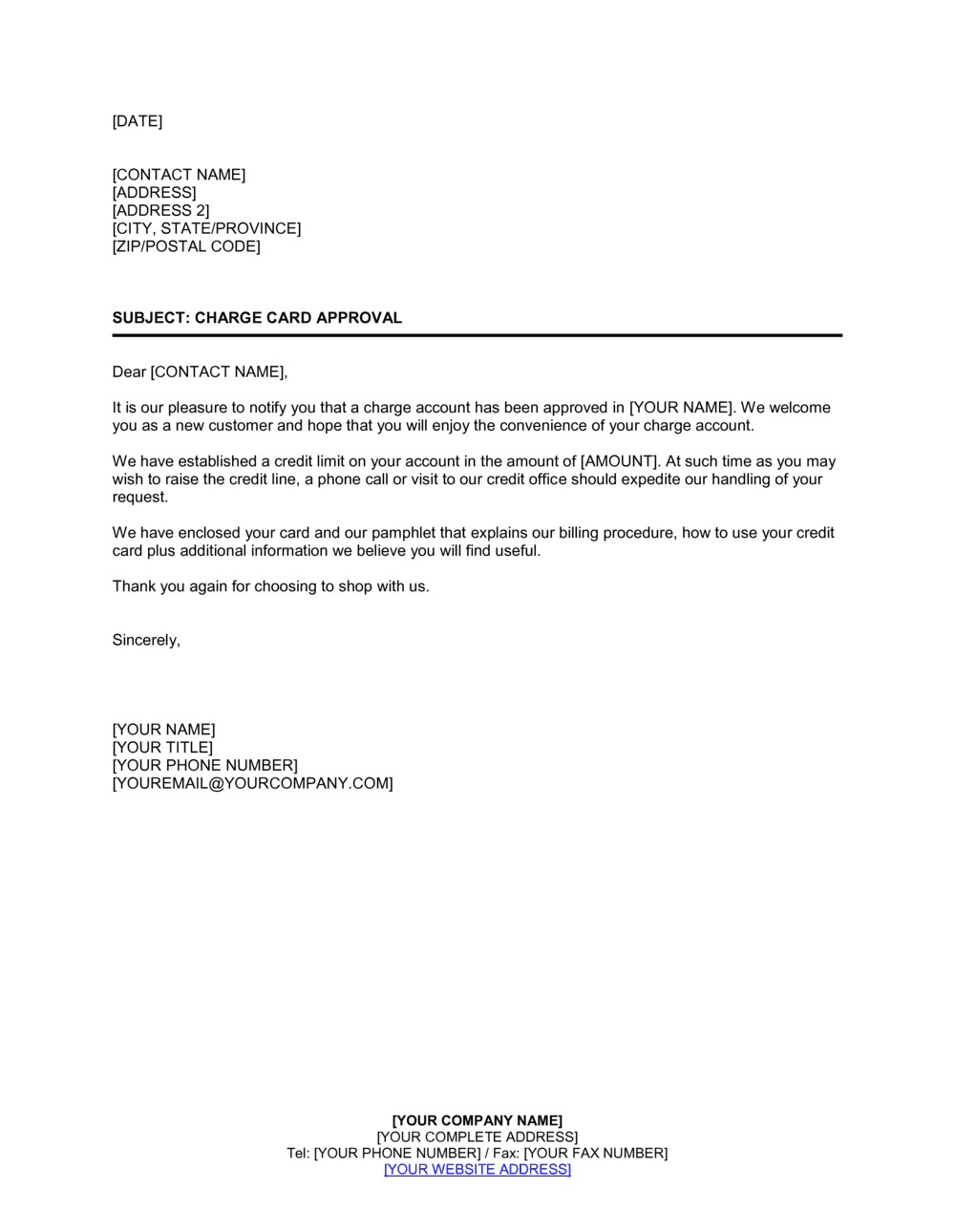
Customer Charge Card Approval Template

Free Word download β€’ Edit online β€’ Save & share with Drive β€’ Export to PDF

1 pageβ€’20–30 min to fillβ€’Difficulty: Standardβ€’Signature requiredβ€’Legal review recommended
Learn more ↓
FreeCustomer Charge Card Approval Template

At a glance

What it is
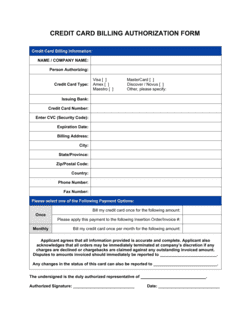
A Customer Charge Card Approval is a legally binding agreement between a business and a customer that establishes a revolving in-house charge account, setting the approved credit limit, billing cycle, payment due dates, interest on overdue balances, and the consequences of default. This free Word download lets you customize credit terms, liability provisions, and dispute procedures, then export as PDF for customer signature before the first charge is made.
When you need it
Use it when a repeat customer requests the ability to purchase on account rather than paying at the point of sale β€” common in wholesale, trade supply, and professional services. It is also required any time you approve a credit application and need a signed record of the customer's acceptance of your terms before extending the line.
What's inside
Account holder identification, approved credit limit, billing cycle and payment terms, interest and late-fee schedule, personal or corporate guarantee, dispute and billing-error procedures, default and collection rights, and governing law. Together these clauses form the enforceable basis for your entire credit relationship with the customer.

What is a Customer Charge Card Approval?

A Customer Charge Card Approval is a legally binding credit agreement between a business and a customer that formally establishes an in-house revolving charge account. It documents the approved credit limit, billing cycle, payment due dates, finance charges on overdue balances, personal guarantee obligations, dispute procedures, and the creditor's remedies upon default. Unlike a third-party credit card arrangement where a bank bears the credit risk, a charge card approval keeps the entire credit relationship β€” and its associated risk β€” directly between you and your customer, making clear, enforceable written terms essential.

Why You Need This Document

Extending credit on a handshake or an unsigned email confirmation leaves you without a legally enforceable basis for charging interest, triggering default, or pursuing collections when a customer stops paying. Courts regularly dismiss or reduce creditor claims where no signed agreement establishes the applicable interest rate, the payment due date, or the personal liability of the business owner behind a limited liability entity. A properly executed charge card approval eliminates each of these gaps: it sets the exact terms the customer has agreed to, creates personal liability through a guarantee clause, and gives you a clear contractual basis for acceleration and collection if the account goes delinquent. This template gives you a complete, customizable starting point that reflects standard commercial credit practice β€” ready for signature before the first charge is ever made.

Which variant fits your situation?

If your situation is…Use this template
Approving a charge account for an individual consumerConsumer Charge Card Approval
Extending credit to a business entity with a corporate guaranteeCustomer Charge Card Approval (Corporate)
Documenting the initial credit application before approvalCustomer Credit Application
Issuing a formal credit limit increase to an existing account holderCredit Limit Increase Letter
Formalizing a structured repayment schedule for an overdue accountPayment Plan Agreement
Sending a written notice when a customer account is placed in defaultNotice of Default Letter
Closing or suspending a customer's charge accountAccount Suspension or Closure Letter

Common mistakes to avoid

❌ Executing after the account is already in use

Why it matters: In most jurisdictions, agreement terms signed after transactions have already occurred may be unenforceable against those earlier charges β€” leaving your interest in prior purchases unsecured.

Fix: Require a signed agreement before the account is opened and any credit is extended. Flag incomplete applications in your credit onboarding workflow so nothing falls through.

❌ No personal guarantee on business accounts

Why it matters: A judgment against a shell or asset-light LLC may be uncollectable, leaving you with an unpaid balance and no recourse against the individuals who made the purchasing decisions.

Fix: Include a personal guarantee clause for all business accounts and require the owner or authorized officer to sign it in their individual capacity.

❌ Failing to disclose the APR in dollar terms

Why it matters: US Regulation Z and equivalent provincial disclosure rules require clear APR disclosure for open-end credit. Noncompliance can void the finance charge clause and expose you to regulatory penalties.

Fix: State the APR prominently in the agreement and confirm it does not exceed your jurisdiction's usury cap. Review with a lawyer if you serve consumers as well as business customers.

❌ Omitting a billing-dispute procedure

Why it matters: Without a defined dispute window and process, customers can contest charges at any time β€” including during collection proceedings β€” with no contractual deadline foreclosing their claim.

Fix: Include a 30- or 60-day written dispute window from the statement date and a creditor response timeline. This creates a clean cutoff that supports your collection position.

❌ Using a trade name instead of the registered legal entity

Why it matters: A contract signed with 'ABC Plumbing' rather than 'ABC Plumbing LLC' may not be enforceable against the legal entity β€” or may be enforced against the wrong entity entirely.

Fix: Verify the customer's exact legal entity name against their business registration before completing the agreement. Add a 'doing business as' reference if a trade name is also in use.

❌ Including a security interest clause but not perfecting it

Why it matters: An unperfected security interest is subordinate to other creditors and is generally voided in bankruptcy β€” meaning you become an unsecured creditor even though the agreement says otherwise.

Fix: File a UCC-1 financing statement with the Secretary of State in the debtor's jurisdiction within days of execution, and calendar a five-year renewal date.

The 10 key clauses, explained

Account holder identification and authorization

In plain language: Identifies the customer β€” individual or legal entity β€” opening the account, lists authorized users who may charge against it, and records the date of approval.

Sample language
This Charge Account Agreement is entered into on [DATE] between [BUSINESS NAME] ('Creditor') and [CUSTOMER LEGAL NAME / ENTITY NAME] ('Account Holder'). The following individuals are authorized to charge against this account: [AUTHORIZED USER NAMES AND TITLES].

Common mistake: Listing only a trade or brand name instead of the customer's full legal entity name. If the account goes to collections, you may be unable to obtain a judgment against the correct legal person.

Approved credit limit

In plain language: States the maximum balance the customer may carry at any time and reserves the creditor's right to lower the limit on notice.

Sample language
The Creditor approves an initial credit limit of $[AMOUNT] ('Credit Limit'). The Creditor reserves the right to adjust the Credit Limit upon [X] days' written notice to the Account Holder.

Common mistake: Setting the credit limit without tying it to the customer's reviewed financial information. If the customer disputes a collection action, an undocumented approval process weakens your position.

Billing cycle and payment terms

In plain language: Defines the billing period, when statements are issued, the payment due date, and minimum payment amount if applicable.

Sample language
Statements are issued on the [LAST / FIRST] day of each calendar month. Payment in full is due by [DAY] of the following month (Net [30/60]). Minimum payment, if permitted, is [X]% of the closing balance or $[MINIMUM], whichever is greater.

Common mistake: Stating 'due upon receipt' instead of a specific day. Ambiguous due dates make it difficult to charge late fees or trigger default notices on a defensible timeline.

Finance charges and late fees

In plain language: Sets the APR applied to unpaid balances after the due date, states the daily periodic rate, and specifies any flat late fee.

Sample language
Unpaid balances remaining after the due date will accrue a finance charge at an APR of [X]% ([DAILY PERIODIC RATE]% per day). A late fee of $[AMOUNT] will be assessed on each statement that is not paid in full by the due date.

Common mistake: Stating only the monthly rate without disclosing the APR. In the US, Regulation Z requires APR disclosure on open-end consumer credit β€” and many states extend similar requirements to commercial accounts.

Personal or corporate guarantee

In plain language: Requires an individual officer or owner to guarantee personal repayment if the business entity account holder defaults.

Sample language
As a condition of account approval, [GUARANTOR FULL NAME], in his/her personal capacity, unconditionally and irrevocably guarantees full payment of all amounts owed under this Agreement. This guarantee survives the termination of the Account Holder's business entity.

Common mistake: Omitting the guarantee clause for small or newly incorporated business customers. A judgment against the entity alone may be uncollectable if the entity has minimal assets.

Dispute and billing-error procedures

In plain language: Gives the customer a defined window to dispute a charge in writing, pauses the finance charge on disputed amounts during investigation, and states the creditor's resolution timeline.

Sample language
Account Holder must notify Creditor in writing of any billing error within [30/60] days of the statement date. Creditor will investigate and respond within [30] days. Finance charges on disputed amounts are suspended pending resolution.

Common mistake: Providing no dispute procedure at all. Without one, a customer can raise billing disputes indefinitely β€” including during collection proceedings β€” without any defined cutoff.

Default, acceleration, and remedies

In plain language: Defines default events, triggers the acceleration clause making the full balance immediately due, and reserves collection rights including attorney fees.

Sample language
Account Holder is in default if: (a) any payment is not received within [X] days of the due date; (b) the Credit Limit is exceeded; or (c) Account Holder becomes insolvent. Upon default, the entire outstanding balance is immediately due and payable. Creditor may recover reasonable attorney fees and collection costs.

Common mistake: Defining only non-payment as a default event. Exceeding the credit limit, providing false information on the application, and insolvency are equally important triggers and should be listed explicitly.

Security interest (optional)

In plain language: Grants the creditor a security interest in goods purchased on the account, allowing repossession or a lien claim if the account is not paid.

Sample language
To secure payment of all amounts owed, Account Holder grants Creditor a security interest in all goods purchased on this account and the proceeds thereof. Creditor may file a UCC-1 financing statement to perfect this interest.

Common mistake: Including a security interest clause but never filing the UCC-1 financing statement. An unperfected security interest is unenforceable against third-party creditors and in bankruptcy.

Amendment and account changes

In plain language: Reserves the creditor's right to change terms β€” including interest rates and fees β€” with advance notice, and states how notice will be delivered.

Sample language
Creditor may amend any term of this Agreement upon [30] days' written or electronic notice to Account Holder. Continued use of the account after the effective date of the amendment constitutes acceptance.

Common mistake: No amendment clause at all. Without one, changing your interest rate or fee structure for existing accounts requires a new signed agreement with every customer.

Governing law and jurisdiction

In plain language: Specifies which state or province's law governs the agreement and designates the forum for disputes.

Sample language
This Agreement is governed by the laws of the State of [STATE], without regard to conflict-of-law rules. Any dispute shall be resolved exclusively in the courts of [COUNTY], [STATE], and Account Holder consents to personal jurisdiction therein.

Common mistake: Choosing a governing law with no connection to either party's location. Some courts refuse to enforce foreign-jurisdiction clauses in consumer credit agreements, and commercial courts may scrutinize them if the choice appears solely forum-shopping.

How to fill it out

  1. 1

    Identify the account holder and authorized users

    Enter the customer's full legal name or registered entity name, their billing address, and the names and titles of every person authorized to charge against the account. Cross-reference the credit application for accuracy.

    πŸ’‘ For business accounts, verify the entity name against the state or provincial corporate registry before signing β€” mismatches create collection headaches later.

  2. 2

    Set the approved credit limit

    Enter the credit limit you approved based on the customer's application, trade references, and your internal credit policy. Document the basis for the limit in your internal credit file, not in the agreement itself.

    πŸ’‘ Include a sentence reserving your right to reduce the limit on 30 days' notice β€” this gives you flexibility if the customer's payment behavior deteriorates.

  3. 3

    Define the billing cycle and payment due date

    Choose a billing period (typically calendar month), state the statement issue date, and set a specific payment due date β€” not 'upon receipt.' Specify whether net-30 or net-60 terms apply.

    πŸ’‘ Aligning all customer billing cycles to the same calendar date (e.g., the last day of the month) simplifies your accounts-receivable workflow significantly.

  4. 4

    Disclose the APR and late-fee schedule

    Enter the annual percentage rate that will apply to unpaid balances, compute and list the daily periodic rate, and state the flat late fee per overdue statement. Confirm these rates comply with your jurisdiction's usury limits.

    πŸ’‘ In the US, check both federal Regulation Z disclosure requirements and the applicable state usury cap β€” some states set ceilings as low as 18% APR for commercial accounts.

  5. 5

    Add the personal guarantee (for business accounts)

    For any business customer, include the guarantee clause with the guarantor's full legal name and have them sign it in their individual capacity, separately from the entity signature block.

    πŸ’‘ Require the guarantor to initial the guarantee clause specifically, in addition to signing the full agreement β€” this reduces the risk of a later claim that they did not read or agree to the personal liability.

  6. 6

    Specify the default events and remedies

    List every event you intend to trigger default β€” non-payment past X days, exceeding the credit limit, and insolvency β€” and confirm that the acceleration clause makes the full balance immediately due upon any trigger.

    πŸ’‘ Build in a cure period for first-time non-payment (e.g., 10 days after written notice) to avoid triggering default over a single missed due date from an otherwise reliable customer.

  7. 7

    Execute before the first charge is made

    Obtain the customer's signature β€” and the guarantor's separate signature β€” before the account is opened and any purchases are charged. File the signed original in your accounts-receivable records.

    πŸ’‘ Send the executed agreement to the customer via email with a PDF copy immediately after signing β€” this eliminates later claims that they never received the final terms.

  8. 8

    File a UCC-1 if taking a security interest

    If you included the security interest clause, file a UCC-1 financing statement with the appropriate state office within a few days of execution to perfect your interest in the purchased goods.

    πŸ’‘ Set a calendar reminder to renew the UCC-1 before it lapses at five years β€” a lapsed financing statement leaves your security interest unperfected as of the lapse date.

Frequently asked questions

What is a customer charge card approval?

A customer charge card approval is a signed agreement between a business and a customer that formally establishes an in-house revolving charge account. It sets the approved credit limit, billing cycle, payment due dates, finance charges on unpaid balances, personal guarantee requirements, and default remedies. It is the legal foundation of the entire credit relationship β€” without it, enforcing payment terms or charging interest on overdue balances is difficult.

Is a customer charge card approval legally binding?

Yes, when properly executed by both parties, a customer charge card approval is generally enforceable as a written credit agreement. The enforceability of specific clauses β€” particularly finance charges, personal guarantees, and security interests β€” depends on compliance with applicable state or provincial law and proper disclosure. Working with a lawyer to review the terms for your jurisdiction is advisable before you extend significant credit lines.

Do I need a personal guarantee for business accounts?

For small or newly formed business entities β€” LLCs, sole proprietorships, or newly incorporated companies β€” a personal guarantee is strongly advisable. Without it, a judgment is limited to the entity's assets, which may be minimal. For well-established companies with a track record, a corporate guarantee may be sufficient, but the decision should be based on a review of the customer's financial statements and credit history.

What interest rate can I charge on overdue balances?

The maximum interest rate you may charge is governed by usury laws in the jurisdiction where the agreement is entered into or the customer is located. In the US, rates vary by state β€” some states permit up to 24–30% APR on commercial accounts while others cap consumer rates at 18%. In Canada, the Criminal Code sets an effective rate ceiling of 60% per year for all credit. Always confirm the applicable cap with a lawyer before setting your finance charge rate.

What happens if a customer defaults on a charge account?

Typically, the acceleration clause makes the entire outstanding balance immediately due. The creditor may then pursue collection through demand letters, referral to a collections agency, or legal action. If a security interest was taken and perfected, the creditor may also claim or repossess the goods. A personal guarantee allows the creditor to pursue the individual guarantor's personal assets through judgment if the entity does not pay.

Does a charge card approval agreement need to be notarized?

Notarization is not required for a charge card approval agreement to be enforceable in most jurisdictions. A witnessed signature or electronic signature is generally sufficient. However, if the agreement includes a real estate security interest or is being filed as part of a formal lien, notarization requirements may apply. Check the specific requirements for your jurisdiction and the collateral involved.

Can I change the terms of an existing charge account?

Yes, provided your agreement includes an amendment clause giving you the right to change terms on advance notice β€” typically 30 days. The amended terms apply to future charges; whether they apply retroactively to the existing balance depends on the language used and applicable law. In some jurisdictions, material changes to credit terms require a new signed agreement from the customer. Consult a lawyer before changing interest rates on existing balances.

What is a UCC-1 financing statement and when do I need one?

A UCC-1 financing statement is a public notice filed with the Secretary of State in the debtor's jurisdiction that perfects a creditor's security interest in personal property collateral β€” including goods purchased on account. You need to file one if your charge card agreement includes a security interest clause. Without the filing, your security interest is unperfected, meaning it is subordinate to other creditors and generally voided if the customer files for bankruptcy.

What is the difference between a charge account and a credit card?

A charge account is an in-house credit arrangement directly between your business and the customer β€” you extend the credit, carry the receivable, and bear the default risk. A credit card is issued by a bank or payment network that pays you immediately and assumes the credit risk from the cardholder. Charge accounts typically have lower transaction costs than credit card processing fees, but they require you to manage credit underwriting, billing, and collections yourself.

How this compares to alternatives

vs Customer Credit Application

A credit application collects the customer's financial information, trade references, and consent to a credit check β€” it is the intake form used before a decision is made. The charge card approval is the binding agreement that follows a positive credit decision, establishing enforceable payment terms. Both documents are needed; the application does not substitute for the approval agreement.

vs Sales Agreement

A sales agreement governs the terms of individual transactions β€” what is being sold, at what price, and with what warranties. A charge card approval governs the ongoing credit relationship that funds those transactions. The sales agreement creates the obligation to deliver goods or services; the charge card approval creates the obligation to pay on account terms.

vs Payment Plan Agreement

A payment plan agreement restructures an existing debt into scheduled installments β€” typically used after a customer has already fallen behind. A charge card approval establishes prospective credit terms before any purchases are made. The charge card approval is a proactive credit instrument; the payment plan is a reactive collection tool.

vs Personal Guarantee Agreement

A standalone personal guarantee is a separate document used to secure a larger commercial obligation β€” a lease, a bank loan, or a supplier contract β€” where the guarantee needs to be independently executed and filed. The personal guarantee within a charge card approval is embedded in the agreement for simplicity, but a standalone document offers more flexibility for complex guarantees with separate negotiated terms and conditions.

Industry-specific considerations

Wholesale and Distribution

Net-30 and net-60 charge accounts are the standard billing method for trade buyers; credit limits are typically set as a multiple of a single order's average value.

Construction and Trade Supply

Contractor accounts often include a personal guarantee from the owner and a security interest in materials delivered, given the risk of mechanic's liens and project insolvency.

Healthcare and Medical Services

Patient charge accounts must comply with state consumer credit disclosure laws and HIPAA when statements include service descriptions tied to health information.

Professional Services

Law firms, accounting firms, and consultancies use charge accounts for retainer billing, with dispute procedures tailored to the fee-agreement terms already in place.

Jurisdictional notes

United States

For consumer accounts, Regulation Z under the Truth in Lending Act requires APR disclosure, billing rights notices, and error-resolution procedures. Commercial accounts are generally exempt from Regulation Z but remain subject to state usury caps, which range from 18% to 30% APR depending on the state. A UCC-1 filing is required to perfect a security interest in goods, and must be renewed every five years with the Secretary of State in the debtor's jurisdiction.

Canada

The Criminal Code of Canada sets a hard ceiling of 60% effective annual interest on any credit product. Provincial consumer protection legislation β€” including Ontario's Consumer Protection Act and Quebec's Consumer Protection Act β€” imposes disclosure and cooling-off requirements for consumer credit agreements. Quebec agreements must be in French for provincially-regulated transactions. Security interests in personal property are governed by provincial Personal Property Security Acts (PPSA), requiring PPSA registration rather than a UCC-1 filing.

United Kingdom

Consumer credit agreements in the UK are regulated by the Financial Conduct Authority under the Consumer Credit Act 1974 and require FCA authorisation for most consumer-facing lenders. Business-to-business charge accounts are generally outside the CCA but must comply with the Late Payment of Commercial Debts (Interest) Act 1998, which sets a default statutory interest rate of 8% over the Bank of England base rate on overdue commercial invoices. Contractual rates that differ from the statutory rate must be 'substantial' remedy to be enforceable.

European Union

Consumer credit in the EU is governed by the Consumer Credit Directive (2008/48/EC), requiring standardised APR disclosure and a 14-day withdrawal right for consumer accounts. Business credit is less harmonised and largely governed by member state contract law. The Late Payment Directive (2011/7/EU) sets a default 30-day payment period and allows interest of 8 percentage points above the European Central Bank reference rate on overdue B2B invoices. GDPR applies to any personal data collected on the credit application, including the guarantor's information.

Template vs lawyer β€” what fits your deal?

PathBest forCostTime
Use the templateSmall businesses extending modest credit limits to familiar trade customers in a single state or provinceFree15–30 minutes per account
Template + legal reviewBusinesses extending credit above $10,000, serving consumers as well as trade accounts, or operating across multiple states$300–$800 for a one-time lawyer review of your standard form3–5 business days
Custom draftedHigh-volume credit programs, regulated industries (healthcare, financial services), or credit lines above $50,000 with complex collateral$1,000–$3,500+1–3 weeks

Glossary

Charge Account
An in-house credit arrangement allowing a customer to make purchases up to an approved limit and pay the balance on a set billing schedule.
Credit Limit
The maximum outstanding balance the account holder is permitted to carry at any one time under the approved charge account.
Billing Cycle
The recurring period β€” typically monthly β€” at the end of which the account balance is calculated and a statement is issued.
Net 30 / Net 60
Payment terms requiring the full statement balance to be paid within 30 or 60 days of the billing date.
Finance Charge
Interest or fees assessed on unpaid balances that remain outstanding past the due date, expressed as an annual percentage rate (APR).
Personal Guarantee
A clause in which an individual β€” typically a business owner or officer β€” agrees to be personally liable for the account balance if the business entity fails to pay.
Default
A triggering event β€” usually non-payment by the due date or exceeding the credit limit β€” that gives the creditor the right to demand immediate full repayment and pursue collection.
Annual Percentage Rate (APR)
The annualized cost of carrying a balance on the account, including interest and certain fees, expressed as a yearly percentage.
Charge-Back
A customer's formal dispute of a specific charge posted to their account, initiating a review and potential reversal of the amount.
Security Interest
A creditor's legal right to claim specific assets of the debtor as collateral if the account is not paid as agreed.
Acceleration Clause
A provision that makes the entire outstanding balance immediately due and payable upon a specified default event, rather than allowing installment repayment to continue.

Part of your Business Operating System

This document is one of 3,000+ business & legal templates included in Business in a Box.

  • Fill-in-the-blanks β€” ready in minutes
  • 100% customizable Word document
  • Compatible with all office suites
  • Export to PDF and share electronically

Create your document in 3 simple steps.

From template to signed document β€” all inside one Business Operating System.
1
Download or open template

Access over 3,000+ business and legal templates for any business task, project or initiative.

2
Edit and fill in the blanks with AI

Customize your ready-made business document template and save it in the cloud.

3
Save, Share, Send, Sign

Share your files and folders with your team. Create a space of seamless collaboration.

Save time, save money, and create top-quality documents.

β˜…β˜…β˜…β˜…β˜…

"Fantastic value! I'm not sure how I'd do without it. It's worth its weight in gold and paid back for itself many times."

Managing Director Β· Mall Farm
Robert Whalley
Managing Director, Mall Farm Proprietary Limited
β˜…β˜…β˜…β˜…β˜…

"I have been using Business in a Box for years. It has been the most useful source of templates I have encountered. I recommend it to anyone."

Business Owner Β· 4+ years
Dr Michael John Freestone
Business Owner
β˜…β˜…β˜…β˜…β˜…

"It has been a life saver so many times I have lost count. Business in a Box has saved me so much time and as you know, time is money."

Owner Β· Upstate Web
David G. Moore Jr.
Owner, Upstate Web

Run your business with a system β€” not scattered tools

Stop downloading documents. Start operating with clarity. Business in a Box gives you the Business Operating System used by over 250,000 companies worldwide to structure, run, and grow their business.

Start freeΒ Β·Β No credit card required