How To Make More Money With Your Business

Free Word download β€’ Edit online β€’ Save & share with Drive β€’ Export to PDF

4 pagesβ€’20–30 min to fillβ€’Difficulty: Standard
Learn more ↓
FreeHow To Make More Money With Your Business Template

At a glance

What it is
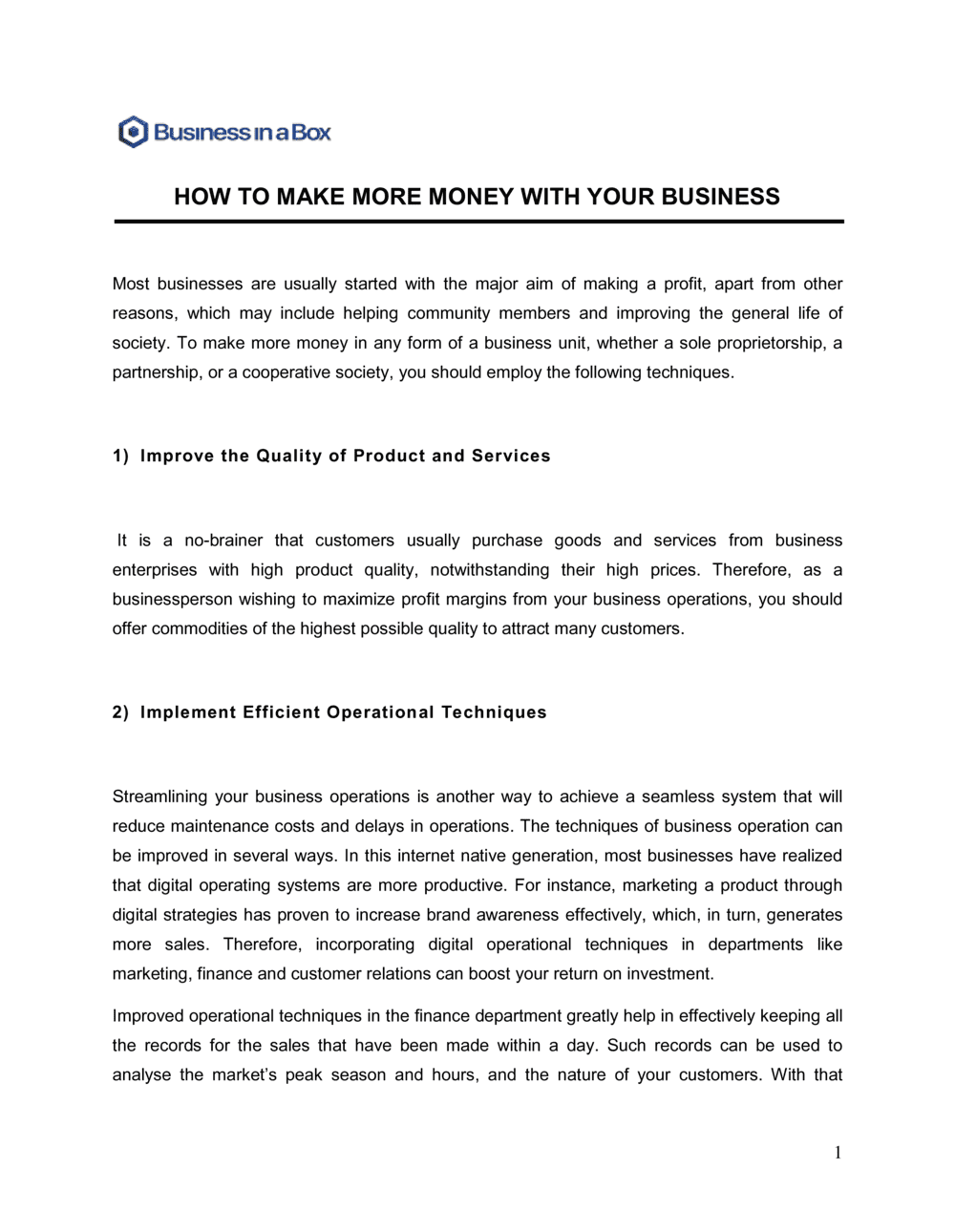
How To Make More Money With Your Business is a structured Word document that guides business owners through a step-by-step framework for identifying and acting on revenue growth opportunities. This free Word download gives you a fill-in-the-blanks plan covering pricing strategy, upselling, cost reduction, new revenue streams, and customer retention β€” ready to edit online and share with your team or advisor.
When you need it
Use it when revenue has plateaued, when you are preparing for a growth push, or when you need to present a concrete profit-improvement plan to a board, lender, or business partner. It is equally useful for annual planning sessions and mid-year performance reviews.
What's inside
A current revenue and profit baseline, pricing review, upsell and cross-sell strategy, new sales channel analysis, customer retention tactics, cost-reduction opportunities, new revenue stream identification, key performance indicators, and a 90-day action plan with assigned owners and deadlines.

What is a How To Make More Money With Your Business Guide?

A How To Make More Money With Your Business guide is a structured operational document that helps business owners systematically identify, prioritize, and act on every major lever for increasing revenue and profit. It moves beyond vague goals like "grow sales" and instead works through pricing strategy, upselling, customer retention, new sales channels, cost reduction, and new revenue stream development in a logical sequence β€” translating each into a concrete 90-day action plan with named owners and measurable KPIs. This free Word download gives you a fill-in-the-blanks framework that works whether your business generates $100K or $5M in annual revenue.

Why You Need This Document

Most businesses have at least three or four underused revenue levers β€” prices that have not moved in two years, customers who have never been offered a higher-value option, and expense lines that auto-renew at rates nobody has renegotiated. Without a structured framework to surface and prioritize these opportunities, growth conversations stay at the level of intention rather than execution. This guide forces you to quantify each lever before committing resources β€” so a 5% price increase on your top revenue line gets evaluated as "$28,000 in incremental annual profit at zero additional cost" rather than "something to think about." For business owners presenting to a lender, board, or investor, it also demonstrates that revenue growth is backed by a disciplined operational plan, not optimistic projections alone.

Which variant fits your situation?

If your situation is…Use this template
Conducting a full annual business performance reviewAnnual Business Plan
Setting specific revenue targets tied to KPIsSales Plan
Restructuring pricing across products or servicesPricing Strategy Template
Improving customer retention and reducing churnCustomer Retention Plan
Launching a new product or service to drive incremental revenueNew Product Launch Plan
Identifying cost reductions to improve margin without cutting revenueCost Reduction Plan
Presenting growth strategy to investors or a boardBusiness Plan

Common mistakes to avoid

❌ Skipping the baseline and starting with tactics

Why it matters: Without knowing which revenue lines are growing and which are shrinking, growth tactics are guesses β€” you may optimize a segment that accounts for 10% of revenue while ignoring the 60% segment that is quietly declining.

Fix: Complete the revenue and profit baseline section first. Spend at least 30 minutes with your accounting data before writing a single tactic.

❌ Avoiding price increases indefinitely

Why it matters: Every year you hold prices flat while your costs rise, your net margin compresses. A business that has not raised prices in two years is effectively running a discount program for its existing customers.

Fix: Model a 5% price increase on your top three revenue lines and calculate the annual impact. Present it to yourself as a business case before deciding not to act.

❌ Assigning actions to the team rather than one person

Why it matters: Shared ownership of a task is no ownership. When a deadline passes with no result, shared assignments produce blame rather than accountability.

Fix: Every row in the 90-day action plan must have a single named owner. If two people share responsibility, one of them is the owner and the other is a contributor.

❌ Pursuing four or more new initiatives simultaneously

Why it matters: Splitting attention across multiple untested growth levers means none of them gets enough execution focus to produce a measurable result, making it impossible to learn what works.

Fix: Rank initiatives by estimated revenue impact divided by implementation effort. Execute the top two fully before starting the third.

❌ Measuring success by activity rather than revenue impact

Why it matters: Completing ten tasks that do not move revenue is not progress. Activity-based reporting creates the illusion of momentum while the underlying numbers stay flat.

Fix: Tie every KPI directly to a revenue or margin metric. If you cannot draw a line from the activity to a dollar outcome, reconsider whether it belongs in the plan.

❌ Launching a new revenue stream before fixing core retention

Why it matters: A new product line built on a customer base that churns at 25% annually will repeatedly fill a leaking bucket β€” the acquisition cost of replacing lost customers cancels out the incremental revenue.

Fix: Reduce churn to below 10% annually before investing material resources in new revenue streams. Use the retained customer base as proof of concept for new offers.

The 9 key sections, explained

Revenue and Profit Baseline

Pricing Review

Upsell and Cross-Sell Opportunities

New Sales Channel Analysis

Customer Retention Strategy

Cost Reduction and Margin Improvement

New Revenue Stream Identification

Key Performance Indicators (KPIs)

90-Day Action Plan

How to fill it out

  1. 1

    Populate the revenue and profit baseline

    Pull your last 12 months of revenue and expenses from your accounting software. Break revenue down by product or service line and calculate gross margin for each. Enter these numbers in the baseline section before touching any other part of the template.

    πŸ’‘ If your accounting is not broken down by line of business, this exercise alone will reveal where your margin actually comes from.

  2. 2

    Audit your pricing against the market

    Research current competitor pricing for each of your core offerings. Note the date of your last price increase. Identify any product or service where your price has not moved in more than 18 months.

    πŸ’‘ A 5–10% price increase on your highest-volume line is almost always your fastest path to incremental profit β€” model it before evaluating any other tactic.

  3. 3

    Map upsell and cross-sell paths for each customer segment

    List your top three customer segments. For each, identify one upsell (a higher-value version of what they buy) and one cross-sell (a complementary product or service). Estimate the conversion rate and annual revenue impact.

    πŸ’‘ Existing customers convert to upsells at 3–5Γ— the rate of new prospects β€” start here before investing in new customer acquisition.

  4. 4

    Evaluate two to three new sales channels

    Identify channels you are not currently using β€” referral programs, wholesale, e-commerce, or a strategic partnership. For each, estimate CAC, monthly revenue potential, and setup cost. Rank them by revenue-per-dollar-invested.

    πŸ’‘ Pick the single highest-ranked channel and commit to it fully before evaluating the next one.

  5. 5

    Calculate and address your churn rate

    Divide the number of customers lost in the past 12 months by your starting customer count. If churn exceeds 10% annually for a service business, make retention your highest-priority growth lever β€” acquiring new customers to replace lost ones costs 5Γ— more than keeping them.

    πŸ’‘ A simple post-cancellation survey asking one question β€” 'What could we have done differently?' β€” consistently identifies the top two or three fixable churn drivers.

  6. 6

    Review costs for renegotiation and elimination opportunities

    Sort your monthly expenses from largest to smallest. For each line item above $500/month, ask: Can this be renegotiated? Automated? Eliminated? Enter the potential saving and assign an action owner.

    πŸ’‘ Software subscriptions and vendor contracts are the most common source of quick savings β€” many renew automatically at rates that were negotiated years ago.

  7. 7

    Select four to six KPIs and assign owners

    Choose metrics that directly measure the levers you are pulling β€” average transaction value, monthly churn rate, upsell conversion rate, gross margin by line, and new channel revenue. Assign each KPI to a specific person and set a monthly review date.

    πŸ’‘ Put your KPI dashboard on a shared screen in your weekly team meeting. Visibility alone improves accountability and keeps the plan from being ignored after Month 1.

  8. 8

    Build the 90-day action plan with single owners and deadlines

    Convert every strategy in the document into a discrete task with one owner, a specific deadline, and a measurable outcome. Prioritize tasks that generate revenue within 30 days β€” these fund the longer-term initiatives.

    πŸ’‘ Review the action plan weekly for the first 90 days. Remove completed items and add new ones as you learn what is and is not working.

Frequently asked questions

What is a 'how to make more money with your business' plan?

It is a structured operational document that helps business owners systematically identify and act on revenue growth opportunities. It covers pricing, upselling, new channels, customer retention, cost reduction, and new revenue streams β€” turning general goals like "grow revenue" into a time-bound action plan with named owners and measurable KPIs.

What is the fastest way to increase business revenue?

For most established businesses, a price increase on existing products or services is the fastest lever β€” it requires no new customers, no new product, and produces immediate margin improvement. The second-fastest lever is selling more to existing customers through upselling and cross-selling, which converts at 3–5Γ— the rate of new customer acquisition. This template helps you model both before committing to either.

How do I increase profit without increasing revenue?

Profit can be improved by reducing costs, increasing gross margin on existing revenue, or eliminating revenue leakage β€” unbilled work, expired discounts, or uncollected invoices. The cost-reduction and margin-improvement section of this template walks through each expense line systematically to find renegotiation, automation, or elimination opportunities.

How is this different from a standard business plan?

A business plan is a comprehensive external document for raising capital or launching a business β€” covering market analysis, competitive positioning, team, and full financial projections. This document is a focused internal operational guide aimed specifically at increasing revenue and profit in an existing business over a 90-day horizon. It is shorter, more tactical, and designed to be acted on immediately.

Who should use this template?

Small business owners who need a structured approach to growing revenue without a large management team, sales managers building a growth case for leadership, business consultants delivering revenue audits to clients, and founders preparing for a funding conversation who need to demonstrate a clear monetization strategy. It is equally useful for businesses at $100K and $5M in annual revenue.

How often should this plan be reviewed and updated?

Review the 90-day action plan weekly and update it monthly with actual KPI results. Rebuild the full plan at least twice a year β€” quarterly for businesses in rapid growth or turnaround. A plan that is more than six months old without an update against actuals is a historical document, not an operating tool.

What KPIs should I track for business revenue growth?

Focus on four to six metrics that directly measure the levers in your plan. Common choices: monthly revenue by line, gross margin percentage, average transaction value, customer churn rate, upsell conversion rate, and new channel revenue. Avoid tracking more than six simultaneously β€” too many metrics produce reports instead of decisions.

How long does it take to complete this template?

A thorough first draft takes four to eight hours, including pulling financial data for the baseline section. The financial modeling steps (pricing impact, churn rate calculation, channel CAC estimates) account for most of that time. A business owner who already has clean monthly financials can complete a working draft in three to four hours.

Do I need an accountant or consultant to use this template?

No β€” this template is designed for business owners to complete independently using data they already have access to. An accountant review is useful if you want to validate the financial projections or use the plan for a loan application. A business coach or consultant can accelerate the strategic sections if you are unsure which levers to prioritize, but neither is required to produce a useful working plan.

How this compares to alternatives

vs Business Plan

A business plan is a comprehensive external document covering market analysis, competitive positioning, team bios, and full multi-year financial projections β€” built primarily for investors and lenders. This revenue growth guide is a focused internal operating document aimed at improving profitability in an existing business over 90 days. Use the business plan to raise capital; use this guide to execute the growth strategy that capital funds.

vs Sales Plan

A sales plan focuses on customer acquisition β€” targets, pipeline stages, quota assignments, and sales process. This revenue guide is broader, covering pricing, retention, cost reduction, and new revenue streams in addition to new sales. Use a sales plan to manage the sales team; use this guide to optimize revenue across the entire business.

vs Strategic Plan

A strategic plan maps 3–5 year vision, competitive positioning, and organizational priorities for an existing business. This revenue guide is a 90-day tactical document focused exclusively on growing money in and reducing money out. Both are useful β€” the strategic plan sets the direction; this guide executes the nearest revenue milestone on that roadmap.

vs Financial Projections Template

A financial projections template models expected revenue, expenses, and cash flow over 12 months. This revenue guide is the strategy document that generates the assumptions behind those projections. Build this guide first to identify and validate your growth levers, then enter the resulting targets into the financial projections template.

Industry-specific considerations

Professional Services

Pricing reviews focus on billable rate increases and minimum engagement sizes; upsell paths map to higher-value retainer or advisory packages.

Retail / E-commerce

Average transaction value and repeat purchase rate are the primary levers; new channel analysis typically evaluates marketplace, wholesale, and subscription-box opportunities.

Food & Beverage

Gross margin improvement centers on food cost percentage and waste reduction; upselling applies to add-ons, catering, and private-event bookings.

SaaS / Technology

Churn reduction and expansion revenue (upsells to higher tiers) typically outperform new customer acquisition as the primary revenue lever at the $1M–$10M ARR stage.

Construction and Trades

Revenue growth focuses on service contracts, maintenance agreements, and referral programs; margin improvement targets materials procurement and subcontractor rate renegotiation.

Creative and Marketing Agencies

Retainer conversion from project-based clients is the highest-impact upsell; new revenue streams often include productized services or licensing of proprietary tools.

Template vs pro β€” what fits your needs?

PathBest forCostTime
Use the templateSmall business owners and founders who want a structured framework for growing revenue independentlyFree4–8 hours
Template + professional reviewBusinesses preparing a growth plan for a lender, board, or investor who wants an advisor to validate the assumptions$300–$1,500 for a business coach or accountant review session1–2 weeks
Custom draftedBusinesses undergoing a formal turnaround, preparing for acquisition, or requiring a full revenue audit by a management consultant$3,000–$15,000 for a consulting engagement3–8 weeks

Glossary

Gross Margin
Revenue minus the direct cost of goods or services sold, expressed as a percentage β€” the share of each dollar left after covering production costs.
Net Profit Margin
Revenue minus all expenses (including overhead, taxes, and interest), expressed as a percentage of total revenue.
Revenue Leakage
Money a business is entitled to but fails to collect β€” through unbilled work, expired discounts left in place, or uncollected overdue invoices.
Upselling
Encouraging an existing customer to purchase a higher-value version of a product or service they are already buying.
Cross-Selling
Offering existing customers a related or complementary product or service alongside their current purchase.
Customer Lifetime Value (LTV)
The total gross profit a business expects to generate from a single customer across the entire relationship.
Customer Acquisition Cost (CAC)
Total sales and marketing spend divided by the number of new customers acquired in the same period.
Churn Rate
The percentage of customers who stop buying or cancel within a given period β€” a key driver of revenue loss in subscription and service businesses.
Average Transaction Value (ATV)
Total revenue divided by the number of transactions in a period β€” a direct measure of how much each sale is worth on average.
Recurring Revenue
Revenue that renews automatically or predictably β€” subscriptions, retainers, maintenance contracts β€” making cash flow more foreseeable.

Part of your Business Operating System

This document is one of 3,000+ business & legal templates included in Business in a Box.

  • Fill-in-the-blanks β€” ready in minutes
  • 100% customizable Word document
  • Compatible with all office suites
  • Export to PDF and share electronically

Create your document in 3 simple steps.

From template to signed document β€” all inside one Business Operating System.
1
Download or open template

Access over 3,000+ business and legal templates for any business task, project or initiative.

2
Edit and fill in the blanks with AI

Customize your ready-made business document template and save it in the cloud.

3
Save, Share, Send, Sign

Share your files and folders with your team. Create a space of seamless collaboration.

Save time, save money, and create top-quality documents.

β˜…β˜…β˜…β˜…β˜…

"Fantastic value! I'm not sure how I'd do without it. It's worth its weight in gold and paid back for itself many times."

Managing Director Β· Mall Farm
Robert Whalley
Managing Director, Mall Farm Proprietary Limited
β˜…β˜…β˜…β˜…β˜…

"I have been using Business in a Box for years. It has been the most useful source of templates I have encountered. I recommend it to anyone."

Business Owner Β· 4+ years
Dr Michael John Freestone
Business Owner
β˜…β˜…β˜…β˜…β˜…

"It has been a life saver so many times I have lost count. Business in a Box has saved me so much time and as you know, time is money."

Owner Β· Upstate Web
David G. Moore Jr.
Owner, Upstate Web

Run your business with a system β€” not scattered tools

Stop downloading documents. Start operating with clarity. Business in a Box gives you the Business Operating System used by over 250,000 companies worldwide to structure, run, and grow their business.

Start freeΒ Β·Β No credit card required