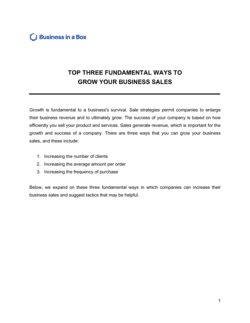
How To Grow Your Business Quickly

Free Word download β€’ Edit online β€’ Save & share with Drive β€’ Export to PDF

4 pagesβ€’20–30 min to fillβ€’Difficulty: Standard
Learn more ↓
FreeHow To Grow Your Business Quickly Template

At a glance

What it is
A How To Grow Your Business Quickly plan is a structured Word document that translates a business owner's growth ambitions into a concrete, time-bound action plan. This free download covers revenue levers, target markets, competitive positioning, operational capacity, and a 90-day execution roadmap β€” all in one editable template you can export as PDF and share with your team, advisors, or investors.
When you need it
Use it when you are ready to move beyond day-to-day operations and commit to a defined growth target β€” whether that means doubling revenue in 12 months, entering a new market, or scaling a product line. It is also the right tool when you need to align a leadership team or present a growth case to a bank or investor.
What's inside
Current business assessment, growth goals and KPIs, target customer analysis, revenue growth levers, marketing and sales strategy, operational capacity plan, team and hiring roadmap, financial projections, and a 90-day action plan with assigned owners and deadlines.

What is a How To Grow Your Business Quickly Plan?

A How To Grow Your Business Quickly plan is a structured operational document that converts a business owner's growth ambitions into a concrete, 12-month action plan with a 90-day execution sprint at its core. It combines a current-state assessment, a prioritized set of revenue growth levers, a marketing and sales strategy with a defined CAC model, an operational capacity analysis, a hiring roadmap, and monthly financial projections β€” all in one editable Word template. Unlike a full business plan, it is designed to be produced quickly and acted on immediately, making it the right tool when the priority is execution speed rather than external fundraising.

Why You Need This Document

Operating without a written growth plan is the single most common reason small businesses plateau. Without one, revenue growth depends on momentum and luck rather than deliberate resource allocation β€” and when growth stalls, there is no diagnostic framework to identify which lever to pull. A growth plan forces you to confront three questions most owners avoid: which customer segment will actually drive the next $X in revenue, which operational constraint will break first if you succeed, and whether the cash flow supports the investment required. It also gives your team a shared execution target with named owners and deadlines, turning a general ambition to "grow faster" into a plan people can act on tomorrow morning.

Which variant fits your situation?

If your situation is…Use this template
Planning growth across a 3–5 year horizon for investors or lendersBusiness Plan
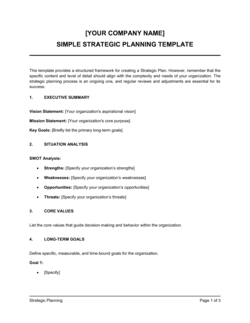
Mapping out annual company objectives and key resultsStrategic Planning Template
Focusing specifically on entering a new geographic or demographic marketMarket Expansion Plan
Launching a new product or service to drive growthProduct Launch Plan
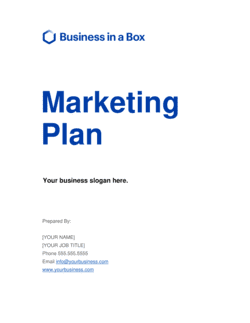
Building the marketing engine that will fuel growthMarketing Plan
Structuring a sales team and process to accelerate revenueSales Plan
Quick one-page growth hypothesis to test with advisors before committingOne-Page Business Plan

Common mistakes to avoid

❌ No prioritization of growth levers

Why it matters: A plan that pursues six growth levers simultaneously splits budget and attention too thin β€” none of the initiatives gets enough resource to produce a measurable result within the quarter.

Fix: Score each lever by expected revenue impact and execution feasibility. Commit to the top two or three, and move the rest to a documented backlog reviewed quarterly.

❌ Growth targets set without leading indicators

Why it matters: An annual revenue target with no monthly KPIs means a miss is only discovered at year-end, when there is no time to course-correct.

Fix: Set two to four leading KPIs β€” pipeline value, new customer count, trial conversions β€” that are measured and reviewed monthly and directly predict whether the annual target is achievable.

❌ Operational capacity ignored in the growth plan

Why it matters: Acquiring customers faster than the business can serve them produces churn, refund requests, and reputation damage that can take longer to fix than the growth took to create.

Fix: For each growth lever, explicitly identify the operational constraint that would be triggered by success and include the investment needed to remove it in the plan budget.

❌ 90-day action plan with no named owners

Why it matters: Team-owned or department-owned tasks routinely slip because everyone assumes someone else is handling them β€” deadlines pass without accountability.

Fix: Assign every action item to a single named individual with a specific completion date. Review progress against the 90-day plan in a weekly stand-up or team check-in.

❌ Only one financial scenario modeled

Why it matters: A single optimistic scenario gives leadership no framework for deciding when to accelerate spending or conserve cash if results diverge from the plan.

Fix: Add a downside scenario at 70% of the base case revenue assumptions and confirm the business remains viable β€” or document the contingency funding plan β€” before finalizing the document.

❌ Target customer defined too broadly

Why it matters: A target customer defined as 'small and medium businesses' or 'anyone who needs our service' produces marketing messaging that resonates with no one and a CAC that climbs with scale.

Fix: Define the target customer by at least four dimensions: industry, company size, geography, and the specific trigger event that makes them ready to buy. Validate against your existing top-revenue customers.

The 9 key sections, explained

Current business assessment

Growth goals and KPIs

Target customer analysis

Revenue growth levers

Marketing and sales strategy

Operational capacity plan

Team and hiring roadmap

Financial projections

90-day action plan

How to fill it out

  1. 1

    Complete the current business assessment honestly

    Pull your last 12 months of revenue, customer count, and gross margin from your accounting system before you open the template. Fill in the assessment section from real numbers, not memory.

    πŸ’‘ Include your single biggest operational bottleneck β€” the one constraint that, if removed, would have the highest impact on growth. Everything downstream depends on knowing what is actually holding you back.

  2. 2

    Set growth goals with a North Star metric

    Choose one primary growth metric β€” annual recurring revenue, total customers, or gross profit β€” and set a specific 12-month target. Then select two to four leading KPIs that you will track monthly to confirm you are on track.

    πŸ’‘ State the goal as a number and a date: '$2M ARR by December 31' is a goal. 'Significant revenue growth' is a wish.

  3. 3

    Define your target customer segment precisely

    Write a one-paragraph profile of the specific customer type that will drive the majority of your growth β€” industry, company size, geography, job title of the buyer, and the trigger event that makes them ready to buy.

    πŸ’‘ If your existing top 20% of customers by revenue share common characteristics, use that profile as your growth segment. Serve more of who already loves you before chasing new archetypes.

  4. 4

    Rank and select your top two or three growth levers

    List every growth lever available to you, then score each by estimated revenue impact and execution effort. Commit the plan to the top two or three β€” the rest go on a backlog for future quarters.

    πŸ’‘ New customer acquisition gets most of the attention, but increasing average order value or reducing churn often delivers a faster return on investment for an established business.

  5. 5

    Build the marketing and sales section around a CAC model

    For each acquisition channel, estimate the number of leads, conversion rate, and cost per acquisition. Confirm that your target CAC is less than one-third of expected LTV before committing the channel to the plan.

    πŸ’‘ If you do not have CAC data yet, use industry benchmarks as a starting point and flag them as assumptions to validate in the first 30 days.

  6. 6

    Map the operational investments required

    For each growth lever, identify what breaks operationally if it succeeds β€” delivery capacity, support headcount, software, or infrastructure β€” and add the investment needed to the plan with a timing and cost estimate.

    πŸ’‘ Schedule operational investments to land one month before the growth initiative they support, not after the bottleneck has already been hit.

  7. 7

    Build the 90-day action plan with named owners

    Break the first 90 days into fortnightly milestones. Assign every line item to a single named owner and a specific deadline. Define the checkpoint metric at Day 30, Day 60, and Day 90.

    πŸ’‘ Keep the 90-day plan to no more than 10 initiatives. A focused plan executed well beats a comprehensive plan executed poorly every time.

  8. 8

    Stress-test the financial projections before sharing

    Run a downside scenario at 70% of planned new customer acquisition. Confirm the business remains cash-flow positive β€” or that you have identified the funding mechanism to cover the gap β€” before presenting the plan.

    πŸ’‘ Share the downside scenario with your leadership team at the same time as the base case. It builds credibility and surfaces risk assumptions early.

Frequently asked questions

What is a business growth plan?

A business growth plan is a structured document that translates a growth target into a time-bound action plan, covering the specific customers you will pursue, the revenue levers you will activate, the operational investments required, and the KPIs you will track monthly to confirm progress. It is more focused than a business plan and more actionable than a strategic plan β€” it answers the question of what you will do in the next 90 to 365 days to grow faster.

How quickly can a business realistically grow?

Growth rate depends heavily on industry, starting size, available capital, and the specific levers being activated. Well-funded startups targeting large markets often target 100%+ annual growth. Established small businesses in mature markets more typically achieve 20–40% annual revenue growth when executing a focused plan. The most important variable is not the target rate but whether the plan is grounded in a realistic customer acquisition model with operational capacity to match.

What are the fastest ways to grow a small business?

The four highest-return growth levers for most small businesses are: increasing average transaction value through upsells or bundles, improving customer retention to reduce churn, activating referral or partnership channels to reduce CAC, and focusing marketing spend on the one or two channels already producing the lowest CAC. New market expansion and product launches tend to deliver slower returns and higher execution risk than optimizing what is already working.

What is the difference between a growth plan and a business plan?

A business plan is a comprehensive document covering the full lifecycle of a business β€” market analysis, competitive positioning, financials, and funding β€” typically used for capital raises. A growth plan is a shorter, more operationally focused document that assumes the business already exists and concentrates on the specific initiatives, investments, and timelines that will accelerate revenue over the next 12 months. Most operating businesses need both.

How long should a business growth plan be?

An effective growth plan for a small or medium business runs 10–20 pages, including the 90-day action plan and financial projections. Longer plans tend to accumulate analysis that is never acted on. The test is whether every section either informs a resource decision or drives an action item on the 90-day plan β€” if it does neither, cut it.

Do I need a financial model in a growth plan?

Yes. At minimum you need a 12-month revenue projection built from unit economics β€” number of customers, average revenue per customer, and retention rate β€” alongside a monthly cash flow view confirming the business can fund the growth investments. Without a financial model, you cannot confirm the plan is viable or make informed decisions about when to hire, spend on marketing, or raise capital.

How do I grow a business without significant capital?

Capital-light growth typically focuses on retention over acquisition β€” reducing churn, increasing referrals, and expanding revenue from existing customers through upsells or cross-sells. These levers have near-zero CAC compared to paid acquisition. Partnerships and co-marketing with complementary businesses also generate new customers at low cost. A growth plan built around these levers should model each one explicitly with expected revenue impact and execution timeline.

How often should a business growth plan be updated?

Review the plan monthly against actual KPIs and update it formally every quarter. Monthly reviews catch execution gaps early enough to course-correct within the same quarter. A quarterly update resets the 90-day action plan, revises the financial projections with actuals, and re-prioritizes growth levers based on what is working. A plan that has not been reviewed in more than 90 days is no longer a plan β€” it is a historical document.

Can this template be used to present a growth plan to investors?

Yes, with one addition. Investors will want to see the financial projections section expanded into a full three-statement model β€” P&L, cash flow, and balance sheet β€” with a clear funding ask and use-of-funds breakdown. The growth plan template provides all the strategic narrative; pair it with the Business Plan or Financial Projections template for the financial depth investors require at due diligence.

How this compares to alternatives

vs Business Plan

A business plan is a comprehensive document covering market analysis, competitive positioning, full financial statements, and funding structure β€” primarily used for capital raises. A growth plan is a shorter, action-oriented document focused on the specific initiatives and 90-day sprints that will accelerate revenue for an existing business. Most operating businesses need both, but a growth plan is faster to produce and easier to execute against.

vs Strategic Planning Template

A strategic plan sets 3–5 year directional goals, defines organizational priorities, and allocates resources at a high level. A growth plan is a 12-month execution document with named owners, specific KPIs, and a 90-day action plan. Strategic plans answer where the business is going; growth plans answer what happens next quarter to get there faster.

vs Marketing Plan

A marketing plan covers one of the key growth levers β€” customer acquisition channels, campaign budgets, and brand positioning β€” in deep detail. A business growth plan is broader, encompassing operational capacity, hiring, financial projections, and all revenue levers, not just marketing. Use the growth plan to set the revenue target and allocate budget to marketing, then use the marketing plan to execute the marketing component.

vs Sales Plan

A sales plan focuses specifically on the sales team's targets, pipeline management, conversion process, and quota allocation. A business growth plan is cross-functional β€” it coordinates marketing, operations, hiring, and finance alongside sales. The two documents are complementary: the growth plan sets the overall revenue target; the sales plan details how the sales function will deliver its portion of that target.

Industry-specific considerations

Retail / E-commerce

Growth levers center on average order value, repeat purchase rate, and paid acquisition efficiency β€” with operational capacity measured in fulfillment throughput and return rates.

Professional Services

Growth is constrained by billable headcount, so the operational capacity plan must sequence hiring before revenue targets are committed, and utilization rate is the primary KPI.

SaaS / Technology

MRR growth, churn rate, and CAC payback are the core metrics; the growth plan must address product-led and sales-led acquisition separately with distinct CAC models for each.

Food & Beverage / Restaurant

Growth typically involves location expansion or catering/wholesale channel development, both of which require upfront capital and operational capacity planning distinct from the core dining model.

Construction and Trades

Growth is bounded by licensed crew capacity and equipment availability; the plan must sequence hiring and equipment investment to match the revenue pipeline, not lag behind it.

Healthcare / MedTech

Growth plans must account for credentialing timelines, reimbursement approval cycles, and regulatory constraints that can delay revenue realization by six to eighteen months.

Template vs pro β€” what fits your needs?

PathBest forCostTime
Use the templateSmall business owners and founders building and executing their own growth strategyFree4–8 hours to complete the full plan
Template + professional reviewBusinesses preparing a growth plan for a bank, investor, or board presentation$500–$2,000 for a business advisor or fractional CFO review1–2 weeks
Custom draftedGrowth-stage companies raising capital above $500K or entering complex new markets requiring deep market research$3,000–$8,000 for a consultant or business plan writer3–6 weeks

Glossary

Growth Lever
A specific, controllable action β€” such as increasing average order value or reducing churn β€” that directly moves a key revenue or profit metric.
Customer Acquisition Cost (CAC)
Total sales and marketing spend divided by the number of new customers acquired in the same period.
Customer Lifetime Value (LTV)
The total gross profit a business expects to generate from a single customer over the entire relationship.
Churn Rate
The percentage of customers or revenue lost in a given period, typically measured monthly or annually.
Revenue Run Rate
Current monthly or quarterly revenue extrapolated to an annual figure, used as a real-time snapshot of business size.
Addressable Market
The realistic pool of potential customers a business can reach and serve with its current product, price point, and distribution channels.
Unit Economics
Revenue and cost metrics measured at the level of a single customer, transaction, or product unit β€” the building blocks of a scalable financial model.
90-Day Sprint
A focused execution window in which a business commits to completing a defined set of high-priority growth initiatives, with weekly accountability check-ins.
CAGR (Compound Annual Growth Rate)
The year-over-year growth rate required to reach a target revenue figure from a starting point over a defined number of years.
North Star Metric
The single metric that best captures the core value a business delivers to customers and that the whole team rallies around as the primary growth indicator.

Part of your Business Operating System

This document is one of 3,000+ business & legal templates included in Business in a Box.

  • Fill-in-the-blanks β€” ready in minutes
  • 100% customizable Word document
  • Compatible with all office suites
  • Export to PDF and share electronically

Create your document in 3 simple steps.

From template to signed document β€” all inside one Business Operating System.
1
Download or open template

Access over 3,000+ business and legal templates for any business task, project or initiative.

2
Edit and fill in the blanks with AI

Customize your ready-made business document template and save it in the cloud.

3
Save, Share, Send, Sign

Share your files and folders with your team. Create a space of seamless collaboration.

Save time, save money, and create top-quality documents.

β˜…β˜…β˜…β˜…β˜…

"Fantastic value! I'm not sure how I'd do without it. It's worth its weight in gold and paid back for itself many times."

Managing Director Β· Mall Farm
Robert Whalley
Managing Director, Mall Farm Proprietary Limited
β˜…β˜…β˜…β˜…β˜…

"I have been using Business in a Box for years. It has been the most useful source of templates I have encountered. I recommend it to anyone."

Business Owner Β· 4+ years
Dr Michael John Freestone
Business Owner
β˜…β˜…β˜…β˜…β˜…

"It has been a life saver so many times I have lost count. Business in a Box has saved me so much time and as you know, time is money."

Owner Β· Upstate Web
David G. Moore Jr.
Owner, Upstate Web

Run your business with a system β€” not scattered tools

Stop downloading documents. Start operating with clarity. Business in a Box gives you the Business Operating System used by over 250,000 companies worldwide to structure, run, and grow their business.

Free Forever PlanΒ Β·Β No credit card required