How to Make a Business Assessment

Free Word download β€’ Edit online β€’ Save & share with Drive β€’ Export to PDF

3 pagesβ€’20–30 min to fillβ€’Difficulty: Standard
Learn more ↓
FreeHow to Make a Business Assessment Template

At a glance

What it is
A Business Assessment is a structured document that systematically evaluates a company's current performance, operations, finances, and strategy against defined benchmarks or goals. This free Word download gives you a ready-to-edit framework you can tailor to your business size and industry, then export as PDF to share with leadership, investors, or advisors.
When you need it
Use it when preparing for a strategic planning cycle, diagnosing performance gaps before a restructuring, conducting due diligence for a sale or acquisition, or presenting a quarterly or annual review to a board or ownership group.
What's inside
Executive summary, company overview, financial performance analysis, operational review, market and competitive position, organizational and team assessment, risk analysis, strategic recommendations, and a prioritized action plan with owners and deadlines.

What is a Business Assessment?

A Business Assessment is a structured diagnostic document that evaluates a company's current state across its most critical dimensions β€” financial performance, operations, market position, organizational health, and risk exposure. It compiles measured data from across the business, compares that data against benchmarks and internal targets, identifies the gaps that matter most, and translates findings into a prioritized set of recommendations and an action plan with named owners and deadlines. Unlike a business plan, which looks forward, a business assessment is grounded in current reality β€” it tells you exactly where the company stands and why, so every strategic decision that follows is built on evidence rather than assumption.

Why You Need This Document

Without a formal assessment, strategic planning is guesswork dressed up as analysis. Leadership teams routinely make investment, hiring, and operational decisions based on incomplete financial snapshots, outdated market data, and process knowledge that lives only in the heads of individual managers. The result is resources directed at the wrong bottlenecks, risks that surface as crises rather than as managed exposures, and board or investor conversations that stall because the company cannot produce a credible account of its own performance. A completed business assessment eliminates all of that β€” it gives owners, executives, and advisors a single, evidence-backed view of what is working, what is not, and what to fix first. This template structures the entire process so you can move from data collection to actionable recommendations without starting from a blank page.

Which variant fits your situation?

If your situation is…Use this template
Evaluating the overall health of an existing business annuallyBusiness Assessment (Annual Review)
Reviewing operations and workflows for a specific departmentOperational Audit Report
Assessing readiness before a merger or acquisitionDue Diligence Checklist
Identifying strategic growth opportunities and threatsSWOT Analysis
Evaluating financial health and projections onlyFinancial Analysis Report
Preparing a structured review for a board of directorsBoard Report
Benchmarking performance against industry competitorsCompetitive Analysis Template

Common mistakes to avoid

❌ Assessing without defined benchmarks

Why it matters: Without a reference point β€” prior-period data, industry averages, or internal targets β€” findings like 'revenue is down' or 'turnover is high' cannot be meaningfully interpreted or acted on.

Fix: Establish at least one comparison point for every metric you report: prior period, internal target, or publicly available industry benchmark.

❌ Recommendations disconnected from findings

Why it matters: Generic recommendations that are not traced back to specific data points read as filler, erode credibility, and give leadership no reason to prioritize one action over another.

Fix: Write each recommendation as a direct response to a named finding, with a quantified expected outcome and a responsible owner.

❌ No owner assigned to action plan items

Why it matters: An action item without a named individual responsible for it will not be completed. In a group context, every unowned task becomes someone else's problem.

Fix: Assign a specific named role or individual β€” not a department or committee β€” to every action plan item before the document is distributed.

❌ Using estimated operational data instead of measured data

Why it matters: Assessments built on gut-feel estimates rather than system data regularly misidentify the root cause of a problem, directing resources at the wrong process.

Fix: Pull data from your ERP, CRM, or accounting system for any claim about operational performance. Where data doesn't exist, note the gap explicitly as a finding.

❌ Treating every risk as equally important

Why it matters: A risk register with 20 identically-weighted items gives leadership no basis for deciding where to act first, and the whole section is typically dismissed.

Fix: Rate every risk on likelihood and impact independently, then sort by combined severity. Highlight the top three to five risks requiring immediate mitigation.

❌ Circulating the assessment without a defined review process

Why it matters: An assessment that sits in a shared folder without a scheduled review meeting and follow-up cadence rarely produces the actions it recommends.

Fix: Schedule a review session with decision-makers before distributing the document, and assign a 30-day check-in date for each action plan item at the time of distribution.

The 9 key sections, explained

Executive Summary

Company Overview

Financial Performance Analysis

Operational Review

Market and Competitive Position

Organizational and Team Assessment

Risk Analysis

Strategic Recommendations

Action Plan

How to fill it out

  1. 1

    Define the scope and purpose before collecting data

    Decide whether the assessment covers the whole business or a specific function. Clarify who commissioned it, who the audience is, and what decisions it will inform. A focused scope prevents scope creep and keeps the document usable.

    πŸ’‘ Write a one-sentence 'purpose statement' at the top of your working document before touching any section β€” it anchors every editorial decision you make.

  2. 2

    Gather financial data for at least three periods

    Pull revenue, gross margin, EBITDA, and cash flow for the current period plus two prior comparable periods. Include the same metrics for industry benchmarks if available from trade associations or market databases.

    πŸ’‘ Use actuals from your accounting system, not management estimates. Even small discrepancies between your assessment figures and audited accounts will undermine credibility.

  3. 3

    Audit core operations with measured data

    Interview process owners and pull system data β€” cycle times, error rates, capacity utilization, and support ticket volumes. Compare current performance to internal targets and industry norms.

    πŸ’‘ If data doesn't exist for a process, note that in the assessment β€” 'no measurement currently in place' is itself a finding.

  4. 4

    Map the competitive and market landscape

    Identify at least three direct competitors and note their pricing, customer segments, and recent strategic moves. Use publicly available sources: press releases, LinkedIn, trade publications, and customer review platforms.

    πŸ’‘ Date-stamp every market data point you include. Stale competitive intelligence is worse than no intelligence β€” it leads to wrong conclusions.

  5. 5

    Conduct the organizational and team review

    Pull HR metrics: headcount by department, voluntary turnover rate, time-to-hire, open roles, and any engagement survey scores. Note critical single points of failure β€” roles where one departure would severely disrupt operations.

    πŸ’‘ Interview at least two to three managers directly, not just HR records. The real skill gaps and team dynamics rarely show up in a spreadsheet.

  6. 6

    Build the risk register with likelihood and impact ratings

    List every significant risk identified during the analysis. Rate each High, Medium, or Low on both likelihood and impact. Identify which risks have no current mitigation and flag them as requiring immediate action.

    πŸ’‘ Limit the risk register to no more than 10–12 items. A list of 30 risks signals that nothing has been prioritized and readers will stop engaging.

  7. 7

    Draft recommendations linked directly to findings

    For each significant finding, write one specific recommendation with an expected outcome, a responsible owner, a timeline, and an estimated cost or resource requirement. Do not include a recommendation that cannot be traced back to a specific finding.

    πŸ’‘ Rank recommendations by a simple priority matrix β€” high impact and low effort first. This gives leadership a clear starting point even if they only act on three items.

  8. 8

    Write the executive summary last

    Pull the three to five most important findings and the top two to three recommendations into a one-page summary. Write it as if the reader will not see any other section β€” because many won't.

    πŸ’‘ Have someone outside the assessment team read only the executive summary and tell you what actions they would take. If they can't answer, the summary is not clear enough.

Frequently asked questions

What is a business assessment?

A business assessment is a structured analysis of a company's current performance across key dimensions β€” financial health, operations, market position, people, and risk. It identifies strengths, gaps, and priorities, then translates findings into specific, actionable recommendations. It functions as both a diagnostic tool and a strategic planning input.

When should a business conduct an assessment?

Common triggers include annual strategic planning cycles, pre-sale or pre-acquisition due diligence, a significant drop in revenue or margins, leadership transitions, entry into a new market, or preparation for a funding round. Many well-run companies conduct a formal assessment annually and a lighter mid-year review to track progress against the action plan.

How long should a business assessment be?

A comprehensive assessment covering all major business dimensions typically runs 15–30 pages plus supporting data appendices. A focused departmental or operational review may be 8–12 pages. The executive summary alone should fit on one page. Length should reflect the scope of the review, not the desire to appear thorough.

Who should conduct a business assessment?

For internal reviews, a cross-functional team led by the CEO, COO, or a senior operations manager is standard. For pre-sale due diligence or turnaround situations, an external consultant brings objectivity that internal teams often cannot. The most useful assessments combine internal data access with external benchmarking and a fresh perspective.

What data do I need to complete a business assessment?

At minimum: 12–36 months of financial statements (P&L, cash flow, balance sheet), operational metrics by department, headcount and turnover data, a current customer list by revenue contribution, and any available competitive intelligence. Industry benchmark reports from trade associations or market research firms add significant analytical depth.

What is the difference between a business assessment and a business plan?

A business plan is forward-looking β€” it defines where the company intends to go and how it will get there. A business assessment is primarily diagnostic β€” it establishes where the company is right now and why. In practice, a well-done assessment often directly feeds the next business plan cycle, because its findings define the starting conditions and priorities for the forward strategy.

How do I prioritize recommendations in a business assessment?

The most practical method is a simple impact-versus-effort matrix: place each recommendation on a 2Γ—2 grid where one axis represents potential business impact and the other represents implementation effort. Prioritize high-impact, low-effort items first. Present no more than five to seven recommendations in total β€” a list of twenty tells leadership nothing about where to start.

Can a small business use the same assessment template as a large company?

Yes, with adjustments to scope and data depth. A 10-person company will not have the same HR metrics or supply chain complexity as a 500-person business, but the structural framework β€” financial review, operations, market position, team, risk, and recommendations β€” applies at every scale. Small businesses should focus on the two or three sections most relevant to their current challenges rather than forcing completeness in every area.

How often should a business assessment be updated?

A full assessment once per year is the standard for most businesses, aligned to the annual planning cycle. A lighter progress review against the action plan every 90 days keeps recommendations from going stale. For businesses in rapid growth, turnaround, or pre-sale situations, a semi-annual full assessment is more appropriate.

How this compares to alternatives

vs SWOT Analysis

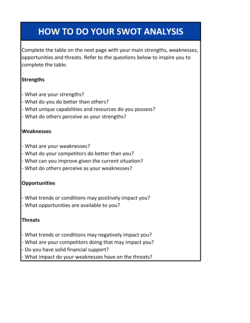
A SWOT analysis is a single-framework snapshot that maps strengths, weaknesses, opportunities, and threats β€” typically one to two pages. A business assessment is a full multi-section diagnostic covering financials, operations, people, and risk with supporting data. Use the SWOT as one component inside a broader assessment, not as a substitute for it.

vs Business Plan

A business plan is forward-looking β€” it describes where the company intends to go and how it will get there. A business assessment is primarily diagnostic β€” it establishes the current state with evidence and identifies what needs to change. A completed assessment is often the most valuable input for the next planning cycle.

vs Strategic Plan

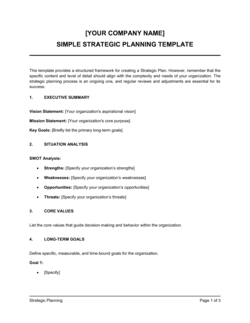
A strategic plan translates organizational goals into multi-year initiatives, KPIs, and resource allocation decisions. A business assessment provides the evidence base β€” the current-state analysis β€” that a sound strategic plan must be built on. Without an accurate assessment, a strategic plan rests on assumptions rather than data.

vs Due Diligence Checklist

A due diligence checklist is a transactional document used by buyers or investors to verify specific facts about a target company β€” ownership, contracts, liabilities, and compliance. A business assessment is a management tool for evaluating performance and setting priorities. In an M&A context, both are used: the assessment informs the seller's positioning; the checklist drives the buyer's verification process.

Industry-specific considerations

Professional Services

Billable utilization rate, client concentration risk, and partner performance are the focal metrics in a professional services assessment.

Retail / E-commerce

Inventory turnover, average order value, customer return rate, and fulfillment cost per order are the primary operational indicators reviewed.

Manufacturing

Capacity utilization, defect rate, cost of goods sold breakdown, and supplier lead-time variability drive the operational and risk sections.

SaaS / Technology

MRR growth, churn rate, CAC payback period, and engineering team capacity are the defining metrics in a SaaS business assessment.

Healthcare

Regulatory compliance status, patient or client volume trends, reimbursement rate changes, and staff credentialing gaps receive specific attention.

Food and Beverage

Food cost percentage, labor cost as a share of revenue, table or location performance, and health compliance history are central to the operational review.

Template vs pro β€” what fits your needs?

PathBest forCostTime
Use the templateSmall to mid-size business owners and managers conducting an internal annual or strategic reviewFree1–3 weeks depending on data availability
Template + professional reviewCompanies preparing for a funding round, sale process, or board-level presentation requiring external validation$500–$2,500 for an advisor or consultant review session2–4 weeks
Custom draftedPre-acquisition due diligence, turnaround situations, or regulated industries where an independent third-party assessment is required$5,000–$25,000+ for a management consulting engagement4–10 weeks

Glossary

Business Assessment
A structured review of a company's operations, finances, strategy, and people to identify strengths, gaps, and actionable improvement priorities.
KPI (Key Performance Indicator)
A measurable value that tracks how effectively a company or department is achieving a defined objective.
SWOT Analysis
A framework that maps a business's internal Strengths and Weaknesses against external Opportunities and Threats.
Gap Analysis
A comparison between a company's current state and its desired future state, used to identify what needs to change and by how much.
Benchmarking
The process of comparing a company's performance metrics against industry averages or best-in-class competitors to calibrate where it stands.
Operational Efficiency
The ratio of useful output to total input in a business process β€” higher efficiency means more output for the same or fewer resources.
Risk Register
A log of identified risks, their likelihood, potential impact, and the mitigation or contingency actions assigned to each.
Stakeholder
Any individual or group with a direct interest in the outcome of the business β€” including owners, employees, customers, suppliers, and investors.
Strategic Recommendation
A specific, prioritized course of action proposed as a result of assessment findings, tied to a measurable outcome and a responsible owner.
Action Plan
A task-level breakdown of the steps required to implement a recommendation, including owners, resources needed, and target completion dates.

Part of your Business Operating System

This document is one of 3,000+ business & legal templates included in Business in a Box.

  • Fill-in-the-blanks β€” ready in minutes
  • 100% customizable Word document
  • Compatible with all office suites
  • Export to PDF and share electronically

Create your document in 3 simple steps.

From template to signed document β€” all inside one Business Operating System.
1
Download or open template

Access over 3,000+ business and legal templates for any business task, project or initiative.

2
Edit and fill in the blanks with AI

Customize your ready-made business document template and save it in the cloud.

3
Save, Share, Send, Sign

Share your files and folders with your team. Create a space of seamless collaboration.

Save time, save money, and create top-quality documents.

β˜…β˜…β˜…β˜…β˜…

"Fantastic value! I'm not sure how I'd do without it. It's worth its weight in gold and paid back for itself many times."

Managing Director Β· Mall Farm
Robert Whalley
Managing Director, Mall Farm Proprietary Limited
β˜…β˜…β˜…β˜…β˜…

"I have been using Business in a Box for years. It has been the most useful source of templates I have encountered. I recommend it to anyone."

Business Owner Β· 4+ years
Dr Michael John Freestone
Business Owner
β˜…β˜…β˜…β˜…β˜…

"It has been a life saver so many times I have lost count. Business in a Box has saved me so much time and as you know, time is money."

Owner Β· Upstate Web
David G. Moore Jr.
Owner, Upstate Web

Run your business with a system β€” not scattered tools

Stop downloading documents. Start operating with clarity. Business in a Box gives you the Business Operating System used by over 250,000 companies worldwide to structure, run, and grow their business.

Start freeΒ Β·Β No credit card required