How To Advertise Your Business For Free

Free to read β€’ Save or share with one click

FreeHow To Advertise Your Business For Free Template

At a glance

What it is
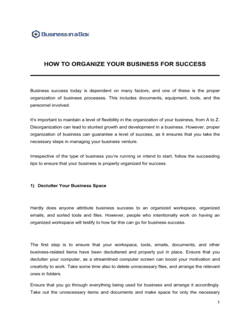
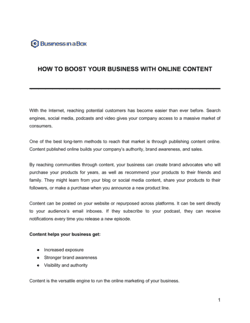
How To Advertise Your Business For Free is a structured Word document that walks business owners through proven zero-budget promotion strategies β€” from optimizing Google Business Profile and claiming directory listings to building a referral program and leveraging social media organically. This free Word download gives you a ready-to-customize action plan you can edit online and share with your team or marketing coordinator.
When you need it
Use it when launching a new business with limited marketing budget, when paid advertising costs are producing a negative ROI, or when you want to build sustainable organic visibility before committing to ad spend.
What's inside
A channel-by-channel breakdown of free advertising methods, a prioritized action checklist, social media and directory setup instructions, content marketing guidance, referral and partnership frameworks, and a tracking section for measuring results without paid tools.

What is a How To Advertise Your Business For Free guide?

A How To Advertise Your Business For Free guide is a structured operational document that walks business owners and marketers through proven zero-budget promotion strategies β€” channel by channel, with practical setup instructions, scripts, and tracking methods. It covers owned and earned media tactics including Google Business Profile optimization, local directory listings, organic social media, content marketing for search, customer referral programs, cross-promotion partnerships, and free PR outreach. Unlike a broad marketing plan, it focuses specifically on actions that generate measurable visibility and leads without any advertising spend.

Why You Need This Document

Without a structured approach to free advertising, most small businesses default to sporadic social media posts and hope for word-of-mouth β€” neither of which produces reliable lead flow. The cost of this gap is concrete: competitors with complete Google Business Profiles consistently outrank businesses with incomplete ones in local search, directory listings with inconsistent name and address data suppress organic rankings, and referral programs left unstructured simply never get launched. A documented free advertising guide converts scattered tactics into a repeatable system with assigned owners, a posting cadence, and monthly tracking. It also ensures that when a marketing hire or agency is eventually brought in, they inherit a functioning organic foundation rather than starting from zero.

Which variant fits your situation?

If your situation is…Use this template
Building a full paid and organic marketing strategy togetherMarketing Plan
Focusing specifically on social media channelsSocial Media Marketing Plan
Launching a new product with limited budgetProduct Launch Plan
Growing an email list as the primary free channelEmail Marketing Plan
Building a content calendar for organic search and socialContent Marketing Plan
Structuring a formal referral or affiliate programReferral Program Policy
Documenting a local community outreach strategyCommunity Engagement Plan

Common mistakes to avoid

❌ Spreading effort across too many channels at once

Why it matters: Posting infrequently on six platforms produces worse brand impressions than consistent activity on two. Thin presence signals a low-credibility business to new visitors.

Fix: Choose the two channels most used by your specific target customer and post on a schedule you can sustain for at least 90 days before evaluating results.

❌ Ignoring Google Business Profile after initial setup

Why it matters: Google demotes listings that go weeks without updates, new photos, or review responses. A stale profile loses ranking to competitors who actively manage theirs.

Fix: Block 20 minutes every two weeks to add a new photo, post an update, and respond to any unanswered reviews. Treat it as a recurring calendar task.

❌ Publishing content with no keyword intent

Why it matters: Content written for a general audience with no search query in mind ranks for nothing. It generates traffic only if you already have a large following β€” which defeats the purpose of free advertising.

Fix: Before writing any piece of content, confirm there is a real search query to target using Google autocomplete or Search Console. Write the title to match the query phrase exactly.

❌ Never directly asking customers for referrals

Why it matters: Referrals are the highest-converting free channel for most service businesses, but they require a direct ask. Waiting for referrals to happen organically leaves most of the potential on the table.

Fix: Build a specific referral ask into your post-delivery process β€” a templated email or a short script for in-person asks β€” and send it within 48 hours of a successful project or positive interaction.

The 9 key sections, explained

Goals and target audience

Google Business Profile optimization

Online directory and citation strategy

Social media organic strategy

Content marketing and SEO basics

Referral and word-of-mouth program

Partnership and cross-promotion outreach

Free PR and earned media tactics

Tracking and measuring results

How to fill it out

  1. 1

    Define your goals and ideal customer profile

    Start by writing one specific, measurable goal β€” for example, '20 new inquiries per month from organic sources by Month 6.' Then describe your target customer in one paragraph: who they are, where they look for solutions, and what triggers them to buy.

    πŸ’‘ A narrow customer description produces better channel choices. 'Local homeowners in [CITY] aged 35–55 searching for kitchen remodelers' is more actionable than 'anyone who needs home improvement.'

  2. 2

    Claim and complete your Google Business Profile

    Go to business.google.com, claim your listing, and fill every available field β€” business description, categories, services, hours, photos (minimum 10), and Q&A. Request reviews from your five most satisfied current customers.

    πŸ’‘ Add a keyword-rich business description of 250–750 characters that naturally includes your primary service and city. This is the single highest-impact free SEO action for any local business.

  3. 3

    Audit and fix your directory listings

    Search your business name on Google and identify every listing that appears. Check that the name, address, and phone number match exactly. Claim and update any incomplete or incorrect listings on Yelp, Bing Places, Apple Maps, and the top two industry-specific directories in your field.

    πŸ’‘ Use a spreadsheet to record the login email and password for each directory β€” you will need to update them quarterly and after any address or phone change.

  4. 4

    Choose two social platforms and set a posting schedule

    Pick the two platforms where your target customers are most active. Set a specific posting frequency you can sustain β€” three times per week is better than daily for two weeks then nothing. Plan content in batches of four weeks at a time.

    πŸ’‘ Repurpose every piece of content across both platforms rather than creating original content for each. A blog post becomes three social captions, one quote graphic, and one short video.

  5. 5

    Create a 90-day content plan targeting search queries

    Use Google's free tools β€” Search Console, Google Trends, and the autocomplete suggestions in Search β€” to identify five to ten questions your customers are already asking. Write one piece of content per week that directly answers one of those questions.

    πŸ’‘ Title each piece of content exactly as the search query is phrased β€” 'How to [TASK] in [CITY]' consistently outperforms creative titles for organic search traffic.

  6. 6

    Design and launch a simple referral ask

    Write a short, direct email or script for asking satisfied customers for a referral. Define the incentive (discount, gift card, free month) and the exact moment to send the ask β€” typically immediately after a successful delivery or positive feedback.

    πŸ’‘ A two-sentence ask outperforms a long explanation every time: 'We'd love an introduction to anyone you know who needs [SERVICE]. We'll give you [INCENTIVE] for every referral that becomes a client.'

  7. 7

    Set up a monthly results review

    Create a simple spreadsheet that pulls four numbers each month: organic website sessions (Google Analytics), Google Business Profile views, new leads from each free channel, and total referrals received. Review on the first Monday of each month and drop any channel producing zero results after 90 days.

    πŸ’‘ Compare month-over-month, not week-over-week β€” free channels build momentum slowly, and weekly variance will mislead you into abandoning strategies that are actually working.

Frequently asked questions

What are the most effective free ways to advertise a business?

The highest-impact free advertising channels for most small businesses are Google Business Profile optimization, organic social media on the one or two platforms your customers actually use, local directory listings with consistent NAP data, and a structured customer referral ask. For businesses with a website, publishing content that targets specific search queries adds compounding organic traffic over time. The best channel depends on whether your customers search locally, browse social media, or rely on word of mouth.

Does free advertising actually work for small businesses?

Yes β€” for most small and service-based businesses, free channels produce a significant share of leads before any paid advertising is introduced. Google Business Profile alone generates an average of over 1,000 views per month for active listings in competitive local markets. The trade-off versus paid advertising is time: free channels take 60–90 days to build momentum and require consistent effort, while paid ads can generate traffic on day one but stop the moment you stop spending.

How is this guide different from a standard marketing plan?

A marketing plan covers the full strategic picture β€” paid and organic channels, budget allocation, brand positioning, and campaign calendars. This guide focuses exclusively on zero-budget tactics, with step-by-step instructions for each channel, practical scripts, and tracking methods that require no paid tools. It is designed to be actionable for a business owner with no marketing team and no advertising budget.

Which free advertising channels work best for local businesses?

For local businesses, Google Business Profile and consistent directory listings are the highest-priority starting points because they directly influence local search rankings and Google Maps placement. Nextdoor, local Facebook groups, and community partnership outreach are also effective for neighborhood-level visibility. Customer referral programs work especially well for local service businesses where the customer base is geographically concentrated.

How long does it take to see results from free advertising?

Google Business Profile improvements typically show measurable ranking and click changes within 4–6 weeks of completing the profile and accumulating new reviews. Content marketing and SEO typically take 3–6 months to generate meaningful organic traffic. Social media organic reach builds over 60–90 days of consistent posting. Referral programs can produce results within days of the first ask if the timing and incentive are right.

Do I need a website to advertise my business for free?

No β€” a Google Business Profile, active social media profiles, and consistent directory listings can generate leads without a website. However, a website dramatically increases the value of every free channel: it gives you a destination for search traffic, a place to collect email addresses, and a platform for content marketing. A basic website on a free or low-cost platform is worth building early even if it contains only a few pages.

How do I track results from free advertising without paid analytics tools?

Google Analytics and Google Search Console are both free and cover organic website traffic, keyword rankings, and click-through rates. Google Business Profile provides free data on profile views, direction requests, and phone calls. A simple spreadsheet tracking monthly leads by source (referral, Google search, social, directory) is sufficient for most small businesses to identify which free channels are worth continuing.

Can I use this guide if I have some advertising budget?

Yes. The strategies in this guide are complementary to paid advertising and improve its performance. Organic search presence reduces your paid cost per click. A strong Google Business Profile increases the conversion rate of paid local ads. Referral programs reduce CAC for paid channels by converting warm introductions rather than cold traffic. Most businesses benefit from building free channel infrastructure before scaling ad spend.

How this compares to alternatives

vs Marketing Plan

A marketing plan covers the full strategic picture β€” paid campaigns, brand positioning, budget allocation, and multi-channel coordination. This guide focuses exclusively on zero-budget tactics with step-by-step instructions. Use this guide first to build organic foundations, then layer a full marketing plan when budget and team capacity allow.

vs Social Media Marketing Plan

A social media marketing plan covers platform strategy, content calendars, paid social, influencer outreach, and analytics in depth. This guide treats social media as one of several free channels and provides a lighter-weight setup process. Use this guide if social is not your primary channel; use the social media marketing plan if it is your core acquisition strategy.

vs Content Marketing Plan

A content marketing plan maps editorial calendars, SEO keyword strategy, content formats, distribution workflows, and performance metrics in full detail. This guide covers content marketing as one module within a broader zero-budget strategy. Use the content marketing plan when SEO and publishing are your primary growth levers.

vs Product Launch Plan

A product launch plan coordinates go-to-market activities across all channels β€” paid, owned, and earned β€” for a specific product introduction. This guide is channel-focused rather than event-focused and applies to ongoing business promotion rather than a one-time launch. Use both together when launching a new product on a limited budget.

Industry-specific considerations

Professional Services

LinkedIn organic content, Google Business Profile reviews, and HARO media pitching are the three highest-leverage free channels for accountants, lawyers, and consultants.

Retail / E-commerce

Google Shopping free listings, Pinterest organic traffic, and user-generated content repurposing allow product sellers to build visibility without ad spend.

Food & Beverage

Google Business Profile, Yelp optimization, and Instagram food photography drive the majority of organic discovery for restaurants and cafes.

Construction and Trades

Houzz and Thumbtack free profiles, before-and-after photo content on social media, and customer referral programs produce the majority of qualified leads for contractors.

Template vs pro β€” what fits your needs?

PathBest forCostTime
Use the templateFounders, solo operators, and small business owners implementing free channels themselvesFree2–4 hours to complete the plan; 3–5 hours per week to execute
Template + professional reviewBusinesses wanting a marketing coordinator or consultant to review channel selection and content strategy$200–$800 for a 1–2 hour marketing consultant session1–2 weeks
Custom draftedBusinesses ready to build a full organic marketing program with dedicated content creation and SEO$1,500–$5,000+ for a fractional CMO or agency organic strategy engagement3–6 weeks

Glossary

Organic Reach
The number of people who see your content or listing without any paid promotion behind it.
Google Business Profile
A free Google-managed listing that displays your business name, address, hours, photos, and reviews in Google Search and Maps results.
Search Engine Optimization (SEO)
The practice of improving a website's content and structure so it ranks higher in unpaid search engine results for relevant keyword queries.
Content Marketing
Creating and distributing useful, relevant content β€” articles, videos, or guides β€” to attract and retain a clearly defined audience without direct advertising.
Referral Program
A structured system that incentivizes existing customers to recommend your business to new prospects, typically in exchange for a discount, credit, or reward.
Business Directory Listing
A free online citation of your business name, address, phone number, and website on platforms such as Yelp, Bing Places, or industry-specific directories.
NAP Consistency
The practice of using the exact same Name, Address, and Phone number across every online listing and directory to improve local SEO rankings.
Earned Media
Publicity generated through editorial coverage, social sharing, or word-of-mouth β€” as opposed to paid advertising or owned channels.
Call to Action (CTA)
A specific instruction β€” such as 'Book a free consultation' or 'Download our guide' β€” that prompts a reader or viewer to take a defined next step.
Engagement Rate
The percentage of people who interact with a piece of content (likes, comments, shares, clicks) relative to the total number who saw it.

Part of your Business Operating System

This document is one of 3,000+ business & legal templates included in Business in a Box.

  • Fill-in-the-blanks β€” ready in minutes
  • Compatible with all office suites
  • Export to PDF and share electronically

Create your document in 3 simple steps.

From template to signed document β€” all inside one Business Operating System.
1
Download or open template

Access over 3,000+ business and legal templates for any business task, project or initiative.

2
Edit and fill in the blanks with AI

Customize your ready-made business document template and save it in the cloud.

3
Save, Share, Send, Sign

Share your files and folders with your team. Create a space of seamless collaboration.

Save time, save money, and create top-quality documents.

β˜…β˜…β˜…β˜…β˜…

"Fantastic value! I'm not sure how I'd do without it. It's worth its weight in gold and paid back for itself many times."

Managing Director Β· Mall Farm
Robert Whalley
Managing Director, Mall Farm Proprietary Limited
β˜…β˜…β˜…β˜…β˜…

"I have been using Business in a Box for years. It has been the most useful source of templates I have encountered. I recommend it to anyone."

Business Owner Β· 4+ years
Dr Michael John Freestone
Business Owner
β˜…β˜…β˜…β˜…β˜…

"It has been a life saver so many times I have lost count. Business in a Box has saved me so much time and as you know, time is money."

Owner Β· Upstate Web
David G. Moore Jr.
Owner, Upstate Web

Run your business with a system β€” not scattered tools

Stop downloading documents. Start operating with clarity. Business in a Box gives you the Business Operating System used by over 250,000 companies worldwide to structure, run, and grow their business.

Start freeΒ Β·Β No credit card required