- Primary Research
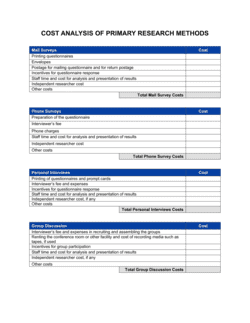
- Data collected directly from the source — through surveys, interviews, focus groups, or observation — rather than gathered from existing publications.
- Secondary Research
- Analysis of data already gathered by others, such as industry reports, government statistics, academic studies, or trade publications.
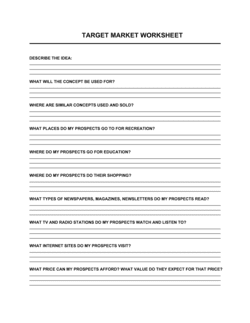
- Target Market
- The specific group of customers a business intends to reach, defined by demographic, psychographic, geographic, or behavioral characteristics.
- Market Segmentation
- The process of dividing a broad market into distinct subgroups with shared characteristics so each can be addressed with tailored messaging or products.
- TAM / SAM / SOM
- Total Addressable Market, Serviceable Addressable Market, and Serviceable Obtainable Market — three nested estimates of market size and realistic capture potential.
- Competitive Positioning
- How a brand or product is perceived relative to competitors on dimensions that matter to buyers, such as price, quality, speed, or specialization.
- PESTLE Analysis
- A framework for scanning the external environment across six dimensions: Political, Economic, Social, Technological, Legal, and Environmental.
- Demand Driver
- A factor — such as population growth, regulation, technology adoption, or income levels — that causes customers to seek out a product or service.
- Buyer Persona
- A semi-fictional profile of an ideal customer built from real data, describing their goals, pain points, purchasing behavior, and decision criteria.
- Market Penetration Rate
- The percentage of the target market currently using a product or service, used to gauge adoption and remaining growth potential.