How to Collect Late Paying Customers

Free to read β€’ Save or share with one click

FreeHow to Collect Late Paying Customers Template

At a glance

What it is
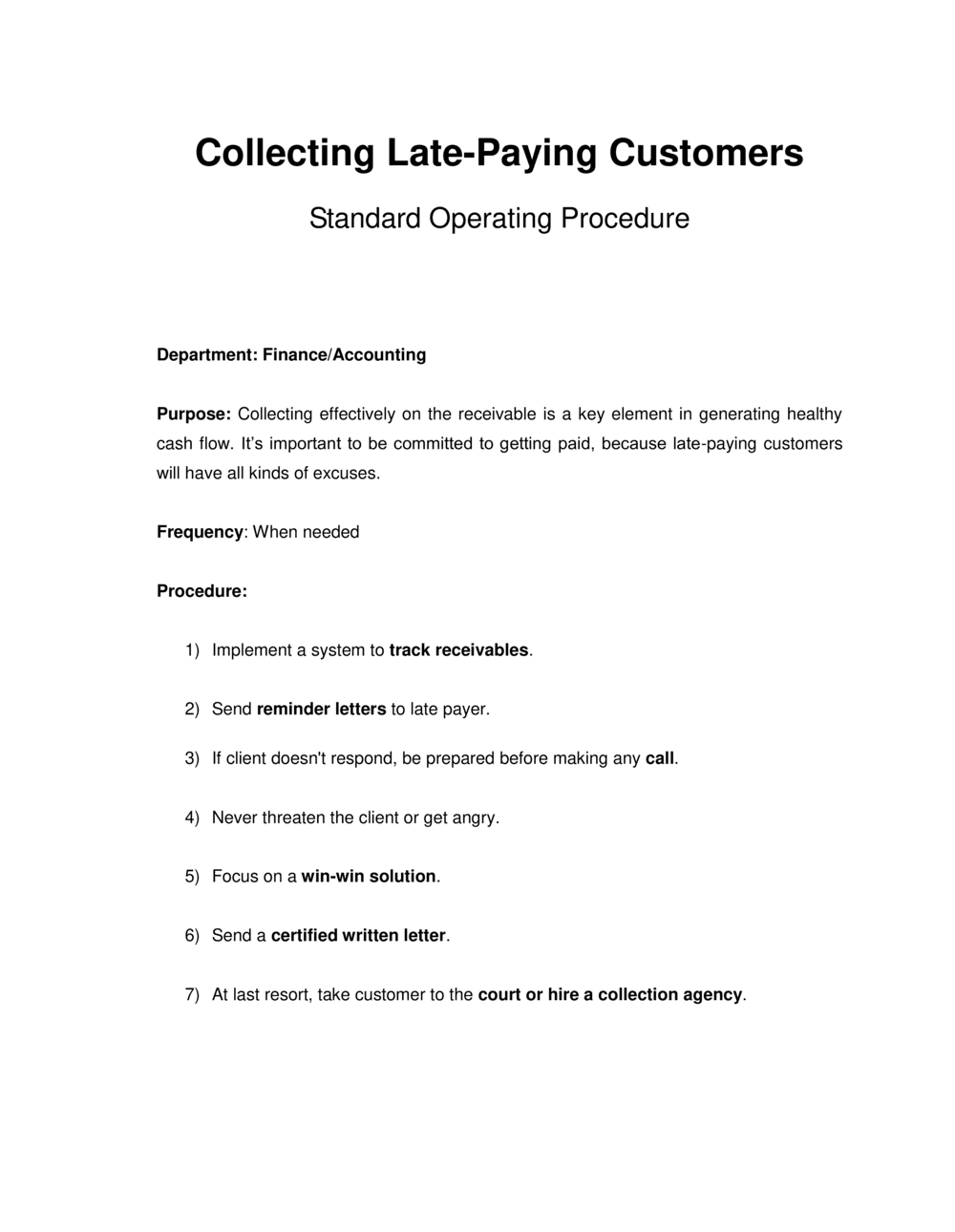
A How To Collect Late Paying Customers document is a step-by-step operational guide that defines exactly how your business pursues overdue invoices β€” from the first friendly reminder through formal escalation, payment plan negotiation, and referral to a collections agency or legal counsel. This free Word download gives you a structured, repeatable process you can edit online and share with your finance, sales, and customer service teams.
When you need it
Use it when invoices start aging past their due date and informal reminders are not producing payment. It is also the right document when you are building out a finance team, onboarding a bookkeeper, or standardizing accounts receivable procedures for the first time.
What's inside
An escalation timeline with day-by-day triggers, phone and email script guidance, payment plan terms, dispute resolution steps, legal and agency referral criteria, and internal record-keeping requirements β€” organized into a sequence any staff member can follow without prior collections experience.

What is a How To Collect Late Paying Customers document?

A How To Collect Late Paying Customers document is a structured operational procedure that defines every step a business takes to recover overdue invoices β€” from the first automated reminder through phone escalation, payment plan negotiation, formal demand, and referral to a collections agency or legal counsel. It replaces ad hoc chasing with a repeatable, documented process that any member of your finance or operations team can follow consistently. The procedure sets specific day-count triggers, approved communication language, payment plan authorization limits, dispute handling rules, and bad debt write-off criteria in a single reference document.

Why You Need This Document

Without a written collections procedure, overdue invoices get chased inconsistently β€” or not at all. Some staff follow up aggressively on small balances while larger accounts age unchallenged; others avoid the conversation entirely because there is no approved script to follow. The result is a rising days sales outstanding figure, cash flow pressure, and customer relationships damaged by unpredictable or unprofessional collections contact. Industry data consistently shows that collection rates drop sharply after 60 days and fall below 50% past 90 days β€” every week without a defined escalation process costs you recovery probability. A documented procedure closes that gap: it ensures every overdue account receives the right action at the right time, creates the paper trail you need to support a legal claim or agency referral, and gives your team the confidence to pursue payment firmly without improvising.

Which variant fits your situation?

If your situation is…Use this template
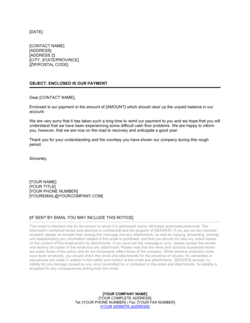
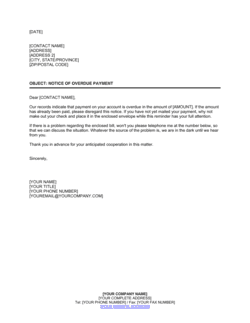
Sending the first reminder immediately after a missed due dateOverdue Payment Reminder Letter
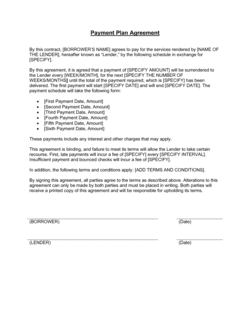
Offering a structured payment plan to a customer who cannot pay in fullPayment Plan Agreement
Escalating to a formal written demand before legal actionDemand Letter for Payment
Settling a disputed invoice for less than the full amountDebt Settlement Agreement
Reporting the collections process outcome internallyAccounts Receivable Aging Report
Documenting that a bad debt has been written off for tax purposesBad Debt Write-Off Policy
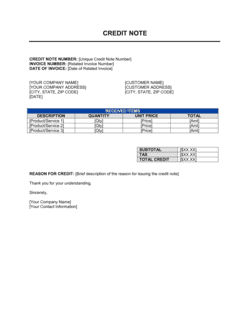
Issuing a credit note to resolve a billing dispute before collectingCredit Note

Common mistakes to avoid

❌ Using vague escalation language instead of specific day counts

Why it matters: Terms like 'after a reasonable time' or 'when significantly overdue' result in inconsistent action across staff and allow accounts to age past the point of easy recovery.

Fix: Replace every time reference with an exact number of days from the invoice due date and confirm the triggers are built into your accounting software or calendar system.

❌ Accepting verbal payment commitments with no written record

Why it matters: Customers dispute the terms they agreed to, and without documentation the business has no enforceable arrangement β€” restarting the collections clock from zero.

Fix: Require a signed Payment Plan Agreement for every arrangement, no matter how small, before accepting any installment payment.

❌ Continuing to chase a disputed invoice before resolving the dispute

Why it matters: Escalating collections on a genuinely disputed invoice damages the customer relationship, may breach consumer protection rules in some jurisdictions, and rarely results in payment.

Fix: Pause collections activity the moment a dispute is logged, complete the review within 10 business days, and reissue the corrected or confirmed invoice before resuming.

❌ Waiting longer than 90 days before referring to a collections agency

Why it matters: Industry data consistently shows collection rates drop below 50% for accounts over 90 days old and fall further every additional month of delay.

Fix: Set a firm 60-day referral trigger for accounts meeting your dollar threshold, and document in the procedure that no exceptions require CFO sign-off.

❌ Failing to log every contact attempt in a central system

Why it matters: Undocumented collections activity cannot support a legal claim, creates liability if a customer alleges harassment, and makes it impossible to audit your DSO trends.

Fix: Mandate same-day logging of every contact attempt β€” date, method, outcome, and any commitment β€” in a single named system, and include logging compliance in AR team performance reviews.

❌ Applying a late fee that was not disclosed in the original invoice or contract

Why it matters: Customers can legitimately dispute undisclosed charges, which stalls payment and can trigger a formal complaint or small claims action against your business.

Fix: Audit every active customer contract and your standard invoice footer to confirm late fee terms are stated before applying any charges to overdue accounts.

The 9 key sections, explained

Purpose and Scope

Collections Timeline and Escalation Triggers

Communication Scripts and Templates

Late Fee and Interest Policy

Payment Plan Negotiation Guidelines

Dispute Resolution Process

Legal and Agency Referral Criteria

Record-Keeping and Documentation Requirements

Bad Debt Write-Off Procedure

How to fill it out

  1. 1

    Define scope and responsible roles

    Specify which invoice types and customer segments the procedure covers. Name the roles responsible for each escalation stage β€” AR clerk, finance manager, CFO β€” so accountability is clear.

    πŸ’‘ Assign a single named owner for each escalation stage rather than a team or department. Shared ownership means no one acts.

  2. 2

    Set specific day thresholds for each escalation stage

    Replace any vague language with exact day counts from the original invoice due date. A typical cadence: Day 7, Day 14, Day 30, Day 60, Day 90+.

    πŸ’‘ Run your last 12 months of invoice aging data before setting thresholds β€” match escalation triggers to where your DSO typically stalls.

  3. 3

    Write or adapt the communication scripts

    Draft an approved email and phone script for each escalation stage. Scripts should escalate in firmness β€” from friendly reminder to formal demand β€” while remaining professional throughout.

    πŸ’‘ Have a manager review tone before finalizing. Language that sounds appropriately firm to a finance person can read as aggressive to a customer who intends to pay.

  4. 4

    Document the late fee and interest policy

    Enter the late fee rate, the day it begins to accrue, and how customers are notified. Confirm the rate matches what is stated in your invoice terms and any signed contracts.

    πŸ’‘ Cross-check your late fee clause in every active customer contract before applying fees β€” mismatched terms create disputes that delay payment further.

  5. 5

    Set payment plan authorization limits

    Define the minimum balance, maximum plan duration, and the approval level required for payment arrangements. Record the form customers must sign before any plan takes effect.

    πŸ’‘ A 90-day plan with three equal installments works for most SMB customers and resolves more accounts than a hard demand for full immediate payment.

  6. 6

    Fill in legal and agency referral thresholds

    Enter the dollar amount and age that trigger escalation to external collections or legal action. Name the person who must approve each referral and the documents they need to receive.

    πŸ’‘ Set a calendar reminder to review accounts at the 45-day mark β€” catching borderline accounts before the 60-day threshold gives you more recovery options.

  7. 7

    Specify record-keeping requirements and the system of record

    Name the specific system (accounting software, CRM, shared folder) where all contact logs and documents must be stored, and set the 24-hour logging requirement for all contact attempts.

    πŸ’‘ If your team uses both an accounting system and a CRM, designate one as the single source of truth for collections activity to avoid conflicting records.

  8. 8

    Define the bad debt write-off approval chain

    State the conditions that make an account eligible for write-off, the dollar approval thresholds for each management level, and the accounting entry required.

    πŸ’‘ Separate write-off approval from collections responsibility β€” the person chasing payment should not be the same person who can approve writing it off.

Frequently asked questions

What is a late payment collections procedure?

A late payment collections procedure is a written operational document that defines the step-by-step process a business follows to recover overdue invoices. It specifies escalation triggers, approved communication scripts, payment plan terms, dispute handling steps, and the criteria for referring an account to a collections agency or legal counsel. Having a written procedure ensures consistent, professional handling of every overdue account regardless of which staff member manages it.

How soon should I start chasing a late invoice?

Send a friendly reminder on the first business day after the due date β€” many late payments result from oversight, not inability to pay. A structured escalation then follows: a second reminder at Day 7, a phone call at Day 14, and a formal written demand at Day 30. Waiting longer than 30 days before escalating increases the chance the account ages past the point of easy recovery.

Can I charge interest on a late invoice?

Yes, in most jurisdictions β€” provided the late fee or interest rate was disclosed to the customer before the invoice became overdue, either in a signed contract or on the invoice itself. A common rate is 1.5% per month on the unpaid balance. Applying interest that was never disclosed in the original terms gives customers grounds to dispute the charge and delay payment further.

When should I offer a payment plan instead of demanding full payment?

Offer a payment plan when a customer acknowledges the debt but demonstrates genuine inability to pay the full balance immediately. A structured installment arrangement β€” documented in a signed Payment Plan Agreement β€” typically recovers more than a demand that results in dispute or silence. Plans running 60–90 days with equal installments work for most SMB debtors and preserve the customer relationship better than immediate legal escalation.

When should I refer an overdue account to a collections agency?

Refer to a collections agency when an account is 60–90 days past due, meets your minimum dollar threshold, and all internal escalation steps have produced no payment or arrangement. Waiting beyond 90 days significantly reduces recovery rates. Most agencies work on a contingency basis β€” typically 20–40% of the amount collected β€” so there is no upfront cost, but the customer relationship is effectively ended.

What should I do if a customer disputes an invoice?

Pause all collections activity immediately and log the dispute in your system of record. Assign the investigation to the billing team or account manager, and commit to a resolution β€” corrected invoice, credit note, or written confirmation of the original amount β€” within 10 business days. Continuing to chase a disputed invoice before resolving it escalates conflict and rarely produces payment.

What records should I keep during the collections process?

Log every contact attempt within 24 hours, recording the date, contact name, method (email or phone), outcome, and any payment commitment made. Store copies of all written communications, signed payment plan agreements, and dispute correspondence in the customer's account file. Complete records are essential if the debt proceeds to legal action and protect the business if a customer alleges improper collections conduct.

When should I write off a bad debt?

Write off a balance as bad debt only after all internal and external collections steps have been exhausted β€” typically after 120 days of non-payment and a failed agency referral. The write-off requires documented approval from the CFO or controller and is recorded as a bad debt expense. In many jurisdictions, properly documented bad debt write-offs are deductible for tax purposes, so accurate record-keeping matters beyond the accounting entry itself.

Does this procedure replace a demand letter?

No β€” the collections procedure is an internal operational document that governs your process. A demand letter is a customer-facing formal notice of the outstanding balance and a final deadline before legal action. The procedure tells your staff when and how to send the demand letter; the demand letter itself is a separate document issued to the customer at the 30-day escalation trigger.

How this compares to alternatives

vs Overdue Payment Reminder Letter

An overdue payment reminder letter is a single customer-facing communication sent at one point in the escalation sequence. The collections procedure is the internal operational document that tells staff when to send that letter, what to say, what to do if there is no response, and how to escalate further. Use the procedure to govern the process; use the letter as one step within it.

vs Demand Letter for Payment

A demand letter is a formal, customer-facing notice requiring payment by a specific date β€” typically the last communication before legal action. The collections procedure defines when the demand letter is triggered (e.g., Day 30) and who is authorized to send it. The demand letter is a single document; the collections procedure is the full operational framework.

vs Payment Plan Agreement

A payment plan agreement is a signed contract between the business and a customer documenting installment terms for an overdue balance. The collections procedure defines when and under what conditions staff may offer a payment plan, what approval is required, and that a signed agreement must be in place before any installment is accepted. One governs the internal process; the other is the binding customer document.

vs Accounts Receivable Policy

An accounts receivable policy covers the broader credit and billing framework β€” credit terms, invoice issuance, payment methods, and credit limit approval. The late payment collections procedure is a subset of that framework, focused specifically on what happens after an invoice becomes overdue. Organizations with a formal AR policy should ensure the collections procedure is consistent with it and cross-referenced within both documents.

Industry-specific considerations

Professional Services

Project milestone billing and retainer invoices frequently go overdue; a documented procedure prevents relationship damage while escalating firmly through account manager, then finance.

Construction and Trades

Progress billing disputes over completed work stages are common; the dispute resolution section and lien right references are especially critical in this industry.

Wholesale and Distribution

High-volume, low-margin accounts make DSO management critical; automated escalation triggers at Day 15 and Day 30 are standard for accounts with Net 30 terms.

Creative and Marketing Agencies

Client relationships make direct collections calls uncomfortable for account managers; a procedure that routes escalation to a finance contact preserves the working relationship.

Template vs pro β€” what fits your needs?

PathBest forCostTime
Use the templateSmall businesses, freelancers, and growing teams building their first structured AR collections processFree1–2 hours to customize and implement
Template + professional reviewBusinesses with high invoice volumes, regulated industries, or staff who interact directly with consumer debtors$200–$500 for a review by an accountant or operations consultant2–5 business days
Custom draftedEnterprise finance teams, businesses operating across multiple jurisdictions, or organizations where collections activity is subject to consumer credit regulations$1,000–$3,000 for a custom procedure drafted with legal and compliance input2–4 weeks

Glossary

Days Sales Outstanding (DSO)
The average number of days it takes a business to collect payment after a sale β€” a key indicator of accounts receivable health.
Aging Report
An accounts receivable report that groups unpaid invoices by how long they have been outstanding β€” typically 0–30, 31–60, 61–90, and 90+ days.
Escalation Trigger
A predefined condition β€” such as an invoice reaching 30 days past due β€” that automatically moves the account to the next stage of the collections process.
Payment Plan
A written arrangement allowing a debtor to pay an overdue balance in scheduled installments rather than a single lump sum.
Demand Letter
A formal written notice requiring payment of a specific amount by a specific date, often the final step before legal action or agency referral.
Collections Agency
A third-party company contracted to recover debts on behalf of a creditor, typically in exchange for a percentage of the amount collected.
Write-Off
An accounting entry removing an uncollectable receivable from the books, recognizing it as a bad debt expense for financial and tax reporting purposes.
Statute of Limitations
The maximum period under applicable law during which a creditor can initiate legal action to collect an unpaid debt β€” varies by jurisdiction and debt type.
Promissory Note
A signed written promise by a debtor to pay a specific sum by a specific date, which can be used as legal evidence of the debt obligation.
Debt Dispute
A formal objection by a customer to the validity, amount, or terms of an invoice β€” requiring investigation before collections activity can continue.

Part of your Business Operating System

This document is one of 3,000+ business & legal templates included in Business in a Box.

  • Fill-in-the-blanks β€” ready in minutes
  • Compatible with all office suites
  • Export to PDF and share electronically

Create your document in 3 simple steps.

From template to signed document β€” all inside one Business Operating System.
1
Download or open template

Access over 3,000+ business and legal templates for any business task, project or initiative.

2
Edit and fill in the blanks with AI

Customize your ready-made business document template and save it in the cloud.

3
Save, Share, Send, Sign

Share your files and folders with your team. Create a space of seamless collaboration.

Save time, save money, and create top-quality documents.

β˜…β˜…β˜…β˜…β˜…

"Fantastic value! I'm not sure how I'd do without it. It's worth its weight in gold and paid back for itself many times."

Managing Director Β· Mall Farm
Robert Whalley
Managing Director, Mall Farm Proprietary Limited
β˜…β˜…β˜…β˜…β˜…

"I have been using Business in a Box for years. It has been the most useful source of templates I have encountered. I recommend it to anyone."

Business Owner Β· 4+ years
Dr Michael John Freestone
Business Owner
β˜…β˜…β˜…β˜…β˜…

"It has been a life saver so many times I have lost count. Business in a Box has saved me so much time and as you know, time is money."

Owner Β· Upstate Web
David G. Moore Jr.
Owner, Upstate Web

Run your business with a system β€” not scattered tools

Stop downloading documents. Start operating with clarity. Business in a Box gives you the Business Operating System used by over 250,000 companies worldwide to structure, run, and grow their business.

Free Forever PlanΒ Β·Β No credit card required