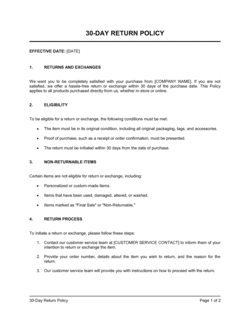
Late Return Authorization Template

Free Word download • Edit online • Save & share with Drive • Export to PDF

1 page20–30 min to fillDifficulty: StandardSignature requiredLegal review recommended
Learn more ↓
FreeLate Return Authorization Template

At a glance

What it is
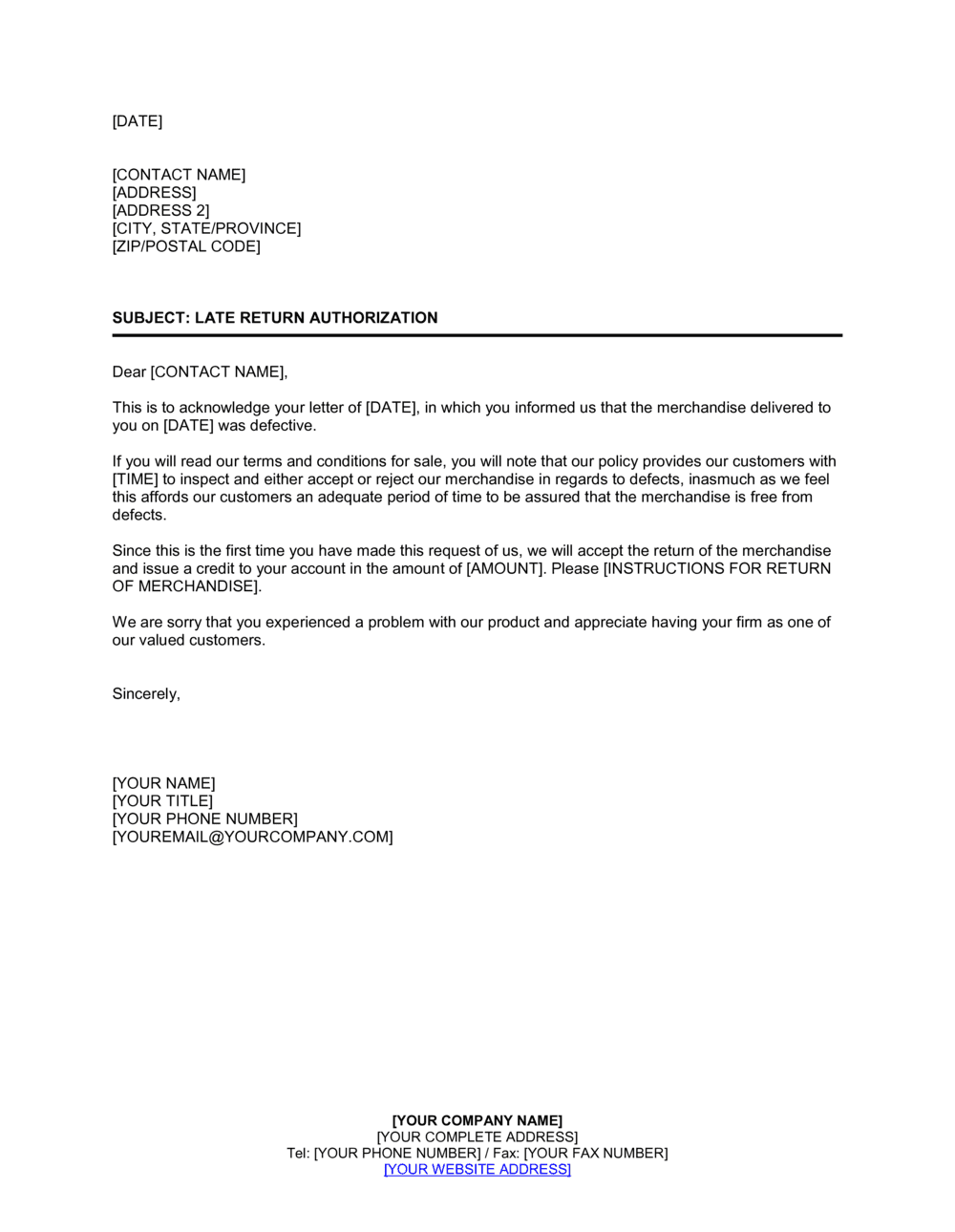
A Late Return Authorization is a legally binding document a seller or supplier issues to a buyer, formally approving the return of goods after the standard return window has expired. This free Word download lets you document the agreed conditions, any restocking or handling fees, the inspection process, and the form of remedy — credit, exchange, or refund — so both parties have a clear written record before the goods move.
When you need it
Use it when a customer or business partner requests a return outside your standard return period and you are willing to accommodate it under specific conditions. It is also appropriate when a dispute over defective goods surfaces weeks or months after delivery and you need a controlled process to accept the return without creating an open-ended liability.
What's inside
Party identification and original transaction reference, a description of the goods being returned, the reason for the late return, agreed conditions and fees, inspection and acceptance terms, the remedy to be provided, and a liability limitation clause. Both parties sign to confirm the agreed terms before any goods are shipped back.

What is a Late Return Authorization?

A Late Return Authorization is a legally binding agreement between a seller and a buyer that formally approves the return of goods after the standard contractual or policy-defined return window has closed. Rather than leaving the terms of the exception to informal email exchanges or verbal agreements, the authorization documents the reason for the late return, the specific goods covered, any applicable restocking or handling fees, the inspection process, and the exact remedy the buyer will receive — whether a cash refund, store credit, or replacement shipment. Both parties sign before any goods are shipped, creating a clear, enforceable record of the agreed terms.

Why You Need This Document

Without a written late return authorization, every exception to your return policy is a liability in waiting. A buyer who ships goods back without a signed agreement can argue for the remedy most favorable to them, leaving the seller with little contractual basis to impose fees, reject non-conforming goods, or cap their exposure. Undocumented exceptions also create precedent: a pattern of informal approvals can be used to argue that your effective return window is longer than your stated policy — weakening enforcement against every future customer. This template closes those gaps by documenting each exception as a one-time, negotiated agreement with specific conditions, a firm return deadline, and a liability limitation that protects you from claims that extend well beyond the value of the goods themselves. For any late return involving meaningful transaction value, a signed authorization is the difference between a controlled resolution and an open-ended dispute.

Which variant fits your situation?

If your situation is…Use this template
Returning goods within the standard return windowReturn Merchandise Authorization (RMA)
Returning defective goods under an active warrantyWarranty Claim Form
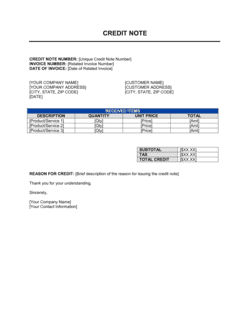
Returning goods after a disputed invoiceCredit Note
Returning leased or rented equipment past the due dateEquipment Rental Agreement
Authorizing a full product recall returnProduct Recall Notice
Replacing defective goods without requiring a returnProduct Replacement Agreement
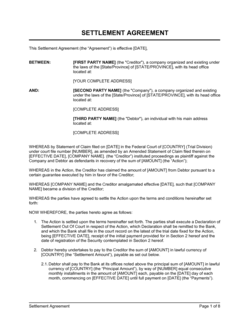
Settling a return dispute through a negotiated creditSettlement Agreement

Common mistakes to avoid

❌ Accepting the return before the authorization is signed

Why it matters: Receiving goods before a signed authorization exists means the seller has accepted the return on unstated terms. The buyer can then argue for the remedy most favorable to them — typically a full refund with no fees.

Fix: Require a countersigned authorization before the buyer ships. Confirm receipt of the signed document in writing and assign the RA number only after execution.

❌ Omitting a return shipment deadline

Why it matters: An open-ended authorization creates an unresolved liability that can sit in accounts receivable indefinitely and prevents the seller from closing the transaction in their financial records.

Fix: Set a firm shipment deadline — typically 10–14 calendar days from the authorization date — and include a clause stating the authorization becomes void if goods are not shipped by that date.

❌ Not documenting the reason for the exception

Why it matters: An undocumented late-return approval can be cited by the buyer in future disputes as evidence that the seller's effective return policy is longer than stated, weakening enforcement of the standard window.

Fix: Include a specific, factual reason in the authorization and a one-time-exception clause confirming it does not modify the standard return policy.

❌ Failing to specify the form and amount of the remedy

Why it matters: Vague remedy language — 'Seller will issue appropriate credit' — leads to follow-up disputes over whether the buyer is entitled to a cash refund versus store credit, and over the exact amount after fees.

Fix: State the remedy type, the exact dollar amount net of all fees, and the timeline for issuance. Treat the remedy clause as a mini-settlement: specific, final, and unambiguous.

❌ Using the authorization to accept goods in unknown condition

Why it matters: Authorizing a return without a stated condition requirement means the seller cannot reject goods that arrive damaged, heavily used, or incomplete — and may be obligated to issue a full remedy regardless of condition.

Fix: Define the minimum acceptable condition in the authorization and include an inspection clause granting the seller the right to reject non-conforming goods at the buyer's expense.

❌ No liability limitation clause

Why it matters: Without a cap, accepting a defective-goods return — even as a goodwill gesture — can be interpreted as an acknowledgment of broader product liability, potentially exposing the seller to consequential damage claims many times the value of the goods.

Fix: Include a liability limitation clause capping total exposure at the original purchase price of the returned goods and excluding all consequential, indirect, and incidental damages.

The 10 key clauses, explained

Parties and transaction reference

In plain language: Identifies the seller and buyer by full legal name and references the original invoice, purchase order, or sales contract that governs the transaction being unwound.

Sample language
This Late Return Authorization ('Authorization') is entered into on [DATE] between [SELLER LEGAL NAME] ('Seller') and [BUYER LEGAL NAME] ('Buyer') with respect to Invoice No. [INVOICE NUMBER] dated [ORIGINAL INVOICE DATE].

Common mistake: Using a trading name instead of the registered legal entity name. If the entity names do not match the original transaction documents, the authorization may not bind the correct contracting party.

Description of goods to be returned

In plain language: Lists the specific items being returned with product name, SKU or serial number, quantity, and original purchase price, so there is no ambiguity about what the authorization covers.

Sample language
Buyer is authorized to return the following goods: [PRODUCT NAME], SKU [SKU NUMBER], Qty: [X], originally purchased at $[UNIT PRICE] per unit (total value: $[TOTAL VALUE]).

Common mistake: Describing goods vaguely as 'the items in question' or 'the order.' Ambiguous descriptions allow the buyer to include unauthorized items in the return shipment, creating acceptance and refund disputes.

Reason for late return

In plain language: States the specific reason the return is being approved after the standard window — for example, a latent defect discovered after extended use, a shipping delay caused by a carrier, or a force majeure event — creating a documented basis for the exception.

Sample language
Buyer's return request is approved on the exceptional basis that: [REASON, e.g., 'a latent manufacturing defect in the goods was not discoverable upon delivery and only became apparent after [X] weeks of normal use'].

Common mistake: Leaving the reason blank or writing 'as discussed.' A documented reason protects the seller from setting a precedent that any late return will be accepted and limits the basis for future similar claims.

Return authorization number and shipping instructions

In plain language: Assigns a unique RA number the buyer must include on all return shipments and specifies the return address, carrier requirements, and packaging standards.

Sample language
Return Authorization No.: [RA-XXXXXX]. Buyer shall mark all returned packages clearly with this RA Number and ship to [RETURN ADDRESS] via [APPROVED CARRIER] no later than [RETURN SHIPMENT DATE]. Seller will not accept returns without the RA Number on the outer packaging.

Common mistake: Omitting a hard deadline for the return shipment. Without a deadline, the authorization remains open indefinitely, and the seller cannot close the liability in their accounting records.

Condition requirements and inspection terms

In plain language: Defines the minimum acceptable condition for returned goods and the process the seller will use to inspect them upon receipt, including the timeframe for completing the inspection and notifying the buyer of acceptance or rejection.

Sample language
Goods must be returned in [CONDITION, e.g., 'original packaging, unused, with all accessories and documentation']. Seller shall inspect returned goods within [5] business days of receipt and notify Buyer in writing of acceptance or rejection. Rejected goods will be returned to Buyer at Buyer's expense.

Common mistake: Accepting goods without any stated condition requirement. Receiving goods in a condition worse than described — without a documented standard — leaves the seller with no basis to reduce or deny the remedy.

Restocking fee and return shipping costs

In plain language: States the restocking fee percentage or flat amount, identifies which party bears return shipping costs, and confirms that these amounts will be deducted from any refund or credit before it is issued.

Sample language
A restocking fee of [X]% of the original purchase price ($[AMOUNT]) applies to this late return. Return shipping costs are the responsibility of [BUYER / SELLER]. These amounts will be deducted from the remedy described in Section [X] below.

Common mistake: Agreeing to waive fees verbally and not documenting the waiver in the authorization. Undocumented waivers create internal accounting confusion and set an unintended precedent for future returns.

Remedy: refund, credit, or exchange

In plain language: Specifies exactly what the buyer will receive in exchange for the accepted return — a full or partial cash refund, a store or account credit, or a replacement shipment — and the timeline for the remedy to be provided.

Sample language
Upon acceptance of the returned goods, Seller shall provide Buyer with [a store credit of / a refund of / a replacement shipment of] $[AMOUNT / GOODS DESCRIPTION] within [X] business days. This remedy constitutes full and final resolution of Buyer's claim relating to the original transaction.

Common mistake: Failing to specify the form and timeline of the remedy. A vague promise to 'make it right' triggers follow-up disputes, delayed credits, and potential breach-of-contract claims if the buyer's expectation differs from the seller's intent.

Limitation of liability

In plain language: Caps the seller's total liability arising from the return and the original transaction to the purchase price of the returned goods, and excludes consequential, indirect, or incidental damages.

Sample language
Seller's total liability to Buyer arising from or related to the returned goods and this Authorization shall not exceed $[ORIGINAL PURCHASE PRICE]. In no event shall Seller be liable for consequential, incidental, or indirect damages, including lost profits or business interruption.

Common mistake: Omitting the liability cap entirely in a goodwill late return. Without it, accepting a return can be interpreted as an acknowledgment of broader defect liability, exposing the seller to claims well beyond the value of the goods.

Entire agreement and waiver of return policy

In plain language: Confirms that this authorization is a one-time exception to the standard return policy, that it does not modify the original sales contract for future transactions, and that it constitutes the entire agreement between the parties regarding this return.

Sample language
This Authorization constitutes a one-time exception to Seller's standard return policy and does not modify the terms of any prior or future agreement between the parties. This document constitutes the entire agreement between the parties with respect to the return of the goods described herein and supersedes all prior discussions or representations.

Common mistake: Not including a 'one-time exception' clause. Without it, the buyer may argue that a pattern of late-return approvals has modified the original contract terms, effectively extending the return window permanently.

Governing law and signatures

In plain language: Specifies which jurisdiction's law governs interpretation and enforcement of the authorization, and provides signature blocks for both parties with name, title, and date.

Sample language
This Authorization is governed by the laws of [STATE / PROVINCE / COUNTRY]. Each party has executed this Authorization as of the date first written above. SELLER: _________________________ Name: [NAME], Title: [TITLE], Date: [DATE]. BUYER: _________________________ Name: [NAME], Title: [TITLE], Date: [DATE].

Common mistake: Only having one party sign the document. A unilaterally signed authorization is more difficult to enforce and may not constitute a binding agreement in jurisdictions that require mutual assent to modify contractual terms.

How to fill it out

  1. 1

    Enter full legal names and the original transaction reference

    Use the registered legal entity name for both seller and buyer — not a brand or trade name. Reference the exact invoice number, purchase order number, or contract ID from the original transaction.

    💡 Cross-check the entity name against the original invoice to ensure they match exactly. A discrepancy can make the authorization unenforceable against the correct party.

  2. 2

    List each item being returned with SKU and quantity

    Enter each product with its full name, SKU or serial number, quantity, and original unit price. Calculate and confirm the total value of the return for use in the remedy and liability cap clauses.

    💡 If serial numbers are available, include them — they eliminate any dispute about whether the goods actually received match what was authorized.

  3. 3

    Document the specific reason for the late return

    Write a concise, factual statement of why the return is being approved after the standard window. Reference supporting evidence where available — for example, a carrier's delay confirmation or a technical report on a latent defect.

    💡 Specific documented reasons protect you from precedent. 'Customer preference' creates a weaker exception than 'latent defect identified in lot [BATCH NUMBER] after 45 days of normal use.'

  4. 4

    Assign an RA number and set the return shipment deadline

    Generate a unique return authorization number following your internal numbering system and enter a firm calendar date by which the goods must be shipped. Specify the return address and any carrier or packaging requirements.

    💡 Set the shipment deadline no more than 14 days from the authorization date — open-ended authorizations create unresolved liabilities in your accounts receivable.

  5. 5

    Define the condition requirement and inspection timeframe

    State the minimum condition the goods must be in to qualify for the agreed remedy. Set a specific number of business days for your team to complete the inspection after receiving the return.

    💡 If the reason for the return is a defect, note that inspection will assess whether the defect matches the described issue — this protects you if a different type of damage is found.

  6. 6

    Calculate and enter restocking fees and shipping cost responsibility

    Apply your restocking fee percentage to the total return value and enter the dollar amount. Confirm in writing which party pays return shipping, and state that these amounts are deducted from the remedy before it is issued.

    💡 Even if you are waiving the restocking fee as a goodwill gesture, include the clause with a $0 amount and a note that the fee has been waived for this transaction — this preserves the policy for future returns.

  7. 7

    Specify the remedy with a precise amount and timeline

    State whether the buyer receives a cash refund, store credit, or replacement goods, the exact dollar amount or replacement SKU, and the number of business days within which the remedy will be provided after acceptance.

    💡 Avoid using the word 'approximately' before any dollar amount. Precise figures eliminate payment disputes and make the obligation easier to enforce.

  8. 8

    Obtain signatures from both parties before the goods are shipped

    Send the authorization to the buyer for countersignature and obtain a fully-executed copy before the buyer ships the goods. File the signed authorization alongside the original transaction documents.

    💡 Use an e-signature tool to timestamp execution and create an audit trail. An unsigned authorization has limited legal weight if the return terms are later disputed.

Frequently asked questions

What is a late return authorization?

A late return authorization is a written agreement between a seller and a buyer that formally approves the return of goods after the standard return window has closed. It documents the agreed conditions — including any restocking fees, inspection requirements, and the form of remedy — so both parties have a clear, enforceable record before any goods are shipped back. It protects the seller from open-ended liability and gives the buyer certainty about what they will receive in exchange.

When should I use a late return authorization instead of a standard RMA?

Use a standard RMA when the return falls within your normal return period and no special terms are required. A late return authorization is needed when the standard window has expired and you are making an exception — whether due to a latent defect, a shipping delay, a goodwill gesture, or a negotiated resolution. The late return authorization adds the documented reason for the exception, modified fee terms, and a liability limitation that a standard RMA does not typically include.

Is a late return authorization legally binding?

Yes, a properly executed late return authorization is generally enforceable as a contract when both parties sign it, there is a clear offer and acceptance, and consideration is present — typically the return of goods in exchange for a refund, credit, or replacement. As with all contracts, enforceability depends on the jurisdiction, the completeness of the terms, and whether both parties had capacity to contract. Consider having an attorney review the document for high-value transactions.

What should a restocking fee be for a late return?

Restocking fees for late returns typically range from 10% to 25% of the original purchase price, depending on the product category and the degree of lateness. Perishable, custom-made, or rapidly depreciating goods often justify higher fees. Whatever percentage you apply, state it explicitly in the authorization as a dollar amount so there is no ambiguity about the net remedy the buyer will receive.

Who pays return shipping on a late return authorization?

In most cases, the buyer bears the cost of return shipping on a late return, since the return is an exception to the standard terms. However, if the reason for the late return is a latent defect or a seller-side error — such as shipping the wrong product — it is common practice for the seller to provide a prepaid return label. Whichever arrangement you agree to, state it explicitly in the authorization to avoid disputes at the time of shipment.

Can a late return authorization limit my liability for product defects?

Yes, a well-drafted liability limitation clause can cap the seller's total exposure to the purchase price of the returned goods and exclude consequential damages such as lost profits or business interruption. However, in many jurisdictions, liability for personal injury, fraud, or statutory consumer protections cannot be excluded by contract. Consult a lawyer if the goods are consumer products, the amounts are material, or the buyer is in a jurisdiction with strong consumer protection laws.

What happens if the returned goods arrive in worse condition than described?

If the authorization includes a condition requirement and inspection clause, the seller has the right to reject goods that do not meet the stated standard, or to adjust the remedy downward to reflect the actual condition. The rejected or adjusted goods should be returned to the buyer at their expense, and the seller should notify the buyer in writing within the inspection period stated in the authorization. Without a condition clause, the seller has limited grounds to dispute the remedy.

Do I need a lawyer to prepare a late return authorization?

For routine late returns of modest value, a well-drafted template is generally sufficient. Engage a lawyer when the transaction involves high-value goods, when the buyer is in a jurisdiction with strong consumer protection legislation that limits your ability to impose fees or conditions, when there is an underlying product liability concern, or when the return is connected to an active dispute or potential litigation.

Does a late return authorization modify the original sales contract?

It should not, and a properly drafted authorization will include a clause explicitly stating that it is a one-time exception that does not modify the original sales contract or establish a new return policy for future transactions. Without this clause, a pattern of approving late returns could be argued by a buyer to have effectively amended the contractual return window — an unintended outcome that weakens your standard terms for all future customers.

How this compares to alternatives

vs Return Merchandise Authorization (RMA)

A standard RMA is used for returns that fall within the normal return window and require no special approval. A late return authorization is a negotiated exception that adds documented justification, modified fee terms, a hard return deadline, and a liability limitation. If the return is on time, use an RMA; if it is past the window, use a late return authorization to protect both parties.

vs Credit Note

A credit note is an accounting document issued after a return has already been processed, reducing the buyer's balance. A late return authorization is a pre-return agreement establishing the conditions under which the return will be accepted. The authorization should be signed first; the credit note follows once the goods are inspected and accepted.

vs Settlement Agreement

A settlement agreement resolves a broader dispute — potentially including multiple claims, damages, and mutual releases. A late return authorization is narrower: it governs only the mechanics of returning specific goods after the return window and does not release all claims between the parties. When a return is part of a larger dispute, a settlement agreement is the more appropriate instrument.

vs Product Warranty Claim Form

A warranty claim form is used when goods are defective within the warranty period and the seller has a pre-existing obligation to repair, replace, or refund. A late return authorization applies when no active warranty obligation exists and the seller is voluntarily accommodating the return under negotiated terms. Warranty claims carry stronger statutory protections in most jurisdictions; late return authorizations are purely contractual.

Industry-specific considerations

Retail and e-commerce

High return volumes make documented late-return exceptions critical for preventing policy erosion and managing reverse logistics costs at scale.

Manufacturing and wholesale

Late returns of components or finished goods often involve complex inspection and restocking procedures tied to lot traceability and quality control records.

Construction and equipment rental

Equipment returned after the contracted period requires documentation of late fees, usage hours, and damage assessments to support accurate billing and insurance claims.

Technology and hardware

Hardware returns tied to cancelled SaaS subscriptions or end-of-lease returns require authorization that accounts for firmware wiping, accessory completeness, and depreciated value.

Jurisdictional notes

United States

US return authorization terms are primarily governed by UCC Article 2, which sets default rules for the sale and return of goods. Consumer transactions in states like California and New York are subject to additional disclosure requirements for return policies. Implied warranty protections under the Magnuson-Moss Warranty Act may survive a contractual return window for defective consumer products, meaning a liability limitation clause may not fully shield a seller in consumer contexts.

Canada

Canada's Sale of Goods Acts (enacted provincially) impose implied conditions of merchantability that sellers cannot fully contract out of in consumer transactions. Consumer protection legislation in Ontario, British Columbia, and Quebec grants consumers rights that may override contractual return windows for defective goods. Quebec's Civil Code applies distinct rules to contracts for the sale of goods and may affect the enforceability of limitation-of-liability clauses in late return agreements.

United Kingdom

The Consumer Rights Act 2015 gives UK consumers a 30-day right to reject faulty goods and up to six months to claim a repair or replacement, regardless of the seller's stated return policy. Business-to-business returns are governed by the Sale of Goods Act 1979 and can generally be structured contractually. Unfair Terms in Consumer Contracts Regulations may render overly restrictive restocking fees or liability exclusions unenforceable in consumer contexts.

European Union

The EU Sale of Goods Directive (2019/771) provides consumers a two-year statutory conformity guarantee, and sellers cannot use a late-return authorization to waive this protection. For B2B cross-border transactions, CISG (UN Convention on Contracts for the International Sale of Goods) may apply by default unless expressly excluded. GDPR considerations arise when buyer personal data is processed as part of the return authorization workflow.

Template vs lawyer — what fits your deal?

PathBest forCostTime
Use the templateStandard B2B or B2C late returns of routine goods where the transaction value is below $5,000 and no product liability concern existsFree15–20 minutes per authorization
Template + legal reviewLate returns involving high-value goods, consumer products subject to statutory protections, or cross-border transactions$200–$5001–2 days
Custom draftedReturns connected to product liability claims, regulated industries, or transactions exceeding $50,000 where full indemnification terms are needed$800–$2,500+3–7 days

Glossary

Return Authorization Number (RA Number)
A unique reference code assigned to an approved return, used to track the shipment and match it to the authorization record in both parties' systems.
Return Window
The contractually or policy-defined period within which a buyer may return goods without needing special approval — typically 14, 30, or 60 days from delivery.
Restocking Fee
A charge applied to returned goods to cover the cost of re-inspecting, repackaging, and returning items to sellable inventory, commonly expressed as a percentage of the original purchase price.
Inspection and Acceptance
The process by which the seller examines returned goods upon receipt to confirm they match the described condition and meet the criteria set out in the authorization.
Remedy
The resolution offered to the buyer in exchange for the return — typically a full or partial refund, store credit, or a direct exchange for replacement goods.
Condition of Goods
A description of the physical state of the items being returned — unopened, opened but unused, used, or damaged — which directly determines the remedy available.
Liability Limitation
A clause capping the seller's financial exposure arising from the late return to a defined amount, typically the original purchase price of the goods.
RMA (Return Merchandise Authorization)
A standard pre-approval document for returns within the normal return window; a Late Return Authorization extends this concept to returns outside that window under negotiated terms.
Force Majeure
An event beyond either party's control — such as a natural disaster, customs delay, or carrier failure — that may justify a late return that would otherwise fall outside policy.
Consignment Return
A return arrangement where goods are shipped back to the seller before the authorization terms are fully finalized, creating risk of disputed liability if the agreement is not signed in advance.
Credit Memo
An accounting document issued by the seller after accepting a return, reducing the buyer's outstanding balance or issuing a refund for the agreed amount.

Part of your Business Operating System

This document is one of 3,000+ business & legal templates included in Business in a Box.

  • Fill-in-the-blanks — ready in minutes
  • 100% customizable Word document
  • Compatible with all office suites
  • Export to PDF and share electronically

Create your document in 3 simple steps.

From template to signed document — all inside one Business Operating System.
1
Download or open template

Access over 3,000+ business and legal templates for any business task, project or initiative.

2
Edit and fill in the blanks with AI

Customize your ready-made business document template and save it in the cloud.

3
Save, Share, Send, Sign

Share your files and folders with your team. Create a space of seamless collaboration.

Save time, save money, and create top-quality documents.

★★★★★

"Fantastic value! I'm not sure how I'd do without it. It's worth its weight in gold and paid back for itself many times."

Managing Director · Mall Farm
Robert Whalley
Managing Director, Mall Farm Proprietary Limited
★★★★★

"I have been using Business in a Box for years. It has been the most useful source of templates I have encountered. I recommend it to anyone."

Business Owner · 4+ years
Dr Michael John Freestone
Business Owner
★★★★★

"It has been a life saver so many times I have lost count. Business in a Box has saved me so much time and as you know, time is money."

Owner · Upstate Web
David G. Moore Jr.
Owner, Upstate Web

Run your business with a system — not scattered tools

Stop downloading documents. Start operating with clarity. Business in a Box gives you the Business Operating System used by over 250,000 companies worldwide to structure, run, and grow their business.

Start free · No credit card required