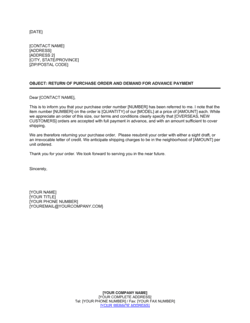
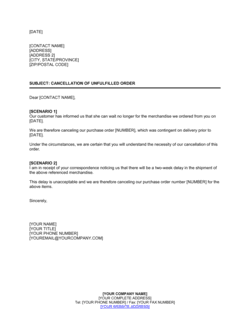
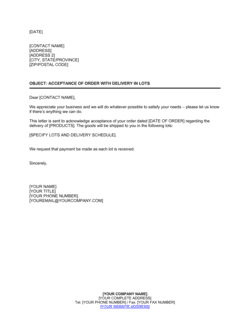
Cancellation of Purchase Order for Late Delivery Template

Free Word download • Edit online • Save & share with Drive • Export to PDF

1 page20–30 min to fillDifficulty: StandardSignature requiredLegal review recommended
Learn more ↓
FreeCancellation of Purchase Order for Late Delivery Template

At a glance

What it is
A Cancellation of Purchase Order for Late Delivery is a formal written notice a buyer sends to a supplier to terminate a purchase order because the supplier failed to deliver goods by the agreed deadline. This free Word download gives you a professionally structured letter you can edit online and export as PDF — establishing a clear paper trail that protects your legal and financial position.
When you need it
Use it when a supplier has missed a confirmed delivery date and you need to formally terminate the order, stop payment obligations, and begin sourcing from an alternative vendor. It is especially critical when time-is-of-the-essence terms were included in the original purchase order.
What's inside
Buyer and supplier identification, original purchase order reference, the agreed delivery date and the date of breach, formal notice of cancellation, demand for refund of any pre-payments, instructions for returning or disposing of goods, reservation of rights to claim damages, and a signature block for authorized execution.

What is a Cancellation of Purchase Order for Late Delivery?

A Cancellation of Purchase Order for Late Delivery is a formal written notice a buyer issues to a supplier to terminate a purchase order because the supplier failed to deliver goods by the contractually agreed deadline. It formally records the breach, ends the buyer's obligation to accept the goods or make further payment, demands the return of any deposits or advance payments, and preserves the buyer's right to seek additional damages — including the cost of sourcing replacement goods from an alternative vendor. Unlike an informal email, a properly drafted cancellation notice creates an unambiguous legal record with a documented effective date, which is essential if the dispute escalates to collections, arbitration, or litigation.

Why You Need This Document

Failing to issue a formal written cancellation when a supplier misses a delivery date exposes you to serious financial and operational risk. Without a documented notice, the supplier can argue the order remains open, continue manufacturing, and ship goods you no longer want — along with an invoice you are legally obligated to pay. If you have made a pre-payment or deposit, an informal cancellation by phone or email creates no enforceable demand for its return. Courts and arbitrators consistently require a clear paper trail establishing when the buyer elected to cancel, what was demanded, and how the notice was delivered. This template gives you that paper trail in 15 minutes, at no cost, with the legal language needed to protect your right to recover pre-payments and pursue cover damages from a non-performing supplier.

Which variant fits your situation?

If your situation is…Use this template
Supplier missed delivery date and you want to cancel and claim damagesCancellation of Purchase Order for Late Delivery
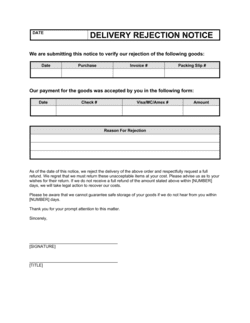
Supplier delivered defective or non-conforming goodsRejection of Goods Letter
Cancelling an order due to a change in business needs, not supplier faultPurchase Order Cancellation Letter
Notifying a vendor of a delivery deadline before cancellation is triggeredNotice to Supplier of Late Delivery
Disputing an invoice after a partial or late shipmentInvoice Dispute Letter
Terminating an ongoing supply agreement due to repeated non-performanceVendor Contract Termination Letter
Requesting a refund after cancellation is confirmedDemand for Refund Letter

Common mistakes to avoid

❌ Using tentative or conditional cancellation language

Why it matters: Phrases like 'we may cancel' or 'we intend to terminate' do not constitute a legally effective cancellation. The supplier can continue shipping and claim the order remains open.

Fix: Use a clear, unconditional present-tense statement — 'Buyer hereby cancels Purchase Order No. [X] in its entirety, effective [DATE]' — with no qualifying conditions attached.

❌ Failing to demand return of pre-payments with a specific deadline

Why it matters: An open-ended refund demand gives the supplier no obligation to act by a particular date, making follow-up collection action harder to initiate promptly.

Fix: Specify both the exact dollar amount owed and a repayment deadline of 5–10 business days, and include your bank or payment details so the supplier has no procedural excuse to delay.

❌ Omitting a reservation of rights clause

Why it matters: Without explicit language preserving your right to further damages, the supplier may argue that the cancellation constituted a settlement of all claims arising from the late delivery.

Fix: Include a standard 'without prejudice to all rights and remedies' clause to preserve your right to pursue cover costs, lost profits, and consequential damages separately.

❌ Ignoring goods already manufactured or in transit

Why it matters: If goods arrive after the cancellation date and you accept them — even by omission — you may waive the cancellation and restore the original payment obligation.

Fix: Include explicit disposition instructions telling the supplier to halt shipment, return goods at their expense, or contact you within a stated timeframe for further direction.

❌ Sending the notice to the wrong contact or by an untracked method

Why it matters: A cancellation notice only creates legal effect when it is received by the supplier. Sending it to a sales rep by informal text with no delivery record leaves your effective cancellation date in dispute.

Fix: Send to the supplier's legal or registered address by email with read receipt and simultaneously by certified mail or courier. Keep all delivery confirmations.

❌ Signing the notice at a level below the required authority

Why it matters: If the cancellation is signed by someone who lacked authority to bind the company — such as a junior buyer — the supplier can argue the cancellation was unauthorized and treat the order as still active.

Fix: Ensure the notice is signed by the same title or a higher title than signed the original purchase order, or by an officer explicitly authorized in the company's procurement policy.

The 9 key clauses, explained

Parties and Purchase Order Reference

In plain language: Identifies the buyer and supplier by full legal name and address, and cites the specific purchase order number, date, and subject matter being cancelled.

Sample language
This notice is issued by [BUYER LEGAL NAME] ('Buyer') to [SUPPLIER LEGAL NAME] ('Supplier') with respect to Purchase Order No. [PO NUMBER] dated [PO DATE] for the supply of [DESCRIPTION OF GOODS] ('Order').

Common mistake: Referencing only an informal PO email or an order number without the original date. Without an unambiguous PO reference, the supplier can dispute which order the cancellation applies to.

Statement of Agreed Delivery Date

In plain language: Restates the delivery deadline expressly agreed in the original purchase order, including any time-is-of-the-essence language.

Sample language
The Order required delivery of [GOODS] to [DELIVERY ADDRESS] on or before [AGREED DELIVERY DATE]. The parties agreed that time is of the essence with respect to this delivery obligation.

Common mistake: Omitting the time-is-of-the-essence statement when it appeared in the original PO. Without it, a supplier may argue that a short delay is not a material breach warranting cancellation.

Notice of Non-Performance

In plain language: Documents that the supplier failed to deliver by the agreed date and states the actual date on which the cancellation notice is being issued.

Sample language
As of [CANCELLATION DATE], Supplier has failed to deliver the Goods by the agreed delivery date of [AGREED DELIVERY DATE]. Supplier has not provided a written explanation or revised delivery commitment acceptable to Buyer.

Common mistake: Cancelling without first documenting that no conforming delivery or acceptable explanation was received. Skipping this step weakens your position if the supplier challenges the cancellation in court.

Formal Notice of Cancellation

In plain language: The operative clause that formally terminates the purchase order, effective on the date of the notice.

Sample language
Buyer hereby cancels Purchase Order No. [PO NUMBER] in its entirety, effective as of [DATE]. Buyer's obligation to accept delivery or make any further payment under the Order is hereby terminated.

Common mistake: Using tentative language such as 'we intend to cancel' or 'we may need to cancel.' A legally effective cancellation requires a clear, unconditional statement of termination.

Demand for Refund of Pre-Payments

In plain language: Demands the return of any deposits, advance payments, or partial payments made by the buyer, with a specific repayment deadline.

Sample language
Buyer demands immediate return of all pre-payments made under the Order, totalling [CURRENCY][AMOUNT], within [NUMBER] business days of this notice. Payment shall be made by [PAYMENT METHOD] to [BANK / ACCOUNT DETAILS].

Common mistake: Not specifying a repayment deadline or amount. An open-ended demand gives the supplier room to delay, complicating any subsequent collection action.

Instructions for Goods in Transit or Production

In plain language: Tells the supplier what to do with goods already manufactured, partially shipped, or in transit — whether to halt shipment, return items, or hold for further instruction.

Sample language
Supplier shall immediately cease production or shipment of any Goods associated with the Order. Any Goods already in transit shall be returned to [ADDRESS] at Supplier's expense, or Supplier shall contact Buyer within [NUMBER] business days for disposition instructions.

Common mistake: Ignoring goods already in transit. If you cancel without addressing in-transit shipments, you may inadvertently accept and pay for goods that arrive after the cancellation date.

Reservation of Rights to Claim Damages

In plain language: Preserves the buyer's right to seek additional compensation — including cover costs, lost profits, and consequential damages — beyond the return of pre-payments.

Sample language
This cancellation is without prejudice to any and all rights and remedies available to Buyer under the Order, at law, or in equity, including but not limited to the right to recover cover damages, consequential losses, and all costs incurred as a result of Supplier's non-performance.

Common mistake: Failing to include a reservation of rights clause. Without it, the supplier may argue that accepting cancellation settled all claims, leaving the buyer unable to pursue cover costs.

Governing Law and Dispute Resolution

In plain language: States which jurisdiction's law governs the cancellation and how disputes arising from the cancellation will be resolved.

Sample language
This notice and any disputes arising from it shall be governed by the laws of [STATE / PROVINCE / COUNTRY]. Any unresolved dispute shall be submitted to [arbitration / mediation / the courts of [JURISDICTION]].

Common mistake: Omitting governing law when the buyer and supplier are in different jurisdictions. A missing clause means courts must determine which law applies — adding cost and uncertainty to any dispute.

Authorized Signature Block

In plain language: Provides a signature line for the buyer's authorized representative, confirming the notice was issued with proper authority and on a specific date.

Sample language
Issued by: [AUTHORIZED REPRESENTATIVE NAME], [TITLE], [BUYER LEGAL NAME]. Signature: ___________________ Date: [DATE]. Delivered by: [EMAIL / COURIER / CERTIFIED MAIL].

Common mistake: Having the notice signed by someone without authority to bind the company — such as a purchasing coordinator instead of a manager or officer. An unauthorized signatory can make the cancellation contestable.

How to fill it out

  1. 1

    Gather the original purchase order and all related correspondence

    Retrieve the signed PO, any order acknowledgments, email confirmations of the delivery date, and any prior late-delivery notices you have sent. These documents form the evidentiary foundation of the cancellation.

    💡 If the original PO contained a time-is-of-the-essence clause, highlight it — it is the single most important phrase supporting your right to cancel.

  2. 2

    Confirm the supplier's breach and document the missed date

    Verify that the agreed delivery date has passed with no conforming delivery. Check whether you sent any prior notice to the supplier warning of the impending cancellation — courts in some jurisdictions require a reasonable cure period before cancellation is permitted.

    💡 If you have not already sent a notice warning of late delivery, consider sending one first (see Notice to Supplier of Late Delivery). For time-critical orders with time-is-of-the-essence terms, a prior notice is not legally required in most jurisdictions, but it strengthens your position.

  3. 3

    Enter the parties' details and PO reference

    Fill in both parties' full legal names, addresses, and the exact purchase order number and date. Confirm the description of the goods matches the original PO exactly.

    💡 Use the supplier's registered legal name, not a trading name, to ensure the notice is addressed to the correct legal entity.

  4. 4

    State the agreed delivery date and the breach

    Enter the original delivery deadline from the PO. Then state today's date and confirm that no conforming delivery has been received and no acceptable revised commitment has been provided.

    💡 If the supplier provided a revised delivery estimate that you rejected, document that rejection in this section to preempt a defense that you accepted a delay.

  5. 5

    Insert the cancellation language and effective date

    Complete the operative cancellation clause with the PO number and the effective date — typically today's date. Confirm the language is unconditional and covers the entire order, unless you are cancelling only specific line items.

    💡 If you are cancelling only part of the order, list the specific line items or SKUs being cancelled to avoid ambiguity about what remains in force.

  6. 6

    Calculate and demand return of pre-payments

    Enter the total amount of any deposits or advance payments made, specify the repayment deadline (typically 5–10 business days), and provide your payment details. Cross-reference invoices or payment records to confirm the exact amount.

    💡 State the currency explicitly, particularly for cross-border orders, to avoid disputes about the applicable exchange rate.

  7. 7

    Address goods in transit and sign the notice

    Decide whether in-transit goods should be returned, destroyed, or held, and fill in the relevant instruction. Then have the notice signed by an authorized officer or manager and send it by a method that creates a delivery record — email with read receipt, certified mail, or courier.

    💡 Keep a copy of the sent notice, the delivery confirmation, and the supplier's response (or lack of response) in a single file — you will need all three if the dispute escalates.

Frequently asked questions

Can I cancel a purchase order if the supplier delivers late?

Yes, in most cases. If the original purchase order specified a delivery date and included time-is-of-the-essence language, a supplier's failure to deliver by that date is typically a material breach, giving the buyer the right to cancel and seek damages. Even without explicit time-is-of-the-essence language, significant delays that defeat the commercial purpose of the order are generally treated as material breaches in most jurisdictions. A formal written cancellation notice documents the breach and the effective date of termination.

Do I need to give the supplier a chance to cure the late delivery before cancelling?

It depends on the terms of the original purchase order and the applicable jurisdiction. If the PO included time-is-of-the-essence language, no cure period is typically required — the deadline is an absolute term. If no such language was included, some jurisdictions expect the buyer to provide a reasonable notice and cure period before cancelling. Sending a Notice to Supplier of Late Delivery before the cancellation letter strengthens your position in either scenario and is recommended for high-value orders.

What is the difference between a purchase order cancellation and a contract termination?

A purchase order is itself a contract once accepted by the supplier, so cancelling a PO is a form of contract termination. The term "PO cancellation" is typically used for individual transactional orders, while "contract termination" is used for longer-term supply agreements. The legal principles governing both — material breach, notice requirements, and damages — are the same. For ongoing supply agreements with repeated late deliveries, a formal vendor contract termination letter is more appropriate.

Can I recover damages beyond the return of my pre-payment?

Yes, provided your cancellation letter includes a reservation of rights clause. Recoverable damages typically include the cost difference between the original order and the replacement order purchased from an alternative supplier (cover damages), production downtime or lost sales caused by the delay, and any expediting or freight costs to source substitute goods. The specific categories of recoverable loss vary by jurisdiction and the terms of the original PO.

What if the supplier claims force majeure caused the delay?

If the original PO contained a force majeure clause and the supplier can document that the delay was caused by a qualifying unforeseeable event — such as a natural disaster, government action, or pandemic restriction — they may be excused from liability. However, force majeure clauses are narrowly interpreted; supply chain disruptions caused by foreseeable business risks or the supplier's own operational failures typically do not qualify. Review the original PO's force majeure language carefully and consider legal advice before accepting a force majeure defense for a high-value order.

Does the cancellation letter need to be notarized?

Notarization is not required for a purchase order cancellation notice in any standard commercial jurisdiction. The document creates legal effect through delivery to the supplier, not through notarization. What matters is that the notice is signed by an authorized representative and sent by a method that creates a delivery record — email with confirmation, certified mail, or courier — so the effective cancellation date is unambiguous.

What should I do with goods that arrive after I have sent the cancellation?

Do not accept or sign for the goods unless you decide to reverse the cancellation. Accepting delivery after sending a cancellation notice may waive the cancellation and reinstate your payment obligation. Instead, refuse the shipment and notify the supplier in writing that the goods were rejected pursuant to the earlier cancellation notice. Keep a record of the refusal, including the carrier's acknowledgment, as part of your documentation file.

How quickly should I send the cancellation letter after the missed delivery date?

As soon as possible — ideally within one to three business days of the missed delivery date. Delayed action can imply that you accepted the late delivery or waived the deadline, particularly if you continued communicating with the supplier about fulfillment without asserting your cancellation rights. For time-sensitive orders, send the notice on the same day the deadline passes without delivery.

Is this document enforceable if the supplier is in a different country?

Generally yes, provided the original purchase order specified a governing law and the cancellation notice references the same jurisdiction. Cross-border enforcement of the right to cancel and recover damages depends on whether the countries involved have treaty relationships or reciprocal enforcement mechanisms. For high-value international orders, consulting a lawyer familiar with the supplier's jurisdiction is advisable before sending the cancellation and pursuing damages.

How this compares to alternatives

vs Notice to Supplier of Late Delivery

A notice to supplier of late delivery is a warning sent before cancellation — it puts the supplier on formal notice of the breach and may provide a short cure window. A cancellation of purchase order is the next step: the operative termination once the deadline has passed without a conforming delivery. For time-is-of-the-essence orders, the cancellation can be sent without a prior notice; for other orders, sending the warning first strengthens the legal position.

vs Vendor Contract Termination Letter

A vendor contract termination letter ends an ongoing, multi-order supply agreement — typically due to repeated performance failures, insolvency, or a fundamental breach. A PO cancellation targets a single discrete order and its specific delivery obligation. Use the termination letter when the relationship itself needs to end; use the PO cancellation when only one order is affected.

vs Rejection of Goods Letter

A rejection of goods letter is used when goods arrive but are non-conforming — wrong specifications, damaged, or defective. A cancellation of purchase order for late delivery is used when nothing arrives at all by the agreed date. The legal basis is different: rejection addresses accepted but non-conforming delivery; cancellation addresses non-delivery.

vs Invoice Dispute Letter

An invoice dispute letter challenges a specific invoice — typically after partial or defective delivery generates a billing disagreement. A PO cancellation letter terminates the order before payment is due and demands return of any pre-payment already made. If the supplier invoices after receiving a cancellation notice, an invoice dispute letter may be needed as a follow-up document.

Industry-specific considerations

Retail and E-commerce

Seasonal inventory orders with hard ship-by dates tied to holiday or promotional windows, where a missed delivery directly translates to lost sales.

Construction and Real Estate

Material supply orders tied to project milestone schedules, where late delivery triggers subcontractor delays, penalty clauses, and liquidated damages downstream.

Manufacturing

Component and raw material orders feeding production lines, where a single late delivery can halt the entire line and trigger cascading delivery failures to the manufacturer's own customers.

Healthcare and Medical Devices

Supply orders for medical consumables or equipment where delivery deadlines are tied to patient care schedules, regulatory compliance windows, or clinical trial timelines.

Food and Beverage

Perishable ingredient orders with strict delivery windows where a late shipment renders the goods commercially useless, requiring immediate cancellation and alternative sourcing.

Professional Services and Government Contracting

Government and institutional procurement contracts with statutory delivery requirements, where late delivery by a vendor exposes the buyer to its own performance penalties under the prime contract.

Jurisdictional notes

United States

Under UCC Article 2, a buyer may cancel a sales contract when the seller fails to make delivery on time, and time-is-of-the-essence terms are generally enforced as written. Cover damages — the difference between the original contract price and the cost to procure substitute goods — are expressly recoverable under UCC §2-712. Some states require the buyer to act in good faith and mitigate losses promptly; unreasonable delay in cancelling after a missed date can reduce the recoverable damages.

Canada

Canadian provinces follow sale-of-goods legislation modelled on the UK Sale of Goods Act, giving buyers the right to treat late delivery as a repudiation if time was a condition of the contract. Ontario, British Columbia, and Alberta all recognize time-is-of-the-essence clauses as enforceable. Quebec civil law applies different principles under the Civil Code, requiring the buyer to put the seller in default (mise en demeure) before cancelling — making a formal written notice even more critical for Quebec-based transactions.

United Kingdom

Under the UK Sale of Goods Act 1979 and the Supply of Goods and Services Act 1982, delivery on time is an implied term where time is expressly made of the essence. A buyer may reject goods and treat the contract as repudiated if the seller fails to deliver by the agreed date. Post-Brexit, UK commercial law diverges from EU rules — particularly on cross-border e-commerce — but the core common-law principles for B2B PO cancellation remain unchanged. The Limitation Act 1980 gives six years to bring a breach of contract claim.

European Union

EU member states apply the UN Convention on Contracts for the International Sale of Goods (CISG) to many cross-border B2B transactions, which allows a buyer to avoid a contract for late delivery if the delay constitutes a 'fundamental breach' — generally requiring that the delivery date was essential to the commercial purpose of the contract. Under the CISG, the buyer may also fix an additional delivery period (Nachfrist) and cancel if the seller fails to deliver within it. Germany and France have domestic commercial codes that supplement CISG where it does not apply.

Template vs lawyer — what fits your deal?

PathBest forCostTime
Use the templateStandard domestic PO cancellations for low-to-mid value orders with a clear missed delivery date and time-is-of-the-essence termsFree15–30 minutes
Template + legal reviewOrders over $25,000, cross-border suppliers, or situations where the supplier disputes the breach or claims force majeure$200–$500 for a one-hour commercial lawyer review1–2 days
Custom draftedHigh-value or complex supply contracts, regulated industries, government procurement, or cancellations where significant consequential damage claims will follow$800–$3,000+3–7 days

Glossary

Purchase Order (PO)
A buyer-issued document that authorizes a supplier to deliver specific goods at an agreed price, quantity, and delivery date — forming a binding contract when accepted.
Time Is of the Essence
A contractual clause specifying that delivery deadlines are strict material terms, meaning any delay constitutes a breach giving the buyer the right to cancel.
Breach of Contract
The failure of one party to fulfill a material obligation under a contract — here, the supplier's failure to deliver by the agreed date.
Notice of Cancellation
A formal written communication from the buyer to the supplier terminating the purchase order and ending the buyer's payment obligation.
Reservation of Rights
A clause stating that the buyer's act of cancellation does not waive any legal claims for damages, costs, or losses caused by the supplier's non-performance.
Pre-payment / Deposit
Any funds paid by the buyer to the supplier before delivery; a cancellation letter should formally demand return of these funds when delivery has not occurred.
Cover Damages
The additional cost a buyer incurs to source equivalent goods from an alternative supplier after the original order is cancelled — recoverable as damages in most jurisdictions.
Force Majeure
A contractual clause that may excuse a supplier's non-performance when delay results from unforeseeable events beyond their control — such as natural disasters or government action.
Consequential Damages
Indirect losses caused by the supplier's breach — such as lost sales or production downtime — that go beyond the direct cost of the undelivered goods.
Mitigation
The buyer's legal obligation to take reasonable steps to limit their losses after a supplier breach — typically by promptly sourcing replacement goods.
Material Breach
A breach significant enough to permit the non-breaching party to treat the contract as terminated and seek damages — late delivery on time-sensitive orders typically qualifies.

Part of your Business Operating System

This document is one of 3,000+ business & legal templates included in Business in a Box.

  • Fill-in-the-blanks — ready in minutes
  • 100% customizable Word document
  • Compatible with all office suites
  • Export to PDF and share electronically

Create your document in 3 simple steps.

From template to signed document — all inside one Business Operating System.
1
Download or open template

Access over 3,000+ business and legal templates for any business task, project or initiative.

2
Edit and fill in the blanks with AI

Customize your ready-made business document template and save it in the cloud.

3
Save, Share, Send, Sign

Share your files and folders with your team. Create a space of seamless collaboration.

Save time, save money, and create top-quality documents.

★★★★★

"Fantastic value! I'm not sure how I'd do without it. It's worth its weight in gold and paid back for itself many times."

Managing Director · Mall Farm
Robert Whalley
Managing Director, Mall Farm Proprietary Limited
★★★★★

"I have been using Business in a Box for years. It has been the most useful source of templates I have encountered. I recommend it to anyone."

Business Owner · 4+ years
Dr Michael John Freestone
Business Owner
★★★★★

"It has been a life saver so many times I have lost count. Business in a Box has saved me so much time and as you know, time is money."

Owner · Upstate Web
David G. Moore Jr.
Owner, Upstate Web

Run your business with a system — not scattered tools

Stop downloading documents. Start operating with clarity. Business in a Box gives you the Business Operating System used by over 250,000 companies worldwide to structure, run, and grow their business.

Start free · No credit card required