- Performance Rating Scale
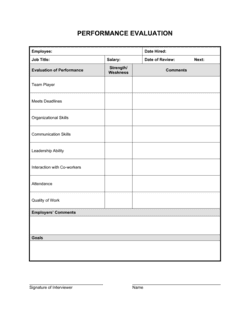
- A defined numeric or descriptive scale — typically 1–5 or 'Exceeds / Meets / Below Expectations' — used to score each competency or goal consistently across reviewers.
- Competency
- A measurable skill, behavior, or attribute — such as communication, problem-solving, or collaboration — against which an employee is evaluated.
- SMART Goals
- Goals that are Specific, Measurable, Achievable, Relevant, and Time-bound, used as the benchmark for assessing whether objectives were met during the review period.
- Self-Assessment
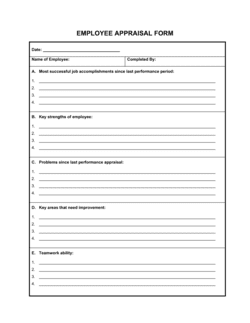
- A section of the review form completed by the employee before the manager meeting, capturing the employee's own view of their achievements and development areas.
- Review Period
- The defined span of time — typically 12 months for annual reviews or 90 days for probationary reviews — covered by the appraisal.
- Development Plan
- A forward-looking section of the review that identifies skills to build, training to complete, and milestones to hit in the next review period.
- Calibration Session
- A meeting where multiple managers compare ratings across their teams to ensure scoring consistency before final reviews are delivered to employees.
- Recency Bias
- The tendency to weight recent events too heavily when rating performance, causing earlier achievements or issues in the review period to be underrepresented.
- Halo Effect
- A cognitive bias where a strong impression in one area — such as communication — causes a reviewer to rate all other areas more favorably than the evidence supports.
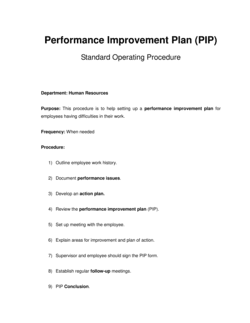
- Performance Improvement Plan (PIP)
- A formal document issued when an overall performance rating falls below the acceptable threshold, setting specific targets and a timeline for remediation.