Understanding Digital Transformation Strategy and How To Execute One

Free Word download β€’ Edit online β€’ Save & share with Drive β€’ Export to PDF

3 pagesβ€’20–25 min to fillβ€’Difficulty: Standard
Learn more ↓
FreeUnderstanding Digital Transformation Strategy and How To Execute One Template

At a glance

What it is
A Digital Transformation Strategy is a structured planning document that defines how an organization will shift its processes, culture, and technology to meet evolving business demands. This free Word download gives you a ready-to-edit framework covering vision, current-state assessment, roadmap, technology stack, change management, and success metrics β€” all in a single document you can export as PDF and share with leadership or stakeholders.
When you need it
Use it when your organization is moving legacy systems to the cloud, automating manual workflows, launching new digital products, or responding to competitive disruption that requires a coordinated, cross-functional technology response.
What's inside
Executive summary and transformation vision, current-state assessment, strategic objectives and success metrics, phased roadmap with milestones, technology stack and vendor selection criteria, change management and training plan, governance model, and financial investment summary.

What is a Digital Transformation Strategy?

A Digital Transformation Strategy is a structured planning document that defines how an organization will integrate technology across its operations, processes, and customer interactions to meet specific business goals. It maps the journey from the current state β€” with its legacy systems, manual workflows, and capability gaps β€” to a defined future state where digital tools enable faster, more scalable, and more data-driven ways of working. Unlike a simple IT upgrade plan, a transformation strategy addresses people, process, and technology together, with measurable objectives, a phased roadmap, and an explicit change management approach built in from the start.

Why You Need This Document

Organizations that attempt digital transformation without a written strategy consistently encounter the same four failures: technology is selected before requirements are defined, change management is treated as a kickoff announcement rather than an ongoing workstream, no one owns the decision rights when scope changes arrive mid-project, and the budget excludes internal labor costs β€” causing actual spend to run 30–50% over the approved figure. The consequences are real: Gartner estimates that through 2025, 75% of digital transformation initiatives fail to meet their objectives. A documented strategy forces the critical decisions β€” sequencing, governance, KPIs, risk ownership β€” to be made on paper before they become expensive problems in production. This template gives you the structure to build a credible, executable transformation strategy in weeks rather than months, whether you are leading a department-level modernization or an enterprise-wide overhaul.

Which variant fits your situation?

If your situation is…Use this template
Organization-wide technology overhaul spanning multiple departmentsDigital Transformation Strategy (Enterprise)
Single department or business unit modernizing its workflowsBusiness Process Improvement Plan
Company migrating on-premise infrastructure to cloud servicesIT Infrastructure Plan
Customer experience overhaul focusing on digital channelsCustomer Experience Strategy
Launching a new digital product or internal platformProduct Launch Plan
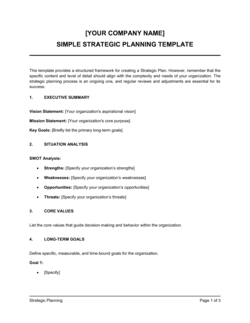
Tracking ongoing transformation progress against KPIsStrategic Planning Template
Communicating transformation priorities to a board or investorsBusiness Plan

Common mistakes to avoid

❌ Starting with technology selection before assessing the current state

Why it matters: Selecting a platform before understanding existing integrations and data architecture consistently results in costly rework, missed requirements, and vendor contracts that must be renegotiated or exited.

Fix: Complete a documented current-state assessment β€” covering systems, processes, and data flows β€” before issuing a single RFP or attending a vendor demo.

❌ Setting transformation objectives without measurable KPIs

Why it matters: Vague goals like 'improve efficiency' give teams no clear target, make progress impossible to report, and allow scope to expand indefinitely without accountability.

Fix: Assign a specific numeric KPI, baseline value, target value, and measurement date to every strategic objective before the roadmap is approved.

❌ Underestimating change management as an afterthought

Why it matters: McKinsey research consistently finds that 70% of transformation failures are caused by people and culture factors β€” not technology. Adoption rates below 50% at 90 days post-go-live are common when change management is treated as a kickoff event rather than an ongoing workstream.

Fix: Budget change management at 15–20% of total transformation spend and treat it as a named workstream with its own lead, milestones, and success metrics from day one.

❌ Running all transformation phases in parallel to compress the timeline

Why it matters: Parallel workstreams with shared infrastructure dependencies create integration conflicts that resolve slowly, overwhelm IT and project teams, and produce a go-live with compounding failures rather than isolated ones.

Fix: Sequence phases so that foundational platforms β€” identity management, data infrastructure, core ERP β€” are live and stable before dependent workstreams begin.

❌ Excluding internal labor costs from the transformation budget

Why it matters: When employee time is not costed, actual transformation spend routinely runs 30–50% over the approved budget, eroding the projected ROI and triggering mid-project funding disputes with leadership.

Fix: Estimate hours per role per phase, multiply by fully-loaded cost rates, and include the total as a line item in the financial summary alongside license and implementation fees.

❌ No defined escalation path for scope changes

Why it matters: When mid-transformation technology requests arrive with no clear decision owner, approvals stall for 4–8 weeks while business units and IT debate responsibility, delaying dependent phases.

Fix: Document decision rights by dollar threshold and scope category in the governance section, distribute to all workstream leads at kickoff, and enforce the process from day one.

The 9 key sections, explained

Executive Summary and Transformation Vision

Current-State Assessment

Strategic Objectives and Success Metrics

Phased Transformation Roadmap

Technology Stack and Vendor Selection

Change Management and Training Plan

Governance and Decision-Making Framework

Risk Assessment and Mitigation Plan

Financial Investment Summary

How to fill it out

  1. 1

    Complete the current-state assessment first

    Audit existing systems, processes, and data infrastructure before writing any other section. Survey department heads, review system logs, and document pain points and inefficiencies with specific metrics where possible.

    πŸ’‘ Use a digital maturity framework (e.g., Gartner's or Deloitte's) to score your starting point β€” it gives leadership a defensible baseline and makes progress measurable.

  2. 2

    Define strategic objectives tied to business outcomes

    Work with business unit leaders to translate operational pain points into 3–6 specific, measurable objectives. Each objective needs a KPI, a baseline value, a target value, and a measurement date.

    πŸ’‘ Limit objectives to six or fewer. Organizations that pursue more than six simultaneously typically achieve fewer than three.

  3. 3

    Build the phased roadmap with sequenced dependencies

    List all planned initiatives, identify dependencies between them, and sequence phases so that foundational systems (data infrastructure, identity management) are in place before dependent workstreams begin.

    πŸ’‘ A dependency map drawn before the roadmap is finalized typically reveals 2–4 sequencing conflicts that would otherwise surface as expensive mid-project blockers.

  4. 4

    Evaluate and select technology platforms

    For each platform category, define selection criteria based on integration requirements, total cost of ownership, vendor support, and security certifications before issuing RFPs or scheduling demos.

    πŸ’‘ Weight integration capability at least 40% of your vendor scoring matrix β€” a best-in-class platform that cannot connect to your data warehouse creates more problems than it solves.

  5. 5

    Build the change management and training plan

    Identify the roles most affected by each initiative, map the behavior changes required, and schedule training at least 3–4 weeks before go-live. Assign departmental change champions to sustain adoption post-launch.

    πŸ’‘ Run a pilot with a small, willing team before full rollout β€” issues discovered in a 10-person pilot cost a fraction of what they cost at full scale.

  6. 6

    Define the governance structure and decision rights

    Name the steering committee members, document their decision authority by dollar threshold and scope, and schedule standing meeting cadences before the first phase begins.

    πŸ’‘ Put the escalation path in writing and distribute it to all workstream leads at kickoff β€” ambiguity about who can approve scope changes is the single most common cause of transformation delays.

  7. 7

    Populate the risk register with named owners

    Identify the top risks per phase, rate each by likelihood and impact, write a specific mitigation action, and assign a named owner with an accountability date.

    πŸ’‘ Review the risk register at every steering committee meeting, not just at phase transitions β€” risks evolve as work progresses.

  8. 8

    Finalize the financial summary and present to leadership

    Aggregate costs by phase and category, add a 10–15% contingency, and calculate projected ROI using conservative assumptions. Present the completed strategy to the steering committee for formal sign-off before work begins.

    πŸ’‘ Show leadership both the expected-case and downside-case ROI β€” decision-makers who only see the optimistic scenario are harder to keep aligned when the plan encounters its first obstacle.

Frequently asked questions

What is a digital transformation strategy?

A digital transformation strategy is a structured document that defines how an organization will use technology to change its operations, processes, and customer interactions in order to meet specific business objectives. It covers the current state, target state, roadmap, technology decisions, change management approach, governance model, and financial plan in a single coordinated framework. It is not an IT project plan β€” it is a business strategy that happens to be executed through technology.

What sections should a digital transformation strategy include?

A complete strategy covers eight core areas: an executive summary with transformation vision, a current-state assessment, strategic objectives with measurable KPIs, a phased roadmap, technology stack and vendor selection criteria, a change management and training plan, a governance and decision-making framework, a risk register with mitigation owners, and a financial investment summary with projected ROI.

How long does a digital transformation take?

Most mid-market digital transformations run 18–36 months for the full initiative, broken into 3–6 month phases. Small businesses modernizing a single department can complete a focused transformation in 3–9 months. Enterprise-wide transformations at large organizations can run 3–5 years. Phasing the work and defining clear exit criteria for each phase makes the timeline manageable and reduces the risk of scope creep.

What is the difference between a digital transformation strategy and an IT strategy?

An IT strategy focuses on technology infrastructure β€” systems, security, networks, and support β€” within the existing operating model. A digital transformation strategy redefines the operating model itself using technology as the enabler. Digital transformation involves business process redesign, cultural change, and new customer-facing capabilities, not just infrastructure upgrades. The two documents are complementary but address fundamentally different questions.

What are the most common reasons digital transformations fail?

The three most cited causes are: poor change management leading to low user adoption, unclear ownership and governance causing decision-making paralysis, and technology selection that happens before requirements are properly defined. Secondary causes include underestimating internal labor costs, running too many workstreams in parallel, and setting objectives that cannot be measured. Addressing all three in the strategy document before work begins reduces failure risk substantially.

How do you measure the success of a digital transformation?

Success is measured against the specific KPIs defined in the strategic objectives section β€” for example, reduction in order processing time, increase in self-service resolution rate, decrease in IT support tickets, or improvement in customer NPS score. Financial metrics like ROI and cost-per-transaction should be tracked quarterly against the baseline values documented before the transformation began.

Do I need a consultant to create a digital transformation strategy?

For small to mid-market businesses, a structured template combined with internal workshops across department heads is typically sufficient to produce a credible strategy. Engage a consultant when the transformation spans multiple legal entities or geographies, involves highly regulated data (HIPAA, PCI-DSS), requires custom systems integration, or when internal teams lack the bandwidth or experience to lead an independent current-state assessment.

What is digital maturity and why does it matter for transformation planning?

Digital maturity is a measure of how effectively an organization currently uses technology across its processes, culture, and customer interactions β€” typically scored on a scale of 1 to 5 using a published framework. It matters because organizations at maturity level 1 or 2 need foundational infrastructure work before advanced automation or analytics initiatives will deliver value. Skipping the maturity assessment leads to roadmaps that assume capabilities the organization does not yet have.

How this compares to alternatives

vs Strategic Planning Template

A strategic plan sets broad organizational goals, priorities, and resource allocations across all functions. A digital transformation strategy is a subset of that β€” focused specifically on how technology will change the operating model to achieve those goals. Organizations typically need both: the strategic plan as the parent document and the transformation strategy as the execution vehicle for its technology-related objectives.

vs IT Infrastructure Plan

An IT infrastructure plan addresses hardware, networks, security, and system availability within the current operating model. A digital transformation strategy redefines the operating model itself. Infrastructure planning is a workstream within the transformation, not a substitute for it β€” a company can have a fully modernized network and still operate manual, paper-based processes.

vs Business Process Improvement Plan

A business process improvement plan targets a specific workflow β€” a purchase order cycle or a customer intake process β€” with incremental efficiency gains. A digital transformation strategy is organization-wide and involves cultural change, new technology platforms, and redefined business models. Process improvement is often a Phase 1 deliverable within a larger transformation strategy.

vs Product Launch Plan

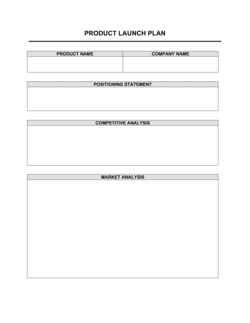
A product launch plan governs the go-to-market execution of a single product or feature β€” positioning, pricing, channels, and launch milestones. A digital transformation strategy governs how the entire organization changes to build, deliver, and support digital products and services. The two documents operate at different scopes and timelines; a product launch may be one output of a successful transformation.

Industry-specific considerations

Financial Services

Core banking modernization, open banking API integration, regulatory compliance automation, and digital-first customer onboarding requiring strict data governance from day one.

Healthcare

EHR system migrations, telehealth platform rollouts, and interoperability requirements under FHIR standards demand transformation roadmaps that sequence regulatory compliance work before patient-facing feature launches.

Retail / E-commerce

Omnichannel inventory unification, headless commerce migration, and real-time personalization engines require transformation strategies that connect POS, ERP, and CRM data under a unified customer data platform.

Manufacturing

IoT-enabled predictive maintenance, MES-to-ERP integration, and shop floor digitization require phased roadmaps that account for OT/IT network separation and legacy PLC compatibility.

Professional Services

Knowledge management system consolidation, AI-assisted document review, and client portal rollouts are common transformation priorities where change management for billable professionals is the primary adoption challenge.

Public Sector and Education

Citizen or student-facing service digitization, legacy mainframe retirement, and accessibility compliance (WCAG 2.1) require longer change management timelines and stakeholder approval processes than private-sector equivalents.

Template vs pro β€” what fits your needs?

PathBest forCostTime
Use the templateSmall and mid-market businesses planning department-level or organization-wide digitization without enterprise complexityFree2–4 weeks (30–60 hours of internal workshops and drafting)
Template + professional reviewMid-market businesses with multi-system integration requirements or regulated data environments$2,000–$8,000 for a digital strategy consultant review and financial model validation4–6 weeks
Custom draftedEnterprise organizations with cross-border operations, legacy mainframe environments, or M&A-driven transformation requirements$15,000–$100,000+ for a full transformation strategy engagement with a management or technology consulting firm8–16 weeks

Glossary

Digital Transformation
The process of integrating digital technology into all areas of a business, fundamentally changing how it operates and delivers value to customers.
Current-State Assessment
A structured review of existing processes, systems, and capabilities that identifies gaps between where the organization is today and where it needs to be.
Technology Roadmap
A phased timeline showing which systems, tools, or platforms will be adopted, retired, or upgraded and in what sequence.
Change Management
The structured approach to transitioning individuals, teams, and organizations from a current state to a desired future state, minimizing resistance and disruption.
KPI (Key Performance Indicator)
A measurable value that shows how effectively an organization is achieving a specific objective β€” used in transformation plans to track progress against defined targets.
Legacy System
An outdated technology platform or application still in use because of its critical role in operations, even though it is difficult to integrate with modern systems.
Agile Methodology
An iterative project management approach that breaks work into short cycles (sprints), enabling teams to adapt quickly to changes during a transformation.
Digital Maturity
A measure of how effectively an organization uses digital technology in its processes, culture, and customer interactions β€” typically assessed on a defined scale.
Governance Model
The framework of roles, responsibilities, decision rights, and escalation paths that controls how a transformation initiative is managed and held accountable.
ROI (Return on Investment)
The financial return from a transformation initiative expressed as a percentage of the total cost β€” used to justify technology spending to senior leadership.

Part of your Business Operating System

This document is one of 3,000+ business & legal templates included in Business in a Box.

  • Fill-in-the-blanks β€” ready in minutes
  • 100% customizable Word document
  • Compatible with all office suites
  • Export to PDF and share electronically

Create your document in 3 simple steps.

From template to signed document β€” all inside one Business Operating System.
1
Download or open template

Access over 3,000+ business and legal templates for any business task, project or initiative.

2
Edit and fill in the blanks with AI

Customize your ready-made business document template and save it in the cloud.

3
Save, Share, Send, Sign

Share your files and folders with your team. Create a space of seamless collaboration.

Save time, save money, and create top-quality documents.

β˜…β˜…β˜…β˜…β˜…

"Fantastic value! I'm not sure how I'd do without it. It's worth its weight in gold and paid back for itself many times."

Managing Director Β· Mall Farm
Robert Whalley
Managing Director, Mall Farm Proprietary Limited
β˜…β˜…β˜…β˜…β˜…

"I have been using Business in a Box for years. It has been the most useful source of templates I have encountered. I recommend it to anyone."

Business Owner Β· 4+ years
Dr Michael John Freestone
Business Owner
β˜…β˜…β˜…β˜…β˜…

"It has been a life saver so many times I have lost count. Business in a Box has saved me so much time and as you know, time is money."

Owner Β· Upstate Web
David G. Moore Jr.
Owner, Upstate Web

Run your business with a system β€” not scattered tools

Stop downloading documents. Start operating with clarity. Business in a Box gives you the Business Operating System used by over 250,000 companies worldwide to structure, run, and grow their business.

Start freeΒ Β·Β No credit card required