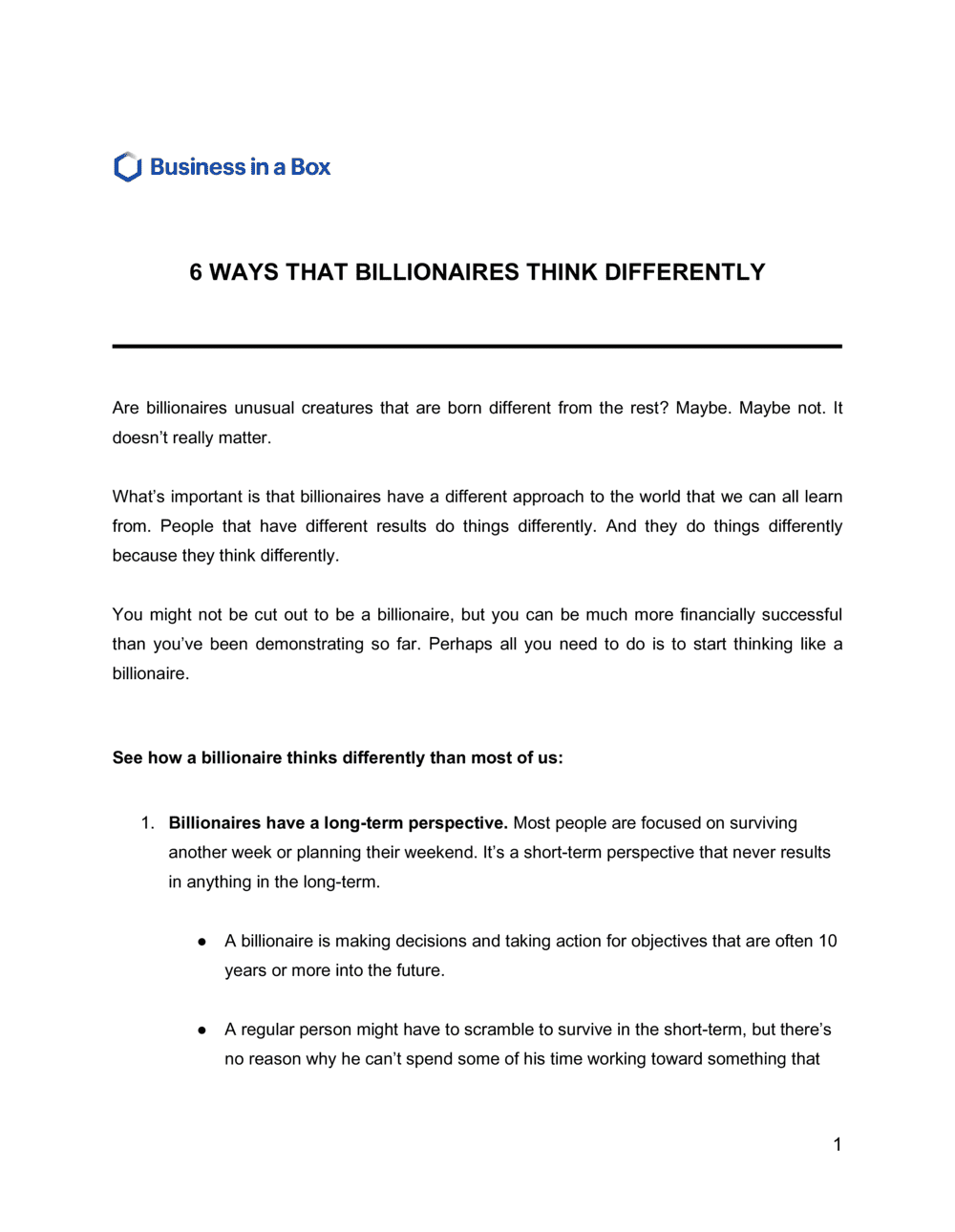
6 Ways That Billionaires Think Differently Template

Free to read β€’ Save or share with one click

Free6 Ways That Billionaires Think Differently Template

At a glance

What it is
"6 Ways That Billionaires Think Differently" is a structured guide that distills six evidence-backed cognitive and strategic frameworks used by the world's most successful wealth creators. Available as a free Word download, it gives entrepreneurs, executives, and coaches a ready-to-use reference they can edit, present, or incorporate into leadership training and personal development programs.
When you need it
Use it when building a leadership development curriculum, preparing a keynote or workshop on entrepreneurial mindset, or conducting a personal audit of the mental models holding your growth back. It is equally useful for individual founders looking to reframe how they approach risk, capital, and opportunity.
What's inside
Six clearly defined thinking frameworks β€” covering long-horizon planning, asymmetric risk, abundance mindset, systems over goals, contrarian opportunity, and ownership mentality β€” each supported by a plain-English explanation, real-world context, and actionable reflection questions.

What is "6 Ways That Billionaires Think Differently"?

"6 Ways That Billionaires Think Differently" is a structured guide that breaks down six cognitive and strategic frameworks β€” long-horizon planning, asymmetric risk, abundance mindset, systems thinking, contrarian opportunity, and ownership mentality β€” into an actionable format designed for entrepreneurs, executives, and coaches. Unlike motivational content that describes what billionaires have achieved, this guide focuses on how they frame decisions, evaluate risk, and design their daily operating patterns. Each framework includes a plain-English explanation, a diagnostic for identifying your current default behavior, and reflection questions grounded in real business scenarios. The free Word download means you can edit, brand, and adapt the content for individual use, team workshops, or coaching programs without starting from scratch.

Why You Need This Document

The gap between a business that stalls at $2M in annual revenue and one that scales past $20M is rarely a product problem or a market problem β€” it is almost always a thinking problem. Without a structured framework for auditing your own mental models, it is easy to keep making the same category of decision β€” underpricing, avoiding asymmetric bets, optimizing for quarterly visibility instead of long-term compounding β€” while expecting different results. This guide gives founders, executives, and coaches a concrete diagnostic tool to identify which of the six frameworks is the binding constraint on their current growth, and a 30-60-90 day action structure to begin changing it. The cost of skipping this kind of mindset audit is not theoretical: it shows up as a revenue ceiling that persists across strategy pivots, market expansions, and new hires. This template gives you the framework to locate and address it directly.

Which variant fits your situation?

If your situation is…Use this template
Delivering a 60-minute leadership workshop on entrepreneurial thinkingLeadership Development Plan
Conducting a one-on-one executive coaching session on growth mindsetCoaching Plan Template
Building a full personal development curriculum for employeesEmployee Development Plan
Creating a strategic vision document grounded in long-horizon thinkingStrategic Planning Template
Running a team offsite focused on innovation and contrarian thinkingBusiness Plan Canvas (One-Page)
Applying billionaire thinking frameworks to a new venture opportunityBusiness Plan Template
Presenting mindset principles as part of a keynote or pitchElevator Pitch Template

Common mistakes to avoid

❌ Using celebrity anecdotes as the primary evidence base

Why it matters: Survivorship bias means the habits of famous billionaires are not necessarily causal β€” many people with identical habits never reached that outcome. Readers spot this quickly and discount the content.

Fix: Anchor each framework in a behavioral or cognitive pattern documented across multiple high-performers, and acknowledge that application requires adapting the principle to the reader's specific context.

❌ Treating all six frameworks as equally urgent

Why it matters: Presenting six equally weighted priorities produces no change β€” readers leave the document without knowing where to start, so they start nowhere.

Fix: Include the self-assessment section and coach readers to identify one framework with the highest gap relative to their current business challenge, then sequence the others.

❌ Skipping the reflection questions to save space

Why it matters: Without structured reflection, the guide functions as a reading exercise rather than a development tool β€” engagement is high during reading but retention and behavior change drop sharply within 48 hours.

Fix: Retain at least two concrete, context-specific reflection questions per framework, even in a condensed version of the document.

❌ Leaving all bracket placeholders unfilled before sharing

Why it matters: A document with [REVENUE CEILING], [SCENARIO], and [DATE] placeholders intact looks unfinished and undermines the credibility of the content, regardless of how strong the frameworks are.

Fix: Do a final find-and-replace pass before exporting β€” search for '[' and resolve every instance before the document leaves your hands.

❌ Framing the guide as prescriptive rather than diagnostic

Why it matters: Telling readers they must adopt all six frameworks creates resistance β€” especially in experienced executives who already have strong mental models. The tone determines whether the guide is used or shelved.

Fix: Frame each framework as a lens to apply in specific situations rather than a replacement for the reader's existing decision-making approach.

❌ Omitting the 30-60-90 action plan entirely

Why it matters: Without a concrete behavior-change structure, the document ends on inspiration β€” which decays within days. No action plan means no measurable outcome from the investment in reading it.

Fix: Even a minimal action plan β€” one behavior change per month with a specific trigger β€” dramatically increases the probability that readers apply at least one framework within the first 30 days.

The 9 key sections, explained

Introduction: Why mindset determines wealth ceiling

Framework 1 β€” Think in decades, not quarters

Framework 2 β€” Seek asymmetric risk, not no risk

Framework 3 β€” Operate from abundance, not scarcity

Framework 4 β€” Build systems, not just goals

Framework 5 β€” Find opportunity in what others dismiss

Framework 6 β€” Own outcomes, not just tasks

Reflection and self-assessment

Action plan and next steps

How to fill it out

  1. 1

    Establish your context and audience

    Before editing, clarify who will read or receive this document β€” individual executive, leadership team, coaching client, or workshop group. This determines how to adjust the tone and depth of each framework section.

    πŸ’‘ If using for a group workshop, add a 'facilitator notes' column to each framework section so co-presenters know where to pause for discussion.

  2. 2

    Customize the introduction with a specific premise

    Replace the generic opening with a revenue ceiling or growth plateau that is specific to your audience β€” $1M to $10M is different from $10M to $100M. The more specific the context, the more the frameworks land.

    πŸ’‘ Lead with a data point or decision scenario your audience has personally faced β€” it creates immediate recognition and engagement.

  3. 3

    Populate each framework with context-specific examples

    Each of the six framework sections contains placeholder scenarios in brackets. Replace them with real examples from your industry, your company's history, or your coaching client's situation.

    πŸ’‘ Use one example from a well-known company and one from the reader's own industry per framework β€” familiarity drives retention.

  4. 4

    Adapt the behavioral diagnostics in the abundance and ownership sections

    Frameworks 3 and 6 include behavior checklists. Edit these to reflect behaviors actually observable in your organization or client base β€” generic lists produce less honest self-assessment.

    πŸ’‘ Ask three people who know your target audience well to review the behavior list and flag anything that doesn't ring true.

  5. 5

    Complete the reflection and self-assessment section

    If using this guide for a workshop, build the self-assessment ratings into a shared scoring tool β€” Google Form, Notion template, or printed worksheet β€” so participants can see group patterns.

    πŸ’‘ Aggregate scores across a leadership team to identify which framework is the weakest collective habit β€” that is usually the highest-leverage place to start.

  6. 6

    Build out the 30-60-90 action plan for each reader's context

    The final section works best when each action is tied to a real decision the reader is currently facing β€” not a hypothetical. Replace all placeholder scenarios with live decisions or challenges.

    πŸ’‘ Set a calendar reminder to revisit the 30-day action at exactly 30 days. Documents without a follow-up trigger almost never produce behavior change.

  7. 7

    Export and distribute in the appropriate format

    For individual use, export as PDF. For workshops, keep the Word file editable so facilitators can annotate in real time. For coaching clients, share as a living document with comment access.

    πŸ’‘ Add your organization's logo and a version date before distributing β€” it signals that the content is current and professionally curated.

Frequently asked questions

What is the '6 Ways That Billionaires Think Differently' guide?

It is a structured document that distills six cognitive and strategic frameworks β€” including long-horizon planning, asymmetric risk, abundance mindset, systems thinking, contrarian opportunity, and ownership mentality β€” into an actionable guide for entrepreneurs and leaders. It is designed to serve as a workshop resource, coaching tool, or personal development reference rather than a purely motivational read.

Who is this guide designed for?

It is most useful for startup founders, growth-stage executives, executive coaches, and corporate trainers who want a structured framework for discussing and developing high-performance thinking patterns. It works equally well as a self-directed personal development tool for individual entrepreneurs who want to audit and upgrade their default mental models.

How is this different from a motivational book summary?

Unlike a book summary, this guide is structured as a working document with behavioral diagnostics, reflection questions, and a 30-60-90 day action plan. Each framework is designed to produce a specific, observable behavior change β€” not just intellectual awareness. The goal is behavior shift, not inspiration.

Can I use this guide in a workshop or training session?

Yes. The Word format is designed to be edited and branded for workshop delivery. You can add facilitator notes, discussion prompts, and group exercises to each framework section. For group use, the self-assessment section works well as a scored worksheet that surfaces collective team patterns and generates discussion.

How long does it take to work through the guide?

Reading the full guide takes approximately 20–30 minutes. Working through the reflection questions and self-assessment for all six frameworks takes 45–60 minutes. Completing a personalized 30-60-90 action plan based on the guide typically requires an additional 30 minutes of focused thinking about current business challenges.

What is the difference between systems thinking and goal-setting in this context?

Goals define the desired outcome; systems define the daily or weekly process that makes that outcome the natural byproduct of consistent execution. The guide does not argue against goal-setting β€” it argues that billionaire-level performers invest more energy designing the system than fixating on the scoreboard, because a well-designed system continues producing results even when motivation fluctuates.

Is contrarian thinking the same as being a contrarian for its own sake?

No. The guide is explicit that genuine contrarian thinking requires a specific thesis about why the consensus view is wrong β€” not simply doing the opposite of what others do. Reflexive differentiation produces bad decisions as often as it produces good ones. The framework asks: what specific assumption underlying the consensus view do you disagree with, and why?

How do I measure whether these frameworks are producing results?

The guide's action-plan section recommends identifying one live decision in your business where each framework would change your approach, then documenting the outcome at 30, 60, and 90 days. The self-assessment scoring tool can also be completed a second time at 90 days to measure shifts in default thinking patterns across each framework.

Can this guide be adapted for industry-specific audiences?

Yes. The most impactful customization is replacing the placeholder scenarios in each framework section with examples specific to your industry β€” SaaS metrics for a tech audience, margin and inventory examples for retail, regulatory timing for healthcare. The frameworks themselves are industry-agnostic; the examples are where context makes the content stick.

How this compares to alternatives

vs Strategic Planning Template

A strategic planning template produces a formal operational roadmap with KPIs, initiatives, and resource allocation for an existing business. This guide addresses the cognitive frameworks that determine how good the inputs to that plan will be. Use this guide first to audit thinking patterns, then apply the strategic planning template to translate those insights into an actionable roadmap.

vs Leadership Development Plan

A leadership development plan documents a structured program for building specific competencies in an individual or team over time β€” covering skills, milestones, feedback loops, and resources. This guide is a focused content module on mindset rather than a full development program. It works best as an input to a leadership development plan rather than a replacement for one.

vs Employee Development Plan

An employee development plan covers a broad range of professional growth objectives β€” technical skills, behavioral competencies, career milestones, and manager feedback. This guide is narrowly focused on six cognitive frameworks relevant to entrepreneurial and executive-level thinking. Use the employee development plan for structured career growth and this guide for mindset-specific sessions within that broader program.

vs Business Plan Template

A business plan is an external-facing operational and financial document designed for investors, lenders, and leadership teams. This guide is an internal thinking tool that shapes how a founder approaches the assumptions and strategy embedded in a business plan. Working through this guide before writing a business plan typically improves the quality of market analysis, risk framing, and competitive positioning.

Industry-specific considerations

SaaS / Technology

Long-horizon and systems thinking frameworks apply directly to product roadmap decisions, where optimizing for quarterly metrics often conflicts with building compounding platform value.

Professional Services

Ownership mentality and abundance frameworks address the common pattern of firms undercharging and avoiding partnerships out of client-poaching fear, both of which cap revenue per partner.

Retail / E-commerce

Asymmetric risk and contrarian thinking frameworks are highly applicable to inventory bets, new category expansion, and channel diversification decisions where consensus behavior tends to cluster.

Financial Services

Asymmetric risk and long-horizon thinking align directly with investment philosophy discussions, making this guide useful for advisor training and client onboarding content.

Template vs pro β€” what fits your needs?

PathBest forCostTime
Use the templateIndividual founders, coaches, and trainers delivering mindset content to small groups or one-on-one clientsFree1–2 hours to customize and prepare
Template + professional reviewCorporate training programs or leadership retreats where the content will be delivered to 20 or more participants$500–$2,000 for a facilitator or instructional design review1–2 days
Custom draftedExecutive coaching firms or L&D departments building a proprietary mindset curriculum for ongoing delivery$3,000–$8,000 for a bespoke content development engagement3–6 weeks

Glossary

Long-horizon thinking
Planning and decision-making oriented toward outcomes 10 or more years in the future, accepting short-term friction in exchange for compounding gains.
Asymmetric risk
A risk-reward profile where the potential upside significantly outweighs the possible downside β€” the core logic behind high-conviction bets made by many ultra-successful investors.
Abundance mindset
The belief that opportunity, capital, and success are not zero-sum β€” that growing the pie is more productive than competing for a fixed share of it.
Systems thinking
Focusing on the design of repeatable processes and structures rather than chasing individual goals, so that results become a byproduct of the system.
Contrarian thinking
Deliberately seeking opportunities in spaces others have dismissed or overlooked, based on the insight that consensus views are already priced into the market.
Ownership mentality
Operating with full accountability for outcomes β€” financial, operational, and relational β€” regardless of formal title or equity stake.
First-principles reasoning
Breaking a problem down to its foundational truths and rebuilding a solution from scratch, rather than reasoning by analogy from existing solutions.
Compounding
The process by which reinvested returns β€” on capital, knowledge, relationships, or reputation β€” generate exponentially larger returns over time.
Scarcity mindset
The cognitive pattern of perceiving resources, opportunity, and success as inherently limited, which drives defensive rather than expansive decision-making.
High-conviction bet
A significant allocation of time, capital, or attention to a single opportunity based on deep independent analysis rather than social proof or consensus.

Part of your Business Operating System

This document is one of 3,000+ business & legal templates included in Business in a Box.

  • Fill-in-the-blanks β€” ready in minutes
  • Compatible with all office suites
  • Export to PDF and share electronically

Create your document in 3 simple steps.

From template to signed document β€” all inside one Business Operating System.
1
Download or open template

Access over 3,000+ business and legal templates for any business task, project or initiative.

2
Edit and fill in the blanks with AI

Customize your ready-made business document template and save it in the cloud.

3
Save, Share, Send, Sign

Share your files and folders with your team. Create a space of seamless collaboration.

Save time, save money, and create top-quality documents.

β˜…β˜…β˜…β˜…β˜…

"Fantastic value! I'm not sure how I'd do without it. It's worth its weight in gold and paid back for itself many times."

Managing Director Β· Mall Farm
Robert Whalley
Managing Director, Mall Farm Proprietary Limited
β˜…β˜…β˜…β˜…β˜…

"I have been using Business in a Box for years. It has been the most useful source of templates I have encountered. I recommend it to anyone."

Business Owner Β· 4+ years
Dr Michael John Freestone
Business Owner
β˜…β˜…β˜…β˜…β˜…

"It has been a life saver so many times I have lost count. Business in a Box has saved me so much time and as you know, time is money."

Owner Β· Upstate Web
David G. Moore Jr.
Owner, Upstate Web

Run your business with a system β€” not scattered tools

Stop downloading documents. Start operating with clarity. Business in a Box gives you the Business Operating System used by over 250,000 companies worldwide to structure, run, and grow their business.

Start freeΒ Β·Β No credit card required