Final Notice Before Legal Action Template

Free Word download β€’ Edit online β€’ Save & share with Drive β€’ Export to PDF

1 pageβ€’15–25 min to fillβ€’Difficulty: Standard
Learn more ↓
FreeFinal Notice Before Legal Action Template

At a glance

What it is
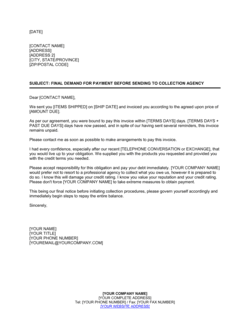
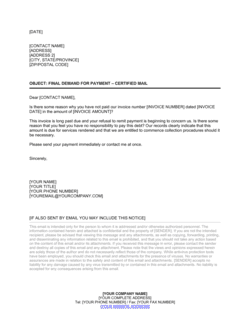
A Final Notice Before Legal Action is a formal written letter sent to a debtor, client, or counterparty to demand payment of an overdue balance or compliance with a contractual obligation before the sender escalates to a court claim, collections agency, or other legal remedy. This free Word download gives you a ready-to-edit template you can complete in minutes and export as PDF for delivery by email, certified mail, or courier.
When you need it
Use it after prior invoices, reminders, and informal payment requests have gone unanswered. It is the last formal step before filing a small claims action, engaging a collections attorney, or reporting the debt to a credit bureau.
What's inside
Sender and recipient identification, a summary of the outstanding obligation, a reference to prior collection attempts, a firm payment or compliance deadline, a clear statement of the legal consequences of non-response, and contact details for resolving the matter without litigation.

What is a Final Notice Before Legal Action?

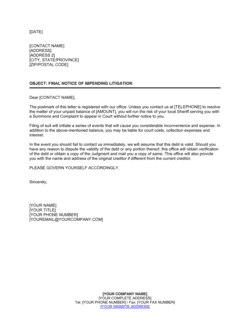
A Final Notice Before Legal Action is a formal written letter sent to a debtor or non-compliant party to demand payment of an overdue balance β€” or fulfillment of a contractual obligation β€” as the last step before the sender escalates to a court filing, collections agency, or other legal remedy. It documents that prior invoices and reminders were sent and ignored, states the exact amount owed, sets a firm response deadline, and names the specific legal consequences of non-compliance. Unlike a routine payment reminder, this letter signals that the sender has exhausted informal options and is prepared to act.

Why You Need This Document

Businesses that skip the final notice and jump directly to court or collections agencies are regularly penalized for failing to demonstrate good-faith collection efforts β€” some small claims courts will not accept a filing without evidence of prior written demand. Beyond procedural requirements, a clearly worded final notice resolves a significant percentage of overdue accounts without litigation: recipients who have ignored earlier reminders often take action when confronted with a specific deadline and a named legal consequence. For the sender, the letter also creates a documented paper trail β€” delivery confirmation, stated amounts, and a record of the escalation sequence β€” that becomes critical evidence if the matter does proceed to judgment. This template gives you a complete, professional final notice you can complete in under 20 minutes and send the same day.

Which variant fits your situation?

If your situation is…Use this template
Recovering an overdue invoice from a business clientFinal Notice Before Legal Action
Demanding payment after a bounced or returned checkReturned Check Demand Letter
Notifying a tenant of unpaid rent before evictionPay or Quit Notice
Demanding a contractor remedy defective work before a claimNotice to Cure Default
First formal reminder before the final notice stagePast Due Payment Reminder Letter
Claiming a debt through the courts without an attorneySmall Claims Court Demand Letter
Requesting contract compliance rather than a monetary paymentNotice of Default and Demand for Cure

Common mistakes to avoid

❌ Using vague deadlines

Why it matters: Phrases like 'respond promptly' give the recipient no clear obligation and undermine your case if you later claim they ignored the notice.

Fix: Always specify a calendar date β€” e.g., 'by June 15, 2026' β€” and confirm that date is achievable given your delivery method.

❌ Threatening legal action you will not take

Why it matters: Repeated final notices with no follow-through train the recipient to ignore them and may expose you to claims of harassment or bad faith in some jurisdictions.

Fix: Only name remedies you are prepared to use and follow through within the stated timeframe if no payment is received.

❌ Sending the letter to the wrong party

Why it matters: A demand letter addressed to an individual who is not the legal obligor β€” or to the wrong company entity β€” has no legal effect against the party actually liable.

Fix: Verify the contracting entity name on the original invoice or agreement and address the letter to that exact legal name.

❌ Omitting prior collection history

Why it matters: Without a documented escalation sequence, the recipient can credibly claim the first letter they received was the final notice, making your position appear unreasonable to a judge or mediator.

Fix: List all prior reminders with specific dates and include copies of at least two prior communications as attachments.

The 9 key clauses, explained

Sender and recipient identification

In plain language: Names, addresses, and contact details for both the sending party and the recipient, along with the date the letter is issued.

Sample language
[YOUR FULL NAME / COMPANY NAME] | [ADDRESS] | [CITY, STATE, ZIP] | [DATE] | To: [RECIPIENT FULL NAME / COMPANY NAME] | [RECIPIENT ADDRESS]

Common mistake: Addressing the letter to an individual contact instead of the legal entity β€” if you sue, the judgment must name the correct legal person or company.

Subject line and reference

In plain language: A brief header identifying the purpose of the letter and referencing the specific invoice number, contract, or account at issue.

Sample language
RE: Final Notice Before Legal Action β€” Invoice #[INVOICE NUMBER] β€” Amount Due: $[AMOUNT]

Common mistake: Omitting invoice or contract reference numbers, making the letter vague and giving the recipient an easy basis to claim confusion about which debt is owed.

Statement of the outstanding obligation

In plain language: A clear, factual statement of what is owed, when it was due, and the original basis for the debt β€” the contract, invoice, or agreement.

Sample language
As of [DATE], you have an outstanding balance of $[AMOUNT] owed to [COMPANY NAME] under Invoice #[NUMBER] dated [INVOICE DATE], with payment originally due on [DUE DATE].

Common mistake: Inflating the claimed amount beyond what the contract or invoice supports β€” any overstatement weakens the letter's credibility and can be used against you in court.

Summary of prior collection attempts

In plain language: A brief chronological record of previous invoices, reminders, and communications sent, establishing that the recipient had ample opportunity to pay.

Sample language
We sent payment reminders on [DATE 1], [DATE 2], and [DATE 3], and made a verbal request on [DATE]. To date, no payment has been received and no satisfactory explanation has been provided.

Common mistake: Skipping this section entirely β€” courts and mediators look favorably on creditors who document a reasonable escalation sequence before resorting to legal action.

Firm payment or compliance deadline

In plain language: A specific calendar date β€” typically 7 to 14 days from the letter date β€” by which the recipient must pay or comply to avoid legal action.

Sample language
You are required to remit payment in full of $[AMOUNT] no later than [DEADLINE DATE], which is [X] days from the date of this letter.

Common mistake: Using vague deadlines like 'immediately' or 'as soon as possible' β€” a specific date creates a clear trigger for follow-through and is required by some small claims courts as evidence of notice.

Statement of intended legal consequences

In plain language: A direct, factual description of the specific legal steps the sender will take if the deadline is missed β€” small claims filing, collections referral, or attorney engagement.

Sample language
If full payment is not received by [DEADLINE DATE], we will have no alternative but to pursue all available legal remedies, including filing a claim in [COURT NAME], engaging a collections agency, and reporting the outstanding balance to applicable credit bureaus.

Common mistake: Threatening legal actions you are not actually prepared to take β€” empty threats reduce your credibility and may expose you to liability in some jurisdictions.

Accruing interest and costs notice

In plain language: Informs the recipient that interest, late fees, or legal costs are accruing on the unpaid balance, referencing the original agreement that authorizes them.

Sample language
Pursuant to our agreement dated [CONTRACT DATE], interest continues to accrue on the outstanding balance at the rate of [X]% per month. Court filing fees and any reasonable legal costs incurred in collecting this debt may also be claimed.

Common mistake: Citing an interest rate not stated in the original contract β€” only contractually agreed or statutorily permitted interest rates are collectable.

Invitation to resolve without litigation

In plain language: A brief, professional offer to resolve the matter by contacting the sender directly, preserving the option of a payment plan or negotiated settlement.

Sample language
We remain open to resolving this matter without legal proceedings. Please contact [NAME] at [PHONE / EMAIL] by [DATE] to discuss payment arrangements.

Common mistake: Omitting this section and making the letter read as an ultimatum with no exit β€” recipients are more likely to respond when a clear, easy path to resolution is offered.

Closing and sender signature block

In plain language: A professional closing, the sender's printed name and title, and their contact information β€” no witness or notarization required.

Sample language
Yours sincerely, [SENDER FULL NAME] | [TITLE] | [COMPANY NAME] | [PHONE] | [EMAIL]

Common mistake: Closing with aggressive or threatening language β€” language such as 'you will regret ignoring this' can constitute harassment and may be used against you in court.

How to fill it out

  1. 1

    Enter sender and recipient legal names

    Use the full registered legal name of your business and the recipient's legal entity name β€” not a trading name or contact person. Include full mailing addresses for both parties.

    πŸ’‘ Look up the recipient's registered entity name in your state's or province's corporate registry to ensure the letter names the correct legal person.

  2. 2

    Add the invoice or contract reference

    Enter the specific invoice number, contract date, and original due date in the subject line and the body of the letter. If multiple invoices are outstanding, list each with its amount.

    πŸ’‘ Attach copies of all referenced invoices or contracts to the letter β€” this prevents the recipient from claiming they never received them.

  3. 3

    State the exact amount owed

    Enter the principal balance due. If your agreement permits interest or late fees, calculate the accrued amount through the letter date and state both figures separately.

    πŸ’‘ Never round up or estimate β€” use the exact figures from your accounting records so the amount is unchallengeable.

  4. 4

    Document prior collection attempts

    List the dates of all prior invoices, reminder emails, phone calls, and any written responses received. Be factual and chronological β€” no editorial commentary.

    πŸ’‘ Pull this information from your email sent folder and call log before completing the letter; accurate dates matter if the matter proceeds to court.

  5. 5

    Set a specific response deadline

    Calculate a deadline 7 to 14 days from the date you will send the letter and enter that calendar date. Confirm the deadline gives enough time for delivery if sending by post.

    πŸ’‘ Add two to three days to the deadline if sending by standard mail to account for transit time.

  6. 6

    State the consequences clearly and accurately

    Choose only the legal remedies you are genuinely prepared to pursue β€” small claims court, collections agency, attorney, or credit bureau reporting β€” and name them specifically.

    πŸ’‘ Filing fees for small claims court are typically $30–$100 and are recoverable if you win; mentioning this signals you are serious.

  7. 7

    Send by certified mail and keep a copy

    Send the final letter by certified mail with return receipt requested and simultaneously by email. Retain the tracking number, delivery confirmation, and a dated copy for your records.

    πŸ’‘ Certified mail delivery confirmation is admissible as evidence that the recipient received the notice β€” it removes 'I never got it' as a defence.

Frequently asked questions

How much time should I give the recipient to respond?

A deadline of 7 to 14 days from the letter date is standard for most payment demands. Some jurisdictions require a minimum notice period β€” 10 days is common for consumer debt notices in the US, and 14 days is typical in the UK before a county court claim. For construction or contract disputes, 30 days is more common. Always check any applicable statutory notice requirements for your specific debt type and location.

What happens if the recipient ignores the final notice?

If the deadline passes without payment or response, you should follow through on the remedies stated in the letter β€” typically filing in small claims court, engaging a collections agency, or instructing an attorney. Sending additional notices after a stated deadline without acting erodes your credibility and signals the recipient can continue ignoring you. Act on your stated timeline.

What is the difference between a final notice and a demand letter?

The terms are often used interchangeably, but a demand letter can be any formal written request for payment or action β€” it may be the first or second contact in a collections sequence. A final notice specifically signals that all prior attempts have failed and legal action is the next step. The final notice carries more urgency and typically references the prior demand letters sent in the sequence.

How this compares to alternatives

vs Payment reminder letter

A payment reminder is an early-stage, relatively informal nudge sent shortly after an invoice becomes overdue β€” its tone is cooperative and it assumes the non-payment may be an oversight. A final notice is the last formal escalation before legal action, documents a pattern of non-payment, and states specific legal consequences. Use the reminder first; send the final notice only after at least one or two reminders have been ignored.

vs Collections referral letter

A collections referral letter notifies the debtor that the account has already been transferred to a third-party collections agency β€” the creditor's involvement is effectively over. A final notice is sent by the creditor directly before that transfer, giving the debtor one last chance to settle directly and avoid the credit-bureau reporting and collections fees that follow agency referral.

vs Letter of demand (legal)

A formal letter of demand is typically drafted or reviewed by an attorney and is used when the anticipated claim is complex, high-value, or likely to proceed to litigation regardless. A final notice before legal action is a self-serve document appropriate for straightforward payment disputes where the facts are clear and the amount is within small claims limits. For claims above $10,000 or involving contract interpretation, a lawyer-drafted demand letter is more appropriate.

vs Notice of default

A notice of default is issued when a party has breached a specific contract term β€” missed a payment under a loan, failed to deliver under a supply agreement, or violated a lease condition β€” and triggers a cure period defined in the contract. A final notice before legal action is broader and is used when no formal cure mechanism exists in the underlying agreement. Use a notice of default when the contract specifies one; use a final notice when it does not.

Industry-specific considerations

Professional Services

Agencies, consultants, and law firms use final notices to recover project fees after milestone non-payment, often referencing retainer agreements and time-tracking records.

Construction and Trades

Contractors combine the final notice with a mechanics lien warning, giving property owners a last opportunity to settle before a lien encumbers the title.

Real Estate and Property Management

Landlords issue final notices for unpaid rent or lease breaches before filing eviction proceedings, with notice periods often governed by state or provincial landlord-tenant law.

Retail and E-commerce

Online sellers use final notices to recover disputed balances, chargebacks, or damaged-goods claims from buyers before escalating to payment-processor dispute resolution or small claims court.

Template vs pro β€” what fits your needs?

PathBest forCostTime
Use the templateBusinesses and individuals recovering straightforward overdue invoices or debts within small claims limitsFree15–20 minutes
Template + professional reviewDisputes involving contract interpretation, multiple parties, or amounts between $5,000 and $25,000$100–$300 for a one-hour attorney review1–2 days
Custom draftedHigh-value claims above $25,000, complex contracts, or situations where litigation is virtually certain$300–$800 for an attorney-drafted demand letter2–5 days

Glossary

Final Notice
The last formal written communication demanding payment or action before the sender pursues legal or collections remedies.
Demand Letter
A letter formally requesting that a party pay money owed or fulfill an obligation, often serving as a prerequisite to filing a court claim.
Pre-litigation Notice
Any formal communication sent to an opposing party before initiating legal proceedings, establishing that the sender made a good-faith attempt to resolve the dispute.
Cure Period
A defined window of time β€” commonly 7 to 30 days β€” given to the recipient to correct a default before consequences take effect.
Certified Mail
A postal service option providing proof that a letter was sent and received, creating a documented delivery record useful in subsequent legal proceedings.
Statute of Limitations
The legally defined time limit within which a creditor or injured party must file a lawsuit β€” missing this window permanently bars the claim.
Judgment
A court's formal ruling that one party owes money or must take specified action, which can be enforced through wage garnishment, bank levies, or property liens.
Collections Agency
A third-party company engaged to recover overdue debts on behalf of a creditor, typically in exchange for a percentage of the amount collected.
Mechanics Lien
A legal claim filed by a contractor or supplier against a property for unpaid work or materials, encumbering the property until the debt is settled.
Accounts Receivable Aging
A report categorizing outstanding invoices by how long they have been unpaid β€” typically 0–30, 31–60, 61–90, and 90+ days β€” used to prioritize collection activity.

Part of your Business Operating System

This document is one of 3,000+ business & legal templates included in Business in a Box.

  • Fill-in-the-blanks β€” ready in minutes
  • 100% customizable Word document
  • Compatible with all office suites
  • Export to PDF and share electronically

Create your document in 3 simple steps.

From template to signed document β€” all inside one Business Operating System.
1
Download or open template

Access over 3,000+ business and legal templates for any business task, project or initiative.

2
Edit and fill in the blanks with AI

Customize your ready-made business document template and save it in the cloud.

3
Save, Share, Send, Sign

Share your files and folders with your team. Create a space of seamless collaboration.

Save time, save money, and create top-quality documents.

β˜…β˜…β˜…β˜…β˜…

"Fantastic value! I'm not sure how I'd do without it. It's worth its weight in gold and paid back for itself many times."

Managing Director Β· Mall Farm
Robert Whalley
Managing Director, Mall Farm Proprietary Limited
β˜…β˜…β˜…β˜…β˜…

"I have been using Business in a Box for years. It has been the most useful source of templates I have encountered. I recommend it to anyone."

Business Owner Β· 4+ years
Dr Michael John Freestone
Business Owner
β˜…β˜…β˜…β˜…β˜…

"It has been a life saver so many times I have lost count. Business in a Box has saved me so much time and as you know, time is money."

Owner Β· Upstate Web
David G. Moore Jr.
Owner, Upstate Web

Run your business with a system β€” not scattered tools

Stop downloading documents. Start operating with clarity. Business in a Box gives you the Business Operating System used by over 250,000 companies worldwide to structure, run, and grow their business.

Free Forever PlanΒ Β·Β No credit card required