Final Warning Before Dismissal Template

Free Word download • Edit online • Save & share with Drive • Export to PDF

1 page20–30 min to fillDifficulty: StandardSignature requiredLegal review recommended
Learn more ↓
FreeFinal Warning Before Dismissal Template

At a glance

What it is
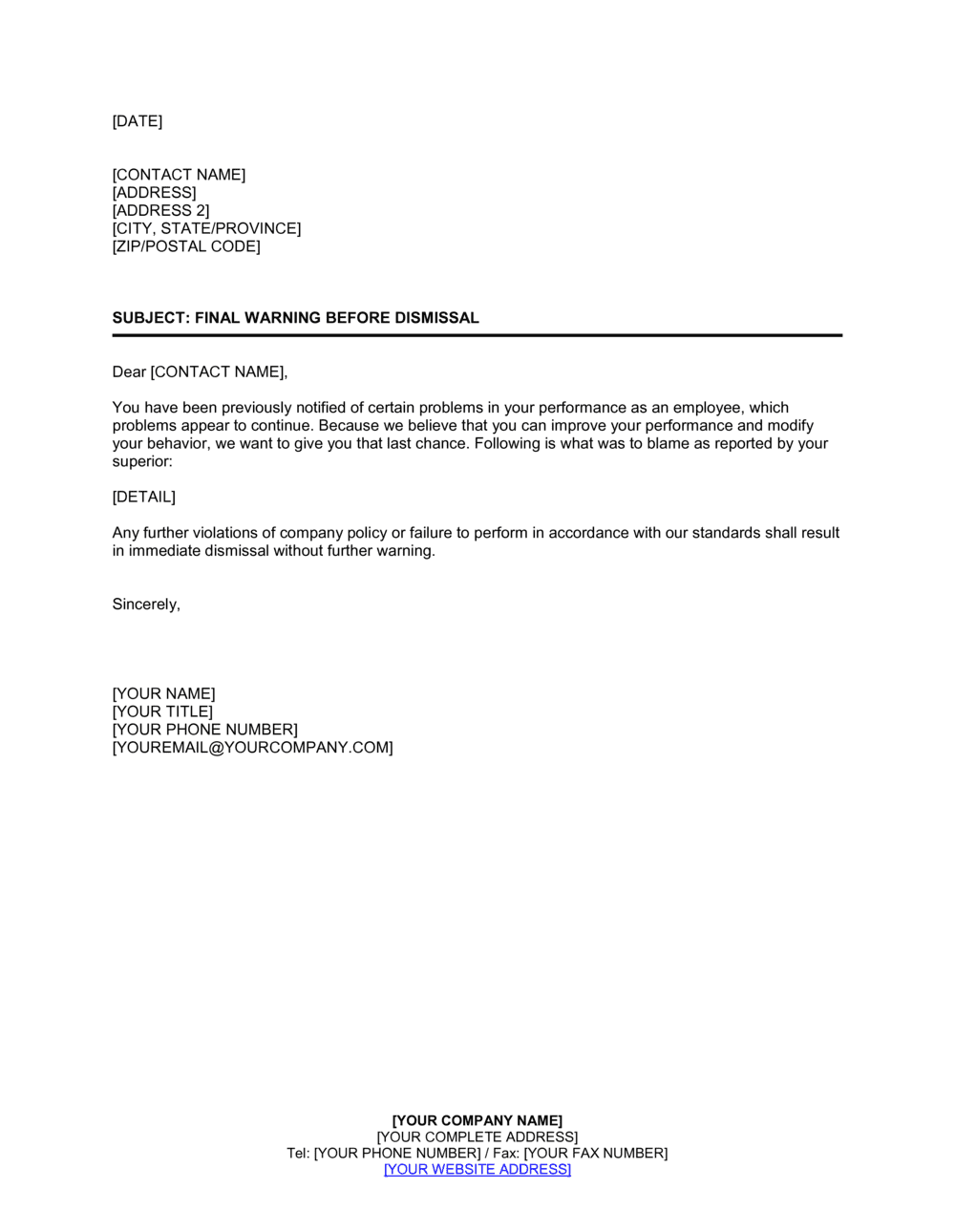
A Final Warning Before Dismissal is a formal written notice issued by an employer to an employee as the last step in a progressive disciplinary process before termination. This free Word download gives you a structured, HR-ready template you can edit online and export as PDF — clearly documenting the infraction, prior warnings, required corrective actions, and the consequences of further non-compliance.
When you need it
Use it when an employee has received prior verbal or written warnings for the same or related misconduct or performance failures and has not made the required improvements. It is also appropriate when a single serious incident — short of gross misconduct — warrants a final warning before any termination decision is made.
What's inside
Employee and employer identification, a precise description of the misconduct or performance failure, a chronology of prior disciplinary actions, specific improvement requirements with measurable targets, a defined review period, a clear statement that dismissal will follow if conditions are not met, and signature blocks for both parties.

What is a Final Warning Before Dismissal?

A Final Warning Before Dismissal is a formal written notice issued by an employer to an employee at the last stage of a progressive disciplinary process — after prior warnings have failed to produce the required improvement. It documents the specific misconduct or performance failure in factual detail, references the full history of prior disciplinary actions, sets measurable improvement targets, defines a structured review period, and states unambiguously that dismissal will follow if the conditions are not met. Unlike earlier warnings, it creates an explicit and legally significant record that the employee was informed of the consequences of continued non-compliance.

Why You Need This Document

Proceeding to dismissal without a documented final warning is the most common procedural error in unfair dismissal claims — and among the most expensive to defend. Employment tribunals and labor boards across every major jurisdiction expect employers to demonstrate that the employee was clearly warned, given a fair opportunity to improve, and informed of the specific consequence of failing to do so. Without this letter, a termination that was substantively justified on the merits can still result in an adverse finding solely on procedural grounds. A properly completed final warning protects the employer by creating a contemporaneous record of the facts, the process followed, and the employee's opportunity to respond — reducing the risk of successful wrongful dismissal claims, costly settlements, and regulatory scrutiny.

Which variant fits your situation?

If your situation is…Use this template
First documented disciplinary action for a performance issueFirst Written Warning Letter
Second written warning following a prior written warningSecond Written Warning Letter
Immediate termination for gross misconduct without prior warningsEmployee Dismissal Letter
Performance improvement plan to accompany the final warningPerformance Improvement Plan (PIP)
Formal termination letter following the final warning periodTermination Letter
Suspension notice pending investigation before a final warning is issuedEmployee Suspension Letter
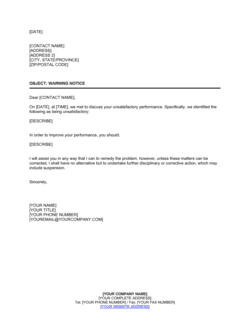
Documenting a verbal counseling session as a precursor to written warningsEmployee Warning Notice

Common mistakes to avoid

❌ Using vague descriptions of the misconduct

Why it matters: Terms like 'poor attitude' or 'unsatisfactory behavior' cannot be evaluated objectively. Employment tribunals routinely dismiss warnings that lack specific dates, incidents, and policy references.

Fix: Replace all adjectives with facts: date, observed behavior, policy section breached, and the impact on the business or colleagues.

❌ Issuing a final warning without documented prior steps

Why it matters: A final warning that appears as a first action undermines the entire progressive discipline defense and can expose the employer to an unfair dismissal claim regardless of the underlying conduct.

Fix: Verify that a prior written warning is on file, dated, and signed. If prior warnings were verbal only, document them retroactively with contemporaneous notes before issuing the final warning.

❌ Setting improvement targets that are not measurable

Why it matters: If the targets cannot be objectively evaluated, any subsequent dismissal based on failure to meet them will be difficult to defend — the employee can argue the standard was subjective and inconsistently applied.

Fix: Attach a performance improvement schedule with numeric targets, due dates, and the data source that will be used to assess them.

❌ Omitting the right-to-appeal clause

Why it matters: In the UK, Canada, and many EU member states, the right to appeal a disciplinary sanction is either a statutory right or a mandatory procedural step. Omitting it can make a subsequent dismissal procedurally unfair regardless of the substantive reason.

Fix: Always include the appeal clause with a named recipient, a written format requirement, and a working-days deadline — typically 5 working days from receipt of the letter.

❌ Sending the letter by email without a delivery confirmation

Why it matters: If the employee denies receiving the final warning, an email-only delivery creates an evidentiary gap. The warning cannot be relied upon in subsequent proceedings without proof of receipt.

Fix: Deliver the letter in person where possible and obtain a signed acknowledgment. Where in-person delivery is not feasible, send by tracked mail and retain the delivery confirmation alongside the email.

❌ Issuing the final warning before the disciplinary meeting has concluded

Why it matters: A letter drafted and signed before the employee has had a genuine opportunity to respond signals a predetermined outcome — this is the defining characteristic of a procedurally unfair dismissal.

Fix: Hold the disciplinary meeting in full, allow the employee to respond and provide mitigation, adjourn to consider the response, then issue the written warning as a separate step.

The 10 key clauses, explained

Parties and employment details

In plain language: Identifies the employer entity and the employee by full legal name, job title, department, and employment start date.

Sample language
This Final Warning is issued by [EMPLOYER LEGAL NAME] ('Company') to [EMPLOYEE FULL NAME] ('Employee'), [JOB TITLE], [DEPARTMENT], employed since [START DATE].

Common mistake: Using a manager's name instead of the registered legal entity as the issuing party — creating ambiguity about who bears any resulting legal liability.

Statement of purpose

In plain language: Declares clearly that this letter constitutes a final written warning and that dismissal will follow if the stated conditions are not met within the review period.

Sample language
This letter constitutes a Final Written Warning under the Company's disciplinary policy. Failure to meet the requirements set out below within [REVIEW PERIOD] will result in the termination of your employment.

Common mistake: Using hedged language like 'may result in termination' instead of 'will result.' Ambiguous consequences weaken the letter's standing if dismissal is later challenged.

Description of misconduct or performance failure

In plain language: Sets out the specific incidents or failures that triggered the final warning — dates, times, locations, and what policy or standard was breached.

Sample language
On [DATE], you [SPECIFIC BEHAVIOR — e.g., failed to meet the monthly sales target of [X] units for the third consecutive month / used inappropriate language toward a colleague in the presence of customers]. This conduct constitutes a breach of [POLICY NAME / SECTION].

Common mistake: Describing the issue in vague terms like 'poor attitude' or 'unsatisfactory performance' without specific dates and measurable facts — vague descriptions are the most common reason final warnings fail to withstand tribunal scrutiny.

Chronology of prior disciplinary actions

In plain language: Lists all prior warnings, counseling sessions, and improvement plans issued to the employee for the same or related issues, with dates and outcomes.

Sample language
You received a Verbal Warning on [DATE] regarding [ISSUE]. A First Written Warning was issued on [DATE] citing [ISSUE]. Despite these interventions, the required improvement has not been sustained.

Common mistake: Omitting dates and document references for prior warnings. Without a documented chronology, the final warning looks like a first action — and an employment tribunal may treat it as one.

Required corrective actions and improvement targets

In plain language: States exactly what the employee must do or stop doing during the review period, expressed in specific, measurable terms.

Sample language
During the review period ending [DATE], you are required to: (a) achieve a minimum of [X METRIC] per [PERIOD]; (b) attend all scheduled shifts without unplanned absence; (c) complete [TRAINING COURSE] by [DATE].

Common mistake: Setting improvement targets that are not measurable — 'improve your attitude' cannot be evaluated objectively, making it impossible to justify a subsequent dismissal on that basis.

Review period and monitoring

In plain language: Defines the start and end dates of the improvement period, how performance will be monitored, and when formal check-in meetings will occur.

Sample language
The review period will run from [START DATE] to [END DATE]. Progress meetings will be held on [DATES]. Your line manager, [NAME], will monitor [SPECIFIC METRICS] and provide written feedback at each meeting.

Common mistake: Setting a review period but scheduling no formal check-ins. Courts and tribunals expect employers to support improvement actively, not simply wait for the deadline and proceed to dismissal.

Consequences of non-compliance

In plain language: States unambiguously that failure to meet the improvement requirements or any further misconduct during the review period will result in dismissal.

Sample language
Should you fail to meet the targets set out above, or should any further breach of Company policy occur during the review period, the Company will proceed to dismiss you. Dismissal may be with or without notice depending on the nature of any further breach.

Common mistake: Listing dismissal as one of several possible outcomes rather than the stated consequence. Leaving room for 'further disciplinary action' after a final warning signals that this is not actually the final step.

Right to appeal

In plain language: Informs the employee of their right to appeal the final warning decision, the timeframe to do so, and to whom the appeal should be addressed.

Sample language
You have the right to appeal this Final Warning within [X] working days of receipt. Appeals must be submitted in writing to [NAME / ROLE] and will be heard by a manager not previously involved in this matter.

Common mistake: Omitting the appeal clause entirely. In the UK and Canada, failure to offer an appeal right can render a subsequent dismissal procedurally unfair regardless of the substantive merits.

Right to be accompanied

In plain language: Confirms that the employee was offered or has the right to bring a companion — a trade union representative or work colleague — to any disciplinary meeting.

Sample language
You were informed of your right to be accompanied by a trade union representative or work colleague at the disciplinary meeting held on [DATE]. [You exercised / You waived] this right.

Common mistake: Skipping this clause for jurisdictions where accompaniment is a statutory right. In the UK, denying accompaniment at a formal disciplinary meeting is itself a statutory breach.

Acknowledgment and signature block

In plain language: Records that the employee has received and read the warning, with signature lines for the employee, the issuing manager, and an HR witness.

Sample language
I, [EMPLOYEE FULL NAME], acknowledge receipt of this Final Warning and confirm that its contents have been explained to me. Signature: _______________ Date: _______________ | Issued by: [MANAGER NAME], [TITLE] | HR Witness: [NAME]

Common mistake: Treating the employee's refusal to sign as a reason not to issue the warning. Document the refusal in writing, have a witness sign, and issue the letter anyway — refusal to sign does not void the warning.

How to fill it out

  1. 1

    Confirm the disciplinary process has been followed

    Before drafting, verify that prior written warnings have been issued for the same or related conduct, that a disciplinary meeting has been held with proper notice, and that the employee was given an opportunity to respond.

    💡 Document every step with dates and file references — a final warning issued without a traceable prior process is the single most common cause of unfair dismissal findings.

  2. 2

    Enter the employer legal entity and employee details

    Use the company's full registered legal name as the issuing party. Enter the employee's full legal name, job title, department, and employment start date.

    💡 Cross-check the employee's name and start date against the signed employment contract — discrepancies create procedural vulnerabilities.

  3. 3

    Describe the misconduct or performance failure with specific facts

    Write out the incident or pattern of failures with exact dates, locations, observed behaviors, and the policy or standard that was breached. Avoid adjectives like 'persistent' or 'unacceptable' without the underlying facts.

    💡 If the issue is performance-based, attach the relevant data — sales figures, attendance records, quality scores — as an exhibit referenced in the letter.

  4. 4

    List the chronology of prior disciplinary actions

    Reference each prior warning by type (verbal, first written), date, and the specific issue it addressed. Confirm whether improvement was achieved and for how long before the current failure.

    💡 Keep copies of all prior warnings in the employee's personnel file and cross-reference their document numbers in this letter.

  5. 5

    Set specific, measurable improvement targets

    Define exactly what acceptable performance or conduct looks like during the review period. Use numbers, deadlines, and observable behaviors — not subjective qualities.

    💡 Frame targets in the positive ('achieve X by Y') rather than the negative ('do not repeat Z') wherever possible — positive targets are easier to evaluate and defend.

  6. 6

    Define the review period and monitoring plan

    Set a start and end date for the review period (typically 30–90 days depending on the issue) and schedule at least two formal check-in meetings with a named manager.

    💡 Shorter review periods (30 days) are appropriate for conduct issues; longer periods (60–90 days) are standard for performance improvement situations.

  7. 7

    State the consequences and right to appeal

    Confirm that dismissal will follow any further breach or failure to meet the stated targets, and state the appeal window (typically 5 working days) and the designated recipient for appeals.

    💡 Use 'will' not 'may' when describing the dismissal consequence — courts read 'may' as a discretionary option, not a clear final warning.

  8. 8

    Obtain signatures before filing

    Have the issuing manager and an HR witness sign the letter. Present it to the employee in person where possible, obtain their signature, and file the original in the personnel file.

    💡 If the employee refuses to sign, note the refusal in writing on the document, have the witness countersign the refusal notation, and retain it — refusal does not invalidate the warning.

Frequently asked questions

What is a final warning before dismissal?

A final warning before dismissal is a formal written notice issued by an employer as the last step in a progressive disciplinary process before terminating an employee's contract. It documents the specific misconduct or performance failure, references prior warnings, sets measurable improvement requirements, defines a review period, and states clearly that dismissal will follow if the conditions are not met. It creates a defensible record that the employee was given a fair opportunity to correct their behavior before termination was pursued.

When should a final warning be issued instead of immediate dismissal?

A final warning is appropriate when the misconduct or performance failure is serious but does not rise to the level of gross misconduct — which justifies immediate summary dismissal. Examples include repeated unauthorized absence, persistent failure to meet agreed performance targets, or a significant but non-criminal policy breach. Gross misconduct such as theft, fraud, or physical violence typically bypasses the progressive discipline process entirely.

Does a final warning have to follow a first written warning?

In most progressive discipline frameworks, yes — a final warning should follow at least one prior written warning for the same or closely related issue. Skipping steps in the disciplinary process is one of the most common procedural defects in unfair dismissal claims. However, a single serious incident may justify moving directly to a final warning in some jurisdictions if the employer's disciplinary policy explicitly provides for this and the employee is informed of the severity at the time.

How long should the review period in a final warning last?

Review periods typically run 30–90 days. A 30-day window is generally appropriate for conduct issues where the required change is behavioral and observable quickly. Performance improvement situations — such as meeting sales targets or reducing error rates — typically warrant 60–90 days to allow a fair assessment. The review period should be long enough for genuine improvement to be demonstrated but not so long that it delays action on a clearly failing situation.

Can an employee refuse to sign a final warning letter?

Yes, and refusal to sign does not invalidate the warning. If an employee refuses to sign, the issuing manager should note the refusal on the document, have an HR witness sign confirming the refusal, and retain the letter in the personnel file. The warning stands regardless of whether the employee signs. Separately, consider whether the refusal itself constitutes a further breach of the disciplinary policy.

Does a final warning expire?

Most disciplinary policies specify that warnings lapse after a defined period — typically 6 to 12 months for a final written warning — provided the employee has met the improvement requirements. After lapsing, the warning generally cannot be relied upon to justify dismissal for a subsequent unrelated incident. However, some policies allow expired warnings to be considered as context when assessing the seriousness of a new matter. Always check your jurisdiction's employment standards and your own written policy.

What is the difference between a final warning and a performance improvement plan?

A final warning is a disciplinary document that formally notifies the employee that dismissal will follow further non-compliance. A performance improvement plan (PIP) is a structured support document that sets specific targets and provides a framework for achieving them. The two are often issued together — the final warning establishes the legal consequence while the PIP provides the operational roadmap for improvement. Issuing a PIP without the formal warning letter can create ambiguity about whether dismissal is genuinely on the table.

Do I need a lawyer to issue a final warning letter?

For straightforward cases following a documented disciplinary process, a high-quality template is generally sufficient. Consider involving an employment lawyer when the employee is likely to bring a claim, when the issue involves protected characteristics such as disability or pregnancy, when the employee is a senior executive with a complex employment contract, or when the employer operates across multiple jurisdictions with different procedural requirements. A 1–2 hour lawyer review typically costs $300–$600 and is worthwhile when termination is the likely next step.

Can a final warning be issued for a single incident?

Yes, in some circumstances. While progressive discipline is the standard framework, many employment policies allow an employer to issue a final warning — rather than a first written warning — for a single serious incident that falls short of gross misconduct. The key is that the employer's written disciplinary policy must support this approach, the employee must be clearly informed that the severity of the incident justifies bypassing earlier steps, and the decision must be consistent with how similar incidents have been handled for other employees.

How this compares to alternatives

vs Employee Dismissal Letter

A dismissal letter formally terminates the employment relationship and is issued after the final warning period has expired without the required improvement, or immediately following gross misconduct. A final warning is the procedural step before dismissal — it is not itself a termination notice. Skipping the final warning and going directly to a dismissal letter without documented prior process significantly increases unfair dismissal exposure.

vs Employee Warning Notice

An employee warning notice is an earlier-stage disciplinary document — typically a first or second written warning — that alerts the employee to unacceptable conduct without threatening immediate dismissal. A final warning is categorically different in that it explicitly states dismissal will follow non-compliance. Using a general warning notice when you intend to proceed to dismissal on the next occurrence leaves the employer without a clear final warning on file.

vs Performance Improvement Plan (PIP)

A performance improvement plan is a support and accountability document that sets measurable targets and a coaching framework. It is not itself a disciplinary notice. A final warning and a PIP are frequently issued together — the warning establishes the legal consequence while the PIP provides the operational structure for improvement. Issuing only a PIP without the formal warning creates ambiguity about whether termination is genuinely imminent.

vs Termination Letter

A termination letter ends the employment contract and specifies the effective date, notice period or payment in lieu, and post-employment obligations. It is issued after the final warning process has concluded without the required improvement. The final warning and the termination letter are sequential documents — together they form a complete, defensible progressive discipline record.

Industry-specific considerations

Retail and hospitality

High employee turnover and customer-facing roles make documented final warnings essential for protecting against unfair dismissal claims arising from conduct such as cash handling errors, attendance failures, or customer complaints.

Healthcare

Patient safety obligations require that performance and conduct failures are formally documented and escalated quickly; final warnings in this sector often trigger parallel regulatory reporting obligations.

Professional services

Client-facing professionals dismissed for performance failures frequently allege constructive dismissal; a robust final warning with measurable targets and a documented review period is the primary employer defense.

Manufacturing

Safety rule violations often move directly to a final warning stage given the potential for serious harm; the letter must reference the specific safety regulation breached and the incident investigation findings.

Technology and SaaS

Remote and distributed workforces require documented digital delivery and acknowledgment of final warnings; policy references should include remote work conduct standards and data security obligations.

Financial services

Regulatory fitness and propriety requirements mean that final warnings for conduct issues may need to be disclosed to the relevant regulator and considered alongside licensing obligations before dismissal proceeds.

Jurisdictional notes

United States

Most US states follow at-will employment, meaning employers can terminate without cause or prior warnings. However, issuing a final warning creates a documented record that can be used to defend against claims of discrimination or retaliation. In states with stronger employee protections — such as California, New York, and Montana — a documented progressive discipline process significantly reduces wrongful termination exposure. Public sector employees and unionized workers typically have contractual or statutory rights to progressive discipline regardless of state law.

Canada

Canada has no at-will employment doctrine. Employers must demonstrate just cause for dismissal without notice, and courts apply a high standard — a documented final warning with a clear review period is central to establishing a just cause defense. Ontario, British Columbia, and Alberta employment standards set statutory minimums for notice and severance that apply regardless of the contract. Quebec employers must comply with the Civil Code of Quebec and the Act Respecting Labour Standards, which impose additional procedural fairness obligations.

United Kingdom

UK employment law requires employers to follow a fair disciplinary procedure before dismissal; the ACAS Code of Practice on Disciplinary and Grievance Procedures sets the statutory benchmark. A final warning must follow a formal disciplinary meeting at which the employee has the statutory right to be accompanied by a trade union representative or work colleague. The right to appeal a final warning is mandatory under the ACAS Code — failure to offer it can increase any tribunal award by up to 25%. Employees with two or more years of continuous service have full unfair dismissal protection.

European Union

EU member states generally provide strong employee protections against dismissal, though procedural requirements vary significantly. France requires a formal convocation letter and meeting before any disciplinary sanction. Germany's works council must be consulted before dismissal in companies with five or more employees. Spain requires written notification and a specific cause. The EU Transparent and Predictable Working Conditions Directive reinforces minimum procedural standards across member states, and national courts routinely scrutinize the adequacy of warnings before upholding a dismissal for cause.

Template vs lawyer — what fits your deal?

PathBest forCostTime
Use the templateHR managers and business owners handling a standard disciplinary case with a documented prior warning historyFree30–60 minutes
Template + legal reviewCases involving a protected characteristic, a senior employee, or a jurisdiction with strict procedural requirements such as the UK or Ontario$300–$6001–3 days
Custom draftedHigh-value executive dismissals, regulated industries with reporting obligations, or multi-jurisdiction employment relationships$1,000–$3,000+3–7 days

Glossary

Progressive Discipline
A structured approach to employee discipline that applies increasingly serious consequences — verbal warning, written warning, final warning, dismissal — before termination.
Final Written Warning
The last formal notice an employer issues before dismissal, explicitly stating that further misconduct or failure to improve will result in termination.
Gross Misconduct
Behavior so serious — fraud, violence, theft, or severe insubordination — that it justifies immediate dismissal without prior warnings or notice.
Performance Improvement Plan (PIP)
A structured document that sets specific, measurable performance targets and a timeline for an employee who is at risk of dismissal for underperformance.
Review Period
The defined window of time — typically 30, 60, or 90 days — during which the employee must demonstrate the required improvement before the warning lapses or dismissal proceeds.
Constructive Dismissal
A situation where an employer's conduct fundamentally breaches the employment contract and effectively forces the employee to resign, which courts treat as a dismissal.
Summary Dismissal
Termination without notice or payment in lieu, reserved for cases of gross misconduct where continuing the employment relationship is untenable.
Without Prejudice
A label on communications indicating that statements made cannot be used as evidence in subsequent legal proceedings — relevant when settlement discussions accompany disciplinary action.
Duty to Accommodate
An employer's legal obligation to make reasonable adjustments for employees with disabilities or protected characteristics before proceeding to dismissal.
Natural Justice
The procedural principle that an employee must be told the case against them and given a fair opportunity to respond before any disciplinary sanction is imposed.
Mitigation
Circumstances or explanations offered by the employee — personal stress, health issues, lack of training — that may reduce the severity of the disciplinary outcome.

Part of your Business Operating System

This document is one of 3,000+ business & legal templates included in Business in a Box.

  • Fill-in-the-blanks — ready in minutes
  • 100% customizable Word document
  • Compatible with all office suites
  • Export to PDF and share electronically

Create your document in 3 simple steps.

From template to signed document — all inside one Business Operating System.
1
Download or open template

Access over 3,000+ business and legal templates for any business task, project or initiative.

2
Edit and fill in the blanks with AI

Customize your ready-made business document template and save it in the cloud.

3
Save, Share, Send, Sign

Share your files and folders with your team. Create a space of seamless collaboration.

Save time, save money, and create top-quality documents.

★★★★★

"Fantastic value! I'm not sure how I'd do without it. It's worth its weight in gold and paid back for itself many times."

Managing Director · Mall Farm
Robert Whalley
Managing Director, Mall Farm Proprietary Limited
★★★★★

"I have been using Business in a Box for years. It has been the most useful source of templates I have encountered. I recommend it to anyone."

Business Owner · 4+ years
Dr Michael John Freestone
Business Owner
★★★★★

"It has been a life saver so many times I have lost count. Business in a Box has saved me so much time and as you know, time is money."

Owner · Upstate Web
David G. Moore Jr.
Owner, Upstate Web

Run your business with a system — not scattered tools

Stop downloading documents. Start operating with clarity. Business in a Box gives you the Business Operating System used by over 250,000 companies worldwide to structure, run, and grow their business.

Free Forever Plan · No credit card required