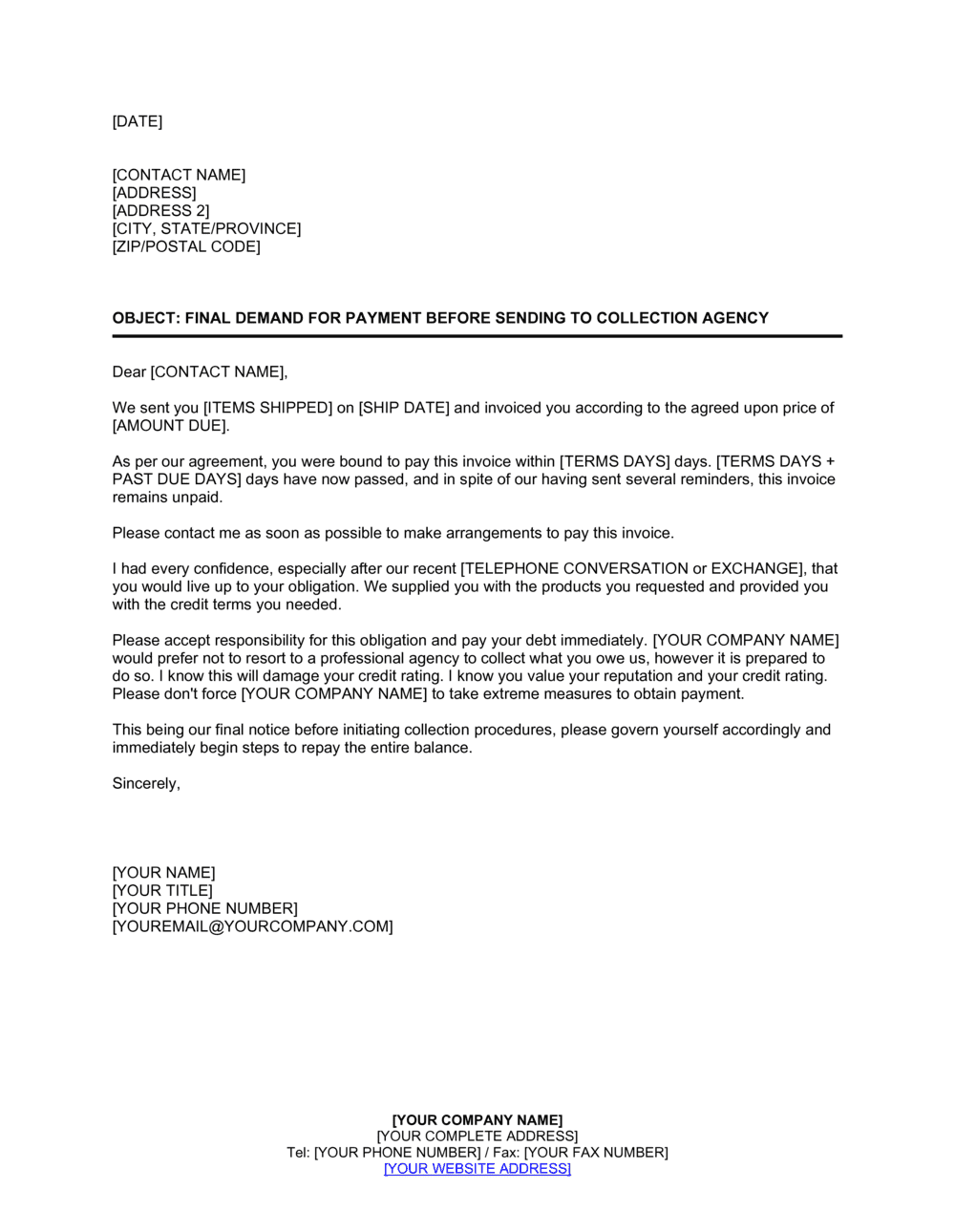
Collection Letter Before Sending to Agency Template

Free Word download β€’ Edit online β€’ Save & share with Drive β€’ Export to PDF

1 pageβ€’15–25 min to fillβ€’Difficulty: Standard
Learn more ↓
FreeCollection Letter Before Sending to Agency Template

At a glance

What it is
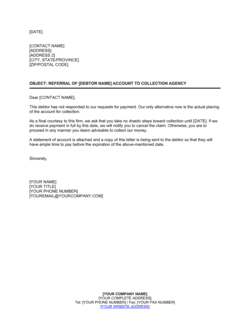
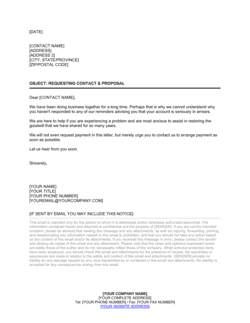
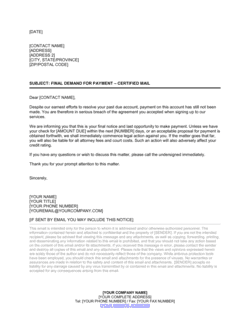
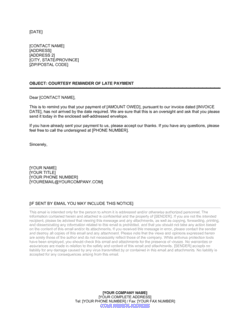
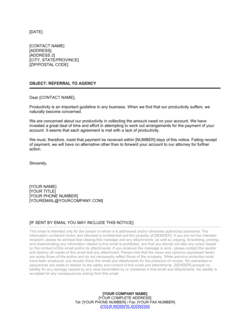
A Collection Letter Before Sending to Agency is a formal written notice sent to a debtor as a final warning that their unpaid account will be referred to a third-party collections agency if payment is not received by a specific deadline. This free Word download gives you a ready-to-use letter you can edit online and send by post or email in minutes.
When you need it
Use it when previous payment reminders and overdue notices have gone unanswered and you are prepared to escalate the account to a collections agency within a defined number of days. It is the last internal step before a third party takes over recovery.
What's inside
Creditor and debtor identification, a clear statement of the outstanding balance and original invoice references, a firm deadline for payment, an explicit warning of agency referral and its consequences, and instructions for how the debtor can resolve the debt immediately.

What is a Collection Letter Before Sending to Agency?

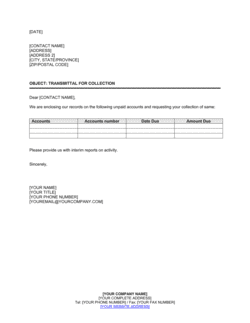
A Collection Letter Before Sending to Agency is a formal final-notice letter that a creditor sends to a debtor after multiple payment reminders have failed to produce payment. It states the total outstanding balance with specific invoice references, summarizes the creditor's prior contact attempts, sets a firm payment deadline β€” typically 7 to 14 days β€” and explicitly warns that failure to pay will result in the account being transferred to a third-party collections agency. It is the last step a business takes internally before handing off the debt to an external recovery service, and it functions both as a genuine escalation notice and as a documented record of the creditor's reasonable efforts to collect.

Why You Need This Document

Sending an undocumented verbal warning or a vague follow-up email before referring a debt to an agency leaves you exposed on two fronts: the debtor can claim they were never given proper notice, and you have no paper trail to show the agency or a court that you acted reasonably. A properly formatted collection letter creates a timestamped record of the outstanding amount, the deadline given, and the consequences warned β€” documentation that strengthens your position in any subsequent dispute, arbitration, or legal proceeding. For many debtors, this letter is also the trigger that finally produces payment: the specific deadline and the explicit mention of agency referral and credit reporting make the consequences of inaction concrete in a way that earlier reminders do not. This template gives you a professional, firm, and legally sensible letter you can send in minutes β€” without paying for an attorney to draft a standard notice from scratch.

Which variant fits your situation?

If your situation is…Use this template
First reminder for a slightly overdue invoicePast Due Invoice Notice
Second reminder after no response to the firstSecond Collection Letter
Final internal notice before escalating to an agencyCollection Letter Before Sending to Agency
Settling a disputed or partially paid debt by agreementDebt Settlement Agreement
Arranging a structured repayment plan with the debtorPayment Plan Agreement
Demand letter from a business with potential legal actionDemand Letter for Payment
Writing off a bad debt after collections efforts have failedBad Debt Write-Off Notice

Common mistakes to avoid

❌ Using vague deadlines

Why it matters: Phrases like 'pay immediately' or 'within a reasonable time' give the debtor no specific target and are routinely ignored. They also weaken your position if the debt later goes to court.

Fix: Always state a specific calendar date β€” e.g., 'by June 15, 2026' β€” and repeat it in both the deadline clause and the agency referral warning.
❌ Sending the letter without prior documented reminders

Why it matters: If a debtor disputes the debt or the matter escalates to court, a creditor who has only sent one letter with no prior contact appears to have jumped to threats without giving the debtor a fair chance.

Fix: Send at least two earlier payment reminders β€” an initial past-due notice and a follow-up β€” before issuing this final-notice letter, and document all contact dates.

❌ Threatening consequences you will not follow through on

Why it matters: Promising agency referral, credit reporting, or legal action and then not acting trains the debtor to treat your notices as empty threats. It also exposes you to potential claims of harassment.

Fix: Only include consequences you are genuinely prepared to execute. If you are ready to refer the account to an agency, state the agency's name or category and act on the deadline.

❌ Omitting itemized invoice details

Why it matters: A letter that states only a lump-sum balance gives the debtor an easy basis to dispute the amount, claiming they do not recognize the charge or that partial payments were not credited.

Fix: List each invoice number, original amount, due date, and any payments already received so the outstanding balance is fully traceable and non-disputable.

The 9 key clauses, explained

Sender and recipient identification

In plain language: Opens the letter with the creditor's full name and contact details, the date, and the debtor's name and address β€” establishing who is writing to whom.

Sample language
[COMPANY NAME] | [ADDRESS] | [CITY, STATE, ZIP] | [DATE] Attention: [DEBTOR NAME / ACCOUNTS PAYABLE CONTACT] [DEBTOR COMPANY NAME] [DEBTOR ADDRESS]

Common mistake: Addressing the letter to a generic contact rather than the specific accounts payable contact or business owner β€” vague addressing reduces the chance the letter reaches the person who can authorize payment.

Reference line

In plain language: A brief header line citing the invoice numbers, account number, or contract reference so the debtor can immediately identify which debt the letter concerns.

Sample language
RE: Final Notice β€” Outstanding Balance of $[AMOUNT] | Invoice(s): [INVOICE NUMBERS] | Account: [ACCOUNT NUMBER]

Common mistake: Omitting invoice references entirely. Without specific invoice numbers, the debtor can claim they are unsure which charges are being disputed, stalling resolution.

Summary of the outstanding debt

In plain language: States the total amount owed, the original due date(s), and how long the debt has been overdue β€” providing an unambiguous financial picture.

Sample language
As of [DATE], your account carries an outstanding balance of $[AMOUNT], originally due on [DUE DATE]. This balance has been overdue for [NUMBER] days despite [NUMBER] prior notices sent on [DATES].

Common mistake: Stating only the total without itemizing invoices or showing how the figure was calculated β€” debtors more often contest vague totals than itemized ones.

Record of prior contact

In plain language: Briefly documents previous payment reminders sent, showing the debtor has had multiple opportunities to resolve the debt.

Sample language
We have previously contacted you regarding this balance on [DATE 1], [DATE 2], and [DATE 3], without receiving payment or a satisfactory response.

Common mistake: Skipping this clause because it feels repetitive. Documenting prior contact strengthens your position if the matter later proceeds to court or formal collections.

Final payment deadline

In plain language: Gives the debtor a specific, short deadline β€” typically 7 to 14 days from the letter date β€” by which full payment must be received.

Sample language
To avoid the consequences described below, full payment of $[AMOUNT] must be received by [SPECIFIC DATE], no later than [TIME] [TIMEZONE].

Common mistake: Using vague language like 'immediately' or 'as soon as possible' instead of a specific date β€” indefinite deadlines are rarely acted upon and are harder to enforce.

Warning of agency referral

In plain language: Explicitly states that failure to pay by the deadline will result in the account being transferred to a third-party collections agency.

Sample language
If payment is not received by [DATE], your account will be referred to [AGENCY NAME / 'a third-party collections agency'] for recovery. All fees, costs, and commissions associated with collections will be added to your outstanding balance.

Common mistake: Threatening agency referral without following through. Empty threats train debtors to ignore future notices β€” only send this letter if you are genuinely prepared to escalate.

Consequences of non-payment

In plain language: Informs the debtor of additional consequences β€” such as credit bureau reporting, legal action, or loss of trading terms β€” that may follow agency referral.

Sample language
Referral to a collections agency may result in a negative entry on your credit report, potential legal proceedings to recover the full balance, court costs, and attorney fees where permitted by applicable law.

Common mistake: Overstating consequences by promising legal action the sender has no intention of pursuing β€” this can expose the sender to claims of harassment or false threats.

Payment instructions

In plain language: Provides clear, complete instructions for how the debtor can pay immediately β€” bank transfer details, online payment link, check payable to, or phone number.

Sample language
To resolve this matter immediately, please remit payment by [ACCEPTED METHODS]. Bank Transfer: [BANK NAME] | Account: [ACCOUNT NUMBER] | Reference: [INVOICE NUMBER]. For assistance, contact [NAME] at [PHONE / EMAIL].

Common mistake: Omitting payment instructions from the letter itself. When debtors are motivated to pay, friction at the payment step causes delay β€” make it effortless.

Closing and signature block

In plain language: A professional closing that reiterates the creditor's willingness to resolve the matter before escalation and includes the sender's name, title, and contact information.

Sample language
We strongly prefer to resolve this matter directly and encourage you to contact us before [DATE]. Sincerely, [SENDER NAME] [TITLE] [COMPANY NAME] [PHONE] | [EMAIL]

Common mistake: Closing with an aggressive or threatening tone that alienates a debtor who might otherwise pay. A firm but professional close keeps the door open for immediate settlement.

How to fill it out

  1. 1

    Enter your company's contact details

    Add your full legal business name, mailing address, phone number, and email address to the sender block at the top of the letter.

    πŸ’‘ Use your registered business name rather than a trading name to ensure the letter is legally attributable to the correct entity.

  2. 2

    Address the letter to the right contact

    Identify the debtor's accounts payable contact, business owner, or the individual responsible for payment and address the letter directly to them by name.

    πŸ’‘ A letter addressed to a named individual is opened and acted upon significantly faster than one addressed to 'Accounts Payable' or 'To Whom It May Concern.'

  3. 3

    Complete the reference line with invoice details

    List every unpaid invoice number, the original due dates, and the current outstanding balance including any accrued late fees.

    πŸ’‘ Attach copies of the original invoices as supporting documentation β€” this removes any claim that the debtor did not receive them.

  4. 4

    Document prior collection attempts

    Briefly note the dates of previous payment reminders β€” emails, letters, or phone calls β€” to establish that the debtor has had ample opportunity to pay.

    πŸ’‘ Keep a contact log for every account so you can populate this section accurately without needing to search through email threads.

  5. 5

    Set a firm payment deadline

    Choose a specific calendar date 7 to 14 days from the letter date and enter it clearly in both the deadline clause and the agency referral warning.
    πŸ’‘ Deadlines of 7 days generate faster responses than 30-day windows for final-notice letters β€” the urgency is the point.

  6. 6

    Fill in payment instructions completely

    Enter all accepted payment methods β€” bank transfer details, a payment portal link, or check instructions β€” so the debtor can pay without any additional steps.

    πŸ’‘ If you accept online payments, include a direct URL. Reducing the number of steps to pay is the single most effective way to improve collection rates on final-notice letters.

  7. 7

    Review, sign, and send by a traceable method

    Proofread the letter for accuracy β€” especially the total amount and deadline date β€” then send by certified mail, courier, or a tracked email service to create a delivery record.

    πŸ’‘ Send a copy by both email and physical mail. Email ensures speed; physical mail creates a formal paper record that carries weight if the matter proceeds to court.

Frequently asked questions

What is a collection letter before sending to an agency?

A collection letter before sending to an agency is a formal final-notice letter a creditor sends to a debtor after multiple payment reminders have gone unanswered. It states the outstanding balance, documents prior contact, sets a specific payment deadline, and explicitly warns that the account will be referred to a third-party collections agency if payment is not received in time. It is the last step in a creditor's internal collection process before handing off the debt.

How many collection letters should I send before using an agency?

Most businesses send two to three letters before referring a debt to an agency: an initial past-due notice around 30 days overdue, a follow-up reminder at 45–60 days, and this final pre-agency warning at 60–90 days. The exact timing depends on your payment terms and industry norms, but documenting at least two prior attempts strengthens your position if the matter later goes to court.

Does this letter need to be sent by certified mail?

There is no universal legal requirement to send this letter by certified mail, but doing so creates a timestamped delivery record that can be valuable if the debtor later claims they never received it. Sending by both tracked email and certified or recorded post gives you two independent proofs of delivery. For larger debts, the small cost of certified mail is almost always worth it.

Can I report the debt to a credit bureau myself?

Individual businesses generally cannot report directly to major credit bureaus β€” that access is typically reserved for financial institutions and licensed collections agencies. However, once you refer the account to a collections agency, the agency can report the delinquency on your behalf. Mentioning potential credit reporting in the letter is accurate and permissible, as long as you only state it as a consequence of agency referral and not as something you will do personally.

What if the debtor disputes the amount in the letter?

If the debtor raises a genuine dispute, pause the collections timeline and respond in writing within a reasonable period β€” typically 5 to 10 business days. Review the original invoices, any partial payments, and any agreed adjustments. If the dispute is unfounded, document your response and proceed. If there is a legitimate discrepancy, correct it before issuing a revised letter or pursuing collections. Sending a debtor to an agency over a disputed amount can create legal complications.

Is this letter legally binding?

The letter itself is not a legally binding contract β€” it is a notice. It does not create new obligations but documents existing ones under your original invoice or service agreement. Its value is evidentiary: it establishes that the debtor was notified, given a reasonable opportunity to pay, and warned of the consequences of non-payment. Courts and collections agencies treat this kind of documented notice favorably.

How much time should I give the debtor to pay after sending this letter?

Seven to fourteen days is the standard window for a final pre-agency collection letter. Shorter deadlines β€” fewer than five days β€” can feel unreasonable and may be challenged. Longer deadlines β€” more than 21 days β€” reduce urgency and slow your recovery timeline. A 10-day deadline balances firmness with fairness and is widely accepted as reasonable across industries.

What happens after I refer the account to a collections agency?

Once referred, the agency takes over all contact with the debtor and pursues recovery on your behalf, typically for a commission of 15–40% of the amount collected depending on the age and size of the debt. You should cease direct contact with the debtor after referral to avoid interfering with the agency's process. If the agency cannot recover the debt, the account may be written off as a bad debt for tax purposes in many jurisdictions.

Can I use this letter for personal debts as well as business debts?

This template is designed for business-to-business or business-to-consumer commercial debts β€” unpaid invoices, service fees, or trade accounts. For consumer debt collection, additional regulations may apply depending on your jurisdiction, such as the Fair Debt Collection Practices Act (FDCPA) in the United States, which governs the language and timing of collection communications. If you are collecting a personal consumer debt, consider reviewing applicable consumer protection laws or consulting a collections attorney before sending.

How this compares to alternatives

vs Past Due Invoice Notice

A past-due invoice notice is an early-stage reminder sent shortly after a payment deadline is missed. It assumes the non-payment may be an oversight and uses a cooperative tone. The collection letter before sending to agency is a final-stage escalation that assumes non-payment is intentional and explicitly warns of third-party referral. Use the past-due notice first; escalate to this letter only after two or more reminders go unanswered.

vs Demand Letter for Payment

A demand letter for payment is a more formal legal document β€” often written on attorney letterhead β€” that demands payment and signals imminent legal action such as a lawsuit. The pre-agency collection letter warns of collections referral but does not threaten litigation. Use this template when your next step is an agency; use a demand letter when your next step is court.

vs Debt Settlement Agreement

A debt settlement agreement is a binding contract used when both parties agree to resolve the debt for less than the full amount owed. The pre-agency collection letter does not offer a settlement β€” it demands full payment or else escalates. If a debtor responds to the collection letter with a partial-payment offer, a debt settlement agreement is the appropriate next document.

vs Payment Plan Agreement

A payment plan agreement formalizes an arrangement for a debtor to repay a balance in scheduled installments over time. The pre-agency collection letter demands payment in full by a specific deadline. If the debtor cannot pay in full but proposes installments, a payment plan agreement converts the conflict into a documented repayment structure β€” often the best outcome for both parties.

Industry-specific considerations

Professional Services

Law firms, accountants, and consultants use pre-agency letters to recover unpaid retainers and project fees before engaging a commercial debt collector.

Healthcare

Medical and dental practices send final-notice letters for patient balances not covered by insurance, with careful attention to patient privacy obligations.

Construction and Trades

Contractors and subcontractors issue pre-agency notices for unpaid progress billings or final invoices, often alongside a notice of intent to file a mechanic's lien.

Wholesale and Distribution

Suppliers use formal pre-agency letters to recover overdue trade accounts before referring them to a commercial collections agency, preserving the business relationship where possible.

Template vs pro β€” what fits your needs?

PathBest forCostTime
Use the templateSmall businesses, freelancers, and any creditor recovering a standard unpaid commercial invoiceFree10–15 minutes per letter
Template + professional reviewDebts above $5,000, disputed invoices, or situations where the debtor has threatened a counter-claim$100–$300 for a brief attorney review1–2 business days
Custom draftedLarge commercial debts, cross-border collections, or cases where legal proceedings are likely to follow$300–$800 for attorney-drafted demand or pre-litigation letter3–5 business days

Glossary

Collections Agency
A third-party company hired by a creditor to pursue repayment of overdue debts, typically for a percentage of the recovered amount.
Creditor
The individual or business to whom money is owed for goods delivered or services rendered.
Debtor
The individual or business that owes money to the creditor under an invoice, contract, or agreement.
Outstanding Balance
The total amount still owed by the debtor, including the original invoice amount plus any accrued late fees or interest.
Final Notice
The last communication a creditor sends before escalating a debt to a third party or initiating legal action.
Agency Referral
The formal transfer of a delinquent account to a collections agency, after which the agency assumes responsibility for recovery.
Late Fee
An additional charge applied to an overdue balance, typically expressed as a flat fee or a monthly percentage of the outstanding amount.
Payment Deadline
The specific date by which the debtor must pay to avoid further escalation β€” clearly stated in the collection letter.
Credit Reporting
The act of notifying a credit bureau about a delinquent account, which can lower the debtor's credit score and affect their ability to borrow.
Dunning
The systematic process of sending increasingly urgent payment reminders to a debtor, of which this letter is typically the final stage.

Part of your Business Operating System

This document is one of 3,000+ business & legal templates included in Business in a Box.

  • Fill-in-the-blanks β€” ready in minutes
  • 100% customizable Word document
  • Compatible with all office suites
  • Export to PDF and share electronically

Create your document in 3 simple steps.

From template to signed document β€” all inside one Business Operating System.
1
Download or open template

Access over 3,000+ business and legal templates for any business task, project or initiative.

2
Edit and fill in the blanks with AI

Customize your ready-made business document template and save it in the cloud.

3
Save, Share, Send, Sign

Share your files and folders with your team. Create a space of seamless collaboration.

Save time, save money, and create top-quality documents.

β˜…β˜…β˜…β˜…β˜…

"Fantastic value! I'm not sure how I'd do without it. It's worth its weight in gold and paid back for itself many times."

Managing Director Β· Mall Farm
Robert Whalley
Managing Director, Mall Farm Proprietary Limited
β˜…β˜…β˜…β˜…β˜…

"I have been using Business in a Box for years. It has been the most useful source of templates I have encountered. I recommend it to anyone."

Business Owner Β· 4+ years
Dr Michael John Freestone
Business Owner
β˜…β˜…β˜…β˜…β˜…

"It has been a life saver so many times I have lost count. Business in a Box has saved me so much time and as you know, time is money."

Owner Β· Upstate Web
David G. Moore Jr.
Owner, Upstate Web

Run your business with a system β€” not scattered tools

Stop downloading documents. Start operating with clarity. Business in a Box gives you the Business Operating System used by over 250,000 companies worldwide to structure, run, and grow their business.

Start freeΒ Β·Β No credit card required