Legal Notice Template

Free Word download β€’ Edit online β€’ Save & share with Drive β€’ Export to PDF

3 pagesβ€’20–25 min to fillβ€’Difficulty: Standard
Learn more ↓
FreeLegal Notice Template

At a glance

What it is
A Legal Notice is a formal written communication sent to another party to put them on record of a legally significant fact, demand, or warning. This free Word download gives you a structured, professional starting point you can edit online and export as PDF β€” ready to send by certified mail, email, or process server.
When you need it
Use it whenever you need to formally assert a right, demand action, or warn another party before escalating to litigation or enforcement. Sending a written legal notice often satisfies a statutory or contractual pre-condition to legal action and starts any applicable response clock.
What's inside
Sender and recipient identification, a clear statement of the legal basis for the notice, a description of the triggering facts or breach, the specific demand or action required, a response deadline, and a statement of consequences if the demand is not met.

What is a Legal Notice?

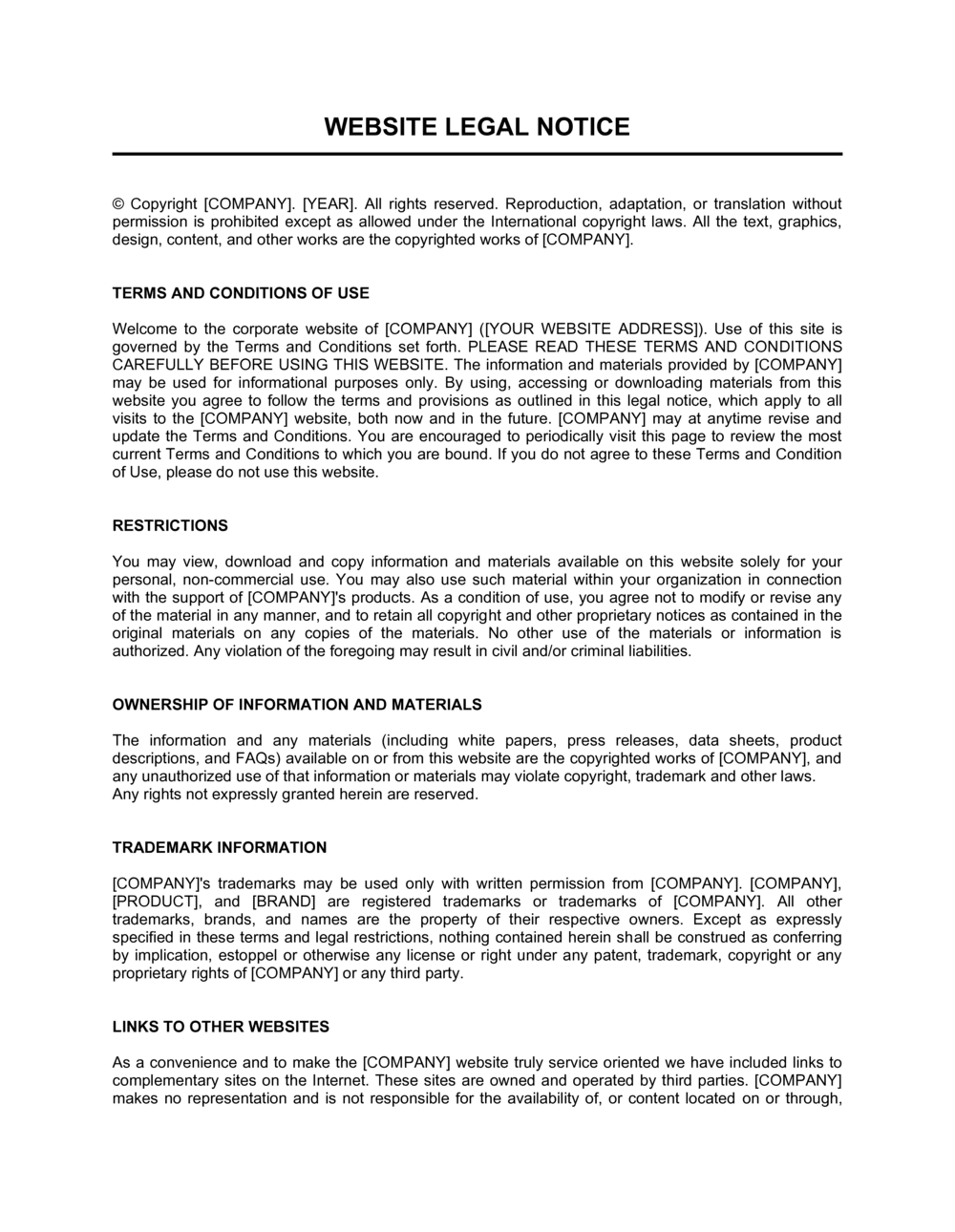
A Legal Notice is a formal written communication sent to another party to put them on official record of a legally significant fact, demand, or warning. Unlike an informal email or phone call, a legal notice creates a date-stamped documentary record that demonstrates the recipient was informed, starts any applicable statutory or contractual response clock, and preserves the sender's rights before escalating to litigation or enforcement. It is one of the most versatile tools in a business owner's document library β€” used for everything from unpaid invoices and lease violations to contract breaches and IP infringement warnings.

Why You Need This Document

Skipping a formal legal notice before escalating a dispute is one of the most common and costly procedural mistakes small businesses make. Many contracts and statutes require written notice as a strict pre-condition to exercising remedies β€” without it, a court may find you acted prematurely and reduce or deny your claim entirely. Beyond satisfying legal requirements, a well-drafted legal notice frequently resolves disputes without litigation: recipients who receive a formal document with a specific deadline and stated consequences respond at a far higher rate than those who receive a phone call or a frustrated email. This template gives you a professionally structured starting point that covers every essential component β€” legal basis, statement of facts, precise demand, deadline, consequences, and reservation of rights β€” so you can send a notice that is taken seriously, creates a clean paper trail, and positions you to act decisively if the deadline passes without response.

Which variant fits your situation?

If your situation is…Use this template
Demanding payment of an overdue invoice or debtDemand Letter for Payment
Notifying a tenant of unpaid rent or a lease violationEviction Notice
Asserting copyright, trademark, or IP infringementCease and Desist Letter
Notifying a party that a contract is being terminatedContract Termination Letter
Formally warning an employee before disciplinary actionEmployee Warning Letter
Putting a contractor on notice for defective work or delaysNotice of Default Letter
Notifying a business partner of a breach of a partnership agreementBreach of Contract Letter

Common mistakes to avoid

❌ Addressing the notice to the wrong party

Why it matters: A notice directed to an individual rather than the contracting legal entity may not satisfy contractual or statutory notice requirements, restarting your timeline from scratch.

Fix: Verify the exact legal name of the recipient entity from the original contract, a corporate registry, or their official correspondence header before sending.

❌ Vague or unmeasurable demand

Why it matters: If the notice says 'resolve this matter' rather than 'remit $4,750 by May 16, 2026,' there is no clear standard for compliance β€” making enforcement and litigation significantly harder.

Fix: State the exact action, amount, or outcome required in a single sentence that a stranger to the transaction could evaluate for compliance without additional context.

❌ No reference to the legal or contractual basis

Why it matters: A notice with no legal anchor reads as a personal complaint rather than a formal legal communication, and the recipient's counsel can dismiss it without substantive response.

Fix: Cite the specific contract clause, statute, or recognized legal principle that gives you the right to make the demand β€” even one sentence of legal grounding transforms the tone and enforceability of the notice.

❌ Sending the notice without keeping proof of delivery

Why it matters: If the matter proceeds to court or arbitration, you must prove the notice was received on a specific date β€” without delivery proof, the statutory or contractual clock may not have started.

Fix: Always send by certified mail, courier with signature confirmation, or email with a delivery and read receipt, and retain copies of all delivery confirmations in your files.

The 9 key clauses, explained

Header: sender and date

In plain language: Identifies who is sending the notice, their contact information, and the date the notice is issued β€” establishing the official starting point for any statutory clock.

Sample language
[SENDER FULL NAME / COMPANY NAME] | [ADDRESS] | [CITY, STATE, ZIP] | [EMAIL] | [PHONE] | Date: [DATE]

Common mistake: Using a personal email address or informal contact details. An unofficial-looking header weakens the notice's credibility and can make it harder to prove delivery.

Recipient identification

In plain language: Names the individual or legal entity receiving the notice, their role, and their full address β€” ensuring the notice is directed to the correct party.

Sample language
TO: [RECIPIENT FULL NAME / COMPANY NAME] | [TITLE / ROLE] | [ADDRESS] | [CITY, STATE, ZIP]

Common mistake: Addressing the notice to a contact person's name without including the legal entity name. If the matter escalates, enforcement actions must name the correct legal party.

Subject line and notice type

In plain language: States in one line what the notice is about and its legal character β€” giving the recipient immediate context and signaling the seriousness of the communication.

Sample language
RE: LEGAL NOTICE β€” [DESCRIPTION OF MATTER, e.g., NOTICE OF BREACH OF CONTRACT DATED [DATE]]

Common mistake: Writing a vague subject line such as 'Important Notice.' A specific subject line demonstrates precision and makes the notice easier to reference in follow-up correspondence or litigation.

Legal basis

In plain language: Cites the specific contract provision, statutory authority, or legal right the sender is relying on to send the notice β€” anchoring the demand in a concrete legal source.

Sample language
Pursuant to Section [X] of the [AGREEMENT NAME] dated [DATE] / under [STATUTE NAME AND SECTION], [SENDER NAME] hereby gives formal notice as follows.

Common mistake: Omitting any reference to a legal basis and relying on general language like 'you are in violation.' Without a specific anchor, the recipient and their counsel have no obligation to take the notice seriously.

Statement of facts

In plain language: Sets out the specific events, actions, or omissions that give rise to the notice β€” creating a documentary record of what happened and when.

Sample language
On [DATE], [RECIPIENT NAME] [DESCRIPTION OF ACTION OR OMISSION]. As of [DATE], [SENDER NAME] has [DESCRIPTION OF CURRENT STATUS, e.g., not received payment of $[AMOUNT] due under Invoice #[NUMBER] dated [DATE]].

Common mistake: Including disputed characterizations or emotional language in the facts section. Courts and opposing counsel view this as a credibility problem β€” keep the facts chronological, specific, and neutral.

Demand or required action

In plain language: States precisely what the sender is requiring the recipient to do β€” pay a sum, cease an activity, provide documentation, or remedy a breach β€” without ambiguity.

Sample language
You are hereby required to [SPECIFIC ACTION, e.g., remit payment of $[AMOUNT] / cease and desist from [ACTIVITY] / remedy the breach described above] no later than [DEADLINE DATE].

Common mistake: Making a vague demand such as 'resolve this matter promptly.' A demand that cannot be measured makes it impossible to determine whether the recipient has complied, undermining any follow-up enforcement.

Deadline and cure period

In plain language: Specifies the exact date by which the recipient must act, giving them a defined window to comply before the sender exercises further remedies.

Sample language
You have [X] calendar days from the date of this notice β€” until [SPECIFIC DATE] β€” to [COMPLY / CURE THE BREACH / RESPOND IN WRITING].

Common mistake: Setting an unrealistically short deadline (e.g., 24 hours for a contractual matter). Courts have reduced damages when senders failed to give reasonable cure periods, particularly where the contract or applicable law implies a longer window.

Consequences of non-compliance

In plain language: Describes what the sender intends to do if the recipient fails to act by the deadline β€” whether legal proceedings, referral to collections, or escalation to regulators.

Sample language
Failure to [COMPLY] by [DATE] will result in [SENDER NAME] commencing [legal proceedings / referring this matter to collections / filing a complaint with [AUTHORITY]] without further notice to you.

Common mistake: Threatening a specific legal action the sender has no intention of or legal basis to take. An empty threat undermines the notice and can expose the sender to counterclaims.

Reservation of rights

In plain language: States that by sending this notice the sender does not waive any other rights or remedies available under the contract or applicable law.

Sample language
[SENDER NAME] expressly reserves all rights and remedies available at law or in equity and does not waive any claim, right, or defense by sending this notice.

Common mistake: Omitting this clause entirely. Without it, a recipient may argue that accepting a partial payment or engaging in further negotiation constitutes waiver of the full claim.

How to fill it out

  1. 1

    Identify the correct legal entity and contact details for both parties

    Use the full registered legal name of the sending and receiving parties β€” not trade names or informal names. Verify the recipient's current address using official records, a registered-agent database, or the contract itself.

    πŸ’‘ If the notice is directed to a company, look up the registered agent address in the state's corporate registry β€” this is the legally recognized address for formal notice delivery.

  2. 2

    State the legal or contractual basis for the notice

    Reference the specific clause number in the contract, the statute, or the regulatory provision that gives you the right to send this notice. If no single provision applies, cite the general body of law β€” for example, contract law principles governing breach.

    πŸ’‘ A one-line citation such as 'Pursuant to Section 4.2 of the Service Agreement dated March 1, 2025' does more work than three paragraphs of general explanation.

  3. 3

    Write the facts section in neutral, chronological order

    List only the specific, verifiable facts: dates, amounts, deliverables due, and actions taken or not taken. Avoid characterizations, adjectives, or emotional language β€” those belong in a lawyer's brief, not a notice.

    πŸ’‘ Attach supporting documents (unpaid invoices, signed contracts, email chains) as numbered exhibits and reference them in the facts section by exhibit number.

  4. 4

    State the demand precisely and quantify it where possible

    Name the exact action required and, where the demand is financial, state the exact amount including any accrued interest or fees. For non-monetary demands, describe the required action specifically enough that compliance is objectively verifiable.

    πŸ’‘ Avoid the phrase 'take appropriate action' β€” it gives the recipient room to argue they complied when they haven't.

  5. 5

    Set a specific deadline date

    Calculate the deadline from the date of delivery (not the date you write the notice) and state it as a specific calendar date rather than a number of days. Check whether your contract or applicable law prescribes a minimum cure period.

    πŸ’‘ Ten to fourteen business days is a common and defensible notice period for most commercial matters; 30 days is standard for landlord-tenant and consumer-facing notices.

  6. 6

    State the consequences and reserve your rights

    Describe the next step you will actually take if the recipient does not comply by the deadline. Add the reservation-of-rights clause verbatim from the template to protect against waiver arguments.

    πŸ’‘ Only threaten the action you are genuinely prepared to take. Bluffing about litigation you won't pursue signals weakness and invites the recipient to call it.

  7. 7

    Send by a method that creates a delivery record

    Send the notice by certified mail with return receipt, courier with signature confirmation, or email with read receipt β€” and retain proof of each. Some contracts specify the required delivery method; follow it exactly.

    πŸ’‘ Sending by both certified mail and email simultaneously is common practice β€” it ensures the recipient receives the notice quickly while creating the postal record that holds up in court.

Frequently asked questions

How this compares to alternatives

vs Cease and Desist Letter

A cease and desist letter is a specific type of legal notice focused solely on demanding that a party stop a particular activity β€” typically IP infringement, harassment, or defamation. A general legal notice can demand a wider range of actions, including payment, contract performance, or acknowledgment of a fact. Use a cease and desist when the only relief you want is that the other party stops doing something.

vs Demand Letter for Payment

A demand letter for payment is tailored specifically to debt collection β€” it itemizes the amount owed, accrued interest, and payment instructions. A legal notice covers a broader set of situations and may not involve money at all. Use a demand letter when your sole objective is collecting a specific sum; use a legal notice when the situation involves a breach, warning, or right that extends beyond payment.

vs Contract Termination Letter

A contract termination letter formally ends an agreement and addresses notice periods, outstanding obligations, and return of property. A legal notice can precede termination β€” for example, notifying a party of a breach and giving them a cure period before termination occurs. The two documents are often used in sequence: notice first, termination letter second if the breach is not cured.

vs Breach of Contract Letter

A breach of contract letter focuses specifically on documenting a contractual violation and is typically sent after a breach has already occurred. A legal notice is broader and can be used before, during, or after a breach β€” including to warn of a potential breach, demand cure, or assert rights unrelated to a contract. Where a breach has clearly occurred, the breach of contract letter provides more targeted language.

Industry-specific considerations

Real Estate and Property Management

Landlords use legal notices to document rent arrears, lease violations, and intent to terminate tenancy in compliance with state-specific notice periods.

Professional Services

Consultants and agencies send legal notices to clients for unpaid invoices, unauthorized use of deliverables, or breach of confidentiality obligations.

Construction and Trades

Contractors issue notices of default for payment delays, scope changes without authorization, or failure to provide site access β€” often a required step before exercising a mechanic's lien.

Retail and E-commerce

Retailers send legal notices to suppliers for late or non-conforming deliveries, to competitors for trademark infringement, or to customers for disputed chargebacks.

Template vs pro β€” what fits your needs?

PathBest forCostTime
Use the templateBusiness owners, landlords, and freelancers handling routine payment demands, lease notices, or contract breach warningsFree15–30 minutes
Template + professional reviewSituations involving significant sums, ongoing business relationships, or notices that must satisfy specific statutory requirements$150–$400 for a lawyer review1–2 days
Custom draftedComplex or high-value disputes, notices involving regulated industries, or situations where litigation is likely to follow$400–$1,500+2–5 days

Glossary

Legal Notice
A formal written communication that puts a party on official record of a legally significant fact, demand, or warning, often required before further legal action can be taken.
Statutory Notice Period
A minimum waiting period prescribed by law that must elapse after a notice is sent before the sender can take a specified legal action.
Certified Mail
A postal service option that provides a mailing receipt and a delivery record signed by the recipient β€” commonly used to prove a legal notice was received.
Proof of Service
A document or declaration confirming that a legal notice or court filing was delivered to the intended recipient in the required manner.
Demand
A specific request in a legal notice requiring the recipient to perform an action β€” such as paying a debt, ceasing an activity, or remedying a breach β€” within a stated time.
Cure Period
A defined window of time given to a party to correct a breach or deficiency before the other party exercises its contractual or legal remedies.
Without Prejudice
A designation indicating that a communication cannot be used as an admission or against the sender in subsequent legal proceedings.
Constructive Notice
Legal knowledge imputed to a party by law, regardless of whether they actually received or read a notice, because it was published or posted in a legally recognized manner.
Respondent
The party to whom a legal notice is directed and who is expected to respond or take action within the specified deadline.
Reserve Rights
Language in a legal notice stating that the sender retains all available legal remedies and does not waive any claims by sending the notice.

Part of your Business Operating System

This document is one of 3,000+ business & legal templates included in Business in a Box.

  • Fill-in-the-blanks β€” ready in minutes
  • 100% customizable Word document
  • Compatible with all office suites
  • Export to PDF and share electronically

Create your document in 3 simple steps.

From template to signed document β€” all inside one Business Operating System.
1
Download or open template

Access over 3,000+ business and legal templates for any business task, project or initiative.

2
Edit and fill in the blanks with AI

Customize your ready-made business document template and save it in the cloud.

3
Save, Share, Send, Sign

Share your files and folders with your team. Create a space of seamless collaboration.

Save time, save money, and create top-quality documents.

β˜…β˜…β˜…β˜…β˜…

"Fantastic value! I'm not sure how I'd do without it. It's worth its weight in gold and paid back for itself many times."

Managing Director Β· Mall Farm
Robert Whalley
Managing Director, Mall Farm Proprietary Limited
β˜…β˜…β˜…β˜…β˜…

"I have been using Business in a Box for years. It has been the most useful source of templates I have encountered. I recommend it to anyone."

Business Owner Β· 4+ years
Dr Michael John Freestone
Business Owner
β˜…β˜…β˜…β˜…β˜…

"It has been a life saver so many times I have lost count. Business in a Box has saved me so much time and as you know, time is money."

Owner Β· Upstate Web
David G. Moore Jr.
Owner, Upstate Web

Run your business with a system β€” not scattered tools

Stop downloading documents. Start operating with clarity. Business in a Box gives you the Business Operating System used by over 250,000 companies worldwide to structure, run, and grow their business.

Start freeΒ Β·Β No credit card required