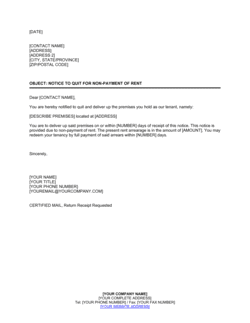
Notice to Pay Rent or Quit Template

Free Word download β€’ Edit online β€’ Save & share with Drive β€’ Export to PDF

1 pageβ€’15–20 min to fillβ€’Difficulty: Standard
Learn more ↓
FreeNotice to Pay Rent or Quit Template

At a glance

What it is
A Notice To Pay Rent Or Quit is a formal written notice a landlord delivers to a tenant who has failed to pay rent by the due date. It demands full payment of the outstanding balance within a specified number of days β€” typically 3, 5, or 10 days depending on the jurisdiction β€” or requires the tenant to vacate the premises. This free Word download gives landlords and property managers a professionally formatted starting point they can edit online and export as PDF in minutes.
When you need it
Issue this notice as soon as rent is overdue and informal reminders have gone unanswered. It is the required first step before filing for eviction in virtually every US state and Canadian province, and sending it in writing creates the paper trail courts expect.
What's inside
Landlord and tenant identification, property address, the exact amount of rent owed with the original due date, a clear deadline to pay or vacate, accepted payment methods, and a statement of the landlord's intent to pursue eviction proceedings if the deadline is not met.

What is a Notice To Pay Rent Or Quit?

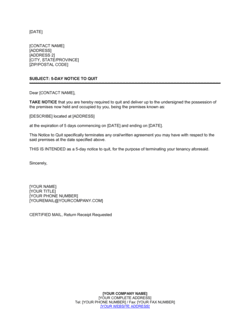
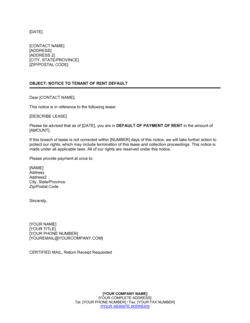
A Notice To Pay Rent Or Quit is a formal written demand a landlord or property manager serves on a tenant who has failed to pay rent by the contractually agreed due date. It specifies the exact dollar amount owed, the rental period it covers, and a legally prescribed deadline β€” commonly 3, 5, or 10 days β€” within which the tenant must either pay the full balance or vacate the rental unit. The notice is not an eviction in itself; it is the mandatory first step in the eviction process, and courts in virtually every US state and Canadian province require proof that it was properly served before they will accept an unlawful detainer filing.

Why You Need This Document

Skipping a formal pay-or-quit notice β€” or serving one that is defective β€” forces a landlord to restart the eviction clock from the beginning, adding weeks of lost rent to an already costly situation. A properly completed notice establishes the paper trail that courts, collection agencies, and small-claims judges rely on to verify that the landlord followed due process. It also signals to the tenant that the situation has moved beyond informal reminders, which resolves a significant share of delinquencies without any further action. For landlords managing multiple units, a standardized template ensures that every notice captures the service documentation, correct cure period, and jurisdiction-compliant demand language needed to withstand a procedural challenge β€” protecting rental income and keeping eviction proceedings on schedule.

Which variant fits your situation?

If your situation is…Use this template
Tenant has not paid rent for the current monthNotice To Pay Rent Or Quit (3-Day)
Tenant is violating a lease term other than nonpaymentNotice To Cure Or Quit
Landlord wants to end the tenancy regardless of paymentUnconditional Quit Notice
Tenant's lease has expired and they remain in the unitNotice To Vacate
Landlord is ending a month-to-month tenancy with proper notice30-Day Notice To Terminate Tenancy
Documenting a formal rent demand for court filing purposesEviction Notice

Common mistakes to avoid

❌ Including non-rent charges in the demand amount

Why it matters: Many states restrict pay-or-quit notices to base rent only. Including late fees or utility charges can render the notice legally defective and force the landlord to start over.

Fix: Separate base rent from all other charges. Issue a standalone demand letter for late fees and other amounts owed alongside the pay-or-quit notice.
❌ Naming only one tenant on a joint lease

Why it matters: A notice that omits a co-tenant may be rejected by the court as insufficient service, delaying eviction proceedings by weeks while a corrected notice is re-served.

Fix: List every adult tenant named on the lease as a recipient of the notice, even if only one tenant is typically your point of contact.

❌ Using the wrong cure period for the jurisdiction

Why it matters: Setting a 3-day deadline in a jurisdiction that requires 10 days makes the notice premature and unenforceable β€” the landlord cannot file for eviction until the statutory period has fully elapsed.

Fix: Look up the specific cure-period requirement for the state or province where the property is located before filling in any deadline.

❌ Failing to document how and when the notice was served

Why it matters: Without evidence of proper service, a tenant can successfully challenge the eviction on procedural grounds, even if the rent is genuinely unpaid.

Fix: Record the service method, date, and server's name on the notice itself. Retain the certified mail tracking receipt and green card as proof.

The 8 key clauses, explained

Landlord and tenant identification

In plain language: States the full legal name of the landlord or property management company and the full name of the tenant or tenants to whom the notice is addressed.

Sample language
To: [TENANT FULL NAME(S)] | From: [LANDLORD / PROPERTY MANAGEMENT COMPANY NAME], [LANDLORD ADDRESS]

Common mistake: Addressing the notice only to one tenant on a joint lease β€” omitting a co-tenant can invalidate the notice and require re-service before eviction proceedings can proceed.

Property address

In plain language: Identifies the exact rental unit subject to the notice, including street address, unit number, city, state, and zip code.

Sample language
RE: Rental Property Located at [STREET ADDRESS], Unit [UNIT NUMBER], [CITY], [STATE] [ZIP CODE]

Common mistake: Using the building address without specifying the unit number in a multi-unit property β€” courts require the notice to identify the specific premises in dispute.

Amount of rent owed

In plain language: States the exact dollar amount of overdue rent, the period it covers, and the original due date on which it became past due.

Sample language
As of [DATE], you owe the total sum of $[AMOUNT] in unpaid rent for the rental period of [START DATE] through [END DATE], which was due on [DUE DATE].

Common mistake: Including late fees or other charges in the overdue rent total in states where only base rent may be included in a pay-or-quit notice β€” doing so can void the entire notice.

Deadline to pay or vacate

In plain language: Specifies the number of days the tenant has to pay the full amount owed or vacate, and states the exact calendar date by which this must occur.

Sample language
You are hereby notified that you must, within [3 / 5 / 10] days of service of this notice, pay the full amount owed or vacate and surrender possession of the premises. The deadline to comply is [SPECIFIC DATE].

Common mistake: Stating a number of days without also stating the specific calendar deadline β€” tenants and courts both expect a concrete date, and ambiguity can delay proceedings.

Accepted payment methods and instructions

In plain language: Tells the tenant exactly how and where to submit payment β€” mailing address, online portal, in-person drop-off, or bank transfer β€” so there is no ambiguity about how to cure the default.

Sample language
Payment must be made in full by [DEADLINE DATE] via [CERTIFIED CHECK / MONEY ORDER / ONLINE PORTAL at URL / BANK TRANSFER to ACCOUNT DETAILS]. Personal checks will not be accepted.

Common mistake: Omitting payment instructions entirely β€” when a tenant wants to pay and cannot determine how, disputes arise over whether payment was tendered and refused.

Statement of intent to pursue eviction

In plain language: Notifies the tenant that failure to comply will result in the landlord initiating formal eviction proceedings without further notice.

Sample language
If you fail to pay the full amount owed or vacate the premises by [DEADLINE DATE], [LANDLORD NAME] will commence eviction proceedings against you as permitted by the laws of [STATE / PROVINCE], without further notice.

Common mistake: Softening this language with phrases like 'may consider' or 'might pursue' β€” conditional language signals negotiability and reduces the notice's effectiveness as a formal demand.

Reservation of rights

In plain language: Preserves the landlord's right to pursue all legal remedies available β€” including monetary judgment for unpaid rent β€” even after the tenant vacates.

Sample language
This notice does not waive any rights or remedies available to [LANDLORD NAME] under the lease agreement or applicable law, including the right to seek a monetary judgment for all unpaid rent and costs.

Common mistake: Omitting this clause, which can create an inference that the landlord's only remedy is repossession of the unit β€” forfeiting the right to sue for the overdue balance.

Date of notice and service information

In plain language: Records the date the notice was prepared, the date and method of service on the tenant, and the name of the person who served it.

Sample language
This notice is dated [DATE] and was served on [SERVICE DATE] by [PERSONAL DELIVERY / CERTIFIED MAIL / POSTING AND MAIL] by [SERVER NAME / TITLE].

Common mistake: Failing to document the service method β€” without a clear record of how and when the notice was delivered, the landlord cannot prove service in court if the tenant disputes it.

How to fill it out

  1. 1

    Confirm the overdue amount before filling in any figures

    Pull the tenant's payment ledger and verify the exact unpaid rent balance, the period it covers, and the original due date. Do not estimate or round.

    πŸ’‘ If the tenant made a partial payment, the notice should reflect only the remaining unpaid balance β€” not the full monthly rent.

  2. 2

    Enter all party names and the full property address

    Use the exact legal names of all tenants listed on the lease. Include the unit number for multi-unit properties and confirm the landlord name matches the lease agreement.

    πŸ’‘ On a joint lease with two or more tenants, name every tenant on the notice β€” courts may reject a notice that omits a co-tenant.

  3. 3

    Set the deadline based on your jurisdiction's required cure period

    Look up the statutory cure period for your state or province β€” common periods are 3 days (California, Florida), 5 days (Illinois, Texas), and 10 days (New York). Calculate the specific calendar date and enter both the number of days and the exact date.

    πŸ’‘ Weekends and holidays may or may not count toward the cure period depending on your jurisdiction β€” verify the counting rule before setting the deadline.

  4. 4

    Add clear payment instructions

    Specify the exact method, location, and format of acceptable payment. If you use an online portal, include the URL. If certified check or money order only, state it explicitly.

    πŸ’‘ Excluding personal checks removes any dispute about a tendered check that was lost, bounced, or arrived late.

  5. 5

    Review for charges that should not be included

    Some states prohibit including late fees, utility charges, or other non-rent amounts in a pay-or-quit notice. Remove any such line items if your jurisdiction restricts the notice to base rent only.

    πŸ’‘ If you need to collect late fees separately, send a separate demand letter β€” do not risk invalidating the pay-or-quit notice by bundling them.

  6. 6

    Serve the notice correctly and document service

    Deliver the notice by the method your jurisdiction requires β€” personal delivery, certified mail, or posting and mail. Record the service date and method on the notice and keep a copy.

    πŸ’‘ Send a second copy via regular first-class mail in addition to certified mail β€” if the tenant refuses the certified letter, the regular mail copy establishes delivery.

Frequently asked questions

What is a Notice To Pay Rent Or Quit?

A Notice To Pay Rent Or Quit is a formal written demand a landlord serves on a tenant who has failed to pay rent. It gives the tenant a set number of days β€” typically 3, 5, or 10 depending on the jurisdiction β€” to pay the full overdue balance or vacate the unit. It is the required first step in the eviction process in virtually every US state and Canadian province.

Is a Notice To Pay Rent Or Quit the same as an eviction notice?

No β€” they are different documents at different stages of the process. A Notice To Pay Rent Or Quit is a pre-eviction demand that gives the tenant an opportunity to cure the default by paying. An eviction notice (or unlawful detainer filing) is the court action a landlord initiates only after the pay-or-quit deadline passes without compliance. The pay-or-quit notice must generally be served before a court will accept an eviction filing.

How many days do I have to give the tenant on a pay-or-quit notice?

The required cure period varies by jurisdiction. Common periods include 3 days in California and Florida, 5 days in Illinois and Texas, and 10 days in New York. Some jurisdictions require longer periods for commercial tenancies or long-term residential tenants. Always verify the applicable statutory requirement for the state or province where the property is located before setting the deadline.

Can I include late fees in the amount demanded on the notice?

It depends on your jurisdiction. Several states β€” including California β€” require that a pay-or-quit notice demand only base rent, not late fees, utility charges, or other costs. Including prohibited charges can invalidate the notice entirely. Check your state's landlord-tenant statute and, if in doubt, limit the notice to base rent and pursue other charges separately.

How do I properly serve a Notice To Pay Rent Or Quit?

Acceptable service methods vary by jurisdiction, but the most common options are personal delivery to the tenant, certified mail with return receipt, and posting the notice on the main entry door plus mailing a copy. Courts require proof of service, so document the method, date, and server's name. Sending both certified and regular first-class mail is a common precaution when personal service is not possible.

What happens if the tenant pays after the deadline but before I file for eviction?

If the tenant pays the full overdue amount after the deadline but before you file for eviction, you are generally not required to accept it β€” but in many jurisdictions accepting a late payment after the cure period resets your rights and requires you to start over. Consult your jurisdiction's rules before accepting any partial or late payment once the deadline has passed.

Does sending a Notice To Pay Rent Or Quit affect the lease agreement?

Sending the notice does not terminate the lease. It is a demand for compliance with an existing lease obligation. If the tenant pays in full before the deadline, the tenancy continues under the same terms. Only if the tenant fails to pay and is subsequently evicted does the lease end β€” and even then, the landlord typically retains the right to sue for any unpaid balance.

Do I need a lawyer to send a Notice To Pay Rent Or Quit?

For a straightforward residential or commercial nonpayment situation, a landlord can typically complete and serve a pay-or-quit notice using a well-structured template without hiring a lawyer. Engaging an attorney makes sense when the overdue amount is large, the tenant is likely to contest the eviction, the property is in a jurisdiction with complex rent-control or tenant-protection laws, or the landlord is unfamiliar with the local service requirements.

How this compares to alternatives

vs Notice To Vacate

A Notice To Vacate requires the tenant to leave the premises but does not offer the option to cure by paying. It is used when the landlord wants to terminate the tenancy regardless of payment β€” for example, after a lease expiration or repeated violations. A Notice To Pay Rent Or Quit is specifically for nonpayment and gives the tenant the opportunity to stay by paying in full.

vs Eviction Notice

An eviction notice is the court filing that begins formal legal proceedings to remove a tenant. A Notice To Pay Rent Or Quit is the pre-litigation demand that must typically be served first. The pay-or-quit notice gives the tenant a chance to cure; the eviction filing is initiated only after that opportunity has passed without compliance.

vs Lease Termination Letter

A Lease Termination Letter ends the tenancy at a future date with proper advance notice β€” typically 30 or 60 days. It is not triggered by nonpayment and does not demand money. A Notice To Pay Rent Or Quit is an immediate demand tied to a specific overdue balance, not a scheduled end to the tenancy.

vs Demand Letter

A general Demand Letter requests payment of any overdue amount and can be used in a wide variety of debtor-creditor situations. A Notice To Pay Rent Or Quit is specifically structured for landlord-tenant nonpayment, follows jurisdiction-specific cure-period rules, and is designed to satisfy the procedural prerequisites for eviction court filings.

Industry-specific considerations

Residential Real Estate

Used by individual landlords and property management companies on apartment, condo, and single-family rental units where monthly rent is the primary lease obligation.

Commercial Real Estate

Applied to office, retail, and industrial tenants; commercial cure periods and permissible demand amounts often differ from residential rules in the same jurisdiction.

Property Management

Property managers issue pay-or-quit notices at scale across large portfolios, requiring standardized templates that capture service documentation and comply with varying state requirements.

Real Estate Investment

Investors managing rental income properties use the notice to enforce lease terms and protect NOI without incurring unnecessary legal fees on routine delinquency situations.

Template vs pro β€” what fits your needs?

PathBest forCostTime
Use the templateLandlords and property managers handling routine nonpayment for a residential or commercial unitFree10–15 minutes
Template + professional reviewLandlords in jurisdictions with strict rent-control or tenant-protection laws, or where the overdue balance exceeds $5,000$100–$300 for a one-hour attorney review1–2 days
Custom draftedHigh-value commercial leases, contested tenancies, or multi-unit portfolio situations requiring jurisdiction-specific customization$300–$8002–5 days

Glossary

Notice to Pay or Quit
A formal written demand requiring a tenant to pay all overdue rent within a set number of days or vacate the rental unit.
Cure Period
The number of days a tenant has to correct a lease violation β€” such as nonpayment β€” before the landlord may proceed with eviction.
Unlawful Detainer
The legal action a landlord files in court to remove a tenant who has not complied with a pay-or-quit notice.
Holdover Tenant
A tenant who remains in a rental unit after the lease has expired or after receiving a valid notice to vacate.
Lease Default
A failure by the tenant to fulfill a material obligation under the lease agreement, most commonly nonpayment of rent.
Certified Mail
A postal service method that provides a trackable delivery record and a signed receipt β€” widely required by courts as proof of proper notice delivery.
Self-Help Eviction
An illegal practice where a landlord removes a tenant without a court order β€” such as changing locks or removing belongings β€” rather than following the formal eviction process.
Writ of Possession
A court order authorizing a sheriff or marshal to remove a tenant who has not vacated after an eviction judgment.
Demand for Possession
A written notice formally requesting that the tenant give up possession of the rental property, often used interchangeably with a quit notice.

Part of your Business Operating System

This document is one of 3,000+ business & legal templates included in Business in a Box.

  • Fill-in-the-blanks β€” ready in minutes
  • 100% customizable Word document
  • Compatible with all office suites
  • Export to PDF and share electronically

Create your document in 3 simple steps.

From template to signed document β€” all inside one Business Operating System.
1
Download or open template

Access over 3,000+ business and legal templates for any business task, project or initiative.

2
Edit and fill in the blanks with AI

Customize your ready-made business document template and save it in the cloud.

3
Save, Share, Send, Sign

Share your files and folders with your team. Create a space of seamless collaboration.

Save time, save money, and create top-quality documents.

β˜…β˜…β˜…β˜…β˜…

"Fantastic value! I'm not sure how I'd do without it. It's worth its weight in gold and paid back for itself many times."

Managing Director Β· Mall Farm
Robert Whalley
Managing Director, Mall Farm Proprietary Limited
β˜…β˜…β˜…β˜…β˜…

"I have been using Business in a Box for years. It has been the most useful source of templates I have encountered. I recommend it to anyone."

Business Owner Β· 4+ years
Dr Michael John Freestone
Business Owner
β˜…β˜…β˜…β˜…β˜…

"It has been a life saver so many times I have lost count. Business in a Box has saved me so much time and as you know, time is money."

Owner Β· Upstate Web
David G. Moore Jr.
Owner, Upstate Web

Run your business with a system β€” not scattered tools

Stop downloading documents. Start operating with clarity. Business in a Box gives you the Business Operating System used by over 250,000 companies worldwide to structure, run, and grow their business.

Free Forever PlanΒ Β·Β No credit card required