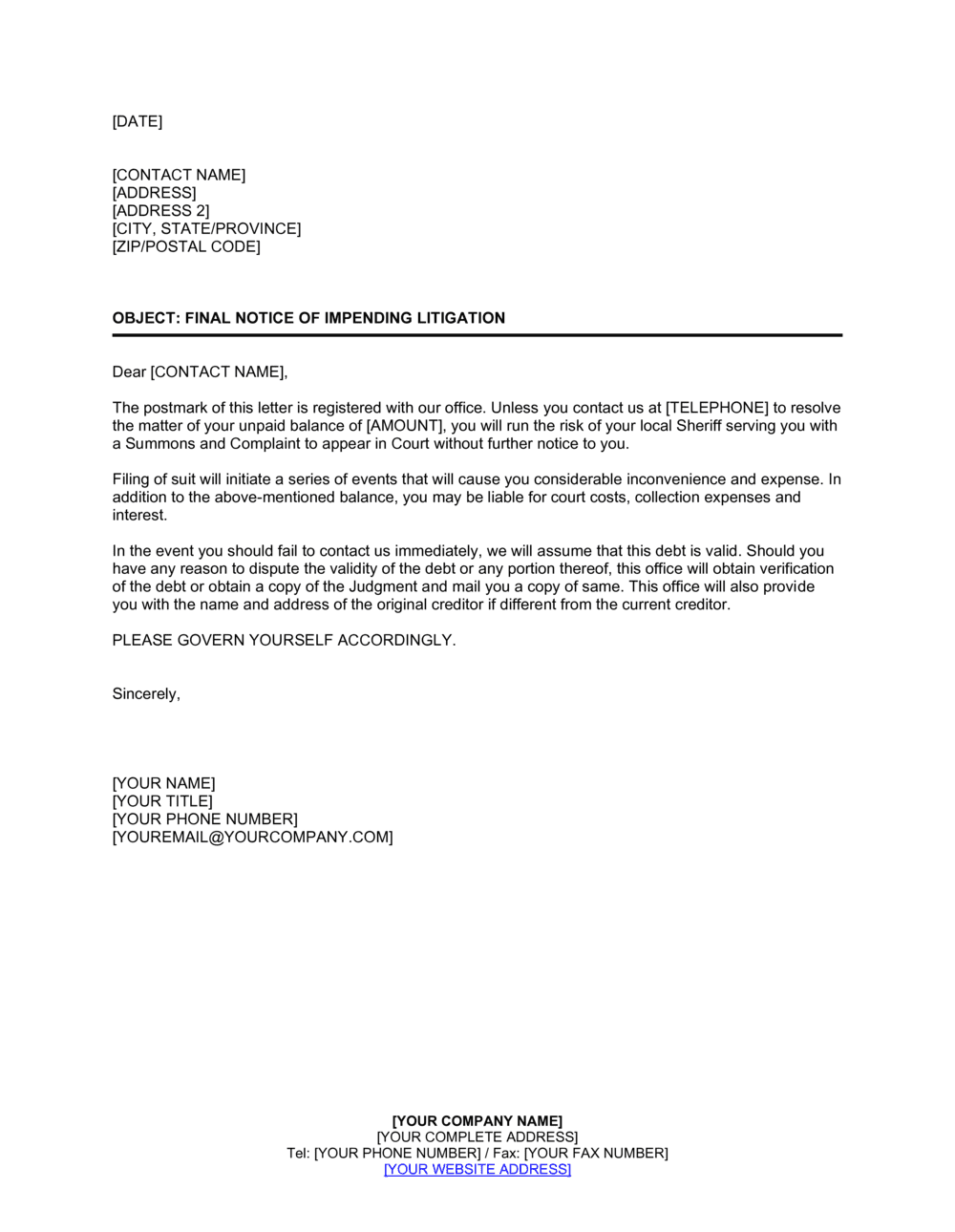
Final Notice of Impending Litigation Template

Free Word download β€’ Edit online β€’ Save & share with Drive β€’ Export to PDF

1 pageβ€’15–25 min to fillβ€’Difficulty: Standard
Learn more ↓
FreeFinal Notice of Impending Litigation Template

At a glance

What it is
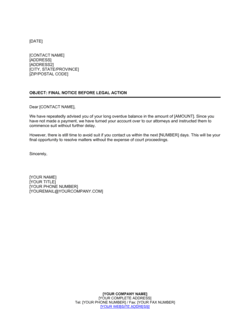
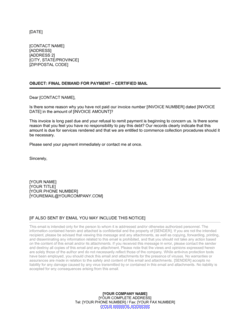
A Final Notice of Impending Litigation is a formal business letter sent to a non-compliant party β€” most often a debtor or contract counterparty β€” declaring that legal action will follow unless the stated demand is met by a specific deadline. This free Word download gives you a structured, professional template you can edit online and export as PDF, ready to send by certified mail or email.
When you need it
Send it after one or more prior collection or compliance notices have been ignored and you are genuinely prepared to file a lawsuit or refer the matter to an attorney if the deadline passes without a response.
What's inside
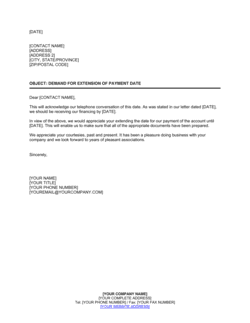
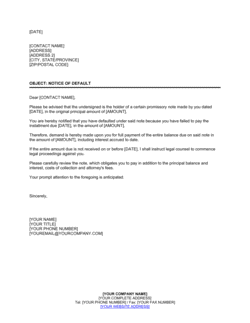
Sender and recipient details, a clear statement of the outstanding obligation or breach, a chronology of prior notices, a precise remedy demanded, a firm deadline, and a declaration of intent to file suit if the demand is not met.

What is a Final Notice of Impending Litigation?

A Final Notice of Impending Litigation is a formal business letter sent to a non-compliant party β€” most often a debtor or a counterparty in breach of a contract β€” declaring that a lawsuit will be filed unless the stated demand is satisfied by a specific deadline. It is the last step in a written escalation sequence: it follows prior notices that have gone unanswered and precedes the actual filing of a legal claim. The letter identifies the outstanding obligation, summarizes the history of prior collection or compliance attempts, demands a precise remedy, and states unambiguously that litigation will follow if the deadline passes without a response.

Why You Need This Document

Without a documented final notice, the moment you file suit you face an immediate credibility problem β€” opposing counsel will argue you gave no warning and provided no opportunity to cure. Courts look favorably on parties who demonstrate good-faith pre-litigation efforts, and many contracts and jurisdictions require written notice before a claim can proceed. Beyond its legal function, this letter resolves a significant percentage of disputes on its own: the explicit threat of a lawsuit and its associated costs β€” attorney fees, court filing fees, and the time burden of litigation β€” prompts payment or settlement from recipients who ignored earlier, softer requests. This template gives you a professional, consistently structured notice you can complete in under 30 minutes, with every essential component in place: parties, reference numbers, demand amount, prior notice chronology, a firm deadline, and an unambiguous statement of intent.

Which variant fits your situation?

If your situation is…Use this template
First written payment request after an invoice goes unpaidPast Due Payment Letter
Second escalation after the initial past-due notice is ignoredSecond Notice of Overdue Payment
Final notice specifically for a tenant's unpaid rent before eviction filingEviction Notice
Formal demand following a specific contract breach before suingBreach of Contract Letter
Collecting a personal debt from an individual rather than a businessDebt Collection Letter
Notifying a party of a defamation claim before filingCease and Desist Letter
Demanding return of property or goods rather than monetary paymentDemand for Return of Property Letter

Common mistakes to avoid

❌ Sending without prior written notices on file

Why it matters: A 'final' notice loses credibility β€” and sometimes legal standing β€” if the sender cannot produce evidence of earlier attempts to resolve the matter. Judges and mediators routinely ask for the full communication history.

Fix: Send at least one earlier written notice before issuing a final notice, and retain dated proof of every communication. If you have only made verbal attempts, send a documented follow-up summary before escalating.
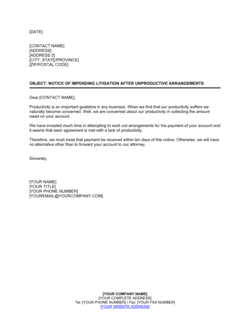
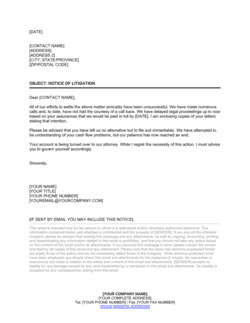
❌ Using vague or conditional litigation language

Why it matters: Phrases like 'we may be forced to consider legal options' tell the recipient the sender is uncertain β€” and uncertainty invites continued non-response.

Fix: Use direct, unconditional language: 'we will file suit' not 'we may consider filing.' Only send this letter if you are genuinely prepared to follow through.

❌ Setting an unreasonably short or indefinite deadline

Why it matters: A 24-hour deadline on a debt that has been outstanding for months looks punitive and bad-faith; 'as soon as possible' is legally meaningless and cannot be enforced.

Fix: Set a deadline of 7 to 14 calendar days from the send date, stated as a specific date. This gives the recipient enough time to arrange payment or counsel while maintaining urgency.

❌ Threatening costs that are not contractually or legally recoverable

Why it matters: If your contract has no fee-shifting clause and the applicable jurisdiction does not award attorney fees to prevailing parties, threatening those fees is a misrepresentation β€” which can undermine your position in court.

Fix: Review your contract and the governing jurisdiction's rules before finalizing the consequences paragraph. Only include cost items you can actually recover.

The 9 key clauses, explained

Sender and recipient identification

In plain language: Opens the letter with the sender's full legal name and address, the date, and the recipient's full legal name and address β€” establishing the parties on record.

Sample language
[SENDER FULL NAME / COMPANY NAME] [SENDER ADDRESS] [DATE] [RECIPIENT FULL NAME / COMPANY NAME] [RECIPIENT ADDRESS]

Common mistake: Using a trade name or nickname instead of the recipient's registered legal entity name β€” this can complicate enforcement if the letter is later submitted as evidence.

Subject line and reference number

In plain language: A clear subject line identifying this as a final notice and referencing any prior invoices, contract numbers, or account identifiers relevant to the dispute.

Sample language
RE: FINAL NOTICE OF IMPENDING LITIGATION β€” Invoice No. [INVOICE NUMBER] / Account No. [ACCOUNT NUMBER]

Common mistake: Omitting reference numbers entirely. Without them, the recipient's accounts payable or legal team cannot match the letter to the underlying transaction, slowing any response.

Statement of the outstanding obligation

In plain language: Clearly states what is owed or what breach has occurred β€” the amount, the original due date, and the relevant contract or invoice that created the obligation.

Sample language
As of [DATE], you remain indebted to [SENDER NAME] in the amount of $[AMOUNT] under Invoice No. [INVOICE NUMBER] dated [INVOICE DATE], which was due and payable on [DUE DATE].

Common mistake: Stating only the total without itemizing how it was calculated. Vague totals invite disputes; itemized amounts are harder to contest.

Chronology of prior notices

In plain language: A brief, dated summary of every prior notice or communication sent to the recipient, demonstrating that the sender made reasonable attempts to resolve the matter before escalating.

Sample language
Previous notices were sent to you on [DATE 1] and [DATE 2]. To date, no payment or response has been received.

Common mistake: Skipping this section when there are prior notices on file. Courts and arbitrators view this chronology favorably β€” it demonstrates good faith and diligence before escalation.

Specific remedy demanded

In plain language: States precisely what the recipient must do to resolve the matter β€” pay a specific dollar amount, cure a specific breach, or take a defined corrective action.

Sample language
You are hereby required to remit full payment of $[AMOUNT] to [SENDER NAME] at the address above, or to contact this office in writing at [EMAIL / ADDRESS] to arrange a mutually acceptable resolution.

Common mistake: Demanding a vague outcome like 'resolve this matter.' A specific, measurable demand defines what compliance looks like and gives the recipient no room to claim confusion.

Firm response deadline

In plain language: Specifies the exact calendar date by which the demanded remedy must be received β€” typically 7 to 14 days from the date of the letter.

Sample language
You must satisfy the above demand no later than [DEADLINE DATE], which is [X] days from the date of this notice.

Common mistake: Setting a deadline of 'immediately' or 'within a reasonable time.' These are unenforceable in practice β€” courts and recipients expect a specific date.

Declaration of intent to litigate

In plain language: A direct statement that failure to comply by the deadline will result in the filing of a lawsuit or referral to counsel β€” no further notice will be given.

Sample language
If we do not receive full payment or a satisfactory response by [DEADLINE DATE], we will have no option but to pursue all available legal remedies, including filing suit in the appropriate court without further notice to you.

Common mistake: Softening this language with phrases like 'may consider' or 'might be forced to.' Conditional language removes urgency and signals the sender is not committed to following through.

Consequences and costs warning

In plain language: Informs the recipient that litigation will expose them to additional costs β€” court fees, attorney fees, interest, and collection costs β€” beyond the original amount owed.

Sample language
Should litigation become necessary, you may also become liable for court filing fees, attorney's fees, pre-judgment interest at the applicable rate, and all costs of collection, in addition to the principal balance owed.

Common mistake: Threatening specific fee amounts you cannot actually recover. Only threaten cost items that are genuinely recoverable under the applicable contract or jurisdiction.

Closing and signature block

In plain language: A professional closing that restates the sender's contact information and invites a response before the deadline β€” ending the letter with a firm but non-hostile tone.

Sample language
We urge you to treat this matter with the urgency it deserves. Should you wish to discuss this matter prior to the deadline, please contact us at [PHONE NUMBER] or [EMAIL ADDRESS]. Sincerely, [SENDER NAME] [TITLE] [COMPANY NAME]

Common mistake: Ending with hostile or inflammatory language. Courts form impressions of both parties from pre-suit correspondence β€” a professional tone is always advantageous.

How to fill it out

  1. 1

    Enter accurate party details

    Add the sender's full legal name, company name if applicable, and address in the header. Then enter the recipient's registered legal entity name and mailing address. Confirm these against any signed contract or invoice.

    πŸ’‘ Send a copy to both the recipient's billing contact and their registered legal or corporate address β€” this maximizes the chance of the letter reaching the decision-maker.

  2. 2

    Reference all relevant documents

    List the invoice numbers, contract dates, purchase order numbers, or account identifiers that gave rise to the obligation. Include the original amount and the current outstanding balance if different.

    πŸ’‘ Attach copies of the original invoices or contract excerpts as exhibits β€” labeled Exhibit A, Exhibit B, and so on β€” and reference them in the body of the letter.

  3. 3

    Summarize prior notices with dates

    Document every previous communication you sent: the date, the method (email, certified mail, or phone), and the outcome. Two or three prior attempts are sufficient to establish escalation.

    πŸ’‘ Pull timestamps from your email sent folder or certified mail receipts before drafting β€” accuracy here matters if the letter ever enters evidence.

  4. 4

    State the specific demand and deadline

    Enter the exact dollar amount or corrective action required and a specific calendar date β€” not a number of days β€” as the compliance deadline. Seven to fourteen calendar days from the send date is standard.

    πŸ’‘ Set the deadline on a weekday and account for delivery time if sending by post β€” a deadline that falls on a weekend or holiday creates unnecessary ambiguity.

  5. 5

    Review the consequences language

    Confirm that every cost item threatened β€” attorney fees, interest, court costs β€” is actually recoverable under your contract or the applicable law before leaving it in the letter.

    πŸ’‘ If your contract does not include a fee-shifting clause, remove the attorney-fees threat. Threatening unrecoverable items undermines your credibility.

  6. 6

    Send by a trackable method and retain proof

    Send the letter by certified mail with return receipt requested, and also by email if you have the recipient's address. Save the delivery confirmation and email read receipt with your file.

    πŸ’‘ Keep a complete file β€” letter, attachments, proof of delivery, and a copy of every prior notice β€” in a single folder so your attorney can pick it up immediately if litigation proceeds.

Frequently asked questions

What is a final notice of impending litigation?

A final notice of impending litigation is a formal written letter sent to a non-compliant party β€” typically a debtor or a party in breach of contract β€” declaring that a lawsuit will be filed if the stated demand is not met by a specific deadline. It is the last step in a written escalation sequence before legal proceedings begin and serves as documented proof of the sender's good-faith attempt to resolve the matter without court involvement.

When should I send a final notice of impending litigation?

Send it after at least one prior written notice has gone unanswered and you are genuinely prepared to file a lawsuit or engage an attorney if the deadline passes without compliance. Using it as a first notice undermines credibility. It is most commonly sent for unpaid invoices, unreturned deposits, lease violations, and material contract breaches.

Does sending this letter guarantee I can sue the recipient?

No. The letter signals intent but does not itself create a legal right to sue β€” that right arises from the underlying contract, invoice, or obligation. Some contracts and certain jurisdictions require a written notice and cure period before litigation is permitted, so the letter may satisfy a contractual prerequisite. Always confirm whether your specific contract requires a pre-suit notice before filing.

What is the difference between this letter and a cease and desist?

A final notice of impending litigation demands payment or correction of a specific breach β€” its purpose is to collect money or compel a defined action. A cease and desist demands that the recipient stop a specific behavior, such as infringing a trademark or violating a non-compete. Both are pre-suit demand letters, but they address different types of claims and are typically used in different contexts.

How many days should I give the recipient to respond?

Seven to fourteen calendar days is the standard range for most payment and breach-of-contract matters. Shorter windows β€” 24 to 48 hours β€” can appear punitive and may work against you in court. Longer windows β€” 30 or more days β€” dilute the urgency of a final notice. State the deadline as a specific calendar date rather than a number of days to eliminate ambiguity about when the clock starts.

Should I send this letter by certified mail or email?

Use both when possible. Certified mail with return receipt requested creates a legally recognized proof-of-service record that is admissible in court. Email provides a faster timestamp and a read receipt you can document. Sending by both methods ensures delivery and eliminates any claim that the notice was never received.

Do I need a lawyer to send this letter?

No β€” a well-drafted template is sufficient for most standard payment disputes and straightforward contract breaches. However, engaging an attorney to send or review the letter adds significant credibility and is advisable when the amount at stake exceeds a few thousand dollars, when the dispute involves complex contract interpretation, or when you are unsure whether the claim is legally sound before threatening to file.

What happens if the recipient ignores the letter?

If the deadline passes without compliance or a substantive response, your next step is to file a claim in the appropriate court β€” small claims court for amounts within its jurisdictional limit, or a civil court for larger claims β€” or to refer the matter to a collections attorney. The letter itself becomes an important exhibit, demonstrating that you provided notice and a reasonable opportunity to cure before escalating.

How this compares to alternatives

vs Breach of Contract Letter

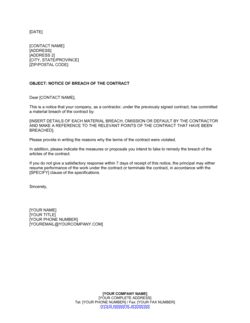
A breach of contract letter notifies a counterparty of a specific contract violation and requests a remedy, but it is typically issued earlier in the escalation sequence and does not always carry an explicit threat of immediate litigation. A final notice of impending litigation is sent when earlier notices have failed and lawsuit filing is imminent. Use the breach letter first; use this notice when that letter produces no response.

vs Cease and Desist Letter

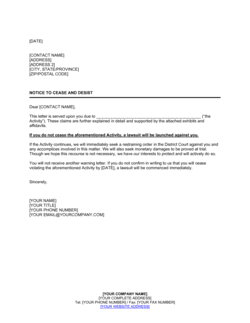
A cease and desist demands that the recipient stop a specific ongoing behavior β€” intellectual property infringement, harassment, or non-compete violation. A final notice of impending litigation demands payment or cure of a specific obligation. Both are pre-suit demand letters, but they target different types of legal claims and are drafted differently.

vs Past Due Payment Letter

A past due payment letter is an earlier-stage collection notice β€” professional and firm, but without a direct threat of litigation. It belongs in the first or second round of outreach. A final notice of impending litigation is appropriate only after earlier letters have been ignored and suit is genuinely the next step. Using the final notice too early weakens its impact.

vs Collections Referral Letter

A collections referral letter informs the debtor that the account has been handed to a third-party collections agency. A final notice of impending litigation keeps the matter in-house and signals a direct lawsuit by the creditor. Use this notice when you intend to file suit yourself; use a referral letter when you are outsourcing collections instead.

Industry-specific considerations

Professional Services

Agencies, consultants, and advisors use this letter to recover unpaid project fees or retainer balances after multiple invoices have gone unanswered.

Construction and Trades

Contractors send final notices before filing mechanics liens or breach-of-contract suits for non-payment on completed work or withheld retention amounts.

Real Estate and Property Management

Landlords and property managers use this notice to demand unpaid rent or lease-compliance cure before initiating eviction proceedings or filing suit.

Retail and Wholesale

Suppliers and distributors send final notices to retailers for overdue accounts receivable before referring the balance to a collections attorney or filing in civil court.

Template vs pro β€” what fits your needs?

PathBest forCostTime
Use the templateBusiness owners and managers handling standard unpaid invoice or contract breach disputes up to a few thousand dollarsFree15–30 minutes
Template + professional reviewDisputes above $5,000, complex contract breaches, or situations where the recipient is likely to respond with a counter-claim$100–$400 for a brief attorney review1–2 business days
Custom draftedHigh-value disputes, regulated industries, or matters where the letter will be filed as an exhibit in pending litigation$300–$900 for attorney-drafted correspondence2–5 business days

Glossary

Impending Litigation
A lawsuit that has not yet been filed but will be initiated if the recipient does not comply with the sender's demand by a stated deadline.
Demand Letter
A formal written notice requiring another party to take a specific action β€” pay a debt, cure a breach, or cease conduct β€” as a prerequisite to legal action.
Cure Period
A defined window of time, stated in the notice, during which the recipient may remedy a breach or default before the sender escalates to litigation.
Certified Mail
A postal service option that provides a dated delivery receipt and proof that a specific item was sent and received β€” commonly used to establish notice in legal disputes.
Material Breach
A failure to perform a core obligation under a contract that is significant enough to justify the non-breaching party in treating the contract as terminated and seeking damages.
Accounts Receivable
Money owed to a business by customers or clients for goods or services already delivered but not yet paid for.
Statute of Limitations
The maximum period of time after an event within which legal proceedings may be initiated β€” varying by jurisdiction and type of claim.
Without Prejudice
A designation on communications indicating that statements made cannot be used as admissions in subsequent court proceedings β€” consult a lawyer before applying this label.
Default
The failure of a party to fulfill a contractual or financial obligation by its agreed-upon deadline.
Pre-Litigation
The phase of a dispute before a lawsuit is formally filed, during which parties may attempt to resolve the matter through negotiation or formal notices.

Part of your Business Operating System

This document is one of 3,000+ business & legal templates included in Business in a Box.

  • Fill-in-the-blanks β€” ready in minutes
  • 100% customizable Word document
  • Compatible with all office suites
  • Export to PDF and share electronically

Create your document in 3 simple steps.

From template to signed document β€” all inside one Business Operating System.
1
Download or open template

Access over 3,000+ business and legal templates for any business task, project or initiative.

2
Edit and fill in the blanks with AI

Customize your ready-made business document template and save it in the cloud.

3
Save, Share, Send, Sign

Share your files and folders with your team. Create a space of seamless collaboration.

Save time, save money, and create top-quality documents.

β˜…β˜…β˜…β˜…β˜…

"Fantastic value! I'm not sure how I'd do without it. It's worth its weight in gold and paid back for itself many times."

Managing Director Β· Mall Farm
Robert Whalley
Managing Director, Mall Farm Proprietary Limited
β˜…β˜…β˜…β˜…β˜…

"I have been using Business in a Box for years. It has been the most useful source of templates I have encountered. I recommend it to anyone."

Business Owner Β· 4+ years
Dr Michael John Freestone
Business Owner
β˜…β˜…β˜…β˜…β˜…

"It has been a life saver so many times I have lost count. Business in a Box has saved me so much time and as you know, time is money."

Owner Β· Upstate Web
David G. Moore Jr.
Owner, Upstate Web

Run your business with a system β€” not scattered tools

Stop downloading documents. Start operating with clarity. Business in a Box gives you the Business Operating System used by over 250,000 companies worldwide to structure, run, and grow their business.

Free Forever PlanΒ Β·Β No credit card required