Final Demand for Payment_Letter Template

Free Word download β€’ Edit online β€’ Save & share with Drive β€’ Export to PDF

1 pageβ€’20–30 min to fillβ€’Difficulty: Standardβ€’Signature requiredβ€’Legal review recommended
Learn more ↓
FreeFinal Demand for Payment_Letter Template

At a glance

What it is
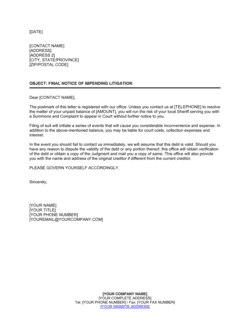
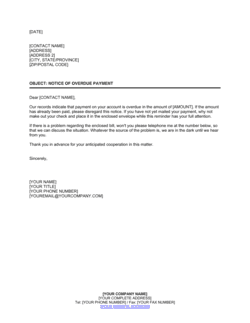
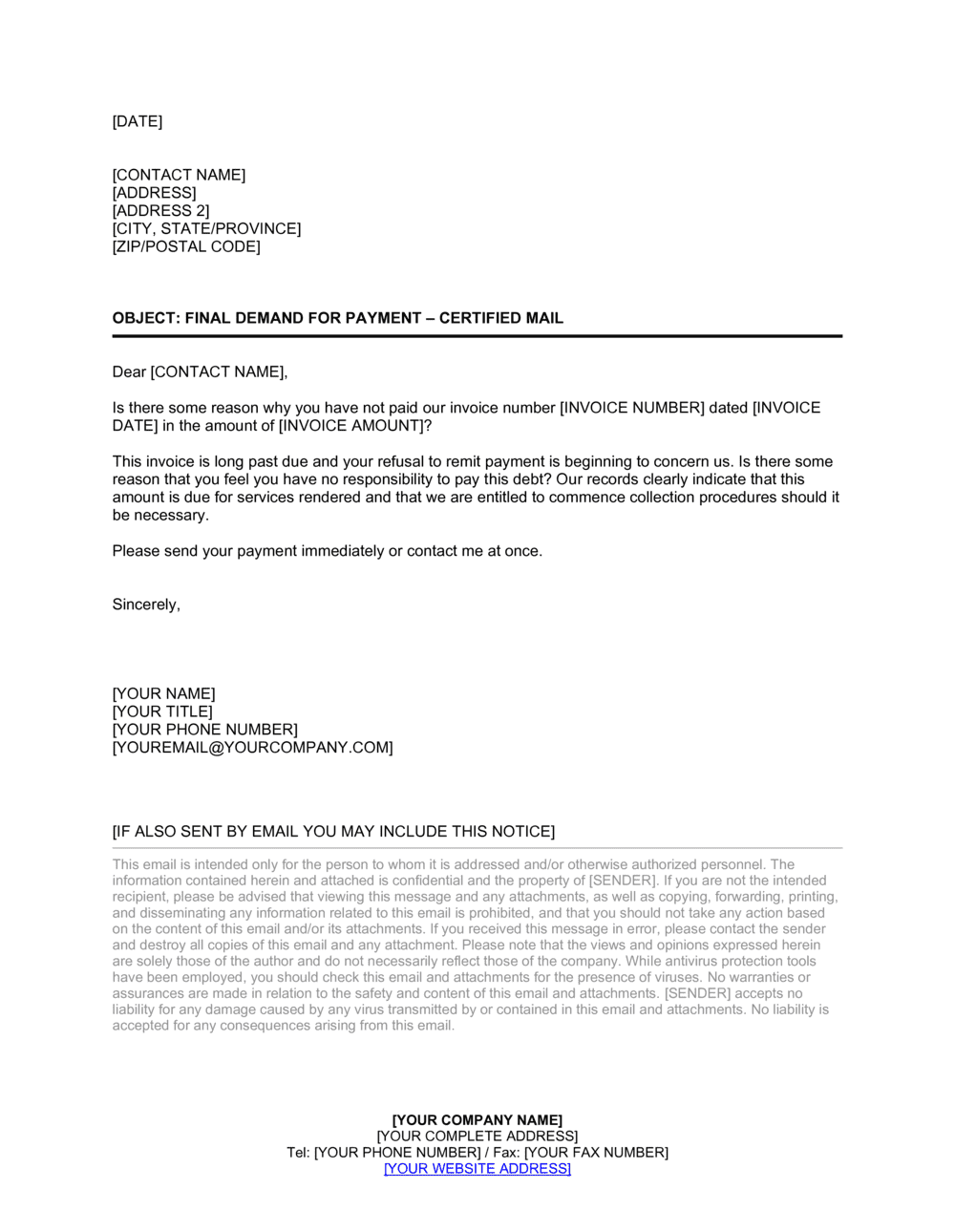
A Final Demand For Payment Letter is a formal written notice sent to a debtor who has failed to pay after prior invoices and follow-up requests. It states the total amount owed, sets a firm payment deadline β€” typically 7 to 14 days β€” and warns that failure to pay will trigger legal action or referral to a collections agency. This free Word download gives you a professionally structured, jurisdiction-aware template you can edit online and export as PDF in minutes.
When you need it
Send it when a client or customer has ignored one or more invoices and at least one informal reminder, and you are prepared to escalate to small claims court, civil litigation, or a third-party collections agency if payment is not received by the stated deadline.
What's inside
Creditor and debtor identification, a clear statement of the total amount due with invoice references, a firm final payment deadline, an explicit warning of legal consequences, and a demand for a written response or payment confirmation.

What is a Final Demand For Payment Letter?

A Final Demand For Payment Letter is a formal pre-litigation notice sent by a creditor to a debtor who has failed to pay one or more outstanding invoices despite prior invoices and follow-up reminders. It identifies both parties, references the specific invoices in default, states the exact total amount owed β€” including any accrued interest or late fees β€” and sets a firm deadline, typically 7 to 14 days, for payment in full. If the debtor does not pay or dispute the amount in writing within that window, the letter puts them on explicit notice that the creditor will proceed with legal action, small claims filing, or referral to a third-party collections agency without further notice.

Unlike a routine payment reminder, a final demand letter is a legally significant document. Courts in most jurisdictions treat it as evidence that the creditor gave the debtor a last reasonable opportunity to cure the default before initiating formal proceedings, which strengthens the creditor's position when seeking court costs and, where applicable, attorney's fees.

Why You Need This Document

Attempting to collect an overdue debt without a properly documented final demand exposes you to procedural setbacks at every stage of escalation. Small claims courts routinely ask whether the plaintiff sent a prior written demand; arriving without one weakens your case before you speak. Civil litigation attorneys charge to send the demand themselves if you haven't β€” adding cost and delay to a process you could have started weeks earlier. Without a trackable, signed, dated letter citing specific invoices and a firm deadline, the debtor can credibly claim ambiguity about what was owed, when it was due, and whether they were ever formally put on notice.

A well-structured final demand letter resolves all three problems simultaneously: it creates a paper trail, establishes the precise amount in dispute, starts a documented cure period running, and signals to the debtor β€” often effectively β€” that you are prepared to follow through. This template gives you a professionally formatted, jurisdiction-aware document you can complete in under 30 minutes and send by both email and certified mail the same day.

Which variant fits your situation?

If your situation is…Use this template
First written reminder after an overdue invoicePayment Reminder Letter
Second notice before escalating to a final demandSecond Notice Payment Letter
Disputing a charge or invoice on behalf of a debtorDebt Dispute Letter
Formally notifying a client you are referring their account to collectionsNotice of Referral to Collections
Recovering payment for a dishonored or bounced checkReturned Check Demand Letter
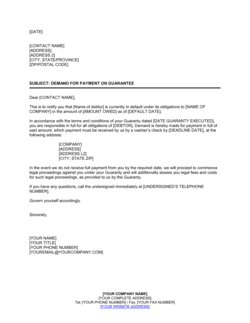
Demanding payment from a guarantor when the primary debtor defaultsDemand Letter to Guarantor
Initiating a formal claim against a business for unpaid commercial debtCommercial Debt Collection Letter

Common mistakes to avoid

❌ No specific payment deadline

Why it matters: A letter that demands payment 'immediately' or 'promptly' gives the debtor no enforceable date to miss. Courts need a specific deadline to establish that the cure period has expired.

Fix: Replace all vague time references with a specific calendar date β€” e.g., 'no later than June 10, 2026' β€” calculated as 7 to 14 days from the date of sending.

❌ Threatening legal action the creditor is not prepared to take

Why it matters: Idle threats train sophisticated debtors to ignore future letters, and courts weigh the credibility of the creditor's claims when awarding fees and costs.

Fix: Only include consequences you have already decided to pursue. If you are not yet sure, write 'all available legal remedies' and consult a lawyer before sending.

❌ Claiming an interest rate not established in the original contract

Why it matters: Courts award only the contractually agreed rate or the statutory default rate β€” claiming a higher rate exposes the creditor to a counterclaim for improper debt collection.

Fix: Check the original invoice, service agreement, or purchase order for the agreed late-fee rate. If none was specified, use the applicable statutory judgment interest rate for the governing jurisdiction.

❌ Sending only by email with no delivery confirmation

Why it matters: A debtor can credibly claim they never received an email. Without proof of delivery, the cure period and the escalation timeline are impossible to establish in court.

Fix: Send by certified mail or courier in addition to email, and retain both the signed return receipt and the email send-timestamp as part of your file.

❌ Using the wrong debtor name or entity

Why it matters: A demand letter addressed to the wrong entity β€” a trade name, a subsidiary, or an individual when the debtor is a corporate entity β€” cannot be enforced against the actual obligor without amendment and re-service.

Fix: Verify the debtor's registered legal name in the applicable business registry before drafting. If the debtor is a sole proprietor, use their personal legal name alongside any trade name.

❌ Omitting the invoice exhibits

Why it matters: Without attached invoices, the debtor can dispute that any debt was ever formally documented, delaying resolution and weakening the creditor's position in court.

Fix: Attach a copy of every invoice referenced in the letter and label each as 'Exhibit A,' 'Exhibit B,' etc. Reference each exhibit by its label in the body of the letter.

The 10 key clauses, explained

Creditor and Debtor Identification

In plain language: Identifies both parties by their full legal names and addresses, establishing who is owed money and who owes it.

Sample language
This Final Demand for Payment is issued by [CREDITOR LEGAL NAME], located at [CREDITOR ADDRESS] ('Creditor'), to [DEBTOR LEGAL NAME], located at [DEBTOR ADDRESS] ('Debtor').

Common mistake: Using a trade name or first name only instead of the debtor's full legal entity name β€” a mismatch makes any subsequent court filing harder to connect to this letter and may require re-filing.

Reference to Prior Invoices and Notices

In plain language: Cites the specific invoices, invoice numbers, and dates of prior payment requests to establish a documented history of non-payment.

Sample language
Despite the issuance of Invoice No. [INVOICE NUMBER] dated [DATE] for $[AMOUNT], and reminder notices sent on [REMINDER DATE 1] and [REMINDER DATE 2], payment has not been received.

Common mistake: Referencing invoices in general terms ('several invoices') without citing specific numbers and dates β€” vagueness weakens the paper trail and gives the debtor room to dispute which amounts are actually in default.

Statement of Total Amount Due

In plain language: States the exact total owed, broken down by principal, accrued interest or late fees, and any other charges authorized by contract or law.

Sample language
The total outstanding balance due to Creditor is $[TOTAL AMOUNT], consisting of: principal $[PRINCIPAL], accrued late fees at [RATE]% per month totaling $[FEE AMOUNT], and any other amounts owing under the Agreement dated [DATE].

Common mistake: Stating a rounded or estimated figure instead of a precise, itemized total β€” a disputed number in a demand letter allows the debtor to stall payment by contesting the arithmetic.

Final Payment Deadline

In plain language: Sets a specific calendar date β€” not a vague 'promptly' or 'immediately' β€” by which full payment must be received.

Sample language
You are hereby required to remit payment in full of $[TOTAL AMOUNT] no later than [SPECIFIC DATE], which is [7 / 14] days from the date of this letter.

Common mistake: Using 'immediately' or 'as soon as possible' instead of a fixed date β€” courts and debtors interpret these differently, and a missing deadline undermines the legal force of the letter.

Payment Instructions

In plain language: Provides specific, current instructions for how payment should be made β€” bank transfer details, check payable to, or a payment portal link.

Sample language
Payment should be made by wire transfer to: [BANK NAME], Account No. [ACCOUNT NUMBER], Routing No. [ROUTING NUMBER], Ref: [INVOICE NUMBER]; or by check payable to [CREDITOR LEGAL NAME] mailed to [ADDRESS].

Common mistake: Omitting payment instructions entirely and expecting the debtor to figure out how to pay β€” at the final demand stage, every friction point that delays payment works against the creditor.

Warning of Legal Consequences

In plain language: Explicitly states the specific actions the creditor will take if payment is not received by the deadline β€” filing in small claims court, civil litigation, or referral to a collections agency.

Sample language
If payment in full is not received by [DATE], Creditor will, without further notice, pursue all available legal remedies, including filing a claim in [COURT NAME / small claims court], retaining a collections agency, and seeking recovery of court costs and attorney's fees where permitted by law.

Common mistake: Writing vague consequences like 'we will take appropriate action' β€” specificity signals seriousness and is more likely to prompt payment than general threats the debtor discounts.

Interest and Late Fees

In plain language: States the contractual or statutory rate at which interest and late fees continue to accrue until the date of payment in full.

Sample language
Interest will continue to accrue on the unpaid balance at the rate of [X]% per month ([Y]% per annum) from the original due date until the date of payment in full, as provided in the Agreement dated [DATE].

Common mistake: Claiming a late-fee or interest rate that was never agreed to in the underlying contract β€” courts will only award the contractual rate or the statutory default rate, and claiming more invites a counterclaim.

Dispute Resolution Window

In plain language: Invites the debtor to contact the creditor in writing within the cure period if they genuinely dispute the amount, preserving the option of a negotiated resolution without litigation.

Sample language
If you believe this amount is incorrect or wish to discuss a payment arrangement, you must contact the undersigned in writing at [EMAIL / ADDRESS] within [7] days of this letter. Silence will be treated as confirmation of the debt.

Common mistake: Omitting any dispute window entirely β€” a letter with no response path pushes debtors directly toward defensive legal posturing, whereas a short dispute window often surfaces resolvable misunderstandings faster.

Governing Law and Jurisdiction

In plain language: States which jurisdiction's laws govern the debt and where any legal proceedings will be filed.

Sample language
This demand and any dispute arising from the underlying obligation are governed by the laws of [STATE / PROVINCE / COUNTRY]. Any legal action will be commenced in the courts of [COUNTY / DISTRICT / JURISDICTION].

Common mistake: Omitting governing law entirely when the creditor and debtor are in different states or countries β€” without it, a debtor can contest jurisdiction and delay proceedings significantly.

Creditor Signature and Date

In plain language: The letter must be signed and dated by an authorized representative of the creditor, creating a record of when notice was formally given.

Sample language
Issued by: [AUTHORIZED SIGNATORY NAME], [TITLE], [CREDITOR LEGAL NAME] | Date: [DATE] | Contact: [EMAIL] | [PHONE NUMBER]

Common mistake: Sending the letter unsigned or signed by someone without authority to bind the creditor β€” unsigned demand letters are routinely ignored by debtors and carry no evidentiary weight in court.

How to fill it out

  1. 1

    Confirm the debtor's current legal name and address

    Look up the debtor's full registered legal name β€” not a trading name or nickname β€” and their current business or residential address. If the debtor is a company, identify the registered entity name and agent address.

    πŸ’‘ Send the letter by both email and certified mail with return receipt so you have documented proof of delivery on the date that starts the cure period.

  2. 2

    List every unpaid invoice by number and date

    Pull all outstanding invoices and list each one by invoice number, date, and amount. Calculate the running total, including any contractual late fees or interest that have accrued to today's date.

    πŸ’‘ Attach copies of every cited invoice as exhibits to the letter β€” the exhibit package is what you bring to court if the debtor does not pay.

  3. 3

    Set a specific payment deadline

    Choose a firm calendar date 7 to 14 days from the sending date. Seven days is appropriate for debtors who have already received multiple reminders; 14 days is standard for a first formal demand.

    πŸ’‘ Avoid weekends and public holidays as the deadline date β€” choose the next business day so there is no ambiguity about whether the deadline was met.

  4. 4

    State the exact total due with an itemized breakdown

    Enter the principal balance, any accrued late fees at the contractual or statutory rate, and any other authorized charges. Show the arithmetic so the debtor cannot dispute the total without attacking specific line items.

    πŸ’‘ If you are unsure which late-fee rate is enforceable, use the statutory judgment interest rate for your jurisdiction rather than risk a counterclaim for overcharging.

  5. 5

    Provide complete payment instructions

    Include wire transfer details (bank name, account number, routing number) and/or a check-payable-to line and mailing address. If you have a payment portal, include the URL and the invoice reference number to use.

    πŸ’‘ Remove any payment instructions that are no longer active β€” sending a debtor to a closed account or a dead payment link is a gift to their lawyer.

  6. 6

    Specify the legal consequences of non-payment

    Name the specific next steps you will take: small claims filing, civil lawsuit, or collections referral. Include that you will seek court costs and attorney's fees where permitted by your governing law.

    πŸ’‘ Only threaten actions you are actually prepared to take. Courts look unfavorably on demand letters that make threats the creditor never follows through on.

  7. 7

    Sign, date, and send by trackable method

    Have an authorized representative sign the letter and date it. Send it simultaneously by email (to the debtor's last known business email) and by certified mail or courier with delivery confirmation.

    πŸ’‘ Keep the email thread and the certified mail receipt together in the same file β€” this two-method delivery record is important evidence if the debtor claims they never received the letter.

Frequently asked questions

What is a final demand for payment letter?

A final demand for payment letter is a formal written notice sent to a debtor who has ignored prior invoices and payment reminders. It states the exact amount owed with a specific deadline β€” typically 7 to 14 days β€” and warns that failure to pay will result in legal action, small claims filing, or referral to a collections agency. It is the last step before a creditor escalates outside direct communication, and it creates a critical paper trail for any subsequent court proceedings.

When should I send a final demand letter instead of another reminder?

Send a final demand when the debtor has already received at least one formal invoice and one or two follow-up reminders, and payment is still outstanding. A final demand signals a genuine shift in posture β€” from requesting payment to warning of imminent legal action. Sending it too early (after only one missed invoice) reduces its credibility; sending it too late (after months of ignored reminders) signals that you have no intention of following through.

Does a final demand letter need to be sent by a lawyer?

No β€” a creditor can send a final demand letter themselves without legal representation. However, a letter on law-firm letterhead is often taken more seriously by debtors and may prompt faster payment. For debts over $10,000, or in heavily regulated collection environments, having a lawyer review or send the letter reduces the risk of inadvertently violating debt collection laws such as the US FDCPA.

What is the difference between a payment reminder and a final demand letter?

A payment reminder is a courtesy notice that the invoice is overdue, with no explicit threat of legal action. A final demand letter states that no further notices will be sent and that specific legal consequences will follow if payment is not received by a firm deadline. The distinction matters legally β€” a final demand establishes that the creditor has given the debtor a last opportunity to cure, which many courts and small claims procedures require before a claim is filed.

How long should the payment deadline in a final demand letter be?

Seven to 14 days is the standard range. Seven days is appropriate when the debtor has already been contacted multiple times over a long period. Fourteen days is the more common standard and gives the debtor enough time to process payment internally without creating unnecessary delay. Deadlines shorter than five business days may be challenged as unreasonable in some jurisdictions.

Can I charge interest and late fees in a final demand letter?

Yes, but only if the underlying contract or invoice contained an agreed late-fee or interest clause, or if a statutory rate applies in your jurisdiction. State the rate explicitly and show the calculation. Never claim a rate higher than the contractual or statutory maximum β€” doing so can expose you to a counterclaim under debt collection laws and may reduce your credibility with the court.

What happens if the debtor ignores a final demand letter?

If the debtor does not pay or dispute the amount in writing within the stated deadline, the creditor's next steps typically include filing a claim in small claims court (for lower amounts, usually up to $10,000– $25,000 depending on the jurisdiction), commencing civil litigation through a lawyer, or referring the account to a licensed third-party collections agency. The final demand letter becomes key evidence that the debtor had notice and an opportunity to pay before legal action began.

Is a final demand letter legally required before suing?

In most jurisdictions it is not strictly required by law before filing a civil claim. However, many small claims courts expect evidence that the plaintiff attempted to resolve the matter before filing. In some US states and Canadian provinces, certain contract types (construction, consumer credit) do require a pre-litigation notice. A final demand letter is also a practical necessity β€” judges consistently look more favorably on plaintiffs who demonstrably gave the debtor a final opportunity to pay.

Should I send the final demand by certified mail or email?

Both. Email provides a timestamped, immediately deliverable record; certified mail with return receipt provides legally robust proof of delivery that is harder for the debtor to challenge. Sending by both methods simultaneously minimizes the debtor's ability to claim non-receipt and starts the cure period running from the earliest confirmed delivery date.

How this compares to alternatives

vs Payment Reminder Letter

A payment reminder is a courteous follow-up that asks for payment without threatening legal consequences. A final demand letter is a pre-litigation notice with a firm deadline and explicit escalation language. Use a reminder first; escalate to a final demand only after at least one reminder has been ignored and you are genuinely prepared to follow through.

vs Demand Letter (General)

A general demand letter can cover any legal claim β€” contract breach, property damage, or personal injury. A final demand for payment is narrowly focused on a liquidated debt already documented by invoices. The payment-specific version is more precise in its arithmetic, references original invoices, and follows a debt-collection paper trail that general demand letters do not.

vs Collections Referral Notice

A collections referral notice informs the debtor that their account has already been transferred to a third-party agency. The final demand letter precedes this step β€” it is the last opportunity to pay before the account moves out of the creditor's direct control and the debtor begins dealing with a collections agency with independent regulatory obligations.

vs Cease and Desist Letter

A cease and desist letter demands that a party stop a specific action β€” infringement, harassment, or breach. A final demand for payment demands money owed, not a behavioral change. The two documents serve opposite creditor objectives and should not be conflated, though both function as pre-litigation notices.

Industry-specific considerations

Professional Services

Agencies, consultants, and law firms use final demand letters to collect on project milestones, retainer balances, and hourly billings where the client relationship has already broken down.

Construction and Trades

Contractors and subcontractors use final demands before filing mechanics liens β€” many jurisdictions require a pre-lien demand notice within a specific window after project completion.

Retail and Wholesale

Suppliers and distributors issue final demands on overdue trade accounts before placing buyers on credit hold or referring balances to commercial collections.

Real Estate and Property Management

Landlords send final demands for unpaid rent, property damage charges, or lease-end balances as a required step before initiating eviction or small claims proceedings in most jurisdictions.

Jurisdictional notes

United States

No federal law requires a demand letter before filing a civil claim, but most small claims courts (jurisdiction limits range from $2,500 in Kentucky to $25,000 in Tennessee) expect evidence of a prior demand. Third-party collectors must comply with the Fair Debt Collection Practices Act (FDCPA), which restricts harassment and requires debt validation notices. First-party creditors (collecting their own debts) are not directly subject to the FDCPA but may face state-level equivalents.

Canada

Pre-litigation demand letters are customary but not universally mandated before filing in Small Claims Court (limits range from $20,000 in Ontario to $35,000 in British Columbia). Collection agencies in each province must be licensed and comply with provincial consumer protection statutes. In Ontario, the Collection and Debt Settlement Services Act restricts contact frequency and requires specific disclosure language. Quebec requires French-language communication for consumer debtors.

United Kingdom

The Late Payment of Commercial Debts (Interest) Act 1998 entitles business creditors to claim statutory interest at 8% above the Bank of England base rate on overdue commercial invoices β€” this rate should be referenced in the letter. The Pre-Action Protocol for Debt Claims (effective 2017) requires creditors to send a compliant letter of claim and allow at least 30 days for a response before commencing court proceedings in England and Wales.

European Union

EU Directive 2011/7/EU on late payments entitles business creditors to statutory interest at 8 percentage points above the ECB reference rate and a fixed recovery fee (€40 for debts under €1,000) without needing to specify it in the original contract. Pre-litigation notice requirements vary by member state β€” France, Germany, and Spain each have distinct procedural steps before a creditor can obtain an injunction to pay (injonction de payer, Mahnverfahren, or juicio monitorio). GDPR applies to any personal data included in or processed in connection with the demand.

Template vs lawyer β€” what fits your deal?

PathBest forCostTime
Use the templateBusinesses and individuals collecting documented debts under $10,000 from clients who have ignored prior invoices and remindersFree20–30 minutes
Template + legal reviewDebts between $10,000 and $50,000, cross-border collections, or situations where the debtor has already threatened a counterclaim$150–$400 for a lawyer review and letterhead send1–2 business days
Custom draftedLarge commercial debts over $50,000, regulated industries, or debtors in jurisdictions with strict pre-litigation notice requirements$500–$1,500+2–5 business days

Glossary

Demand Letter
A formal written notice from a creditor to a debtor specifying the amount owed and the consequences of non-payment.
Creditor
The party to whom money is owed β€” the business, individual, or entity sending the demand letter.
Debtor
The party who owes money and is the recipient of the demand letter.
Cure Period
The defined window of time β€” typically 7 to 14 days β€” given to the debtor to pay or dispute before legal action is initiated.
Statute of Limitations
The maximum period during which a creditor can file a legal claim to collect a debt β€” typically 3 to 6 years for written contracts, varying by jurisdiction.
Small Claims Court
A lower civil court designed to resolve relatively low-value disputes quickly and without formal legal representation β€” the most common next step after a final demand.
Pre-Litigation Notice
A required or customary written notice sent to a debtor before filing a lawsuit, giving them a final opportunity to resolve the matter outside court.
Debt Validation
Under the US Fair Debt Collection Practices Act, the debtor's right to request written proof of the amount owed and the original creditor's identity within 30 days of initial contact.
Judgment
A court order establishing that the debtor owes a specific amount, which the creditor can then enforce through wage garnishment, bank levies, or liens.
Charge-Off
An accounting action in which a creditor writes a debt off as a loss after a defined period of non-payment β€” typically 90 to 180 days β€” though the debt remains legally collectible.
Fair Debt Collection Practices Act (FDCPA)
A US federal law regulating how third-party debt collectors may contact and communicate with debtors β€” including restrictions on language that may constitute harassment.

Part of your Business Operating System

This document is one of 3,000+ business & legal templates included in Business in a Box.

  • Fill-in-the-blanks β€” ready in minutes
  • 100% customizable Word document
  • Compatible with all office suites
  • Export to PDF and share electronically

Create your document in 3 simple steps.

From template to signed document β€” all inside one Business Operating System.
1
Download or open template

Access over 3,000+ business and legal templates for any business task, project or initiative.

2
Edit and fill in the blanks with AI

Customize your ready-made business document template and save it in the cloud.

3
Save, Share, Send, Sign

Share your files and folders with your team. Create a space of seamless collaboration.

Save time, save money, and create top-quality documents.

β˜…β˜…β˜…β˜…β˜…

"Fantastic value! I'm not sure how I'd do without it. It's worth its weight in gold and paid back for itself many times."

Managing Director Β· Mall Farm
Robert Whalley
Managing Director, Mall Farm Proprietary Limited
β˜…β˜…β˜…β˜…β˜…

"I have been using Business in a Box for years. It has been the most useful source of templates I have encountered. I recommend it to anyone."

Business Owner Β· 4+ years
Dr Michael John Freestone
Business Owner
β˜…β˜…β˜…β˜…β˜…

"It has been a life saver so many times I have lost count. Business in a Box has saved me so much time and as you know, time is money."

Owner Β· Upstate Web
David G. Moore Jr.
Owner, Upstate Web

Run your business with a system β€” not scattered tools

Stop downloading documents. Start operating with clarity. Business in a Box gives you the Business Operating System used by over 250,000 companies worldwide to structure, run, and grow their business.

Free Forever PlanΒ Β·Β No credit card required