Demand for Acknowledgment of Shipping Dates Template

Free Word download β€’ Edit online β€’ Save & share with Drive β€’ Export to PDF

1 pageβ€’20–25 min to fillβ€’Difficulty: Standardβ€’Signature requiredβ€’Legal review recommended
Learn more ↓
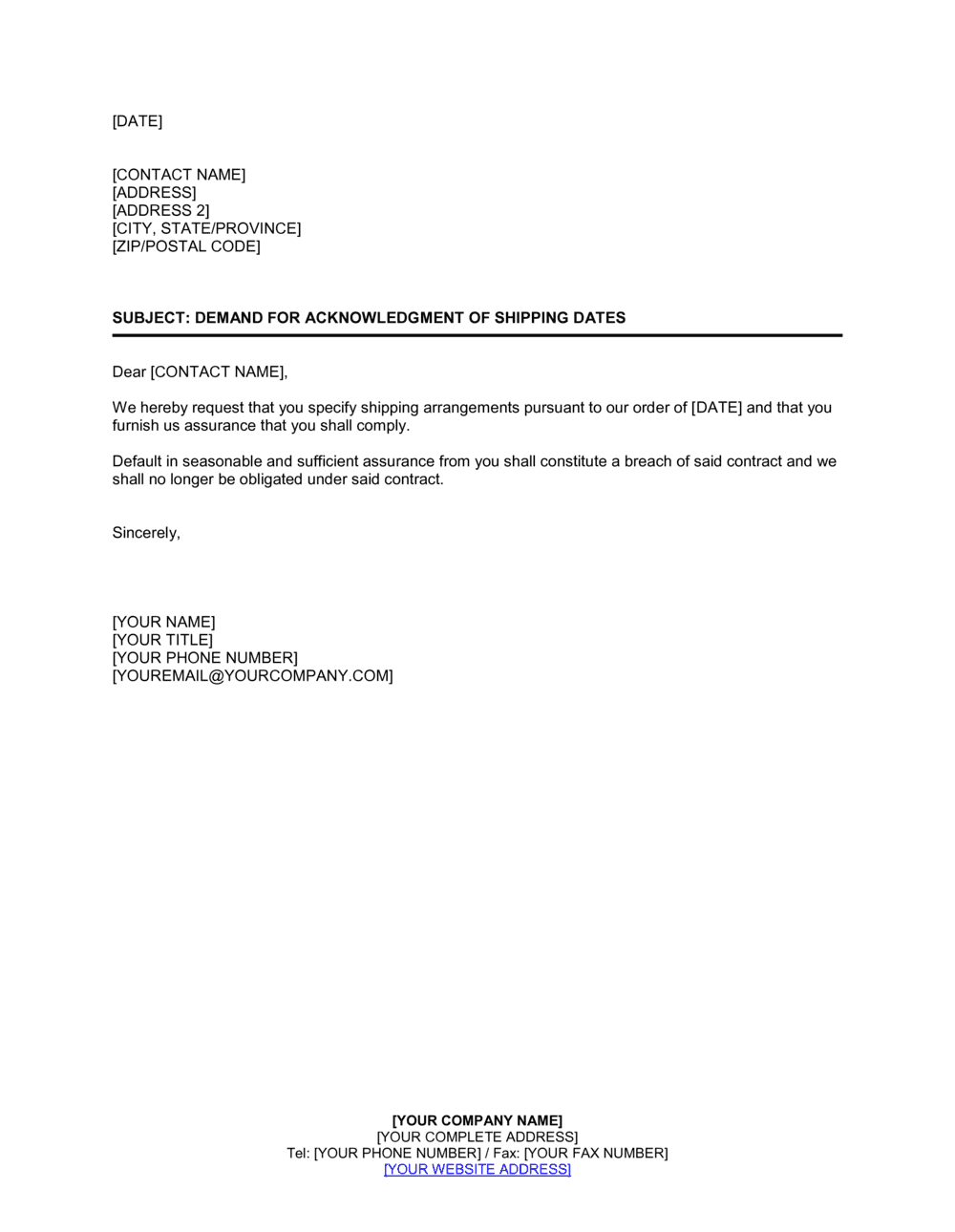
FreeDemand for Acknowledgment of Shipping Dates Template

At a glance

What it is
A Demand For Acknowledgment Of Shipping Dates is a formal written notice issued by a buyer or contracting party to a supplier or seller, requiring written confirmation of agreed or anticipated delivery dates for goods under a purchase order or supply agreement. This free Word download gives you a legally structured starting point you can edit online and export as PDF to send to any vendor or logistics partner.
When you need it
Use it when a supplier has failed to confirm shipping dates after a purchase order has been placed, when delivery timelines are approaching and confirmation is outstanding, or when you need a documented paper trail before escalating to breach-of-contract remedies.
What's inside
Identification of the parties and the underlying purchase order, a specific demand for written acknowledgment of shipping dates, a response deadline, a statement of consequences for non-response, and signature blocks for both parties. Together these elements create a formal record that supports any subsequent legal or commercial action.

What is a Demand For Acknowledgment Of Shipping Dates?

A Demand For Acknowledgment Of Shipping Dates is a formal written notice issued by a buyer to a supplier requiring the supplier to confirm in writing the specific dates on which ordered goods will be shipped under an existing purchase order or supply agreement. Unlike a casual follow-up email, this document is structured as a legal notice β€” it cites the underlying contract, states a binding response deadline, identifies the consequences of non-response, and is signed by an authorized representative. When the supplier countersigns the acknowledgment section, the confirmed shipping dates become a documented contractual commitment that supports cancellation rights, liquidated damages claims, or reprocurement cost recovery if the supplier subsequently fails to perform.

Why You Need This Document

Relying on verbal assurances or informal email threads about shipping dates leaves buyers exposed in two ways: they have no enforceable commitment to point to if the supplier misses the date, and they have no formal notice on record to satisfy the procedural prerequisites for most contractual remedies. When a supplier goes silent after a purchase order is placed β€” or provides only vague reassurances β€” every day without written confirmation brings a production halt, missed sales window, or downstream contract breach closer. This demand letter creates the paper trail that transforms a communication problem into a legally documented failure, giving the buyer the standing to cancel the order, source alternative goods at the supplier's expense, and pursue damages β€” all of which depend on having sent proper written notice first.

Which variant fits your situation?

If your situation is…Use this template
Supplier has confirmed dates verbally but not in writingDemand For Acknowledgment Of Shipping Dates
Supplier has already missed a confirmed shipping dateDemand Letter for Breach of Contract
You need to formally cancel the order after non-responsePurchase Order Cancellation Letter
You want to put supplier on notice before cancellationNotice of Intent to Cancel Purchase Order
Requesting a revised delivery schedule after a known delayRequest For Extension of Delivery Date
Documenting ongoing shipping performance issues with a vendorVendor Performance Warning Letter
Formalizing agreed shipping terms at the outset of a relationshipSupply Agreement

Common mistakes to avoid

❌ Omitting the original agreed shipping date

Why it matters: Without a specific date on record, the demand is too vague to enforce. The supplier can respond that it was never told what date to confirm, and any downstream legal action loses its anchor.

Fix: Quote the shipping date directly from the purchase order or supply agreement and include the relevant clause number so there is no ambiguity about what confirmation is demanded.

❌ Setting an unreasonably short response deadline

Why it matters: A 24- or 48-hour deadline for an international supplier is commercially unreasonable. Courts and arbitrators may treat the demand as procedurally defective, negating its effect as formal notice.

Fix: Use 5–7 business days for domestic suppliers and 10–14 business days for international suppliers. If urgency requires a shorter window, document the business reason explicitly in the letter.

❌ Failing to include a reservation of rights clause

Why it matters: Sending a demand with a cure period can be read as the buyer electing to treat the failure as curable rather than already actionable β€” potentially waiving the right to claim damages for an existing default.

Fix: Include standard 'without prejudice' and reservation of rights language in every demand letter, regardless of whether you intend to escalate immediately.

❌ Not specifying what a valid acknowledgment must contain

Why it matters: Without clear requirements, the supplier may send a one-line email saying 'we'll ship soon' and claim they have complied. This defeats the purpose of the demand entirely.

Fix: State that acknowledgment must include the PO number, specific ship date(s), and the signature of an authorized representative β€” and that vague confirmations do not satisfy the demand.

The 9 key clauses, explained

Parties and purchase order identification

In plain language: Names the buyer and supplier as legal entities and references the specific purchase order number, date, and goods covered by the demand.

Sample language
This demand is issued by [BUYER LEGAL NAME] ('Buyer') to [SUPPLIER LEGAL NAME] ('Supplier') with respect to Purchase Order No. [PO NUMBER] dated [DATE] for [DESCRIPTION OF GOODS] ('the Order').

Common mistake: Referencing a trade name instead of the registered legal entity name β€” this weakens enforceability and creates ambiguity about which entity is bound.

Statement of outstanding acknowledgment

In plain language: Identifies specifically that shipping date confirmation is outstanding, states what was originally agreed or expected, and notes the date by which confirmation should have been received.

Sample language
As of [DATE], Buyer has not received written acknowledgment of the shipping dates for the Order. Pursuant to the Order, goods were to ship no later than [REQUIRED SHIP DATE]. Supplier's written confirmation of this date remains outstanding.

Common mistake: Omitting the original agreed shipping date β€” without it, the demand is vague and the supplier can dispute what confirmation is actually being demanded.

Formal demand for written acknowledgment

In plain language: Directs the supplier to provide written confirmation of specific shipping dates within a defined response deadline.

Sample language
Buyer hereby formally demands that Supplier provide written acknowledgment, no later than [RESPONSE DEADLINE DATE], confirming the specific shipping date(s) for all goods covered by the Order, including any partial shipment schedule.

Common mistake: Setting an unrealistically short response deadline (e.g., 24 hours for an international supplier) β€” courts and arbitrators treat commercially unreasonable deadlines as procedurally defective.

Consequences of non-response or non-compliance

In plain language: States clearly what actions the buyer will take if the supplier fails to respond or fails to confirm acceptable shipping dates β€” such as cancellation, sourcing alternatives, or pursuit of damages.

Sample language
Failure to provide the required acknowledgment by [RESPONSE DEADLINE DATE] may result in Buyer cancelling the Order, procuring substitute goods from an alternative supplier at Supplier's expense, and/or pursuing all available remedies for breach of contract.

Common mistake: Listing only cancellation as a consequence and omitting the right to recover excess reprocurement costs β€” this limits the buyer's documented remedies at the time they need them most.

Time of the essence declaration

In plain language: Expressly states that the shipping dates are essential performance obligations and that any delay constitutes a material breach, not merely a minor inconvenience.

Sample language
Buyer expressly notifies Supplier that time is of the essence with respect to the shipping dates specified in the Order. Any failure to ship by the confirmed date shall constitute a material breach of the Order entitling Buyer to exercise all available remedies.

Common mistake: Assuming the original purchase order already contains a 'time is of the essence' clause β€” if it doesn't, this must be included explicitly in the demand letter to establish the legal standard.

Reference to governing contract terms

In plain language: Points back to the purchase order, supply agreement, or general terms and conditions that govern the parties' obligations, so the demand is grounded in existing contractual language.

Sample language
This demand is issued pursuant to and in accordance with the terms and conditions of the Order, including Section [X] (Delivery Terms) and Section [Y] (Remedies for Non-Performance), incorporated herein by reference.

Common mistake: Failing to cite the specific contract sections β€” a demand that floats free of the underlying agreement is harder to enforce and easier for the supplier to dismiss as informal.

Method and address for acknowledgment

In plain language: Specifies exactly how and where the supplier must send its written acknowledgment β€” email address, physical address, or both β€” and what the acknowledgment must contain to be valid.

Sample language
Acknowledgment must be provided in writing to [BUYER CONTACT NAME] at [EMAIL ADDRESS] and [PHYSICAL ADDRESS]. A valid acknowledgment must identify the Order number, confirm the specific ship date(s), and be signed by an authorized representative of Supplier.

Common mistake: Accepting any informal email response as acknowledgment β€” without specifying that the acknowledgment must be signed by an authorized representative, an intern's reply email may not bind the supplier.

Reservation of rights

In plain language: States that sending this demand does not waive any rights the buyer already has under the contract or applicable law, so that taking this step does not limit available remedies.

Sample language
Buyer's issuance of this demand is without prejudice to any and all rights and remedies available to Buyer under the Order, any applicable supply agreement, or applicable law, all of which are hereby expressly reserved.

Common mistake: Omitting a reservation of rights entirely β€” without it, sending a demand letter with a cure period can inadvertently be read as the buyer waiving its right to treat an existing default as already actionable.

Signature and authorization block

In plain language: Provides signature lines for authorized representatives of both parties, confirming the demand has been issued by a person with authority to act on behalf of the buyer.

Sample language
Issued by: [BUYER AUTHORIZED REPRESENTATIVE NAME], [TITLE], [BUYER LEGAL NAME], on [DATE]. Acknowledged by: [SUPPLIER AUTHORIZED REPRESENTATIVE NAME], [TITLE], [SUPPLIER LEGAL NAME], on [DATE].

Common mistake: Having a non-authorized employee sign the demand β€” if the signatory lacks authority, the supplier may challenge the validity of the demand and any downstream notice it purports to give.

How to fill it out

  1. 1

    Identify the parties using registered legal entity names

    Enter the full registered legal name of both the buyer and the supplier β€” not trade names or abbreviations. Cross-reference the supplier's name against the original purchase order to ensure consistency.

    πŸ’‘ Mismatched entity names between the demand letter and the underlying PO are the most common reason these documents fail to create a clean paper trail.

  2. 2

    Reference the specific purchase order and goods

    Enter the PO number, PO date, and a brief description of the goods covered. If the order covers multiple SKUs or product lines, list them or attach a schedule.

    πŸ’‘ If the PO covers a large number of line items, reference 'all goods as described in Purchase Order No. [X], attached hereto as Exhibit A' rather than listing each item inline.

  3. 3

    State the originally agreed or expected shipping date

    Identify the shipping date that was agreed in the PO or supply agreement, or the date the buyer reasonably expected based on prior communications. Be specific β€” month, day, and year.

    πŸ’‘ Pull the exact language from the PO's delivery section rather than paraphrasing it β€” quoting the contract directly makes the demand harder to dispute.

  4. 4

    Set a commercially reasonable response deadline

    Enter the date by which the supplier must respond with written acknowledgment. For domestic suppliers, 5–7 business days is standard. For international suppliers, 10–14 business days is more defensible.

    πŸ’‘ Back-calculate from your own downstream production or sales deadlines β€” the response deadline should give you enough time to source alternatives if the supplier fails to respond.

  5. 5

    Specify the required content of the acknowledgment

    State that a valid acknowledgment must include the PO number, specific ship date(s), and signature of an authorized supplier representative. This prevents a vague reply from counting as compliance.

    πŸ’‘ Consider adding a line that partial shipment schedules must be confirmed line by line if the order covers multiple SKUs.

  6. 6

    Complete the consequences and reservation of rights clauses

    Confirm which remedies you are reserving β€” cancellation, reprocurement at supplier's cost, and/or damages. Ensure the reservation of rights language is present so no existing default is inadvertently waived.

    πŸ’‘ If your supply agreement includes a specific liquidated damages clause for late shipment, reference it explicitly in the consequences section.

  7. 7

    Have an authorized representative sign before sending

    Ensure the signatory is a person with documented authority to issue binding demands on behalf of the buyer β€” a procurement manager, VP of Operations, or equivalent. Note their title under the signature.

    πŸ’‘ If your company requires dual authorization for contract notices above a certain value, follow that internal policy before issuing the demand β€” a non-compliant internal process can undermine the document.

  8. 8

    Send via a method that creates a delivery record

    Send the demand by email with read-receipt confirmation, tracked courier, or certified mail β€” whichever your supply agreement specifies for notices. Retain proof of delivery.

    πŸ’‘ If your supply agreement designates a specific notice address or method, use exactly that method β€” using the wrong delivery channel can invalidate the notice under the contract's terms.

Frequently asked questions

What is a demand for acknowledgment of shipping dates?

A demand for acknowledgment of shipping dates is a formal written notice from a buyer to a supplier requiring the supplier to confirm in writing the specific dates on which ordered goods will be shipped. It is used when a supplier has not voluntarily confirmed shipping timelines after a purchase order has been placed, and it creates a documented record that supports cancellation, reprocurement, or damages claims if the supplier fails to respond or perform.

When should I send a demand for acknowledgment of shipping dates?

Send it when a purchase order has been placed, the shipping date is approaching or has passed, and the supplier has not provided written confirmation of when goods will ship. It is also appropriate when a supplier has given only verbal or informal assurances and you need a binding written record. Sending this letter before the deadline passes is strategically important β€” it establishes that you put the supplier on formal notice before seeking remedies.

Is this document legally binding?

The demand letter itself is a formal notice, not a standalone contract. Its legal effect derives from the underlying purchase order or supply agreement it references. When the supplier signs and returns the acknowledgment section, that response is generally enforceable as a written confirmation of a material delivery obligation. Even without a signed return, the demand creates a documented record of the buyer's notice that strengthens any subsequent breach-of-contract claim.

What happens if the supplier ignores the demand?

Non-response by the deadline stated in the demand typically entitles the buyer to exercise the remedies reserved in the letter β€” which may include cancelling the order, procuring replacement goods from an alternative supplier and charging the cost difference to the non-responsive supplier, and pursuing contractual or common-law damages. The demand letter serves as the formal notice required before most of these remedies can be triggered, so retaining proof of delivery is critical.

How long should I give the supplier to respond?

Five to seven business days is standard for domestic suppliers; ten to fourteen business days is more appropriate for international suppliers where time zone and translation considerations apply. If your supply agreement specifies a notice period, use that period. An unreasonably short deadline can undermine the document's enforceability, so match the response window to the practical realities of the supplier relationship.

Does the demand need to be signed by both parties?

The demand is issued and signed by an authorized representative of the buyer. The supplier's signature on the acknowledgment section confirms their written commitment to the shipping dates. If the supplier does not return a signed acknowledgment, the demand still functions as formal notice of the buyer's requirements β€” but the buyer will not have a signed shipping commitment from the supplier, which weakens the position if shipping dates are later disputed.

Can I use this document for international shipments?

Yes, but the governing law and notice requirements vary by jurisdiction. For cross-border transactions, confirm which country's law governs the supply agreement and ensure the response deadline and notice method comply with that jurisdiction's commercial standards. Include the Incoterms designation (e.g., FOB, CIF, DAP) applicable to the shipment so there is no ambiguity about which party controls the shipping date.

What is the difference between this document and a purchase order?

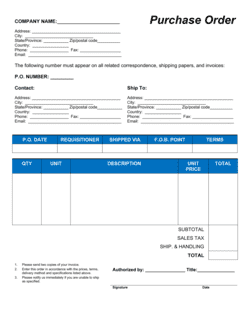
A purchase order authorizes and initiates a transaction β€” it sets out quantities, prices, and required delivery dates at the outset. A demand for acknowledgment of shipping dates is a follow-up enforcement document issued when the supplier has not confirmed compliance with those delivery obligations. The purchase order creates the obligation; the demand enforces it.

Should I send this by email or certified mail?

Use whichever method your supply agreement specifies for formal notices β€” typically certified mail, tracked courier, or email to a designated address. If the agreement does not specify a notice method, send it by both tracked email (with read receipt) and certified mail to create two independent delivery records. Retain both confirmations. The method matters because a notice sent via the wrong channel can be argued to have not been validly delivered under the contract's terms.
How this compares to alternatives

vs Purchase Order

A purchase order initiates a transaction by setting out quantities, prices, and required delivery dates. A demand for acknowledgment of shipping dates is a follow-up enforcement document issued when the supplier has not confirmed those delivery obligations. The PO creates the duty; the demand enforces it. Both should be referenced together in any subsequent dispute.

vs Demand Letter for Breach of Contract

A breach of contract demand is issued after a material failure has already occurred β€” the supplier missed the ship date or delivered non-conforming goods. A demand for acknowledgment of shipping dates is a proactive step issued before a breach, designed to compel confirmation and create a paper trail. Use the acknowledgment demand first; escalate to a breach letter if the supplier fails to respond or perform.

vs Supply Agreement

A supply agreement is the master contract governing the ongoing commercial relationship β€” pricing, delivery standards, IP, warranties, and remedies. A demand for acknowledgment of shipping dates is a transactional enforcement notice that operates under the supply agreement's terms. The supply agreement sets the rules; the demand invokes them for a specific shipment.

vs Notice of Intent to Cancel Purchase Order

A notice of intent to cancel is issued when the buyer has decided to terminate the order and is providing the supplier a final opportunity to cure. A demand for acknowledgment of shipping dates is an earlier-stage document that does not yet threaten cancellation β€” it demands confirmation. Sending the acknowledgment demand first, then escalating to a cancellation notice if no response is received, is the correct procedural sequence.

Industry-specific considerations

Retail and e-commerce

Seasonal inventory windows (e.g., holiday stock) make confirmed ship dates critical β€” a missed acknowledgment deadline can mean missed sell-through entirely.

Manufacturing

Just-in-time production schedules mean a single unconfirmed component shipment can halt an entire assembly line, making formal shipping acknowledgments essential supply chain management.

Construction

Material delivery tied to project milestones and sub-contractor schedules makes unconfirmed shipping dates a direct source of liquidated damages liability downstream.

Food and beverage

Perishable goods and regulatory shelf-life requirements mean shipping date uncertainty creates both financial and compliance risk that written acknowledgments help manage.

Jurisdictional notes

United States

Under the Uniform Commercial Code (UCC) Article 2, buyers have specific rights to demand adequate assurance of performance when reasonable grounds for insecurity arise. A demand for shipping date acknowledgment can serve as a formal assurance request under UCC Β§2-609, giving the seller up to 30 days to respond before the buyer may treat the contract as repudiated. State-specific variations in UCC adoption and notice requirements mean the governing state should be identified explicitly in the document.

Canada

Canadian common law (and Quebec civil law) both recognize the right to demand written confirmation of performance obligations when a party has reasonable grounds to doubt compliance. Provincial Sale of Goods Acts mirror many UCC concepts but vary by province. In Quebec, the Civil Code of Quebec governs commercial sales and imposes good-faith obligations on both parties. Response deadlines should be commercially reasonable under the circumstances of the specific transaction.

United Kingdom

Under the UK Sale of Goods Act 1979 and the Supply of Goods and Services Act 1982, time of delivery is a condition of the contract where the parties have agreed a specific date. A formal demand letter establishes the buyer's position before exercising the right to treat the contract as repudiated or claiming damages under the Hadley v. Baxendale remoteness principle. The Late Payment of Commercial Debts (Interest) Act 1998 may also be relevant where financial consequences attach to delayed shipments.

European Union

The UN Convention on Contracts for the International Sale of Goods (CISG) applies to cross-border EU commercial sales unless excluded by contract. Under CISG Article 71, a party may suspend performance if it becomes apparent the other party will not perform a substantial part of its obligations β€” a demand for acknowledgment documents this concern formally. Member state procedural rules for serving formal commercial notices vary, and the applicable language requirements should be checked for the supplier's jurisdiction.

Template vs lawyer β€” what fits your deal?

PathBest forCostTime
Use the templateBuyers dealing with routine supplier communication failures on standard domestic purchase ordersFree15–30 minutes
Template + legal reviewHigh-value orders, international suppliers, or transactions where liquidated damages or order cancellation are likely next steps$200–$500 for a 1-hour commercial lawyer review1–2 business days
Custom draftedComplex multi-party supply chains, regulated industries (pharmaceutical, aerospace, defense), or disputes where litigation is already anticipated$800–$2,500+3–7 business days

Glossary

Shipping Date
The calendar date on which goods are dispatched from the seller's facility to the buyer, as distinguished from the delivery or arrival date.
Acknowledgment
A written confirmation from a party that they have received, reviewed, and accepted specific terms or obligations β€” here, the agreed shipping schedule.
Purchase Order (PO)
A commercial document issued by a buyer authorizing a purchase from a supplier, specifying quantities, prices, and typically required delivery dates.
Demand Letter
A formal written notice requiring the recipient to take a specific action or face stated legal or contractual consequences.
Liquidated Damages
A pre-agreed sum specified in a contract that a party must pay if it fails to perform a defined obligation, such as shipping by a required date.
Material Breach
A failure to perform a contractual obligation serious enough to excuse the non-breaching party from its own obligations and entitle it to remedies.
Cure Period
A defined window of time β€” stated in the contract or demand letter β€” within which the defaulting party must remedy a failure before consequences attach.
FOB (Free on Board)
A shipping term indicating the point at which title and risk of loss transfer from seller to buyer β€” FOB Origin transfers at the seller's dock; FOB Destination transfers at the buyer's location.
Time of the Essence
A contractual provision stating that delivery or performance deadlines are strict obligations, and that any delay constitutes a material breach.
Notice Requirement
A contractual or statutory obligation to provide advance written notice before exercising a remedy such as cancellation or damages.

Part of your Business Operating System

This document is one of 3,000+ business & legal templates included in Business in a Box.

  • Fill-in-the-blanks β€” ready in minutes
  • 100% customizable Word document
  • Compatible with all office suites
  • Export to PDF and share electronically

Create your document in 3 simple steps.

From template to signed document β€” all inside one Business Operating System.
1
Download or open template

Access over 3,000+ business and legal templates for any business task, project or initiative.

2
Edit and fill in the blanks with AI

Customize your ready-made business document template and save it in the cloud.

3
Save, Share, Send, Sign

Share your files and folders with your team. Create a space of seamless collaboration.

Save time, save money, and create top-quality documents.

β˜…β˜…β˜…β˜…β˜…

"Fantastic value! I'm not sure how I'd do without it. It's worth its weight in gold and paid back for itself many times."

Managing Director Β· Mall Farm
Robert Whalley
Managing Director, Mall Farm Proprietary Limited
β˜…β˜…β˜…β˜…β˜…

"I have been using Business in a Box for years. It has been the most useful source of templates I have encountered. I recommend it to anyone."

Business Owner Β· 4+ years
Dr Michael John Freestone
Business Owner
β˜…β˜…β˜…β˜…β˜…

"It has been a life saver so many times I have lost count. Business in a Box has saved me so much time and as you know, time is money."

Owner Β· Upstate Web
David G. Moore Jr.
Owner, Upstate Web

Run your business with a system β€” not scattered tools

Stop downloading documents. Start operating with clarity. Business in a Box gives you the Business Operating System used by over 250,000 companies worldwide to structure, run, and grow their business.

Start freeΒ Β·Β No credit card required