Demand Note Template

Free Word download β€’ Edit online β€’ Save & share with Drive β€’ Export to PDF

1 pageβ€’20–30 min to fillβ€’Difficulty: Standardβ€’Signature requiredβ€’Legal review recommended
Learn more ↓
FreeDemand Note Template

At a glance

What it is
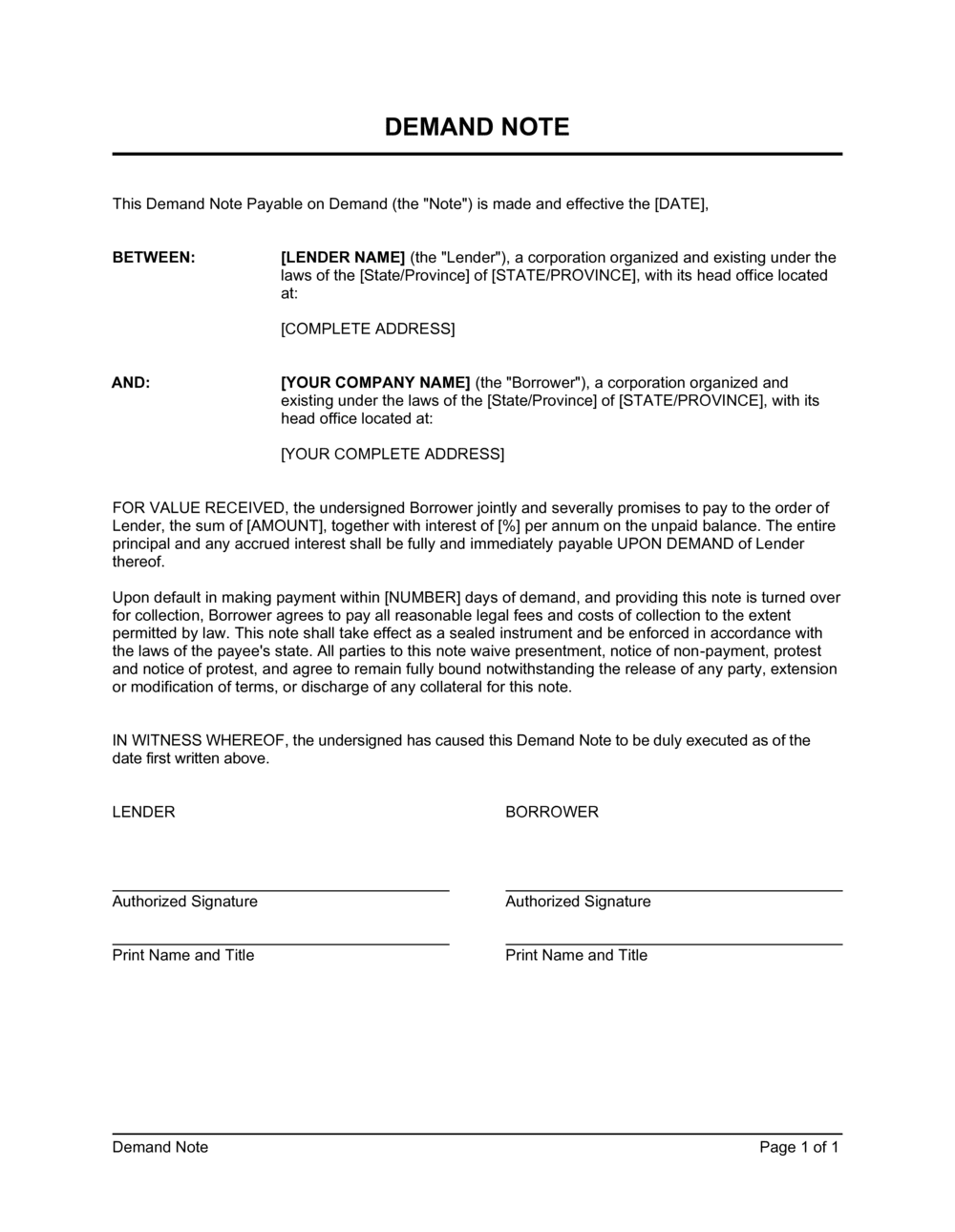
A Demand Note is a legally binding promissory note that requires the borrower to repay the principal and any accrued interest immediately upon the lender's written request β€” with no fixed maturity date. This free Word download lets you document family loans, owner-to-company advances, or short-term commercial loans in minutes, then export as PDF for signature.
When you need it
Use it when lending money without a fixed repayment schedule β€” common in family loans, shareholder advances to a corporation, or bridge financing where the lender wants the flexibility to call the loan at any time.
What's inside
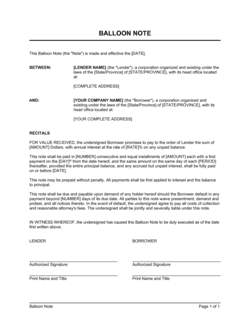
Parties and principal amount, interest rate and accrual method, demand and repayment mechanics, default and acceleration, governing law, and signature blocks for borrower and optional co-signer or guarantor.

What is a Demand Note?

A Demand Note is a legally binding promissory note signed by a borrower that obligates repayment of the full principal and all accrued interest immediately upon the lender's written request β€” with no fixed maturity date and no predetermined repayment schedule. Unlike a standard installment loan, the debt does not come due on a calendar date; it comes due the moment the holder asks for it. Demand notes function as negotiable instruments under the Uniform Commercial Code in the United States and under equivalent bills-of-exchange legislation in Canada, the UK, and most other common-law jurisdictions, meaning they can be transferred to a third party who then holds the right to demand repayment.

Why You Need This Document

Lending money without a signed demand note β€” even to a family member or to your own company β€” creates serious legal and tax exposure. Without a written instrument, tax authorities may reclassify the advance as a taxable gift or a disguised dividend, triggering income tax or gift tax consequences for both parties. In an insolvency, an undocumented advance ranks behind even unsecured creditors who hold written instruments. A signed demand note with a documented interest rate also gives the lender a clear enforcement path: serve a written demand, wait out the cure period, then pursue judgment β€” no ambiguity about terms, no he-said-she-said dispute about the original intent. This template gives you a professionally structured, jurisdiction-aware demand note you can complete in under 30 minutes and rely on if the relationship ever turns adversarial.

Which variant fits your situation?

If your situation is…Use this template
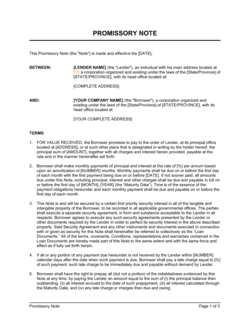
Lending with a fixed maturity date and installment schedulePromissory Note
Secured loan where borrower pledges collateralSecured Promissory Note
Personal loan between two private individualsPersonal Loan Agreement
Shareholder or director loan to a corporation with formal repayment termsShareholder Loan Agreement
Revolving credit line a borrower can draw and repay repeatedlyLine of Credit Agreement
Zero-interest loan for which the IRS imputed-interest rules must be navigatedInterest-Free Loan Agreement
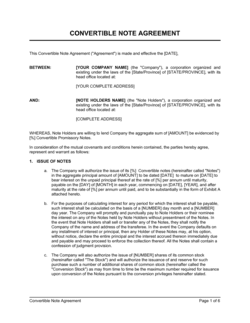
Bridge financing that converts to equity at a future roundConvertible Note Agreement

Common mistakes to avoid

❌ Setting no interest rate

Why it matters: An interest-free demand note between related parties triggers IRS imputed-interest rules, creating phantom income for the lender even if no interest is paid. In Canada, CRA applies similar attribution rules.

Fix: Set the rate at or above the applicable federal rate (AFR in the US) or the CRA prescribed rate in Canada. Even a nominal rate eliminates the imputed-income problem.

❌ Not specifying the demand notice method

Why it matters: An unspecified delivery method invites disputes about whether a valid demand was ever made, stalling the lender's ability to start the cure period clock and pursue collection.

Fix: Name the exact delivery method β€” registered mail, courier, or email with delivery confirmation β€” and the address or email to which demand must be sent.

❌ Skipping the waiver of presentment and protest

Why it matters: Several US states and Canadian provinces still require formal presentment and protest before a promissory note can be enforced. Omitting the waiver forces the lender through procedural steps that can delay or void enforcement.

Fix: Include a standard waiver clause in which the maker expressly waives presentment, demand, notice of dishonor, and protest.

❌ Using a demand note when a fixed-term note is more appropriate

Why it matters: If the borrower needs predictable repayment terms to service the debt, a demand note creates anxiety and relationship risk β€” especially in family loans. Calling the loan unexpectedly can destroy trust and trigger an inability-to-pay default.

Fix: If the borrower needs a predictable schedule, use a standard promissory note with fixed installments. Reserve the demand structure for situations where the lender genuinely needs call flexibility.

The 10 key clauses, explained

Parties and principal amount

In plain language: Identifies the lender (holder) and borrower (maker) by full legal name and address, and states the exact principal sum advanced.

Sample language
FOR VALUE RECEIVED, [BORROWER FULL NAME], of [BORROWER ADDRESS] ('Maker'), promises to pay to [LENDER FULL NAME], of [LENDER ADDRESS] ('Holder'), the principal sum of [AMOUNT IN WORDS] ($[AMOUNT IN FIGURES]).

Common mistake: Using a nickname or trade name instead of the borrower's full legal name. If you need to pursue collection, the note must name the party with legal standing to be sued.

Interest rate and accrual

In plain language: States the annual interest rate and specifies how interest accrues β€” typically simple interest on the outstanding principal from the date of advance.

Sample language
This Note shall bear interest at the rate of [X]% per annum, calculated as simple interest on the outstanding principal balance from the date hereof until repayment in full.

Common mistake: Leaving the interest rate blank or writing 'TBD.' A note with no stated rate is treated as interest-free in most jurisdictions, and tax authorities may impute interest income to the lender regardless.

Demand and repayment mechanics

In plain language: Establishes that the full principal and accrued interest become due immediately β€” or within a short defined window β€” upon the lender's written demand, with no prior notice otherwise required.

Sample language
The entire outstanding principal balance, together with all accrued and unpaid interest, shall be due and payable ON DEMAND by the Holder. Demand shall be made in writing and delivered to the Maker at the address above.

Common mistake: Not specifying the delivery method for demand notices. A demand delivered by email to an address the borrower no longer monitors can spark a dispute about when the repayment clock started.

Prepayment right

In plain language: Confirms the borrower's right to repay all or any portion of the principal at any time without penalty, reducing the outstanding balance on which interest accrues.

Sample language
The Maker may prepay this Note in whole or in part at any time without premium or penalty. Prepayments shall be applied first to accrued interest and then to principal.

Common mistake: Omitting this clause and leaving the prepayment right ambiguous. Some jurisdictions imply a prepayment right; others do not β€” an explicit clause eliminates the uncertainty.

Default and cure period

In plain language: Defines what constitutes default β€” primarily failure to pay following a demand β€” and grants the borrower a short cure window before the lender may pursue remedies.

Sample language
Maker shall be in default under this Note if payment in full is not received by Holder within [5] business days of written demand. Upon default, Holder may exercise all rights and remedies available at law or in equity.

Common mistake: Setting no cure period at all. Courts in some jurisdictions expect a reasonable opportunity to cure before a lender can sue, and a zero-day cure window can make the default clause harder to enforce.

Acceleration on insolvency

In plain language: Makes the full balance automatically due if the borrower becomes insolvent, files for bankruptcy, or has a judgment entered against them β€” without a separate demand being required.

Sample language
Notwithstanding the foregoing, the entire outstanding principal and accrued interest shall become immediately due and payable, without demand or notice, upon: (a) Maker's insolvency or general assignment for the benefit of creditors; (b) the filing of any voluntary or involuntary bankruptcy petition; or (c) appointment of a receiver.

Common mistake: Relying solely on the demand mechanic and omitting an automatic acceleration trigger. In an insolvency, waiting to serve a formal demand can put the lender behind secured creditors who act faster.

Costs of collection

In plain language: Requires the borrower to reimburse the lender for reasonable legal fees and collection costs incurred in enforcing the note after default.

Sample language
In the event of default, Maker agrees to pay all reasonable costs of collection, including attorney's fees and court costs, incurred by Holder in enforcing this Note.

Common mistake: Using a reciprocal fee-shifting clause that also awards fees to the borrower if they prevail. This increases litigation risk for the lender and is rarely appropriate in a simple promissory note.

Governing law and jurisdiction

In plain language: Specifies which jurisdiction's law governs the note and where any legal proceedings must be brought, providing certainty when lender and borrower are in different locations.

Sample language
This Note shall be governed by and construed in accordance with the laws of the State / Province of [JURISDICTION], without regard to conflict-of-laws principles. The parties consent to the exclusive jurisdiction of the courts located in [CITY / COUNTY].

Common mistake: Choosing a governing jurisdiction with no connection to either party. Courts may decline to apply a foreign law that has no reasonable nexus to the transaction, creating unpredictable outcomes.

Waiver of presentment and protest

In plain language: The borrower waives the formal common-law rights to presentment, demand, notice of dishonor, and protest β€” simplifying the lender's enforcement path.

Sample language
Maker hereby waives presentment for payment, demand, notice of non-payment, protest, and notice of protest with respect to this Note.

Common mistake: Skipping this clause in states or provinces where these formalities are still legally required for enforcement. Without a waiver, a lender who skips the formal demand ritual may lose the right to collect.

Signature block and date

In plain language: Captures the borrower's signature, printed name, and the date of execution β€” and optionally a co-signer or guarantor signature β€” to make the note enforceable.

Sample language
IN WITNESS WHEREOF, Maker has executed this Demand Note as of [DATE]. Signature: _____________________________ | Printed Name: [BORROWER FULL NAME] | Date: [DATE] | [GUARANTOR SIGNATURE BLOCK IF APPLICABLE]

Common mistake: Dating the note on the disbursement date rather than the actual signing date when those differ. Inconsistent dates create ambiguity about when interest began accruing and can trigger questions about whether consideration was actually exchanged.

How to fill it out

  1. 1

    Enter full legal names and addresses for both parties

    Use the borrower's complete legal name as it appears on government-issued ID or corporate registration documents, and the lender's full name and current address.

    πŸ’‘ For a loan to a corporation, confirm the exact registered entity name β€” 'Acme Inc.' and 'Acme Incorporated' are legally distinct and can complicate enforcement.

  2. 2

    State the principal amount in both words and figures

    Write the loan amount in full words and in numerals β€” e.g., 'Ten Thousand Dollars ($10,000.00).' Both forms must match exactly.

    πŸ’‘ If they conflict, courts in most jurisdictions treat the written-word version as controlling, which can work for or against you depending on which has the error.

  3. 3

    Set the interest rate and confirm it is below the usury ceiling

    Enter the annual rate and verify it does not exceed the maximum legal rate in the governing jurisdiction. For family loans, even a nominal rate (e.g., the applicable federal rate) protects against IRS imputed-interest adjustments.

    πŸ’‘ The IRS publishes the Applicable Federal Rate (AFR) monthly β€” using at least the short-term AFR on a family loan avoids gift tax complications.

  4. 4

    Define the demand notice method

    Specify exactly how a demand must be delivered β€” registered mail, overnight courier, email with read receipt, or hand delivery β€” and the address or email to which it must be sent.

    πŸ’‘ Add a provision that demand is effective the next business day after delivery to avoid disputes about whether the borrower actually received it.

  5. 5

    Set the cure period after demand

    Decide how many business days the borrower has to pay after a demand is served β€” typically three to ten business days. Enter this number in the default clause.

    πŸ’‘ A five-business-day cure period is a practical standard that gives the borrower time to arrange a wire transfer while keeping the lender's enforcement timeline short.

  6. 6

    Add a guarantor block if the borrower's credit is uncertain

    If the loan carries meaningful default risk, include a separate guarantor signature block and have the guarantor sign on the same date as the borrower.

    πŸ’‘ A guaranty signed after the original note may lack consideration in some jurisdictions β€” execute everything simultaneously.

  7. 7

    Sign before or on the disbursement date

    Both the note date and the disbursement date should match or the note should explain any gap. The borrower signs; the lender retains the original executed copy.

    πŸ’‘ Keep the original signed note in a secure location β€” you must be able to produce it to enforce collection. A copy is rarely sufficient in court.

  8. 8

    Record the advance and note in your books

    Log the loan on the lender's balance sheet as a note receivable and on the borrower's books as a note payable. For owner-shareholder loans, confirm the accounting treatment with your accountant at year-end.

    πŸ’‘ Tax authorities scrutinize owner-to-company advances. A signed demand note with a market interest rate is the strongest evidence the transaction is a loan, not a disguised dividend or capital contribution.

Frequently asked questions

What is a demand note?

A demand note is a promissory note with no fixed maturity date β€” the borrower is required to repay the full principal and accrued interest immediately upon the lender's written request. Unlike installment loans, there is no predetermined repayment schedule. Demand notes are commonly used in family loans, shareholder advances, and short-term commercial lending where the lender wants flexibility to call the loan at any time.

What is the difference between a demand note and a promissory note?

All demand notes are promissory notes, but not all promissory notes are demand notes. A standard promissory note has a fixed maturity date and often a structured repayment schedule. A demand note has no maturity date and becomes due only when the lender calls it. Use a demand note when you want lender flexibility; use a fixed-term promissory note when the borrower needs a predictable repayment schedule.

Is a demand note legally enforceable?

A demand note is generally enforceable when it is signed by the borrower, states a definite principal amount and interest rate, and clearly sets out the demand and repayment mechanics. Courts in most jurisdictions treat demand notes as valid negotiable instruments under the Uniform Commercial Code in the US or equivalent legislation elsewhere. Having a lawyer review the document is advisable when the loan amount is significant or the parties are in different jurisdictions.

Does a demand note need to be notarized?

Notarization is not required for a demand note to be enforceable in most US states, Canadian provinces, or UK jurisdictions. A witnessed signature by the borrower is typically sufficient. However, notarization adds an extra layer of authentication that can simplify enforcement if the borrower later disputes their signature.

What interest rate should I use on a demand note?

For arm's-length commercial loans, the rate should reflect prevailing market rates for comparable short-term credit. For family loans or related-party advances, use at least the IRS Applicable Federal Rate (AFR) β€” published monthly β€” to avoid imputed-interest income and potential gift tax consequences. In Canada, the CRA prescribed rate applies to related-party loans. Setting any rate above zero and at or above these minimums protects both parties from unintended tax consequences.

How does the lender make a demand for repayment?

The lender sends a written demand notice to the borrower at the address specified in the note, using the delivery method specified in the document β€” commonly registered mail, overnight courier, or email with delivery confirmation. The borrower then has the cure period stated in the note (typically three to ten business days) to remit payment in full before the lender can pursue collection remedies.

Can a demand note be used between a company and its shareholder?

Yes β€” owner-to-company and shareholder-to-company advances are one of the most common uses for demand notes. A signed demand note with a market interest rate is the primary evidence tax authorities use to confirm the advance is a genuine loan rather than a disguised dividend, salary, or capital contribution. Ensure both parties record the note correctly on their balance sheets and that interest is actually paid or accrued in each tax year.

What happens if the borrower cannot repay after a demand?

If the borrower fails to pay within the cure period specified in the note, the lender may pursue all available legal remedies β€” filing a civil lawsuit to obtain a judgment, garnishing wages or bank accounts, or placing a lien on property. If the note includes a guarantor, the lender can also pursue the guarantor simultaneously. Consulting a lawyer before initiating collection is advisable, particularly if the borrower has initiated insolvency proceedings, which trigger automatic stays in most jurisdictions.

Are there limits on the interest rate I can charge?

Yes β€” every jurisdiction has usury laws that cap the maximum lawful interest rate on private loans. In the US, limits vary by state and loan type, ranging from roughly 6% to 45% per annum depending on the jurisdiction and borrower type. In Canada, the Criminal Code caps interest at an effective annual rate of 60%. In the UK, there is no statutory cap for most commercial loans, but the Financial Conduct Authority regulates consumer credit rates. Exceeding the applicable limit can void the interest clause or the entire note.

How this compares to alternatives

vs Promissory Note

A standard promissory note has a fixed maturity date and typically a structured repayment schedule β€” the borrower knows exactly when each payment is due. A demand note has no maturity date and is callable at any time. Use a fixed-term promissory note when the borrower needs predictable obligations; use a demand note when the lender needs maximum flexibility.

vs Loan Agreement

A loan agreement is a more comprehensive bilateral contract that governs the entire lending relationship β€” covenants, representations, conditions precedent, and ongoing reporting obligations. A demand note is a single instrument signed only by the borrower, simpler and faster to execute. Use a loan agreement for larger or more complex facilities; use a demand note for straightforward advances where simplicity matters.

vs Line of Credit Agreement

A line of credit agreement lets the borrower draw, repay, and redraw funds up to a maximum limit repeatedly over time. A demand note documents a single fixed advance that is repayable on demand. Use a line of credit when the borrower has recurring, variable funding needs; use a demand note for a one-time lump-sum advance.

vs Convertible Note Agreement

A convertible note is a debt instrument that automatically converts to equity at a future financing event β€” it is designed to eventually become ownership, not cash repayment. A demand note is pure debt with no conversion feature. Use a convertible note for startup bridge financing intended to become equity; use a demand note when the lender expects cash repayment.

Industry-specific considerations

Family and personal lending

Demand notes formalize loans between relatives or friends, establishing a paper trail that satisfies tax authorities and avoids gift reclassification.

Professional services

Accounting and law firms use demand notes to document principal advances to partnerships or to record partner capital loans that are repayable on firm request.

Real estate

Private real estate investors use demand notes for bridge financing between property acquisition and long-term mortgage placement, where repayment timing is unpredictable.

Technology / SaaS

Startup founders use demand notes to document shareholder bridge advances made before a priced equity round closes, keeping the capital structure clean for due diligence.

Jurisdictional notes

United States

Demand notes are governed by Article 3 of the Uniform Commercial Code, adopted in all 50 states. Usury limits vary significantly by state β€” some states impose no cap on business loans while others cap consumer loans at 6–16% per annum. For related-party loans, the IRS Applicable Federal Rate (AFR) sets the minimum interest rate to avoid imputed-income and gift tax consequences. California, New York, and Texas each have specific usury carve-outs for certain commercial lenders.

Canada

Demand notes are valid across all provinces under common law and the Bills of Exchange Act. The Criminal Code caps the effective annual interest rate at 60% for all loans. For shareholder or related-party demand loans, CRA requires interest to be paid or accrued at the prescribed rate by January 30 of the following year to avoid income attribution. Quebec civil law governs loans made entirely within Quebec and may impose additional formality requirements.

United Kingdom

Demand notes are enforceable under the Bills of Exchange Act 1882 and general contract law. There is no statutory interest cap for most commercial loans, but the Consumer Credit Act 1974 applies to loans to individuals up to Β£25,000 and imposes unfair credit relationship protections. For loans between connected parties, HMRC may challenge the interest rate under transfer pricing or thin capitalisation rules if the borrower is a company.

European Union

Demand note enforceability is governed by member state law β€” there is no single EU promissory note statute. Consumer lending is subject to the Consumer Credit Directive, which imposes disclosure requirements and interest rate oversight in most member states. For commercial loans between related entities, transfer pricing rules under OECD guidelines (implemented by most member states) require interest to be set at arm's-length rates. GDPR applies to any personal data included in or processed in connection with the note.

Template vs lawyer β€” what fits your deal?

PathBest forCostTime
Use the templateFamily loans, small owner-shareholder advances under $50,000, and straightforward short-term commercial demand notes between parties in the same jurisdictionFree15–30 minutes
Template + legal reviewLoans above $50,000, cross-border advances, or situations where the tax treatment of interest is uncertain$200–$5001–2 days
Custom draftedLarge commercial demand facilities, loans with guarantors and collateral, or intragroup advances in regulated industries$800–$3,000+3–7 days

Glossary

Demand Note
A promissory note with no fixed maturity date that becomes due and payable immediately upon the lender's written demand.
Principal
The original sum of money lent, exclusive of any interest that accrues over time.
Accrued Interest
Interest that has accumulated on the outstanding principal balance but has not yet been paid by the borrower.
Per Annum Rate
The annual interest rate expressed as a percentage of the outstanding principal balance.
Demand
A written notice from the lender to the borrower requiring repayment of all or part of the outstanding balance, typically effective on delivery or within a short notice window.
Default
The borrower's failure to repay the full amount owed within the period specified in a demand notice, triggering the lender's right to pursue collection.
Acceleration
A clause that makes the entire outstanding balance immediately due upon a defined trigger event β€” such as the borrower's insolvency or breach of the note terms.
Imputed Interest
Interest the IRS or tax authority deems to have been charged on a below-market or interest-free loan, even if no interest was actually paid, creating a taxable event.
Guarantor
A third party who agrees to repay the note if the primary borrower fails to do so, providing the lender an additional source of recovery.
Usury
The practice of charging interest above the maximum rate permitted by law in the applicable jurisdiction, which can render the interest provision β€” or the entire note β€” unenforceable.
Maker
The party who signs a promissory note as the borrower and is legally obligated to repay the amount stated.
Holder
The party who holds and is entitled to enforce a promissory note β€” typically the lender or any subsequent assignee.

Part of your Business Operating System

This document is one of 3,000+ business & legal templates included in Business in a Box.

  • Fill-in-the-blanks β€” ready in minutes
  • 100% customizable Word document
  • Compatible with all office suites
  • Export to PDF and share electronically

Create your document in 3 simple steps.

From template to signed document β€” all inside one Business Operating System.
1
Download or open template

Access over 3,000+ business and legal templates for any business task, project or initiative.

2
Edit and fill in the blanks with AI

Customize your ready-made business document template and save it in the cloud.

3
Save, Share, Send, Sign

Share your files and folders with your team. Create a space of seamless collaboration.

Save time, save money, and create top-quality documents.

β˜…β˜…β˜…β˜…β˜…

"Fantastic value! I'm not sure how I'd do without it. It's worth its weight in gold and paid back for itself many times."

Managing Director Β· Mall Farm
Robert Whalley
Managing Director, Mall Farm Proprietary Limited
β˜…β˜…β˜…β˜…β˜…

"I have been using Business in a Box for years. It has been the most useful source of templates I have encountered. I recommend it to anyone."

Business Owner Β· 4+ years
Dr Michael John Freestone
Business Owner
β˜…β˜…β˜…β˜…β˜…

"It has been a life saver so many times I have lost count. Business in a Box has saved me so much time and as you know, time is money."

Owner Β· Upstate Web
David G. Moore Jr.
Owner, Upstate Web

Run your business with a system β€” not scattered tools

Stop downloading documents. Start operating with clarity. Business in a Box gives you the Business Operating System used by over 250,000 companies worldwide to structure, run, and grow their business.

Start freeΒ Β·Β No credit card required