Demand for Shipping Instructions Template

Free Word download • Edit online • Save & share with Drive • Export to PDF

1 page20–30 min to fillDifficulty: StandardSignature requiredLegal review recommended
Learn more ↓
FreeDemand for Shipping Instructions Template

At a glance

What it is
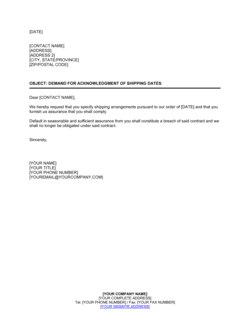
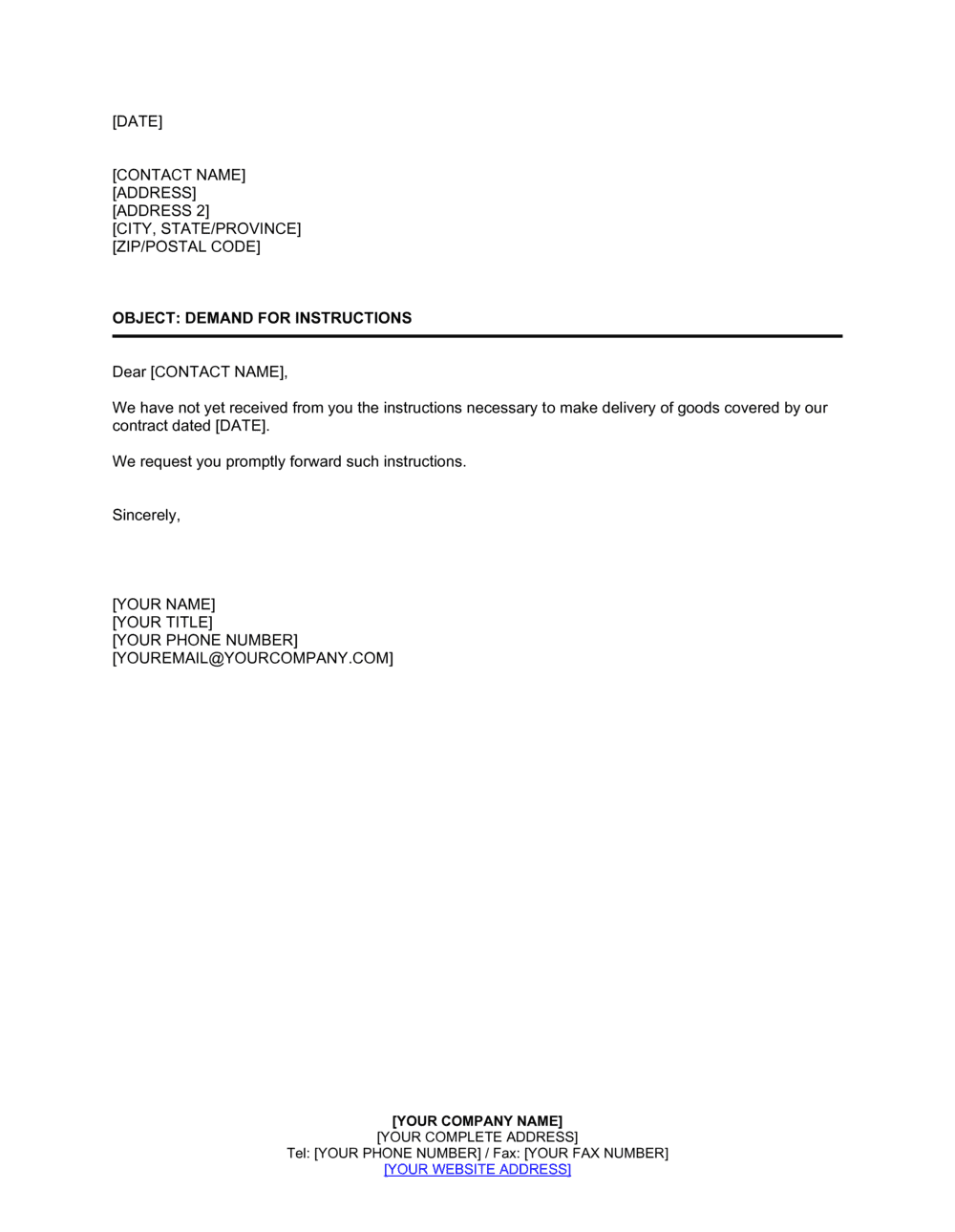
A Demand For Shipping Instructions is a formal legal document issued by a seller, freight forwarder, or carrier to a buyer or consignee requiring the recipient to provide complete delivery and routing instructions within a defined deadline. This free Word download gives you an enforceable starting point you can edit online and export as PDF — covering cargo identification, consignee details, port of destination, and the legal consequences of non-response.
When you need it
Use it when a buyer or consignee has failed to provide routing or delivery instructions by the contractually agreed date, leaving goods in storage, at port, or in a warehouse at the seller's or carrier's expense. It is also used to formally trigger the buyer's obligations under a sales contract before escalating to a breach-of-contract claim or exercising a seller's lien.
What's inside
Identifies the parties and the underlying sales or freight contract, describes the goods and their current location, states the specific instructions required and the response deadline, details accruing storage and demurrage costs, and warns of the legal remedies the issuing party will pursue if instructions are not received in time.

What is a Demand For Shipping Instructions?

A Demand For Shipping Instructions is a formal legal document issued by a seller, freight forwarder, or carrier to a buyer or consignee who has failed to provide the delivery and routing information required under a sales or freight contract. It places the recipient on formal notice of their default, identifies the specific instructions that must be provided, sets a binding response deadline, quantifies the storage and demurrage costs accruing as a result of the delay, and states the legal remedies the issuing party will exercise if no response is received. Unlike an informal follow-up email, a properly drafted demand creates a documented legal record that supports the exercise of a seller's lien, resale of goods, or a breach-of-contract claim if the buyer continues to fail to act.

Why You Need This Document

Every day that cargo sits at a port, terminal, or warehouse without routing instructions, storage and demurrage charges accumulate — and in most commercial contracts, those costs ultimately rest on the party who caused the delay. Without a formal demand on the record, recovering those costs is significantly harder, and exercising remedies like a seller's lien or stoppage in transit may be legally unavailable until proper notice has been given. An informal email requesting instructions will not satisfy the notice requirements of most commercial contracts or applicable sale of goods legislation. This template gives you an enforceable, clearly structured document that starts the notice clock, puts the financial exposure directly in front of the buyer, and preserves every legal remedy available to you — without the delay and cost of having a lawyer draft from scratch for a routine shipment dispute.

Which variant fits your situation?

If your situation is…Use this template
Buyer has not provided delivery instructions after the contracted ship dateDemand For Shipping Instructions
Cargo has been abandoned at port and you need to recover costsNotice of Cargo Abandonment
Escalating to formal breach of contract after demand is ignoredDemand Letter for Breach of Contract
Notifying a buyer that goods will be sold to recover storage costsNotice of Sale of Goods (Seller's Lien)
Confirming revised shipping terms agreed after the original demandShipping and Delivery Agreement
Documenting the original sale terms that created the shipping obligationSales Agreement
Raising a formal claim for demurrage costs against the defaulting buyerDemurrage Claim Letter

Common mistakes to avoid

❌ Using reminder language instead of formal default language

Why it matters: Phrases like 'please send us your instructions' do not constitute a legal demand and fail to trigger the buyer's cure period or the seller's remedies under most contracts.

Fix: Open the document with a clear statement that the buyer is in default of their contractual obligation and that this is a formal demand, not a request.

❌ Omitting a specific response deadline

Why it matters: Without a defined deadline, courts and arbitrators cannot determine when the right to exercise remedies — seller's lien, resale, or proceedings — was triggered.

Fix: State a precise calendar date and time in the governing time zone. For international shipments, 72 to 120 hours from service is a commonly accepted window.

❌ Failing to quantify accruing storage and demurrage costs

Why it matters: A demand that does not state the daily cost accrual makes it significantly harder to recover those amounts later, because the buyer can argue they were unaware of the financial exposure.

Fix: Include the daily rate, the accrual start date, and the total as of the demand date. Attach the applicable tariff or rate schedule as a supporting exhibit.

❌ Threatening remedies the issuing party cannot legally exercise

Why it matters: Claiming a right to immediately resell goods when the contract requires further notice, or asserting a seller's lien in a jurisdiction where title has already passed, exposes the issuing party to a counterclaim.

Fix: Review the underlying contract and the governing jurisdiction's commercial law before drafting the consequences clause. Only list remedies you are actually entitled to exercise.

❌ Signing the demand with an unauthorized employee

Why it matters: If the signatory lacks authority to bind the company, the recipient can challenge the validity of the demand, restarting the notice timeline and potentially delaying enforcement.

Fix: Ensure the demand is signed by a director, officer, or person with written authority to issue legal notices on the company's behalf.

❌ Serving the demand without a documented delivery record

Why it matters: Without proof of service, the buyer can claim they never received the demand, and the notice period never started — collapsing your enforcement timeline.

Fix: Send by tracked courier and email simultaneously, and retain delivery confirmation and read receipts as part of the formal file.

The 10 key clauses, explained

Parties and Reference to Underlying Contract

In plain language: Identifies the issuing party and the recipient, and references the specific sales contract, purchase order, or freight agreement that created the obligation to provide shipping instructions.

Sample language
This demand is issued by [ISSUING PARTY LEGAL NAME] ('Seller/Carrier') to [RECIPIENT LEGAL NAME] ('Buyer/Consignee') pursuant to Contract No. [CONTRACT NUMBER] dated [CONTRACT DATE] ('Agreement').

Common mistake: Omitting the contract reference number or date, making it impossible to connect the demand to the specific agreement — which weakens any subsequent legal action.

Description of Goods and Current Location

In plain language: Describes the goods in sufficient detail for identification — quantity, type, packaging, and any reference numbers — and states where they are currently held and the name of the facility or carrier.

Sample language
[QUANTITY] units of [GOODS DESCRIPTION], packaged as [PACKAGING TYPE], currently held at [WAREHOUSE/PORT NAME], [CITY, COUNTRY], under reference [STORAGE OR BOOKING REFERENCE].

Common mistake: Using a vague description like 'the goods' without quantity or specification. If the demand proceeds to litigation, courts require enough particularity to identify the exact cargo at issue.

Statement of Default — Failure to Provide Instructions

In plain language: States clearly that the recipient has failed to provide the required shipping instructions by the contractually agreed date and that this failure constitutes a breach of their obligations.

Sample language
As of [TODAY'S DATE], [BUYER/CONSIGNEE NAME] has failed to provide shipping instructions as required under Clause [X] of the Agreement, notwithstanding that the delivery date of [ORIGINAL DEADLINE] has passed.

Common mistake: Framing the failure as a request or reminder rather than a formal notice of default. Softened language undermines the document's legal effect and may restart the clock on a cure period.

Specific Instructions Required

In plain language: Lists the exact information the recipient must provide — port of discharge, consignee name and address, carrier nomination, booking reference, customs documentation, and any special handling requirements.

Sample language
You are required to provide the following instructions no later than [DEADLINE]: (a) named port of discharge; (b) consignee name, address, and contact; (c) nominated carrier and booking confirmation; (d) any applicable customs or import license references.

Common mistake: Listing incomplete instruction requirements, so the buyer provides partial information and claims compliance — leaving the cargo still undirected and the timeline reset.

Response Deadline

In plain language: States the specific date and time by which the recipient must respond with complete instructions, and confirms the method of delivery required (email, written notice, or courier).

Sample language
You must deliver complete shipping instructions to [ISSUING PARTY] at [ADDRESS / EMAIL] no later than [TIME] on [DATE]. Instructions sent after this deadline will not be considered timely under the terms of this demand.

Common mistake: Setting an ambiguous deadline like 'within a reasonable time' instead of a specific date. Courts in most jurisdictions require a definite response window for a demand to trigger remedies.

Accruing Storage, Demurrage, and Carrying Costs

In plain language: Quantifies the daily or weekly costs accruing as a result of the buyer's failure to provide instructions, including storage fees, demurrage charges, insurance, and financing costs.

Sample language
Storage and demurrage charges are currently accruing at the rate of [CURRENCY AMOUNT] per [day/week]. As of [DATE], total accrued costs stand at [AMOUNT]. All such costs are for the account of [BUYER/CONSIGNEE NAME] pursuant to Clause [X] of the Agreement.

Common mistake: Failing to quantify accruing costs in the demand. Without a stated rate, recovering storage and demurrage in a subsequent claim is harder to establish as a known and accepted cost.

Consequences of Non-Compliance

In plain language: Warns the recipient of the specific legal remedies the issuing party will exercise if instructions are not received by the deadline — including exercising a seller's lien, stoppage in transit, resale of goods, or initiating legal proceedings.

Sample language
If complete shipping instructions are not received by [DEADLINE], [ISSUING PARTY] reserves the right, without further notice, to: (a) exercise a seller's lien over the goods; (b) arrange resale of the goods to recover costs; (c) initiate legal proceedings for breach of contract and recovery of all losses.

Common mistake: Listing consequences that the issuing party does not actually have the contractual or legal right to exercise. Threatening remedies you cannot legally pursue damages credibility and may constitute misrepresentation.

Reservation of Rights

In plain language: Preserves all legal and contractual rights of the issuing party, confirming that issuing this demand does not constitute a waiver of any existing rights or remedies.

Sample language
Nothing in this demand constitutes a waiver of any right or remedy available to [ISSUING PARTY] under the Agreement, applicable law, or otherwise. All rights are expressly reserved.

Common mistake: Omitting this clause entirely. Without it, a court could interpret the demand as an election to pursue only the stated remedies, inadvertently waiving others such as consequential damages.

Governing Law and Jurisdiction

In plain language: Specifies which jurisdiction's law governs the demand and any disputes arising from it, consistent with the underlying sales or freight contract.

Sample language
This demand and any dispute arising from it shall be governed by the laws of [STATE/COUNTRY]. The parties submit to the exclusive jurisdiction of the courts of [FORUM].

Common mistake: Specifying a governing law that differs from the underlying contract. Inconsistency between documents creates ambiguity about which forum applies and can delay enforcement.

Signatory Block and Date

In plain language: Identifies the authorized signatory for the issuing party, their title, and the date the demand is issued — establishing the formal start of the notice period.

Sample language
Issued by: [SIGNATORY FULL NAME], [TITLE], on behalf of [COMPANY LEGAL NAME], on [DATE]. Signature: ________________________

Common mistake: Having an unauthorized employee sign the demand. If the signatory lacks authority to bind the company, the demand's formal legal status may be challenged by the recipient.

How to fill it out

  1. 1

    Identify the parties and locate the underlying contract

    Enter the full legal names of the issuing party and the recipient. Pull the exact contract number, purchase order number, and date from the original sales or freight agreement to reference in the demand.

    💡 Use the registered entity name — not a trade name — to ensure any enforcement proceedings name the correct legal party.

  2. 2

    Describe the goods and their current location precisely

    Enter the quantity, product description, packaging type, and any SKU or shipment reference numbers. State the full name and address of the terminal, warehouse, or port where goods are currently held.

    💡 Include the storage reference or booking number issued by the facility — it makes it much easier to connect this demand to specific cargo if the dispute escalates.

  3. 3

    Document the default clearly

    State the original contractual deadline for instructions, confirm today's date, and calculate how many days the buyer is already in default. Cite the specific contract clause that imposed the obligation.

    💡 Keep the language factual and non-accusatory — courts and arbitrators respond better to documented timelines than to expressions of frustration.

  4. 4

    List every piece of information required in the instructions

    Be exhaustive: port of discharge, consignee details, carrier nomination, booking confirmation, and any customs or import documentation. Leave nothing to inference.

    💡 Incomplete instruction requirements are a common loophole — buyers provide partial information and claim compliance. List every field explicitly.

  5. 5

    Set a specific response deadline with time and method

    Enter a concrete date and time (e.g., 5:00 PM EST on [DATE]) and specify the required delivery method — email to a named address, written notice by courier, or both. Avoid relative terms like 'within 5 business days'.

    💡 For international shipments, specify the time zone explicitly to avoid ambiguity across jurisdictions.

  6. 6

    Quantify all accruing costs

    Enter the daily or weekly storage and demurrage rate, the start date from which costs are accruing, and the total accrued to the date of the demand. Reference the contract clause or tariff schedule that establishes these rates.

    💡 Attach the port or warehouse tariff schedule as an exhibit — it pre-empts disputes over the applicable rate and makes recovery in a claim straightforward.

  7. 7

    State consequences and obtain an authorized signature

    List only the remedies you are legally and contractually entitled to exercise. Have a director, partner, or duly authorized officer sign and date the document. Serve it by a tracked and documented method.

    💡 Send by both email (with read receipt) and courier so you have two independent delivery records — email alone is often disputed in cross-border freight matters.

  8. 8

    Retain a complete file with proof of service

    Save a copy of the signed demand, proof of delivery, and all correspondence. If the matter proceeds to arbitration or litigation, the service record is the foundation of your timeline.

    💡 Note the exact time and method of service on a cover sheet and attach it to the file immediately — memory of these details fades quickly once a dispute escalates.

Frequently asked questions

What is a demand for shipping instructions?

A demand for shipping instructions is a formal legal document issued by a seller, freight forwarder, or carrier to a buyer or consignee who has failed to provide the delivery and routing instructions required under a sales or freight contract. It notifies the recipient that they are in default, specifies exactly what information is needed, sets a response deadline, quantifies accruing costs, and warns of the legal remedies that will follow if instructions are not received in time.

When should I send a demand for shipping instructions?

Send it as soon as the contractual deadline for instructions has passed and informal follow-up has not produced a response. Do not wait weeks hoping the buyer will act — every day of delay increases your storage and demurrage exposure and may weaken your legal position if you later need to exercise a seller's lien or claim costs. Most commercial practice suggests issuing a formal demand within 3 to 7 business days of the missed deadline.

What happens if the buyer ignores the demand?

If the buyer fails to respond by the stated deadline, the issuing party typically becomes entitled to exercise contractual remedies — which may include asserting a seller's lien over the goods, arranging resale to recover accrued costs, or initiating legal proceedings for breach of contract. The specific remedies available depend on the terms of the underlying contract and the governing law. In most jurisdictions, the formal demand is a prerequisite to exercising these remedies.

Does a demand for shipping instructions need to be signed?

Yes. The document should be signed by a person with actual authority to issue legal notices on behalf of the company — typically a director, officer, or authorized representative. An unsigned or improperly authorized demand can be challenged as informally made and may not trigger the formal notice period under the contract or governing law.

Who typically issues a demand for shipping instructions?

The issuing party is most commonly a seller holding goods that a buyer has failed to direct, a freight forwarder awaiting consignee release instructions for cargo held at a terminal, or a warehouse operator notifying a cargo owner that storage costs are accruing on uncollected goods. Import/export attorneys also prepare these demands on behalf of clients before escalating to formal breach-of-contract proceedings.

What is the difference between a demand for shipping instructions and a standard shipping notice?

A shipping notice informs a buyer that goods have been dispatched or are ready for collection — it is informational, not legally demanding. A demand for shipping instructions is a formal legal document issued when the buyer has failed to act, placing them on notice of default and triggering a defined response window before remedies are exercised. The demand has direct legal consequences; the notice does not.

Can I recover storage and demurrage costs through this document?

Yes, if the underlying contract allocates those costs to the buyer upon failure to provide timely instructions — which most commercial sales contracts do. Quantifying the accruing daily rate in the demand itself is important because it puts the buyer on formal notice of the financial exposure and makes the amounts much easier to recover in arbitration or litigation if the dispute escalates.

Do I need a lawyer to send a demand for shipping instructions?

For straightforward domestic shipments where the contract terms are clear and the amounts at stake are modest, a well-drafted template is generally sufficient. Engage a lawyer when the shipment is international, the cargo is high-value, the governing law is unfamiliar, or the situation is likely to proceed to arbitration or litigation. A 1- to 2-hour legal review typically costs $200–$500 and is worthwhile when the accruing exposure justifies it.

How long should the response deadline in the demand be?

Most commercial practice sets a response window of 48 to 120 hours for domestic shipments and 5 to 10 business days for international cargo, depending on time zones and the complexity of the instructions required. The deadline should be stated as a specific calendar date and time in a named time zone — not as a relative period like 'within 3 days' — to avoid any dispute about when the window expired.

How this compares to alternatives

vs Demand Letter for Breach of Contract

A demand for shipping instructions is a pre-escalation document that formally requests specific performance — providing routing directions — before breach remedies are pursued. A breach of contract demand letter is issued after the default has been established and the issuing party is claiming damages or specific performance through formal legal process. The shipping instructions demand typically precedes and supports the breach letter.

vs Notice of Default

A notice of default is a broader legal document notifying a contracting party that they have failed to meet one or more obligations, often used in loan, lease, or supply agreements. A demand for shipping instructions is narrower — it targets the specific failure to provide delivery routing information and includes the operational detail (instructions required, costs accruing) needed to resolve the immediate logistics problem.

vs Sales Agreement

A sales agreement is the underlying contract that creates the buyer's obligation to provide shipping instructions in the first place. The demand document is issued downstream when that obligation is not met. The demand references and enforces the sales agreement rather than replacing it.

vs Shipping and Delivery Agreement

A shipping and delivery agreement sets out the logistics terms for an ongoing supply relationship — carrier responsibilities, lead times, Incoterms, and delivery windows. A demand for shipping instructions is a reactive enforcement document issued when a specific shipment's instructions have not been provided. The two documents serve opposite ends of the logistics lifecycle.

Industry-specific considerations

International Trade and Export

Exporters routinely issue these demands when overseas buyers miss the ship date or fail to nominate a carrier, triggering demurrage at the port of origin.

Logistics and Freight Forwarding

Freight forwarders use this document to formally demand consignee instructions for cargo held at terminals, protecting the forwarder from liability for accruing port fees.

Manufacturing and Wholesale

Manufacturers selling FOB terms need a formal demand mechanism when buyers delay nominating a carrier, as the seller bears warehouse costs until the goods are collected.

Retail and E-commerce

Large retailers that source internationally may dispute delivery terms, leaving suppliers holding finished goods in a bonded warehouse pending routing instructions.

Construction and Project Goods

Specialized equipment and project cargo often sits at port awaiting site readiness confirmation, requiring formal demands to protect the supplier from open-ended storage liability.

Food and Perishable Goods

For temperature-controlled or perishable cargo, a demand with a very short response window — often 24 to 48 hours — is essential to prevent spoilage and limit the seller's loss exposure.

Jurisdictional notes

United States

US commercial law under the Uniform Commercial Code (UCC Article 2) gives a seller the right to withhold delivery and exercise a lien when the buyer fails to provide instructions or make payment. Under UCC §2-311, a buyer who fails to specify required delivery details within a reasonable time may be in breach. State-level variations in what constitutes 'reasonable time' and the right to resell mean reviewing the governing-state's UCC enactment is advisable for high-value cargo.

Canada

Canadian sale of goods legislation (modeled on the UK Sale of Goods Act and enacted provincially) preserves a seller's right to lien and stoppage in transit when a buyer defaults on their delivery obligations. Quebec's civil law framework under the Civil Code of Québec provides analogous protections but uses different terminology and procedural steps. For interprovincial or international shipments, the Carriage of Goods by Water Act and federal Transport Canada regulations may also apply.

United Kingdom

The UK Sale of Goods Act 1979 and the Carriage of Goods by Sea Act 1992 provide the statutory framework for seller's liens and stoppage in transit in English law. A seller retains a lien over goods as long as they remain in possession, and may exercise stoppage in transit if the buyer becomes insolvent before delivery. Post-Brexit, UK courts no longer apply EU commercial regulations directly, but many standard shipping contract terms still reference English law as the governing law for international transactions.

European Union

EU member states apply the UN Convention on Contracts for the International Sale of Goods (CISG) to international commercial sales by default unless contracted out. Under CISG Article 65, a seller may proceed with shipment on the basis of reasonably inferred specifications if the buyer fails to provide instructions within the required time, after giving notice. Demurrage and storage costs, and the right to resell, vary by member state — German, French, and Dutch commercial law each have distinct procedural requirements for formal demands before remedies can be exercised.

Template vs lawyer — what fits your deal?

PathBest forCostTime
Use the templateDomestic shipments with clear contract terms and accruing costs below $10,000Free20–30 minutes
Template + legal reviewInternational cargo, high-value shipments, or situations where the buyer is likely to dispute the demand$200–$500 for a 1–2 hour legal review1–2 business days
Custom draftedComplex cross-border disputes, specialized cargo (hazmat, perishables), or matters likely to proceed to arbitration or litigation$500–$2,000+3–7 business days

Glossary

Shipping Instructions
Directions provided by a buyer or consignee specifying how, where, and to whom cargo should be delivered, including carrier choice, port of destination, and routing.
Consignee
The party named on a bill of lading or shipping document as the recipient of the goods — typically the buyer or their appointed agent.
Demurrage
A charge levied when cargo remains at a port, terminal, or on a vessel beyond the agreed free time for loading or unloading.
Seller's Lien
A seller's legal right to retain possession of goods until the buyer pays the agreed purchase price or fulfills their contractual obligations.
Stoppage in Transit
A seller's right to reclaim goods from a carrier while they are in transit, typically exercised when the buyer becomes insolvent before delivery.
Bill of Lading
A legal document issued by a carrier to a shipper that details the type, quantity, and destination of goods, and serves as a receipt, contract of carriage, and document of title.
Free Time
The period allowed by a port, terminal, or carrier during which cargo can remain without incurring additional storage or demurrage charges.
FOB (Free On Board)
An Incoterm specifying the point at which title and risk transfer from seller to buyer — typically when goods pass the ship's rail at the named port of shipment.
Freight Forwarder
An intermediary who arranges the carriage of goods on behalf of a shipper, coordinating documentation, customs clearance, and carrier selection.
Notice Period
The defined window within which a party must respond to a formal demand before the issuing party is entitled to pursue contractual or legal remedies.
Incoterms
A standardized set of international trade terms published by the International Chamber of Commerce that define the responsibilities of buyers and sellers for delivery, risk, and costs.

Part of your Business Operating System

This document is one of 3,000+ business & legal templates included in Business in a Box.

  • Fill-in-the-blanks — ready in minutes
  • 100% customizable Word document
  • Compatible with all office suites
  • Export to PDF and share electronically

Create your document in 3 simple steps.

From template to signed document — all inside one Business Operating System.
1
Download or open template

Access over 3,000+ business and legal templates for any business task, project or initiative.

2
Edit and fill in the blanks with AI

Customize your ready-made business document template and save it in the cloud.

3
Save, Share, Send, Sign

Share your files and folders with your team. Create a space of seamless collaboration.

Save time, save money, and create top-quality documents.

★★★★★

"Fantastic value! I'm not sure how I'd do without it. It's worth its weight in gold and paid back for itself many times."

Managing Director · Mall Farm
Robert Whalley
Managing Director, Mall Farm Proprietary Limited
★★★★★

"I have been using Business in a Box for years. It has been the most useful source of templates I have encountered. I recommend it to anyone."

Business Owner · 4+ years
Dr Michael John Freestone
Business Owner
★★★★★

"It has been a life saver so many times I have lost count. Business in a Box has saved me so much time and as you know, time is money."

Owner · Upstate Web
David G. Moore Jr.
Owner, Upstate Web

Run your business with a system — not scattered tools

Stop downloading documents. Start operating with clarity. Business in a Box gives you the Business Operating System used by over 250,000 companies worldwide to structure, run, and grow their business.

Start free · No credit card required