Demand for Particulars of Rejection of Goods Template

Free Word download • Edit online • Save & share with Drive • Export to PDF

1 page20–30 min to fillDifficulty: StandardSignature requiredLegal review recommended
Learn more ↓
FreeDemand for Particulars of Rejection of Goods Template

At a glance

What it is
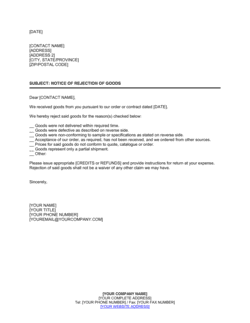
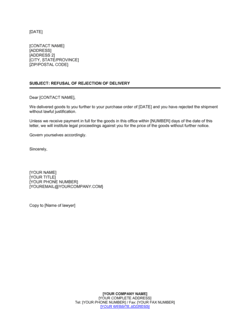
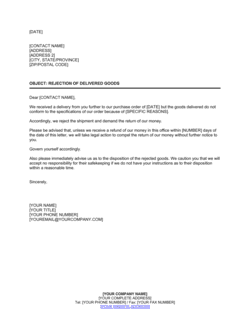
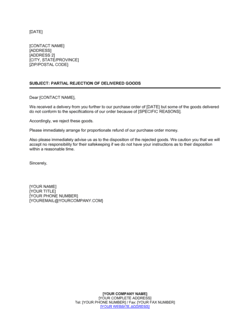
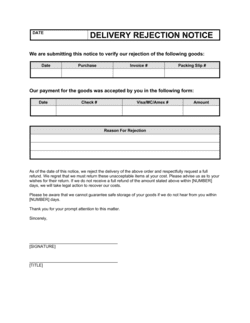
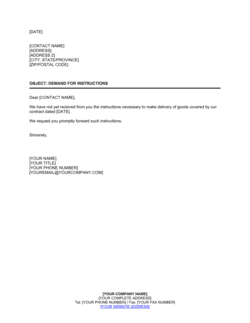
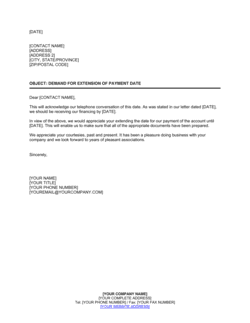
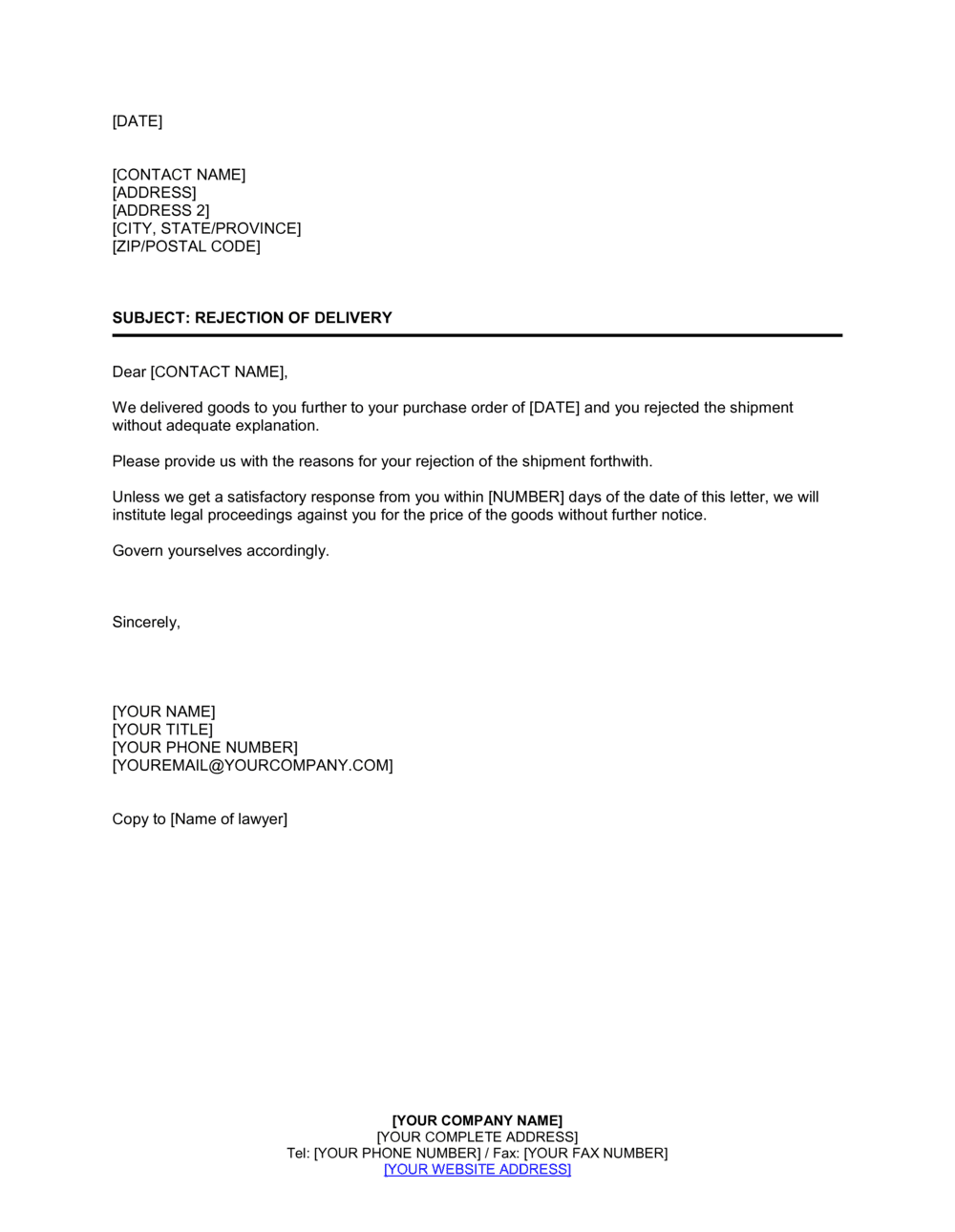
A Demand for Particulars of Rejection of Goods is a formal legal letter a seller or supplier sends to a buyer who has rejected a shipment or delivery without adequately specifying the grounds for that rejection. This free Word download gives you a ready-to-edit template you can customize and export as PDF to formally compel the buyer to state, in writing, the precise defects, non-conformities, or contractual breaches they allege justify the rejection.
When you need it
Use it when a buyer notifies you of a rejection but fails to provide specific reasons, item-by-item defect descriptions, or reference to the contractual clause allegedly breached — leaving you unable to assess, cure, or dispute the rejection. It is especially critical before any limitation period for a cure or legal response begins to run.
What's inside
Identification of the parties and the original purchase contract, reference to the buyer's rejection notice, a formal demand for detailed particulars of each alleged defect or non-conformity, a deadline for the buyer's response, a reservation of all legal rights, and a signature block for the authorized seller representative.

What is a Demand for Particulars of Rejection of Goods?

A Demand for Particulars of Rejection of Goods is a formal legal letter a seller or supplier sends to a buyer who has purported to reject a delivery without providing adequate, itemized grounds for doing so. Under commercial law in most jurisdictions, a buyer exercising a right of rejection must specify the defects or non-conformities alleged — a blanket statement that goods are "unsatisfactory" or "not as ordered" is generally insufficient. This document formally invokes that obligation, requiring the buyer to identify in writing each affected item or lot, the precise nature and extent of each alleged defect, the contractual or statutory standard allegedly breached, and the date and method of discovery. It is available as a free Word download that you can edit online and export as PDF.

Why You Need This Document

A vague rejection notice leaves a seller in an impossible position: unable to assess whether the rejection has any merit, unable to exercise a contractual right to cure, and unable to prepare an evidence-based legal response — all while limitation periods continue to run. Without a formal demand on record, a buyer can expand the grounds for rejection after the fact, making disputes far harder to win. This document creates a documented evidentiary trail that either compels the buyer to commit to specific allegations — which can then be tested against inspection results — or establishes, through the buyer's silence or inadequate response, that the rejection lacked a legitimate factual basis. For any seller facing a disputed shipment, this template is the first and most critical step before deciding whether to cure, negotiate, or litigate.

Which variant fits your situation?

If your situation is…Use this template
Buyer rejected goods without any written notice at allNotice of Acceptance of Goods
Goods were partially accepted and partially rejectedDemand for Particulars of Partial Rejection of Goods
Buyer rejected goods and is refusing to pay the invoiceDemand for Payment Letter
Seller wants to formally dispute the rejection after receiving particularsLetter Disputing Rejection of Goods
Seller is prepared to cure a legitimate defect and wants to confirm termsNotice of Intent to Cure
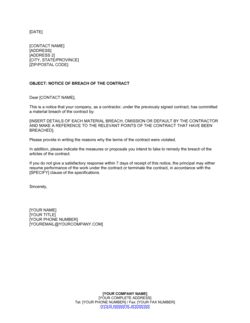
Dispute has escalated and a formal breach-of-contract notice is neededBreach of Contract Notice
Seller needs to document the chain of events before commencing litigationDemand Letter

Common mistakes to avoid

❌ Failing to preserve the rejected goods

Why it matters: If the buyer returns, destroys, or resells the goods before the seller can inspect, the seller loses the ability to challenge the rejection with physical evidence — significantly weakening any legal claim.

Fix: Include an explicit instruction in the demand directing the buyer to hold the goods in their current condition at a specified location until the seller completes its inspection.

❌ Omitting the insufficiency statement

Why it matters: A demand that goes straight to requesting particulars without first asserting the rejection notice is inadequate may be read as an implicit acknowledgment that the rejection was properly made.

Fix: Always include a dedicated clause stating that the buyer's rejection notice fails to meet the specificity requirements of the contract and applicable commercial law.

❌ Using vague response categories

Why it matters: Asking for 'the reasons for rejection' produces a one-line answer. A buyer who responds with 'goods were defective' has technically complied but given you nothing to work with legally or operationally.

Fix: Structure the demand as a numbered list requiring responses to each specific element — item or lot number, defect nature and extent, contractual standard breached, and discovery date.

❌ Signing with an unauthorized or junior representative

Why it matters: A demand signed by a salesperson or account manager rather than a director or officer gives the buyer's legal team a procedural objection that can delay and complicate the dispute.

Fix: Have the demand executed by a director, general manager, or someone with documented signing authority, and include their title below their signature.

❌ Sending only by email without a traceable delivery method

Why it matters: Email delivery is easy to dispute — a buyer can claim non-receipt, and the timestamp is controllable by either party. If a limitation period is running, the transmission date matters.

Fix: Send by both email (with read receipt or delivery confirmation) and a traceable physical method — courier or recorded mail — and retain proof of both.

❌ Citing a governing law inconsistent with the underlying contract

Why it matters: If the demand states it is governed by New York law but the purchase contract specifies English law, the buyer can raise a procedural objection that delays substantive engagement with your claim.

Fix: Review the original contract's governing law and dispute-resolution clause before completing the demand, and mirror those provisions exactly.

The 10 key clauses, explained

Parties and contract identification

In plain language: Identifies the seller and buyer by full legal name and address, and references the specific purchase order, contract number, or invoice to which the demand relates.

Sample language
This Demand is issued by [SELLER LEGAL NAME] ('Seller') to [BUYER LEGAL NAME] ('Buyer') with respect to Purchase Order No. [PO NUMBER] dated [DATE] ('Contract'), under which Seller delivered [DESCRIPTION OF GOODS] on [DELIVERY DATE].

Common mistake: Referencing only an invoice number without the underlying PO or contract. If the invoice is disputed, there is no clear contractual hook to anchor the demand.

Reference to rejection notice

In plain language: Quotes or summarizes the buyer's rejection communication — date, method of delivery, and the language used — to establish the factual starting point of the dispute.

Sample language
By [letter / email / notice] dated [DATE], Buyer purported to reject the Goods, stating only that '[VERBATIM OR SUMMARIZED REJECTION LANGUAGE].' Seller received this notice on [DATE].

Common mistake: Paraphrasing the rejection notice inaccurately. Quote the buyer's exact words where possible — courts and arbitrators compare the demand letter against the original notice.

Demand for specific particulars

In plain language: The operative clause: formally requires the buyer to provide, in writing, the precise defect, non-conformity, or contractual breach alleged for each item or lot rejected.

Sample language
Seller hereby demands that Buyer provide, within [X] business days, full written particulars of each alleged defect or non-conformity, including: (a) the specific goods affected by item or lot number; (b) the nature and extent of each alleged defect; (c) the contractual provision, specification, or standard alleged to have been breached; and (d) the date and method by which each defect was discovered.

Common mistake: Demanding 'reasons for rejection' without specifying the required format or items (a)–(d). Vague demands receive vague responses that still leave the seller unable to assess the rejection.

Deadline for response

In plain language: States a specific number of business days within which the buyer must respond, calibrated to preserve the seller's cure rights or limitation period.

Sample language
Buyer is required to provide the particulars demanded herein no later than [DATE] — being [X] business days from the date of this Demand. Time is of the essence.

Common mistake: Setting an unrealistically short deadline (fewer than 5 business days for complex shipments). Courts may treat an unreasonable deadline as bad faith, undermining the demand's legal weight.

Statement that rejection notice is inadequate

In plain language: Explicitly states that the buyer's rejection notice, as issued, is legally insufficient under the governing contract and applicable law — preserving the seller's right to contest the rejection.

Sample language
Seller puts Buyer on notice that the rejection notice dated [DATE] is legally insufficient in that it fails to identify the specific goods rejected, the nature of the alleged defects, or the contractual basis for rejection, as required by [CONTRACT CLAUSE / APPLICABLE LAW].

Common mistake: Omitting this statement and jumping straight to the demand for particulars. Without it, the seller may be treated as having implicitly accepted that the rejection was properly made.

Preservation of seller's right to inspect and cure

In plain language: Reserves the seller's right to physically inspect the rejected goods and, where permitted by contract or law, to offer a cure — replacement, repair, or price reduction.

Sample language
Seller expressly reserves the right to inspect the allegedly defective Goods at [LOCATION] and, subject to receipt of adequate particulars, to exercise any right of cure available under the Contract or applicable law. Buyer is directed not to return, dispose of, or alter the Goods pending such inspection.

Common mistake: Failing to instruct the buyer to preserve the goods. Once goods are returned, destroyed, or resold, the seller loses the ability to conduct an independent inspection.

Reservation of all rights and remedies

In plain language: A standard clause confirming that nothing in the demand waives any legal or contractual right the seller may have, including the right to claim the full contract price.

Sample language
Nothing in this Demand shall be construed as an admission that the rejection of the Goods was valid, or as a waiver of any right or remedy available to Seller under the Contract, at law, or in equity, all of which are expressly reserved.

Common mistake: Omitting the reservation of rights entirely. A demand that acknowledges the rejection without this clause may be used by a buyer's lawyer to argue the seller conceded the rejection was legitimate.

Consequences of failure to respond

In plain language: Warns the buyer that failure to provide adequate particulars within the deadline will result in specific consequences — typically escalation to legal proceedings or a deemed waiver of the rejection.

Sample language
If Buyer fails to provide the particulars demanded herein by [DATE], Seller will have no alternative but to treat the purported rejection as invalid and to pursue all available remedies, including legal proceedings to recover the full contract price of [CURRENCY AND AMOUNT].

Common mistake: Threatening consequences the seller has no intention of acting on. If you state you will commence proceedings by a specific date, calendar that date — empty threats damage credibility in subsequent litigation.

Governing law and jurisdiction

In plain language: States which jurisdiction's law governs the dispute and, if relevant, the agreed forum for resolution — mirroring the dispute-resolution clause in the underlying contract.

Sample language
This Demand and any dispute arising from the rejection of the Goods shall be governed by the laws of [STATE / PROVINCE / COUNTRY]. Any proceedings shall be commenced in the courts of [JURISDICTION], as agreed in the Contract.

Common mistake: Citing a governing law that differs from the underlying contract's choice-of-law clause. The inconsistency gives the buyer an easy procedural objection.

Signature and authority block

In plain language: Identifies the authorized signatory — their name, title, and authority to bind the seller — and provides contact details for the buyer's response.

Sample language
Signed on behalf of [SELLER LEGAL NAME] by: [AUTHORIZED SIGNATORY NAME], [TITLE]. Direct responses to: [EMAIL] / [ADDRESS]. Date: [DATE].

Common mistake: Having the demand signed by a sales representative rather than someone with authority to bind the company (e.g., a director or officer). A junior signatory gives the buyer grounds to challenge whether the demand was formally authorized.

How to fill it out

  1. 1

    Gather all transaction documents

    Collect the original purchase order or contract, the delivery confirmation or bill of lading, all invoices, and a verbatim copy of the buyer's rejection notice before drafting the demand.

    💡 Note the exact date the rejection notice was received — this starts the clock on your response window and any statutory cure period.

  2. 2

    Identify the parties and reference the contract

    Enter both parties' full legal names and addresses. Reference the PO number, contract date, and invoice number so the demand is unambiguously tied to the specific transaction.

    💡 Use the registered legal entity name from the contract — not a trade name or abbreviation — to avoid jurisdictional objections.

  3. 3

    Quote the rejection notice accurately

    Reproduce the buyer's rejection language as closely as possible — exact quotes are stronger than paraphrases. State the date the notice was issued and the date you received it.

    💡 Attach a copy of the rejection notice as Exhibit A; this prevents later disputes about what the buyer actually said.

  4. 4

    State that the rejection notice is legally insufficient

    Explicitly assert that the buyer's notice fails to meet the specificity requirements of your contract and applicable law, identifying which provision requires particulars.

    💡 Check your contract's notice clause — many commercial contracts require rejection within a specific number of days and in a prescribed format. Cite the clause number.

  5. 5

    Draft the demand for particulars in itemized form

    List each category of information you require — affected item/lot number, nature of defect, contractual basis, discovery date and method. Number each requirement so the buyer cannot claim to have addressed it without responding to each one.

    💡 Mirroring the structure of the buyer's own quality-control documentation (if you have it) makes it harder for them to give a vague response.

  6. 6

    Set a specific deadline and invoke time-is-of-the-essence

    Calculate a response deadline based on your contract's cure period, the applicable statute of limitations, and a reasonable inspection window. State the exact calendar date, not just a number of days.

    💡 7–14 business days is the typical range for complex shipments; fewer than 5 days is usually considered unreasonable by courts unless the goods are perishable.

  7. 7

    Include preservation and inspection instructions

    Direct the buyer to hold the goods in their current condition pending inspection by or on behalf of the seller, and state the proposed inspection timeline.

    💡 If the goods are perishable or the buyer is threatening to return them, send this demand by traceable courier as well as email to create a documented delivery record.

  8. 8

    Have an authorized signatory execute the demand

    Obtain signature from a director, officer, or other person with documented authority to bind the seller, then retain a signed copy for your records before transmitting.

    💡 Send the demand by a method that generates a delivery receipt — recorded mail, courier, or email with read receipt — and note the transmission date in your file.

Frequently asked questions

What is a demand for particulars of rejection of goods?

A demand for particulars of rejection of goods is a formal legal letter a seller sends to a buyer who has rejected a shipment without providing specific grounds. It requires the buyer to identify, in writing, the exact defects, non-conformities, or contractual breaches that allegedly justify the rejection — item by item and clause by clause. The demand protects the seller's right to inspect, cure, or dispute the rejection before any limitation period expires.

When should a seller send this demand?

Send it promptly after receiving a rejection notice that is vague, general, or lacks itemized defect descriptions. In most commercial contracts, the seller has a limited window to exercise a right of cure or to formally contest the rejection — delaying the demand can forfeit those rights. As a practical rule, issue the demand within 5 to 10 business days of receiving the buyer's rejection notice.

What happens if the buyer does not respond to the demand?

If the buyer fails to provide adequate particulars by the stated deadline, the seller gains a strong factual and legal basis to treat the purported rejection as invalid. The seller can then pursue the full contract price through legal proceedings, with the unanswered demand as evidence that the buyer failed to substantiate the rejection. In some jurisdictions, a court may also draw an adverse inference from the buyer's silence.

Is this document the same as a rejection dispute letter?

No. A demand for particulars comes first — it asks the buyer to specify the grounds for rejection before the seller takes a position on whether those grounds are valid. A rejection dispute letter comes after the buyer has provided particulars, and it contests the merits of those stated grounds. The demand is a procedural step; the dispute letter is the substantive response.

Can I use this document for a partial rejection of goods?

Yes, with modification. If the buyer accepted some items and rejected others, the demand should reference both the accepted and rejected portions, and require particulars only for the rejected items or lots. Clearly distinguishing accepted from rejected goods in the demand prevents the buyer from later expanding the scope of the rejection to cover goods they originally accepted.

Should I instruct the buyer to preserve the rejected goods?

Yes — always. Include a clause directing the buyer to hold the goods in their current condition at a stated location pending the seller's inspection. If the goods are resold, returned to a carrier, or destroyed before inspection, the seller loses the ability to challenge the stated defects with physical evidence, which is often decisive in litigation or arbitration.

What law governs this document in the United States?

In the US, commercial goods transactions are typically governed by Article 2 of the Uniform Commercial Code, which has been adopted in substantially similar form in 49 states. Under UCC §2-605, a buyer who fails to state a particular defect in a timely rejection notice may be precluded from relying on that defect in later litigation if the seller could have cured it. The governing law provision in your purchase contract also applies and may affect which state's UCC rules control.

Do I need a lawyer to send this demand?

For straightforward domestic disputes involving standard commercial goods, a well-drafted template is typically sufficient. Engage a lawyer when the transaction value exceeds $50,000, when the goods were shipped internationally, when a letter of credit is involved, or when the buyer has already threatened or commenced legal proceedings. A lawyer review of a high-value demand typically costs $300–$800 and is worthwhile when the rejection could result in significant financial exposure.

How this compares to alternatives

vs Demand Letter

A general demand letter asserts a claim and demands a remedy — typically payment or performance. A demand for particulars of rejection does not yet assert a full claim; it is a procedural step requiring the buyer to substantiate their rejection before the seller decides whether to cure, dispute, or litigate. Use the general demand letter after particulars have been received and the seller is ready to make a formal claim for the contract price.

vs Breach of Contract Notice

A breach of contract notice formally asserts that the other party has violated the contract and demands cure or compensation. A demand for particulars precedes this — it is issued when the seller does not yet know whether a breach has occurred because the rejection grounds are unspecified. Once the buyer provides particulars, the seller may follow up with a breach notice if the stated grounds do not justify the rejection.

vs Demand for Payment Letter

A demand for payment letter skips the particulars stage and goes straight to claiming the overdue invoice amount. Use a payment demand when the rejection was clearly invalid on its face and you are ready to assert the full contract price. Use a demand for particulars first when the rejection grounds are unclear and you need to preserve cure rights or build an evidentiary record.

vs Notice of Acceptance of Goods

A notice of acceptance confirms that goods meet the contract and have been accepted — it is the seller's affirmative document. A demand for particulars is a reactive document issued after the buyer has purported to reject. If the seller believes the rejection is entirely unjustified, a notice confirming the goods met specification can be issued alongside or instead of a demand for particulars, depending on litigation strategy.

Industry-specific considerations

Manufacturing

Lot-level defect identification is essential; demands must reference batch numbers, inspection certificates, and the specific manufacturing specification alleged to have been breached.

Construction and building materials

Rejection of materials on-site often occurs without formal documentation; the demand establishes a written record before the contractor installs alternatives and the original goods are returned or discarded.

Import and export / international trade

Cross-border rejections carry letter-of-credit risk and customs complications; demands must address the applicable trade terms (Incoterms) and preserve rights under both exporting and importing jurisdiction law.

Wholesale and distribution

High-volume rejections spanning multiple SKUs require the demand to require lot-by-lot particulars to prevent a blanket rejection from covering items that were not actually inspected.

Jurisdictional notes

United States

Commercial goods transactions in the US are governed by Article 2 of the Uniform Commercial Code, adopted in substantially similar form across 49 states. Under UCC §2-605, a buyer who fails to state a particular defect when rejecting goods may be precluded from relying on that defect in litigation if the seller could have cured it. The UCC also gives sellers a right to cure before the contract deadline under §2-508. State-specific variations exist — New York and California courts have developed distinct bodies of case law on what constitutes an adequate rejection notice.

Canada

Canadian goods disputes are governed by provincial Sale of Goods Acts, which closely follow the UK model and impose a requirement that rejections be communicated promptly and with reasonable specificity. Ontario's Sale of Goods Act and equivalent statutes in other provinces recognize the seller's right to notice of the grounds for rejection. Quebec is a civil law jurisdiction governed by the Civil Code of Quebec, which applies different rules on hidden defects and requires the buyer to notify the seller of non-conformity within a reasonable time.

United Kingdom

In the UK, the Sale of Goods Act 1979 and the Consumer Rights Act 2015 (for B2C transactions) govern rejection rights. Under the SGA, a buyer who rejects goods must act promptly and notify the seller; a buyer who retains goods beyond a reasonable examination period may lose the right to reject. The Sale and Supply of Goods to Consumers Regulations and the 2015 Act also impose tiered remedies — repair, replacement, price reduction — before outright rejection in consumer contexts. Commercial buyers have a shorter inspection window, making a prompt demand for particulars critical.

European Union

EU cross-border goods contracts are subject to the UN Convention on Contracts for the International Sale of Goods (CISG) if both parties are in contracting states and have not excluded its application. Under CISG Article 39, a buyer must give notice of non-conformity specifying the nature of the defect within a reasonable time after discovery, and forfeits the right to rely on a defect if notice is not given within two years of delivery. Member state domestic law (e.g., the German BGB or French Code Civil) applies where the CISG is excluded. GDPR considerations are minimal for this document type but personal data in correspondence should be handled in accordance with applicable EU data protection law.

Template vs lawyer — what fits your deal?

PathBest forCostTime
Use the templateDomestic commercial disputes under $50,000 where the rejection is clearly vague and no proceedings have been threatenedFree30–60 minutes
Template + legal reviewTransactions between $50,000 and $250,000, cross-border shipments, or disputes involving a letter of credit or Incoterms$300–$8001–3 days
Custom draftedHigh-value contracts above $250,000, international arbitration clauses, regulated industries, or where the buyer has already commenced legal proceedings$1,000–$3,500+3–7 days

Glossary

Rejection of Goods
A buyer's refusal to accept delivered goods on the grounds that they do not conform to the contract — typically triggering a right to a refund or replacement under commercial law.
Particulars
Specific, itemized details of an alleged defect, non-conformity, or breach — as opposed to a general or blanket assertion of non-compliance.
Non-Conforming Goods
Goods that fail to meet the description, quality, quantity, or other specifications set out in the purchase contract or applicable law.
Right to Cure
A seller's contractual or statutory right to remedy a defect or replace non-conforming goods within a defined period before the buyer's rejection becomes final.
Perfect Tender Rule
A US UCC principle requiring that goods conform exactly to the contract in every respect; if they do not, the buyer may in theory reject the entire shipment.
Acceptance of Goods
A buyer's act of receiving and retaining goods in a manner that, under applicable law, extinguishes the right to reject — typically through use, resale, or failure to inspect within a reasonable time.
Reservation of Rights
A statement in a legal letter preserving all claims and remedies the sender may have, preventing any inference that action taken constitutes a waiver.
Statute of Limitations
The maximum period after an event within which a party must commence legal proceedings; for goods disputes, this is commonly 4 years under the UCC and varies by jurisdiction.
Revocation of Acceptance
A buyer's act of undoing a prior acceptance of goods after discovering a defect that substantially impairs their value — distinct from initial rejection.
Purchase Order (PO)
The buyer's written authorization to ship goods at an agreed price and specification; it forms part of the contract the seller relies on when demanding rejection particulars.
Letter of Credit
A bank instrument guaranteeing payment to the seller once specified documentary conditions are met — commonly at risk when a buyer rejects internationally shipped goods.

Part of your Business Operating System

This document is one of 3,000+ business & legal templates included in Business in a Box.

  • Fill-in-the-blanks — ready in minutes
  • 100% customizable Word document
  • Compatible with all office suites
  • Export to PDF and share electronically

Create your document in 3 simple steps.

From template to signed document — all inside one Business Operating System.
1
Download or open template

Access over 3,000+ business and legal templates for any business task, project or initiative.

2
Edit and fill in the blanks with AI

Customize your ready-made business document template and save it in the cloud.

3
Save, Share, Send, Sign

Share your files and folders with your team. Create a space of seamless collaboration.

Save time, save money, and create top-quality documents.

★★★★★

"Fantastic value! I'm not sure how I'd do without it. It's worth its weight in gold and paid back for itself many times."

Managing Director · Mall Farm
Robert Whalley
Managing Director, Mall Farm Proprietary Limited
★★★★★

"I have been using Business in a Box for years. It has been the most useful source of templates I have encountered. I recommend it to anyone."

Business Owner · 4+ years
Dr Michael John Freestone
Business Owner
★★★★★

"It has been a life saver so many times I have lost count. Business in a Box has saved me so much time and as you know, time is money."

Owner · Upstate Web
David G. Moore Jr.
Owner, Upstate Web

Run your business with a system — not scattered tools

Stop downloading documents. Start operating with clarity. Business in a Box gives you the Business Operating System used by over 250,000 companies worldwide to structure, run, and grow their business.

Free Forever Plan · No credit card required