1
Gather the guarantee agreement and underlying transaction documents
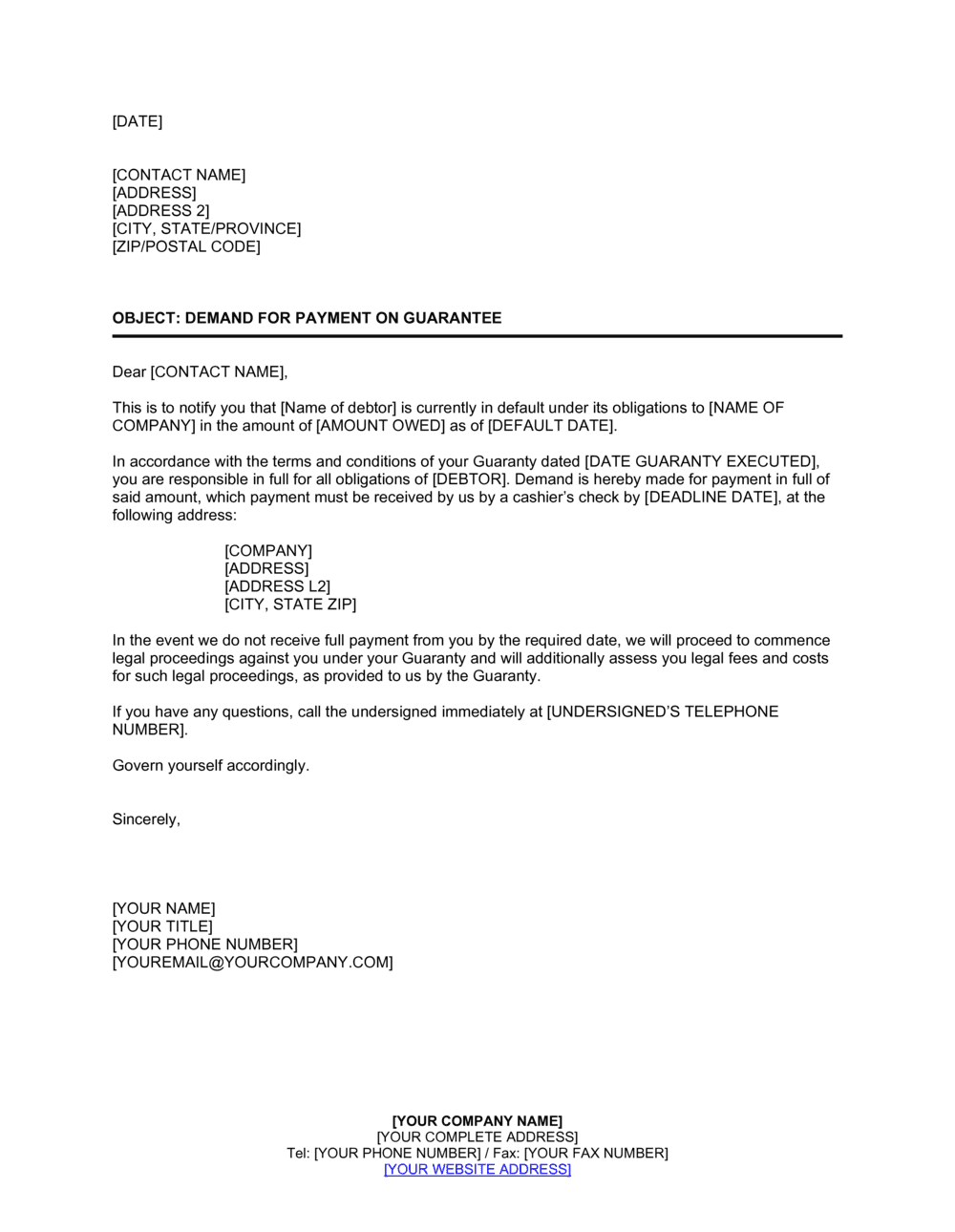
Locate the signed guarantee agreement, the original loan or contract the guarantee supports, and any correspondence or notices already sent to the primary debtor. Confirm the guarantor's current legal name and registered address.
💡 Check the guarantee agreement for any conditions precedent to calling the guarantee — some require that you first demand payment from the primary debtor or obtain a judgment before turning to the guarantor.
2
Confirm the event of default is documented
Identify the specific payment or performance failure that constitutes a default under the underlying agreement, the exact date it occurred, and whether any cure period has expired.
💡 If the underlying agreement has a cure period — typically 5 to 30 days — confirm in writing that the period has passed before issuing the guarantee demand.
3
Calculate the total amount demanded with a full breakdown
Add up outstanding principal, accrued interest calculated at the contracted rate from the date of default to the date of the demand, any late charges, and any enforcement costs the guarantee covers. Document each figure with a reference to the underlying agreement.
💡 Run the interest calculation to the date the demand will be received, not the date you draft it — guarantors will verify the math.
4
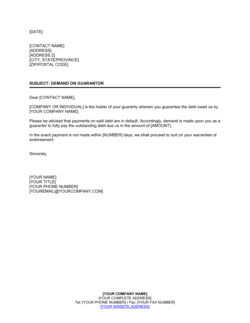
Enter the parties' full legal names and addresses
Use the guarantor's name exactly as it appears in the guarantee agreement — including legal entity type (LLC, Inc., Ltd.) if applicable. Use the notice address specified in the guarantee, not just the guarantor's primary business address.
💡 Cross-reference the signature block of the original guarantee agreement to verify the exact name spelling and any assumed or trade names that might create ambiguity.
5
Set a specific payment deadline
Calculate the deadline based on the notice period in the guarantee agreement — commonly 7, 14, or 30 days. Write the exact calendar date, not a relative reference like 'within 30 days of receipt.'
💡 Add 3 business days to your planned deadline when sending by certified mail to account for delivery time — this prevents a dispute over when the clock started.
6
Include complete payment instructions
Provide full wire transfer or ACH details — bank name, account number, routing number, and a payment reference the guarantor should include. If a check is acceptable, specify the payee name and mailing address.
💡 Name a specific contact at your organization for the guarantor to call with questions — guarantors who can't reach anyone in time often let the deadline pass by default.
7
Verify delivery method against the guarantee agreement
Match the delivery method to the notice provisions in the guarantee. Send by certified mail with return receipt, courier with proof of delivery, or personal service. If the agreement permits email, send to the exact address specified and retain the delivery confirmation.
💡 Send the demand simultaneously by two delivery methods — certified mail and email — and document both. Courts in most jurisdictions accept whichever arrives first as the operative delivery date.
8
Have an authorized officer sign and retain a complete file
The demand must be signed by a person with authority to bind the creditor — an officer, director, or general counsel. Retain copies of the signed demand, all delivery confirmations, the guarantee agreement, and the underlying default documentation in a single enforcement file.
💡 Create the enforcement file before sending — if the guarantor does not pay and proceedings begin, your lawyers will need every document organized from day one.