Demand to Endorsers for Immediate Payment Template

Free Word download β€’ Edit online β€’ Save & share with Drive β€’ Export to PDF

1 pageβ€’20–30 min to fillβ€’Difficulty: Standardβ€’Signature requiredβ€’Legal review recommended
Learn more ↓
FreeDemand to Endorsers for Immediate Payment Template

At a glance

What it is
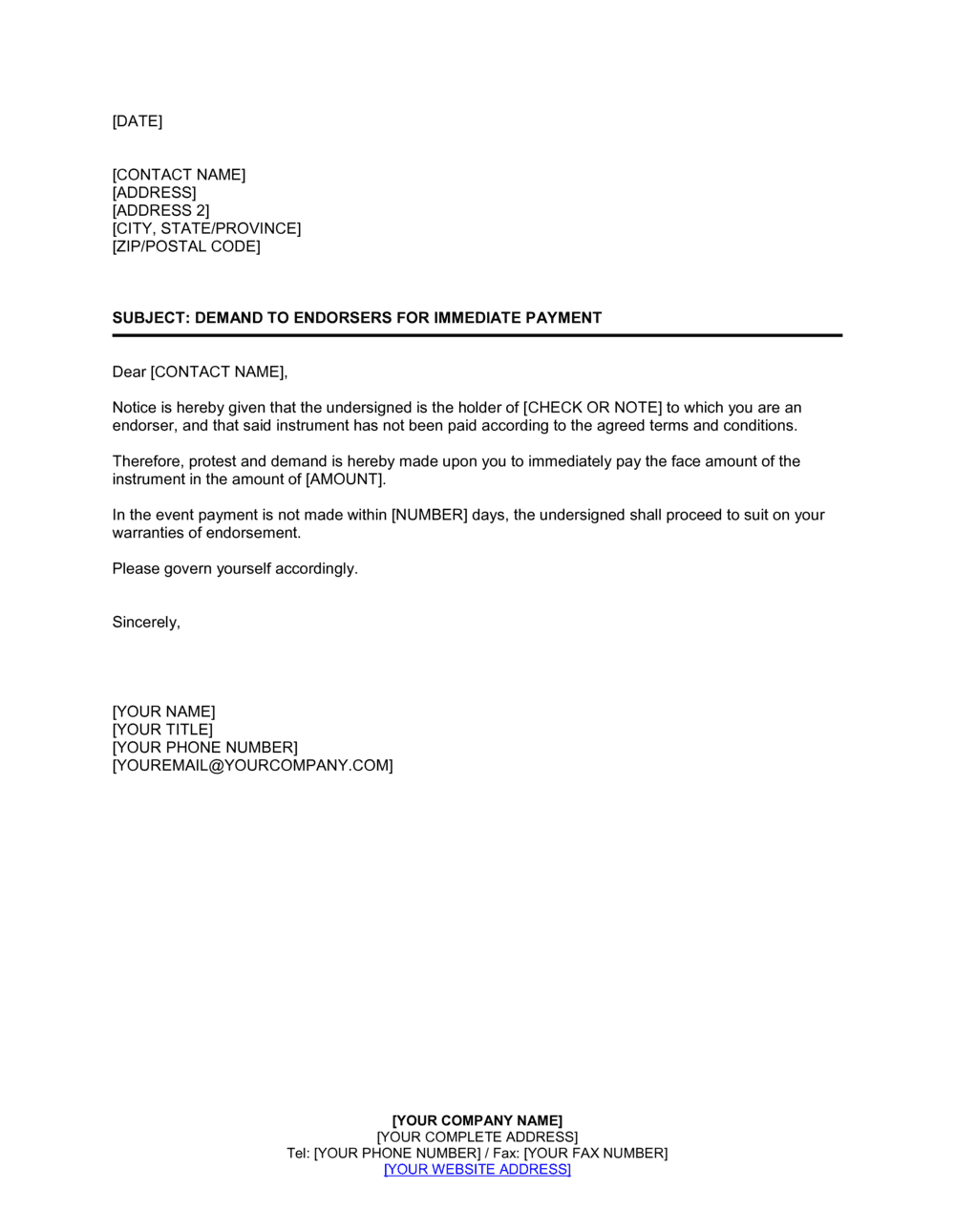
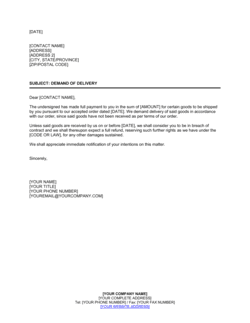
A Demand to Endorsers for Immediate Payment is a formal legal notice sent by the holder of a dishonored negotiable instrument β€” such as a promissory note, check, or draft β€” to one or more endorsers, demanding that they fulfill their secondary liability and pay the outstanding amount immediately. This free Word download gives you a ready-to-edit template you can customize with the instrument details, amounts, and party information, then export as PDF and deliver by certified mail or other legally recognized method.
When you need it
Use it when a primary obligor (maker or drawer) has failed to pay a negotiable instrument on its due date and you need to formally activate the secondary liability of one or more endorsers. Timely delivery is critical β€” most jurisdictions require notice of dishonor to be sent within a strict window, often 24 hours to a few business days, or the endorser's liability may be discharged.
What's inside
Identification of the holder and each endorser, a description of the dishonored instrument (type, amount, date, and parties), the facts of presentment and dishonor, the formal demand for immediate payment of principal plus any accrued interest and fees, a deadline for compliance, and a statement of intent to pursue legal remedies if payment is not received.

What is a Demand to Endorsers for Immediate Payment?

A Demand to Endorsers for Immediate Payment is a formal legal notice issued by the holder of a dishonored negotiable instrument β€” typically a promissory note, check, or commercial draft β€” to one or more endorsers of that instrument, demanding that they satisfy the outstanding debt in their capacity as secondary obligors. When the primary maker or drawer fails to pay the instrument at maturity or upon presentment, endorsers who signed the instrument become conditionally liable for the full amount, but only if the holder complies with strict procedural requirements: proper presentment to the primary obligor, a documented dishonor, and timely notice to each endorser. This document fulfills all three functions in a single, legally structured letter. It identifies the parties, describes the instrument and the facts of dishonor, itemizes the amount demanded, and notifies the endorser of the legal consequences of non-payment.

Why You Need This Document

Failing to send this demand β€” or sending it even one day late β€” can permanently extinguish your right to collect from endorsers, regardless of how clearly their obligation appears on the face of the instrument. Under UCC Article 3 and equivalent statutes in Canada and the UK, endorser liability is not automatic: it must be formally activated through timely notice of dishonor. Without a properly structured, verifiably delivered demand, you are left with recourse only against a primary obligor who has already demonstrated an inability or unwillingness to pay. Beyond preserving your legal rights, this letter creates the evidentiary foundation β€” instrument description, presentment date, dishonor facts, and delivery proof β€” that your attorney will need if the matter proceeds to litigation. This template gives you a compliant, professionally structured starting point that covers every required element, so you can act within the statutory window and protect your full recovery position.

Which variant fits your situation?

If your situation is…Use this template
Primary maker has defaulted on a promissory note with an endorserDemand to Endorsers for Immediate Payment
Drawer's check has been returned NSF and you need to demand payment from the drawerDemand Letter for Returned Check
Debtor has missed installment payments and no endorser is involvedDemand for Payment Letter
You need to formally notify a guarantor (not an endorser) of a defaultDemand Letter to Guarantor
Debt remains unpaid after initial demand and you are escalating to legal actionFinal Demand Letter Before Legal Action
You want to document the dishonor formally before sending any demandNotice of Dishonor
Multiple parties share joint and several liability on a noteDemand Letter to Co-Signers

Common mistakes to avoid

❌ Sending notice after the statutory deadline

Why it matters: Most jurisdictions β€” including the UCC in the US β€” require notice of dishonor to be sent within one business day (banks) or within 30 days (non-banks) of dishonor. Late notice discharges the endorser's liability entirely, leaving the holder with no recourse against them.

Fix: Calendar the dishonor date the moment you receive the return notice and send the demand the same day or the next business day. Do not wait for internal approval processes that eat up the notice window.

❌ Using unverifiable delivery methods

Why it matters: A demand sent by regular email or standard mail with no delivery confirmation gives the endorser a viable 'I never received it' defense, which can discharge their liability and void your enforcement effort.

Fix: Always use certified mail with return receipt requested, overnight courier with signature confirmation, or personal service. Retain the delivery proof in the instrument file permanently.

❌ Demanding a lump sum without itemizing principal, interest, and fees

Why it matters: Endorsers who receive an undifferentiated demand can dispute the total amount owed, stalling payment while the calculation is contested. Courts also require itemized claims to enter judgment for a specific amount.

Fix: Break the demand amount into at least three line items β€” principal, per-diem interest from the due date to the demand date, and any recoverable fees β€” and show the calculation method.

❌ Sending a single demand to multiple endorsers addressed collectively

Why it matters: Each endorser is an independent party with their own name, address, endorsement date, and potential defenses. A collective demand addressed to 'all endorsers' may be legally defective as to each individual and creates service-of-notice problems.

Fix: Prepare a separate, individually addressed demand letter for each endorser, even if the instrument details and demand amount are identical. Send each by a tracked method and retain separate delivery confirmations.

❌ Omitting the consequences-of-non-payment clause

Why it matters: A demand that does not state what happens next signals to the endorser that the holder is unlikely to act. Without this clause, the demand lacks the legal and practical pressure needed to prompt payment.

Fix: Include a clear statement that failure to pay by the deadline will result in the holder filing suit, seeking attorney's fees and costs to the full extent permitted by law, and reporting the judgment to credit bureaus where applicable.

❌ Failing to attach or reference the original instrument

Why it matters: Without identification of or reference to the specific instrument, the endorser can credibly claim they do not know which obligation the demand relates to β€” particularly if they have endorsed multiple instruments.

Fix: Include the instrument's full identification details (type, number, date, amount, and primary obligor name) in the body of the letter, and attach a copy of the instrument or the bank's return notice as an exhibit.

The 10 key clauses, explained

Identification of parties

In plain language: Names and addresses the holder (creditor making the demand) and each endorser receiving the notice, establishing the legal standing of each party to the instrument.

Sample language
This demand is made by [HOLDER FULL LEGAL NAME], located at [ADDRESS] ('Holder'), to [ENDORSER FULL LEGAL NAME], located at [ADDRESS] ('Endorser'), with respect to the negotiable instrument described below.

Common mistake: Using a trade name instead of the endorser's full legal name as it appears on the instrument β€” a mismatch can allow the endorser to dispute service and delay enforcement.

Description of the dishonored instrument

In plain language: Identifies the instrument by type, original amount, issue date, due date, instrument number (if any), and the name of the primary obligor who has defaulted.

Sample language
The instrument is a [PROMISSORY NOTE / CHECK / DRAFT] dated [DATE], in the original principal amount of $[AMOUNT], payable on [DUE DATE], issued by [MAKER / DRAWER NAME] ('Primary Obligor'), instrument number [NUMBER].

Common mistake: Omitting the instrument's due date or original principal amount. Courts require sufficient identification of the instrument β€” vague descriptions can render the demand legally defective.

Statement of endorsement

In plain language: Confirms the fact and date of the endorser's signature on the instrument, establishing that they assumed secondary liability at the time of endorsement.

Sample language
On [ENDORSEMENT DATE], Endorser endorsed the above-described instrument by signing [their name on the reverse / an allonge attached thereto], thereby assuming secondary liability for payment in accordance with [UCC Article 3 / applicable law].

Common mistake: Failing to reference the date and form of endorsement. If multiple endorsers exist, each must be addressed individually with their specific endorsement date.

Facts of presentment

In plain language: States that the holder duly presented the instrument for payment to the primary obligor on or after maturity, satisfying the procedural prerequisite to enforcing endorser liability.

Sample language
On [PRESENTMENT DATE], Holder duly presented the above instrument for payment to [PRIMARY OBLIGOR NAME] at [ADDRESS / BANK / PLACE OF PAYMENT]. Payment was demanded in full.

Common mistake: Describing presentment in vague terms without specifying the date and place. Some jurisdictions treat an inadequately described presentment as equivalent to no presentment at all.

Statement of dishonor

In plain language: Formally records that the primary obligor refused or failed to pay the instrument upon presentment, triggering the endorser's secondary liability.

Sample language
The Primary Obligor dishonored the instrument on [DATE OF DISHONOR] by [failing to pay / refusing payment / the instrument being returned by [BANK NAME] marked '[NSF / ACCOUNT CLOSED / PAYMENT STOPPED]'].

Common mistake: Using informal language like 'the check bounced' instead of a precise statement of dishonor. The legal standard requires a clear factual record of non-payment on presentation.

Demand for immediate payment

In plain language: Formally demands that the endorser pay the full amount now due β€” principal, accrued interest, and any fees or costs β€” within a specified time, typically immediately or within 3–10 business days.

Sample language
Holder hereby demands that Endorser immediately pay the sum of $[TOTAL AMOUNT DUE], representing principal of $[PRINCIPAL], accrued interest of $[INTEREST] at [RATE]% per annum through [DATE], and [fees/costs] of $[AMOUNT], no later than [DEADLINE DATE].

Common mistake: Demanding an amount without breaking it into principal, interest, and fees. A lump-sum demand without itemization is easier to dispute and harder to enforce in court.

Consequences of non-payment

In plain language: Notifies the endorser that failure to pay by the stated deadline will result in legal proceedings, additional costs being sought, and potentially a judgment being entered against them.

Sample language
If payment in full is not received by [DEADLINE DATE], Holder reserves the right to pursue all available legal remedies against Endorser, including filing suit in [APPLICABLE COURT], and will seek recovery of all costs, attorney's fees, and post-judgment interest to the extent permitted by law.

Common mistake: Omitting this clause entirely or making it sound optional. Without a clear statement of legal consequences, the demand lacks urgency and may not create the evidentiary record needed for later litigation.

Method and proof of delivery

In plain language: Specifies that the demand is being sent by a method that creates a verifiable record of receipt β€” certified mail, overnight courier, or process server β€” which is often required to preserve endorser liability.

Sample language
This demand is delivered to Endorser by [CERTIFIED MAIL, RETURN RECEIPT REQUESTED / OVERNIGHT COURIER / PERSONAL SERVICE] on [DATE]. Tracking number: [NUMBER]. Proof of delivery is maintained in Holder's records.

Common mistake: Sending the demand only by regular email or standard mail with no delivery confirmation. In most jurisdictions, unverified delivery is insufficient to prove timely notice and may discharge the endorser's liability.

Governing law and jurisdiction

In plain language: Identifies the law governing the instrument and the demand, and states the jurisdiction in which any legal proceedings would be filed.

Sample language
This demand is governed by the laws of the State of [STATE] / Province of [PROVINCE] / [COUNTRY], and any legal proceedings arising from non-payment shall be commenced in the courts of [JURISDICTION].

Common mistake: Omitting governing law when the endorser is located in a different state or country. Conflicting jurisdictional assumptions cause procedural delays and can complicate enforcement.

Holder's signature and date

In plain language: Signed by the holder or their authorized representative, with the date of the demand, establishing an authenticated record of when the notice was formally issued.

Sample language
Issued on [DATE] by: [HOLDER SIGNATURE] | [PRINTED NAME] | [TITLE, if applicable] | [COMPANY NAME, if applicable] | [ADDRESS] | [PHONE] | [EMAIL]

Common mistake: Having an unauthorized employee sign the demand letter on behalf of a corporate holder without documented authority. If the endorser challenges the demand, lack of signing authority can delay or void enforcement.

How to fill it out

  1. 1

    Identify all endorsers and gather instrument details

    Collect each endorser's full legal name and address exactly as they appear on the instrument or endorsement. Locate the original instrument and record its type, amount, issue date, due date, and instrument number.

    πŸ’‘ Cross-reference the endorsement signatures on the instrument against government-issued ID or corporate registration records before sending β€” a name discrepancy gives endorsers grounds to dispute the demand.

  2. 2

    Confirm presentment occurred and document it

    Verify that you or your agent formally presented the instrument for payment to the primary obligor on or after its due date. Record the date, time, and place of presentment, and any written or verbal refusal.

    πŸ’‘ If presentment was made through a bank (e.g., a check deposit that was returned), obtain and retain the bank's formal return notice as evidence of both presentment and dishonor.

  3. 3

    Calculate the total amount due

    Itemize the demand amount by breaking it into principal, accrued interest calculated at the instrument's stated rate from the due date to the demand date, and any recoverable fees or costs permitted by the instrument or applicable law.

    πŸ’‘ Attach a simple interest calculation worksheet to the demand letter so the endorser cannot credibly dispute the math β€” itemized demands settle faster than lump-sum ones.

  4. 4

    Set a firm payment deadline

    Enter a specific calendar date β€” not 'immediately' or 'upon receipt' β€” by which full payment must be received. A 3–10 business day window is standard; check jurisdiction-specific rules for any mandatory minimum or maximum.

    πŸ’‘ Date your deadline from the delivery date, not the sending date, to avoid disputes over when the clock started β€” certified mail tracking makes delivery date verifiable.

  5. 5

    Select the correct delivery method and send

    Send the demand by a method that generates proof of delivery: certified mail with return receipt, overnight courier, or personal service by a process server. Retain the tracking confirmation or signed receipt.

    πŸ’‘ If the endorser's address may have changed, send copies to both the last known address and any known business address simultaneously β€” most jurisdictions accept delivery to the last known address as sufficient.

  6. 6

    Have the holder sign the demand

    The demand must be signed by the holder or a duly authorized representative. For corporate holders, confirm the signatory has documented authority β€” a board resolution or authorization letter if needed.

    πŸ’‘ Include the signatory's title and direct contact information. Endorsers who are willing to pay need a clear point of contact to resolve the matter quickly.

  7. 7

    File a copy in your records immediately

    Retain the signed demand, the original instrument, any presentment and dishonor evidence, and the proof of delivery in a dedicated file. This package is the foundation of your litigation file if the endorser does not pay.

    πŸ’‘ Scan every document to a timestamped digital record the same day you send the demand β€” paper files get lost; dated digital backups do not.

  8. 8

    Monitor the deadline and take prompt action

    Calendar the payment deadline and the first business day after it. If payment is not received by the deadline, refer the matter to legal counsel immediately β€” delay can create waiver arguments in some jurisdictions.

    πŸ’‘ A brief follow-up call on the day after delivery confirms the endorser received the letter and removes any 'I never got it' defense before the deadline passes.

Frequently asked questions

What is a demand to endorsers for immediate payment?

A demand to endorsers for immediate payment is a formal legal notice sent by the holder of a dishonored negotiable instrument β€” such as a promissory note, check, or draft β€” to the endorsers of that instrument, requiring them to satisfy the outstanding debt. When the primary obligor (maker or drawer) fails to pay, endorsers become conditionally liable, but only if the holder provides timely notice of dishonor. This letter is that notice and demand combined.

Who is an endorser and what is their liability?

An endorser is a person who signs the back of a negotiable instrument, transferring it to another party and simultaneously guaranteeing payment if the primary obligor defaults. Endorser liability is secondary and conditional β€” it is triggered only when the holder makes proper presentment to the primary obligor, the instrument is dishonored, and the holder provides timely notice of dishonor to the endorser. If any of these steps are missed, the endorser's liability may be discharged.

How quickly must I send this demand after the instrument is dishonored?

Timing is critical. Under UCC Article 3 in the United States, banks must give notice of dishonor by midnight of the next banking day following dishonor. Non-bank holders must give notice within 30 days of the day dishonor occurs. In Canada and the UK, similar statutory windows apply under their respective Bills of Exchange Acts. Sending the demand late β€” even by one day beyond the statutory deadline β€” can fully discharge the endorser's liability, leaving you with no recourse against them.

What is the difference between an endorser and a guarantor?

An endorser's liability arises from their signature on the instrument itself and is governed by negotiable instruments law (e.g., UCC Article 3). Their liability is conditional on proper presentment and notice. A guarantor's liability arises from a separate guarantee agreement and is typically absolute β€” the guarantor can be pursued without first presenting the instrument to the primary obligor. For a guarantor, use a demand letter to guarantor template rather than this one.

Does this demand need to be notarized?

Notarization is not required for a standard commercial demand to endorsers in most US states, Canadian provinces, or the UK. However, for international instruments β€” particularly bills of exchange used in cross-border trade β€” a formal protest by a notary public may be required to preserve rights against endorsers in certain countries. Check the governing law of the instrument and the endorser's location before deciding whether protest is necessary.

What if the endorser refuses to pay after receiving this demand?

If the endorser does not pay by the stated deadline, you have the right to file suit in the applicable court to obtain a judgment for the amount owed, plus interest, attorney's fees, and court costs to the extent permitted by the governing law and the instrument's terms. The demand letter, along with the original instrument and proof of dishonor and delivery, forms the core of your litigation file. Engage legal counsel before filing, as procedural requirements vary by jurisdiction and court level.

Can I send this demand to multiple endorsers at the same time?

Yes β€” and you typically should, because each endorser's liability runs independently, and notice to one does not constitute notice to others. Prepare a separate demand letter for each endorser, individually addressed, and send each by a tracked delivery method. Depending on jurisdiction and the instrument's terms, endorsers may have joint and several liability, meaning you can recover the full amount from any one of them, not just a proportional share.

What governing law applies to this demand?

In the United States, UCC Article 3 (Negotiable Instruments) governs promissory notes, drafts, and checks, and the demand should reference the applicable state's adoption of the UCC. In Canada, the Bills of Exchange Act is the federal statute governing negotiable instruments. In the UK, the Bills of Exchange Act 1882 applies. EU member states have varying domestic implementations of international conventions on bills of exchange. The demand should always specify the governing law jurisdiction to avoid ambiguity.

Is this document sufficient on its own to preserve all my rights?

This demand covers the notice-of-dishonor requirement and creates a formal record of your claim against the endorser. However, preserving all rights may also require that you retain the original instrument, document presentment, and, in some jurisdictions, file a formal protest. For high-value instruments or cross-border transactions, consider engaging a collections attorney to review your process before sending the demand to ensure full compliance with applicable statutory requirements.

How this compares to alternatives

vs Demand for Payment Letter

A general demand for payment is sent directly to a primary debtor to recover an unpaid debt β€” it does not require a negotiable instrument or a formal endorsement. A demand to endorsers is specifically triggered by dishonor of a negotiable instrument and targets secondary liable parties who signed that instrument. Use the general demand letter when there is no endorsed instrument involved.

vs Final Demand Letter Before Legal Action

A final demand letter is a last-resort notice to any debtor β€” primary or secondary β€” warning that litigation is imminent if payment is not made. A demand to endorsers is the first and often only required notice to activate endorser liability under negotiable instruments law. The two can be combined, but the demand to endorsers must be sent promptly at dishonor, not after a series of prior demands.

vs Notice of Default on Promissory Note

A notice of default is sent to the maker of a promissory note when they miss a payment, triggering acceleration or cure rights under the note's terms. A demand to endorsers is sent after default and dishonor, targeting secondary parties rather than the primary obligor. Both may be sent simultaneously, but they serve different legal purposes and are addressed to different parties.

vs Guarantee Demand Letter

A guarantee demand letter is addressed to a guarantor under a separate guarantee agreement, which typically allows the holder to demand payment without first presenting the instrument to the primary obligor. A demand to endorsers is governed by negotiable instruments law and requires strict compliance with presentment and notice-of-dishonor procedures. The two documents are not interchangeable even when the same individual is both guarantor and endorser.

Industry-specific considerations

Banking and Financial Services

Banks use this notice as a formal compliance step under UCC Article 3 or the Bills of Exchange Act when returning dishonored checks or drafts to preserve recourse against endorsers before the midnight deadline.

Commercial Lending

Private lenders and commercial finance companies issue this demand to endorsers on defaulted promissory notes, particularly in asset-based lending or trade finance arrangements where multiple parties have signed the instrument.

Retail and Trade

Wholesale and retail suppliers who accept endorsed checks or notes as payment for goods use this letter to activate endorser liability when a trade payment instrument is returned unpaid by the primary buyer.

Construction and Contracting

General contractors and subcontractors who hold endorsed payment instruments from project owners or principals send this demand when payment instruments are dishonored mid-project, often in conjunction with a mechanics lien claim.

Jurisdictional notes

United States

UCC Article 3, adopted in all 50 states, governs endorser liability on negotiable instruments. Non-bank holders must give notice of dishonor within 30 days of the dishonor date; banks face a midnight-deadline rule. Notice may be given in any commercially reasonable manner, but certified mail or overnight delivery is strongly recommended to create proof of receipt. Some states impose additional consumer-protection notice requirements for checks.

Canada

The federal Bills of Exchange Act governs negotiable instruments across all provinces. Notice of dishonor must generally be given by the day after dishonor to preserve endorser liability, though the Act provides specific exceptions for non-business days. In Quebec, the Civil Code may apply to certain transactions, and French-language notice requirements may be relevant for instruments issued in the province.

United Kingdom

The Bills of Exchange Act 1882 governs endorser liability in England, Wales, Scotland, and Northern Ireland. Notice of dishonor must be given within a reasonable time β€” interpreted as the day after dishonor or the next business day. For bills of exchange used in international trade, formal protest by a notary may be required to preserve rights against foreign endorsers. The Cheques Act 1992 modified certain presentment requirements for crossed cheques.

European Union

EU member states implement negotiable instruments law through domestic legislation rather than a unified EU regulation. France, Germany, and Italy follow the Geneva Conventions on Bills of Exchange, which impose strict formal protest requirements for international drafts. Notice timelines and protest formalities vary significantly by member state. Cross-border enforcement within the EU may benefit from the European Payment Order procedure for uncontested claims.

Template vs lawyer β€” what fits your deal?

PathBest forCostTime
Use the templateBusiness owners and AR managers pursuing straightforward domestic dishonored instruments under $25,000 with a clear endorsement and documented presentmentFree30–60 minutes
Template + legal reviewInstruments over $25,000, multiple endorsers, cross-state or cross-provincial enforcement, or any situation where the notice timeline is close to the statutory deadline$200–$600 for a one-hour attorney review1–2 business days
Custom draftedInternational bills of exchange requiring formal protest, high-value instruments with complex endorsement chains, or anticipated litigation in a jurisdiction with strict procedural requirements$800–$3,000+3–7 business days

Glossary

Endorser
A person who signs the back of a negotiable instrument, thereby guaranteeing payment if the primary obligor defaults and proper presentment and notice procedures are followed.
Negotiable Instrument
A written, unconditional promise or order to pay a fixed sum of money β€” such as a promissory note, check, or bill of exchange β€” that can be transferred from one party to another.
Dishonor
The failure of a primary obligor to pay a negotiable instrument when it is duly presented for payment on or after its due date.
Notice of Dishonor
A formal notification sent to endorsers and other secondary parties informing them that the instrument has been dishonored β€” a prerequisite to enforcing their liability in most jurisdictions.
Presentment
The act of demanding payment from the maker or drawee of a negotiable instrument on or after its maturity date, which is generally required before secondary liability is triggered.
Secondary Liability
The conditional obligation of an endorser to pay the instrument if the primary obligor fails to do so, provided the holder complies with presentment and notice requirements.
Holder in Due Course
A party who acquires a negotiable instrument for value, in good faith, and without notice of defects or claims β€” holding it free from most personal defenses.
Accommodation Party
A person who signs a negotiable instrument to lend their credit to another party, without receiving value themselves, and is liable to any holder who takes the instrument after it is issued.
Recourse
The right of the holder of a dishonored instrument to seek payment from endorsers, drawers, or other secondary liable parties after the primary obligor has failed to pay.
Maker
The person or entity who signs and issues a promissory note, promising to pay the stated amount on a specified date or on demand.
Protest
A formal certificate issued by a notary public or authorized official evidencing presentment and dishonor of an instrument β€” required in some jurisdictions for international bills of exchange.

Part of your Business Operating System

This document is one of 3,000+ business & legal templates included in Business in a Box.

  • Fill-in-the-blanks β€” ready in minutes
  • 100% customizable Word document
  • Compatible with all office suites
  • Export to PDF and share electronically

Create your document in 3 simple steps.

From template to signed document β€” all inside one Business Operating System.
1
Download or open template

Access over 3,000+ business and legal templates for any business task, project or initiative.

2
Edit and fill in the blanks with AI

Customize your ready-made business document template and save it in the cloud.

3
Save, Share, Send, Sign

Share your files and folders with your team. Create a space of seamless collaboration.

Save time, save money, and create top-quality documents.

β˜…β˜…β˜…β˜…β˜…

"Fantastic value! I'm not sure how I'd do without it. It's worth its weight in gold and paid back for itself many times."

Managing Director Β· Mall Farm
Robert Whalley
Managing Director, Mall Farm Proprietary Limited
β˜…β˜…β˜…β˜…β˜…

"I have been using Business in a Box for years. It has been the most useful source of templates I have encountered. I recommend it to anyone."

Business Owner Β· 4+ years
Dr Michael John Freestone
Business Owner
β˜…β˜…β˜…β˜…β˜…

"It has been a life saver so many times I have lost count. Business in a Box has saved me so much time and as you know, time is money."

Owner Β· Upstate Web
David G. Moore Jr.
Owner, Upstate Web

Run your business with a system β€” not scattered tools

Stop downloading documents. Start operating with clarity. Business in a Box gives you the Business Operating System used by over 250,000 companies worldwide to structure, run, and grow their business.

Free Forever PlanΒ Β·Β No credit card required