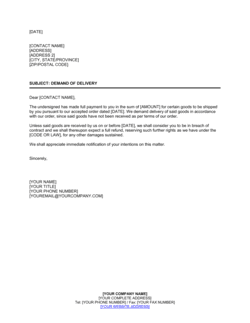
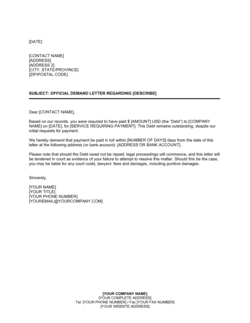
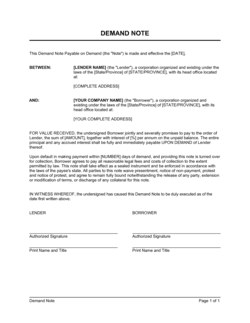
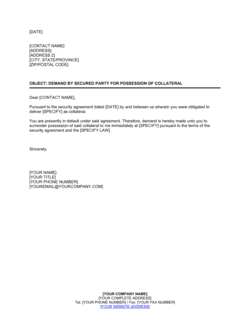
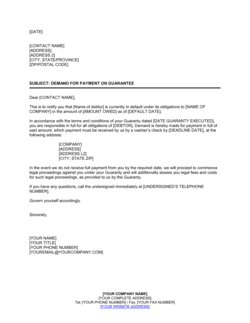
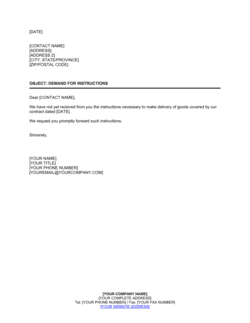
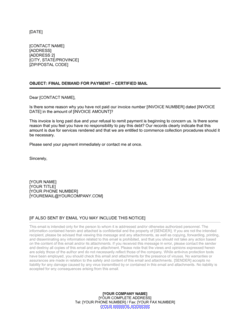
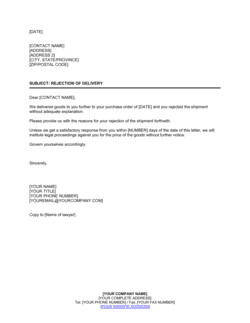
Demand on Guarantor Template

Free Word download • Edit online • Save & share with Drive • Export to PDF

1 page20–30 min to fillDifficulty: StandardSignature requiredLegal review recommended
Learn more ↓
FreeDemand on Guarantor Template

At a glance

What it is
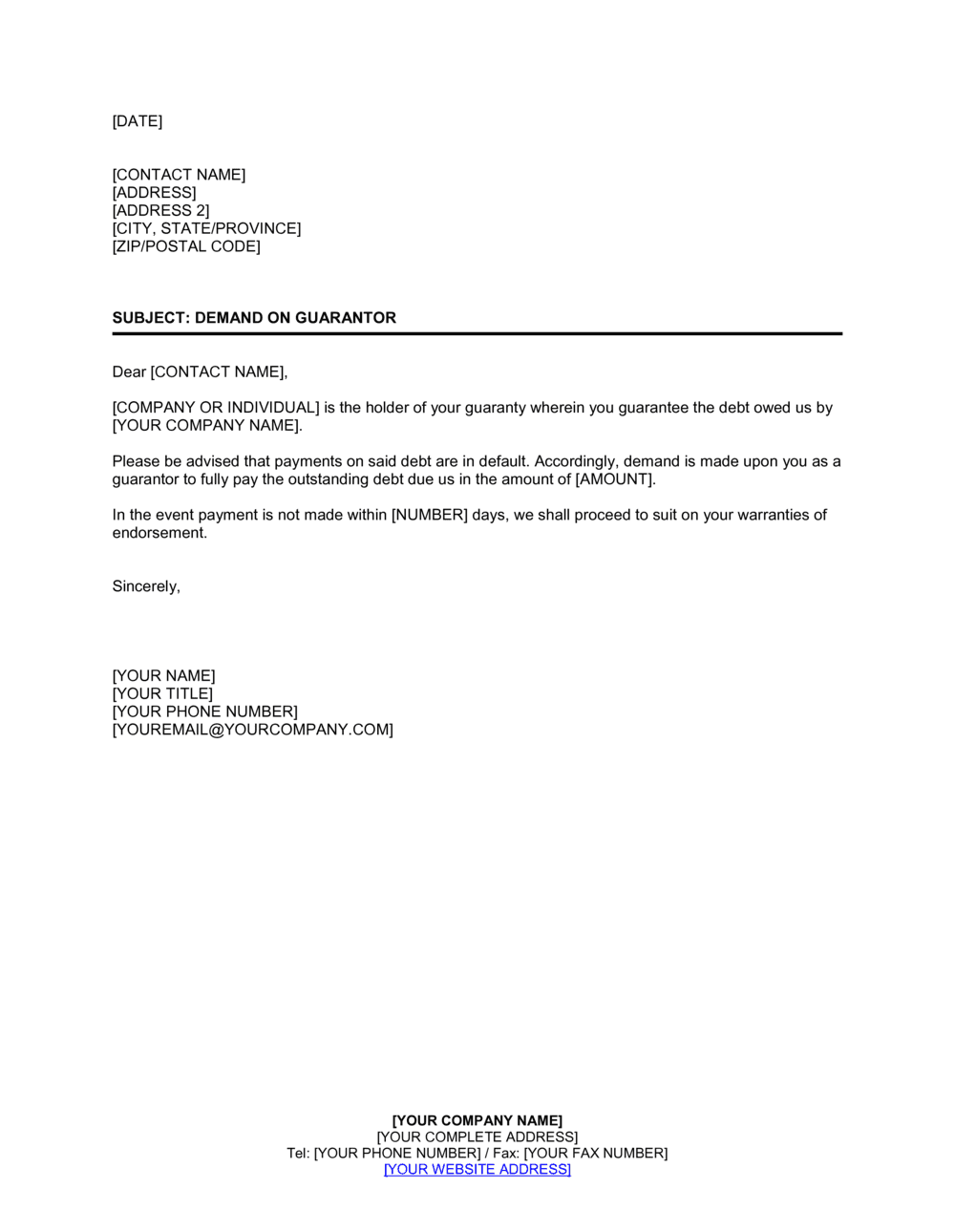
A Demand On Guarantor is a formal written notice issued by a creditor or lender to a guarantor, calling on them to fulfill their guarantee obligation after the principal debtor has defaulted. This template is a free Word download you can edit online and export as PDF — covering the identity of all parties, the outstanding debt amount, the basis of the guarantee, and a clear deadline for payment.
When you need it
Use it as soon as the principal debtor misses a payment or formally defaults on an obligation that is backed by a personal or corporate guarantee. Sending a properly structured written demand is typically a contractual prerequisite before a creditor can pursue the guarantor through litigation or collections.
What's inside
Parties and notice details, identification of the underlying obligation and default, the specific amount demanded, reference to the guarantee instrument, a firm payment deadline, consequences of non-payment, and authorized signature block.

What is a Demand On Guarantor?

A Demand On Guarantor is a formal written notice issued by a creditor to a guarantor, requiring that person or entity to honor their guarantee by paying an outstanding debt after the primary borrower or obligor has defaulted. The document identifies all parties, cites the underlying obligation and the guarantee instrument, quantifies the exact amount demanded with a breakdown of principal and interest, and sets a firm deadline for payment. Because most guarantee instruments make a written demand a contractual and legal prerequisite for enforcement, the demand is not a courtesy notice — it is the mechanism that activates the guarantor's liability and starts the clock on legal proceedings if payment is not made.

Why You Need This Document

Calling on a guarantor without a properly structured written demand creates four immediate problems. First, many guarantee instruments are explicitly triggered only by a written demand in a specified form — an oral or informal request does not start the payment obligation running. Second, without a specific deadline stated in the demand, the limitation period for bringing a legal claim against the guarantor may not begin, weakening your enforcement timeline. Third, an imprecise demand — missing the guarantee reference, the default date, or an itemized amount — gives a guarantor grounds to request further particulars, buying them weeks of delay before they are technically in breach. Fourth, failing to reserve your rights in writing can allow a guarantor to argue that subsequent negotiations or partial payments waived the full claim. This template gives you a legally structured demand that satisfies notice requirements, documents the default, and preserves every enforcement option available to you — the prerequisite for recovering what you are owed without unnecessary delay.

Which variant fits your situation?

If your situation is…Use this template
Demanding payment from an individual who personally guaranteed a business loanDemand On Guarantor (Personal Guarantee)
Calling on a corporate guarantor after a subsidiary defaultsDemand On Corporate Guarantor
Demanding rent arrears from a lease guarantorDemand On Guarantor (Commercial Lease)
Sending a general overdue payment notice to the primary debtor firstDemand For Payment Letter
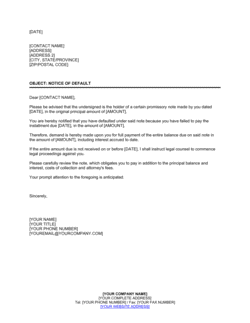
Notifying the debtor formally that they are in breach before involving the guarantorNotice of Default
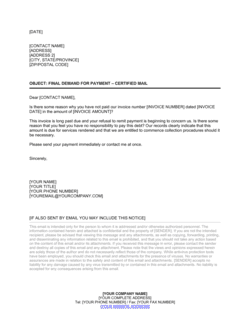
Following up after the guarantor ignores the initial demandFinal Demand Letter
Commencing formal debt recovery after the guarantor fails to payDebt Collection Letter

Common mistakes to avoid

❌ Demanding payment before confirming the notice procedure is satisfied

Why it matters: Many guarantees require a prior default notice to the principal debtor, or a waiting period, before the creditor can call on the guarantor. Skipping this step can render the demand premature and unenforceable.

Fix: Review the guarantee's notice clause before drafting the demand. Confirm all prerequisite steps — notice to principal debtor, cure period — have been satisfied and documented.

❌ Using an unitemized total amount

Why it matters: A lump-sum demand gives the guarantor an easy basis to dispute the figure as overstated, introducing delay. Courts may also require a clear breakdown to assess whether the demanded amount falls within the scope of the guarantee.

Fix: Itemize the demand into at least three components: principal outstanding, accrued interest with rate and period stated, and any recoverable costs. Show the arithmetic explicitly.

❌ Setting a vague or missing payment deadline

Why it matters: Without a specific calendar date, the limitation period for bringing a claim may not start running, and the guarantor has no firm trigger for when they are in breach of the demand.

Fix: Always state the deadline as a specific date — e.g., 'on or before June 15, 2026' — calculated from the date of service plus the contractual notice period.

❌ Omitting the reservation-of-rights clause

Why it matters: Creditors sometimes negotiate or accept partial payments after issuing a demand. Without a reservation of rights, the guarantor can argue this conduct waived the creditor's right to the remainder.

Fix: Include a standard clause reserving all rights under the guarantee and applicable law, regardless of any subsequent communications or partial payments accepted.

❌ Sending the demand to the wrong address or by an unauthorized method

Why it matters: If the guarantee specifies a service address or an accepted method of notice (registered post, email), serving by any other method may be treated as non-service, restarting the timeline and potentially prejudicing a limitation claim.

Fix: Check the notice provisions in the guarantee instrument and serve strictly in accordance with them. Retain proof of delivery for every method used.

❌ Failing to identify the underlying obligation and guarantee by date and clause

Why it matters: A demand that does not precisely identify the guarantee instrument and principal agreement gives a sophisticated guarantor grounds to request further particulars, buying weeks of delay before they are in technical breach.

Fix: Cite both documents by their exact titles, dates, and relevant clause numbers in the body of the demand so the guarantor cannot credibly claim uncertainty about which guarantee is being called.

The 10 key clauses, explained

Parties and notice details

In plain language: Identifies the creditor sending the demand, the guarantor receiving it, and all contact and address details used to establish proper service of notice.

Sample language
To: [GUARANTOR FULL LEGAL NAME], of [GUARANTOR ADDRESS] ('Guarantor'). From: [CREDITOR LEGAL NAME], of [CREDITOR ADDRESS] ('Creditor'). Date: [DATE].

Common mistake: Using a trade name or informal name instead of the guarantor's full legal name as it appears in the guarantee instrument — a mismatch can allow the guarantor to contest that the demand was properly served on them.

Reference to the underlying obligation

In plain language: Identifies the original contract, loan agreement, or lease that gave rise to the debt, including its date and the parties involved.

Sample language
This demand is made pursuant to the [LOAN AGREEMENT / LEASE / CREDIT FACILITY] dated [DATE] between [PRINCIPAL DEBTOR NAME] and [CREDITOR NAME] (the 'Principal Agreement').

Common mistake: Referencing the guarantee instrument rather than the underlying obligation — both should be cited to make clear the chain of liability from the principal agreement through to the guarantee.

Reference to the guarantee instrument

In plain language: Cites the specific guarantee document under which the guarantor assumed liability, including its date and any relevant clause numbers.

Sample language
You provided a guarantee dated [DATE] (the 'Guarantee') under which you agreed to pay all sums owed by [PRINCIPAL DEBTOR NAME] under the Principal Agreement in the event of default. Clause [X] of the Guarantee requires payment within [X] business days of a written demand.

Common mistake: Omitting the guarantee date or clause reference — without this, the guarantor can delay payment by requesting proof that a valid guarantee exists, triggering a document chase that stalls enforcement.

Statement of default

In plain language: Describes the specific act of default by the principal debtor — missed payment, insolvency, or breach — that triggers the creditor's right to call on the guarantee.

Sample language
[PRINCIPAL DEBTOR NAME] has failed to make the payment of $[AMOUNT] due on [DATE] under the Principal Agreement, constituting an event of default. Despite a notice of default issued on [DATE], the sum remains unpaid as of the date of this demand.

Common mistake: Stating only that a default has occurred without specifying the date and nature of the default — ambiguity here gives the guarantor grounds to argue the demand is premature or that no default has actually been established.

Amount demanded

In plain language: States the exact dollar amount being demanded, broken down into principal, accrued interest, and any fees or charges where applicable.

Sample language
You are hereby demanded to pay the sum of $[TOTAL AMOUNT], comprising: principal outstanding: $[X]; accrued interest at [X]% per annum from [DATE] to [DATE]: $[X]; enforcement costs: $[X].

Common mistake: Stating only a round total without itemizing the components — if the guarantor disputes the amount, an unitemized demand is harder to defend and may be challenged as overstated.

Payment deadline

In plain language: Sets a specific calendar date or number of business days by which the guarantor must pay in full.

Sample language
You are required to pay the full amount of $[TOTAL AMOUNT] on or before [SPECIFIC DATE], being [X] business days from the date of this demand, as required by clause [X] of the Guarantee.

Common mistake: Using vague language such as 'immediately' or 'as soon as possible' instead of a specific deadline — courts have found that an insufficiently specific demand fails to start the limitation clock running.

Payment instructions

In plain language: Provides the creditor's bank account details or other accepted payment method so the guarantor can remit funds without further correspondence.

Sample language
Payment should be made by electronic funds transfer to: Bank: [BANK NAME] | Account Name: [CREDITOR NAME] | Account Number: [XXXXXX] | Routing/Sort Code: [XXXXXX] | Reference: [REFERENCE NUMBER].

Common mistake: Omitting payment instructions entirely and expecting the guarantor to contact the creditor — this creates a pretext for the guarantor to claim they were ready to pay but did not know how, delaying enforcement.

Consequences of non-payment

In plain language: Warns the guarantor that failure to pay by the deadline will result in legal action, additional costs, or both — without making the demand conditional on those consequences.

Sample language
If payment is not received in full by [DATE], the Creditor reserves the right to commence legal proceedings against you to recover the full amount demanded, together with interest and legal costs, without further notice.

Common mistake: Phrasing the consequences as an ultimatum that makes the demand conditional — e.g., 'we will only proceed if you do not pay.' Courts have treated overly conditional language as undermining the finality of the demand.

Preservation of rights

In plain language: States that issuing the demand does not waive any of the creditor's other rights under the guarantee, the principal agreement, or applicable law.

Sample language
Nothing in this demand constitutes a waiver of any right or remedy available to the Creditor under the Guarantee, the Principal Agreement, or applicable law, all of which are expressly reserved.

Common mistake: Omitting a reservation-of-rights clause — without it, a guarantor may later argue that accepting a partial payment or negotiating after the demand waived the creditor's right to the full amount.

Authorized signature and notice of authority

In plain language: The demand is signed by an authorized representative of the creditor, with their name, title, and date of signature stated clearly.

Sample language
Signed on behalf of [CREDITOR LEGAL NAME] by: [SIGNATORY NAME], [TITLE]. Date: [DATE]. If you have questions regarding this demand, contact [CONTACT NAME] at [PHONE / EMAIL].

Common mistake: Signing with an illegible signature and no printed name or title — if the guarantor challenges the demand, the creditor must be able to prove the signer had authority, which requires an identifiable signatory.

How to fill it out

  1. 1

    Confirm the guarantee is valid and in force

    Retrieve the original guarantee document and verify it covers the specific debt in question, has not expired, and was properly executed. Check for any conditions precedent to making a demand — such as a prior notice of default to the principal debtor.

    💡 Some guarantees require the creditor to first exhaust remedies against the principal debtor before calling on the guarantor. Confirm this is not the case before sending.

  2. 2

    Identify the guarantor's full legal name and address

    Use the exact name as it appears in the guarantee instrument. For individuals, include full given name and surname. For companies, include the registered entity name and company number.

    💡 For corporate guarantors, search the company registry to confirm the current registered address — guarantors sometimes change addresses and will use a stale address as a service-of-notice defense.

  3. 3

    Document the principal debtor's default

    State the specific missed payment date, the amount due, and any prior notices issued to the principal debtor. Attach or reference any default notice previously sent to make the default record clear.

    💡 Keep copies of all communications with the principal debtor — emails, default notices, and demand letters — as supporting evidence in case the guarantor challenges the validity of the default.

  4. 4

    Calculate the exact amount demanded

    Break the total into principal, accrued interest calculated at the contractual rate from the default date to the demand date, and any recoverable fees or enforcement costs permitted by the guarantee.

    💡 Double-check the interest calculation method specified in the guarantee or principal agreement — daily, monthly compounding, and simple interest produce materially different amounts over time.

  5. 5

    Set a specific payment deadline

    Insert the deadline as a calendar date, not a relative phrase. Count the number of business days specified in the guarantee from the date of service — not the date the letter is drafted.

    💡 If you are serving by post, add the number of days your jurisdiction allows for postal service (typically 2–5 business days) before the clock starts running.

  6. 6

    Include full payment instructions

    Enter your bank account name, account number, routing or sort code, and a payment reference number the guarantor should use so funds can be matched to the account immediately on receipt.

    💡 Use a unique reference number per demand so that partial payments or multiple guarantors can be tracked without ambiguity in your accounts-receivable system.

  7. 7

    Have an authorized signatory execute the demand

    The letter must be signed by a person with authority to act on behalf of the creditor — a director, officer, or authorized agent. Print the signatory's full name and title below the signature.

    💡 If the creditor is a corporate entity, confirm the signatory's authority in board minutes or a delegation-of-authority document in case the guarantor later challenges whether the demand was validly issued.

  8. 8

    Serve the demand and record proof of delivery

    Deliver the demand in the manner specified in the guarantee — often registered post, courier, or email with read receipt. Retain proof of delivery as evidence the notice was properly served on the specified date.

    💡 Send by at least two methods (e.g., email and registered post) to reduce the risk that a technical defect in one method of service invalidates the demand.

Frequently asked questions

What is a demand on guarantor?

A demand on guarantor is a formal written notice issued by a creditor to a guarantor, requiring them to pay an outstanding debt after the principal debtor has defaulted. It triggers the guarantor's contractual obligation under the guarantee instrument and is typically a mandatory prerequisite before the creditor can commence legal proceedings against the guarantor. The demand must identify the parties, the debt, the default, and a specific payment deadline to be legally effective.

When can a creditor make a demand on a guarantor?

A creditor can typically make a demand on a guarantor as soon as the principal debtor defaults on the underlying obligation — for example, by missing a loan repayment or failing to pay rent. However, many guarantee instruments require the creditor to first issue a notice of default to the principal debtor, allow a cure period, and in some cases exhaust remedies against the principal before calling on the guarantor. Review the specific guarantee document before issuing any demand.

Does a demand on guarantor need to be in writing?

Yes. In virtually all jurisdictions, a valid demand on a guarantor must be in writing and served in the manner specified in the guarantee instrument — typically by registered post, courier, or email with confirmation. An oral demand is generally insufficient to trigger the guarantor's payment obligation or to start the limitation period running. A written demand also creates the evidentiary record needed if litigation follows.

What happens if the guarantor does not respond to the demand?

If the guarantor fails to pay by the stated deadline, the creditor may commence legal proceedings to recover the full amount demanded, plus accrued interest and legal costs. In many cases, a creditor can also register a judgment against the guarantor's personal or corporate assets, seek a charging order over property, or initiate insolvency proceedings depending on the jurisdiction and the size of the debt.

Can a guarantor dispute a demand on guarantor?

Yes. A guarantor may dispute the demand on several grounds: that the principal debtor was not in default, that the amount demanded exceeds the scope of the guarantee, that the demand was not served properly, or that the creditor's conduct has discharged the guarantee — for example, by granting the principal debtor a material concession without the guarantor's consent. This is why precise drafting of the demand and strict compliance with the notice provisions in the guarantee are essential.

What is the difference between a guarantee and an indemnity?

A guarantee is a secondary obligation — the guarantor is only liable if the principal debtor defaults, and the guarantor's liability mirrors the debtor's. An indemnity is a primary, independent obligation — the indemnifier is liable regardless of what happens to the principal debtor's obligation and cannot use defences available to the debtor. In practice, most commercial guarantee documents include both a guarantee and an indemnity clause to maximize enforceability.

Does issuing a demand on a guarantor affect the claim against the principal debtor?

No. Calling on a guarantor does not release or waive any claim against the principal debtor. The creditor retains the right to pursue both the principal debtor and the guarantor simultaneously until the full amount is recovered. Once the guarantor pays, they are typically subrogated to the creditor's rights and may themselves pursue the principal debtor for reimbursement.

How long does a guarantor have to pay after receiving a demand?

The payment period is set by the guarantee instrument — commonly between 5 and 30 business days from the date of service of the demand. Some demand guarantees require payment on first demand with no grace period. If the guarantee is silent, a reasonable period — typically 7 to 14 days — is implied. Always calculate the deadline from the date of service, not the date the letter is drafted.

Do I need a lawyer to issue a demand on a guarantor?

For straightforward personal guarantees involving clear defaults and well-drafted guarantee instruments, a high-quality template is sufficient to issue an initial demand. Legal advice is recommended when the guarantee contains complex conditions precedent, the guarantor is likely to mount a legal challenge, the amount is material, the guarantee involves a cross-border element, or the creditor needs to enforce the demand through litigation or insolvency proceedings.

How this compares to alternatives

vs Demand For Payment Letter

A demand for payment letter is sent directly to the primary debtor who owes the debt. A demand on guarantor is sent to the third party who guaranteed that debt after the primary debtor defaults. The two can be sent simultaneously or sequentially, but they are distinct documents addressed to different parties with different legal bases.

vs Notice of Default

A notice of default informs the principal debtor that they are in breach of a contract and typically allows a cure period before further action. A demand on guarantor comes after the default is established and uncured — it calls on the third-party guarantor to pay, not the debtor. In many guarantee structures, a prior notice of default to the debtor is a condition that must be met before a valid demand on the guarantor can be issued.

vs Final Demand Letter

A final demand letter is a last-resort notice sent to the original debtor before commencing legal action. A demand on guarantor is a first-instance demand to a different party — the guarantor — and is itself often a legal prerequisite before any claim against the guarantor can proceed. The two serve different enforcement stages and are directed at different parties.

vs Debt Collection Letter

A debt collection letter is a broader recovery notice used across various debtor relationships and is often the precursor to passing the account to a collection agency. A demand on guarantor is a legally specific notice triggering a contractual obligation under a guarantee instrument, with formal requirements that must be strictly followed. Using a generic collection letter to call on a guarantor may be legally insufficient to trigger the guarantee.

Industry-specific considerations

Banking and financial services

Personal and corporate guarantees are standard security for business loans, revolving credit facilities, and trade finance — demands are triggered by covenant breaches or missed repayments.

Commercial real estate

Landlords call on lease guarantors when tenants default on rent or vacate premises, particularly where the tenant entity is insolvent and the guarantor is the individual director or a parent company.

Trade and wholesale supply

Suppliers who extend trade credit frequently require director personal guarantees, which are called upon when a customer company enters administration or liquidation with unpaid invoices outstanding.

Equipment and asset finance

Finance companies securing equipment leases with personal guarantees issue demands when lessees default on installments, with the guarantor liable for the full outstanding balance plus early-termination fees.

Jurisdictional notes

United States

Guarantee enforceability is governed by state law and the Statute of Frauds, which requires guarantees to be in writing and signed to be enforceable. Courts in states such as California and New York have specific rules on anti-deficiency protections that can limit what a creditor can recover from a guarantor after a secured asset sale. Some states require the demand to be sent to both the principal debtor and the guarantor simultaneously. Interest on the demanded amount is governed by the contract rate or applicable state usury laws.

Canada

Guarantees in Canada are governed by provincial law. Most provinces require guarantees to be in writing under the Statute of Frauds. In Ontario, the Guarantee Companies Securities Act imposes additional requirements on corporate guarantors. Quebec treats guarantees as 'suretyships' under the Civil Code of Quebec, with distinct rules on the benefit of discussion and division that can require the creditor to exhaust the principal debtor's assets first. French-language demands may be required for Quebec guarantors.

United Kingdom

Guarantees in England and Wales must be evidenced in writing under section 4 of the Statute of Frauds 1677 to be enforceable. The demand must be clear and unambiguous — courts have struck down demands that were insufficiently precise about the amount or the guarantee called upon. Personal guarantors who are consumers may have additional protections under the Consumer Credit Act 1974. Scottish law treats guarantees as 'cautionary obligations' under distinct principles and requires separate drafting consideration.

European Union

Guarantee law varies significantly across EU member states. France, Germany, and Italy each have civil code provisions governing the rights of guarantors, including rights of discussion and division that can complicate enforcement. In France, a guarantor who is a natural person must receive specific written warnings about the extent of their liability under the Code de la consommation. Cross-border demands within the EU must consider whether local consumer protection or insolvency laws may affect enforceability, and translation of the demand into the local language is advisable.

Template vs lawyer — what fits your deal?

PathBest forCostTime
Use the templateCreditors with a straightforward personal guarantee, a clear default, and a well-drafted guarantee instrument that contains no unusual conditions precedentFree30 minutes
Template + legal reviewDemands involving significant sums, complex guarantee terms, or guarantors who are likely to dispute the default or the amount$300–$8001–3 days
Custom draftedCross-border guarantees, syndicated lending arrangements, guarantors threatening insolvency, or where enforcement through litigation or insolvency proceedings is anticipated$1,000–$5,000+1–2 weeks

Glossary

Guarantor
A person or entity that agrees to be responsible for another party's debt or obligation if that party fails to perform.
Principal Debtor
The primary borrower or obligor whose failure to pay triggers the creditor's right to call on the guarantee.
Guarantee
A legally binding promise by a third party to satisfy a debt or perform an obligation if the primary party defaults.
Personal Guarantee
A guarantee given by an individual — often a company director or owner — making them personally liable for a business debt.
Default
A failure by the principal debtor to meet a contractual obligation, such as missing a scheduled loan repayment or rent payment.
Demand Notice
A formal written communication requiring a party to perform an obligation or pay a sum of money by a specified deadline.
Acceleration Clause
A provision that makes the entire outstanding balance of a debt immediately due and payable upon default, rather than in installments.
Subrogation
The legal right of a guarantor who has paid a debt to step into the creditor's shoes and pursue the principal debtor for reimbursement.
Indemnity
A broader form of guarantee under which the indemnifier's liability is independent of the principal debtor's obligation, making it harder to challenge.
Continuing Guarantee
A guarantee that covers a series of transactions or an ongoing credit facility rather than a single specific debt.
Demand Guarantee
A guarantee payable on first written demand without the creditor needing to prove the principal debtor's default — common in trade finance.

Part of your Business Operating System

This document is one of 3,000+ business & legal templates included in Business in a Box.

  • Fill-in-the-blanks — ready in minutes
  • 100% customizable Word document
  • Compatible with all office suites
  • Export to PDF and share electronically

Create your document in 3 simple steps.

From template to signed document — all inside one Business Operating System.
1
Download or open template

Access over 3,000+ business and legal templates for any business task, project or initiative.

2
Edit and fill in the blanks with AI

Customize your ready-made business document template and save it in the cloud.

3
Save, Share, Send, Sign

Share your files and folders with your team. Create a space of seamless collaboration.

Save time, save money, and create top-quality documents.

★★★★★

"Fantastic value! I'm not sure how I'd do without it. It's worth its weight in gold and paid back for itself many times."

Managing Director · Mall Farm
Robert Whalley
Managing Director, Mall Farm Proprietary Limited
★★★★★

"I have been using Business in a Box for years. It has been the most useful source of templates I have encountered. I recommend it to anyone."

Business Owner · 4+ years
Dr Michael John Freestone
Business Owner
★★★★★

"It has been a life saver so many times I have lost count. Business in a Box has saved me so much time and as you know, time is money."

Owner · Upstate Web
David G. Moore Jr.
Owner, Upstate Web

Run your business with a system — not scattered tools

Stop downloading documents. Start operating with clarity. Business in a Box gives you the Business Operating System used by over 250,000 companies worldwide to structure, run, and grow their business.

Start free · No credit card required