Notice Of Intent To Vacate Premises Template

Free Word download β€’ Edit online β€’ Save & share with Drive β€’ Export to PDF

1 pageβ€’15–25 min to fillβ€’Difficulty: Standard
Learn more ↓
FreeNotice Of Intent To Vacate Premises Template

At a glance

What it is
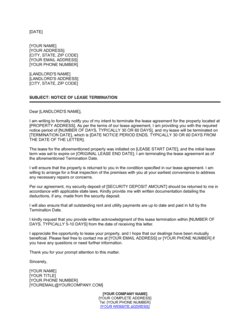
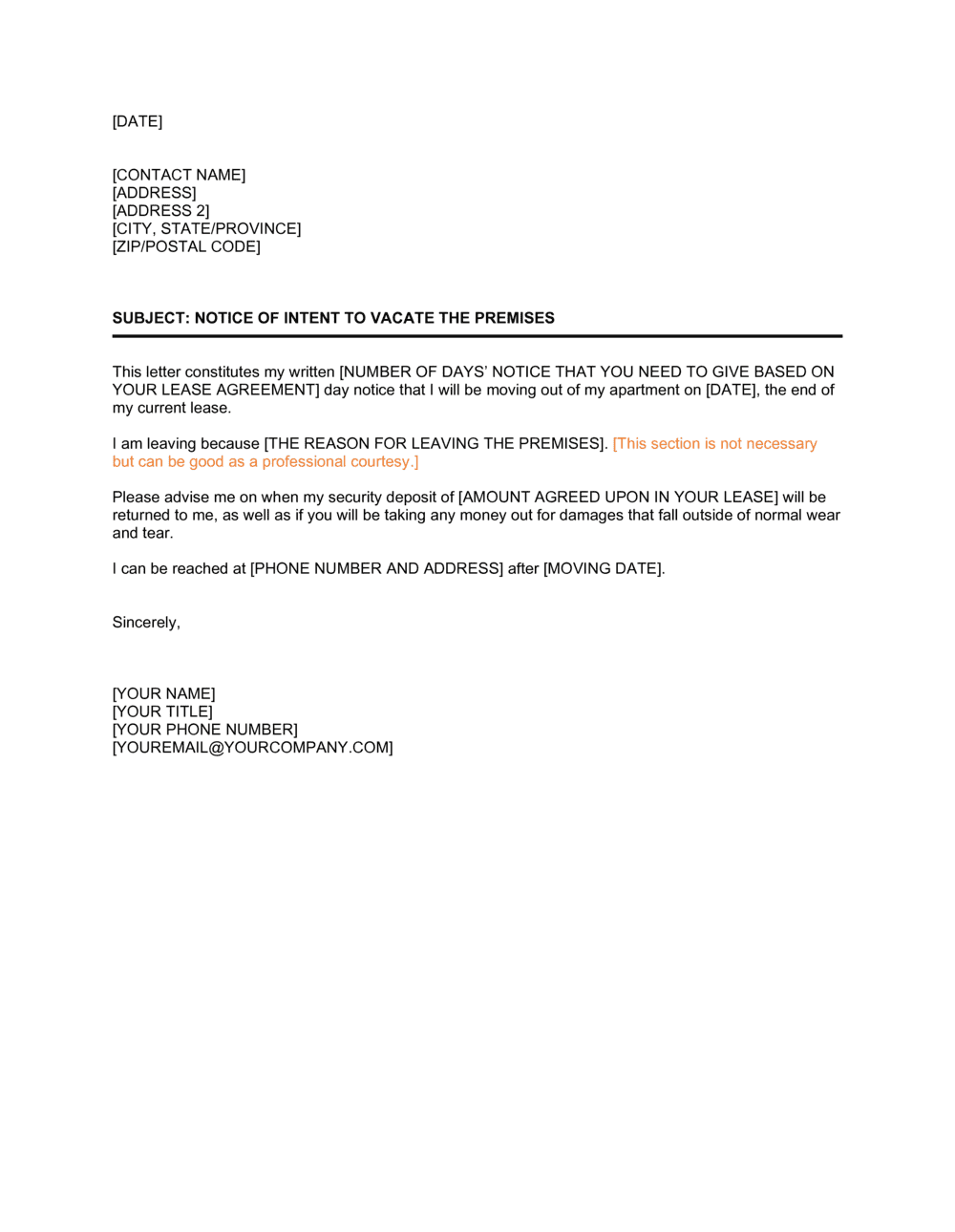
A Notice of Intent to Vacate Premises is a formal written letter a tenant sends to a landlord to confirm they will be leaving the rental unit on a specific date. This free Word download gives you a ready-to-edit template that covers the required notice period, move-out date, forwarding address, and security deposit return request β€” exportable as PDF and deliverable in under 15 minutes.
When you need it
Use it when your lease is ending, when you are exercising an early-termination clause, or any time your lease requires advance written notice before vacating. Send it as early as your lease allows to protect your deposit and avoid liability for additional rent.
What's inside
Tenant and landlord contact details, the rental property address, the intended move-out date, a statement of compliance with the required notice period, a forwarding address for the security deposit refund, and a request for a pre-move-out inspection.

What is a Notice of Intent to Vacate Premises?

A Notice of Intent to Vacate Premises is a formal written letter a tenant sends to a landlord or property manager to confirm they will be leaving the rental unit on a specific date and will not be renewing the lease. It records the planned move-out date, confirms compliance with the notice period required by the lease, provides a forwarding address for the security deposit refund, and requests a pre-move-out inspection. The letter creates a documented paper trail that protects the tenant from rent liability beyond the stated departure date and starts the landlord's legal obligation to return the deposit.

Why You Need This Document

Leaving without a formal written notice β€” or sending one that doesn't meet your lease's requirements β€” can cost you a full month's rent even after you've handed back the keys. Landlords in most jurisdictions are entitled to hold tenants to the full notice period, and oral notice or a text message is routinely disputed or denied. A properly dated, signed, and delivered notice of intent eliminates that exposure and starts the deposit-return clock running. It also creates a written record for the pre-move-out inspection request β€” a step that, in several US states and Canadian provinces, limits the deductions a landlord can make from your deposit if they fail to schedule the walkthrough. This template gives you a complete, ready-to-send letter in under 15 minutes, with every clause a landlord expects to see.

Which variant fits your situation?

If your situation is…Use this template
Giving 30 days notice on a month-to-month residential leaseNotice of Intent to Vacate Premises
Vacating commercial office or retail space at lease endCommercial Lease Termination Letter
Terminating a lease early due to uninhabitable conditionsConstructive Eviction Notice Letter
Landlord requiring a tenant to leave before the lease expiresEviction Notice
Mutual agreement between landlord and tenant to end the lease earlyLease Termination Agreement
Requesting confirmation of security deposit return after vacatingSecurity Deposit Demand Letter
New tenant taking over the remaining lease termLease Assignment Agreement

Common mistakes to avoid

❌ Giving shorter notice than the lease requires

Why it matters: If the notice period is 60 days and you give 30, the landlord can hold you liable for rent through the full 60-day period β€” even after you have moved out and returned the keys.

Fix: Read the notice clause in your lease before choosing a move-out date, then count back from your intended departure date to confirm the send date satisfies the minimum.

❌ Using verbal or informal notice instead of written notice

Why it matters: A text message or phone call is not a formal notice in most jurisdictions. Landlords can deny receiving it, restarting the clock, and pursuing a holdover-rent claim.

Fix: Always send a signed written notice by a traceable method β€” certified mail, email with read receipt, or in-person delivery with a written acknowledgment β€” and retain proof.

❌ Leaving the forwarding address blank

Why it matters: The landlord's legal window to return the deposit runs from the move-out date in most jurisdictions. An unknown forwarding address does not pause that clock, but it does leave you unable to prove where the deposit should have been sent.

Fix: Provide any confirmed address β€” a friend's, a P.O. box β€” and follow up in writing with your permanent address as soon as it is known.

❌ Not requesting confirmation of receipt

Why it matters: Without written confirmation, a landlord can dispute the notice date, argue the notice was late, and claim an extra month's rent.

Fix: Ask for written acknowledgment in the closing paragraph, and follow up within 48 hours if you have not received a response.

The 9 key clauses, explained

Date and parties

In plain language: Records the date the letter is sent, the tenant's full name and current address, and the landlord's or property manager's name and address.

Sample language
[DATE] | From: [TENANT FULL NAME], [RENTAL UNIT ADDRESS] | To: [LANDLORD / PROPERTY MANAGER NAME], [LANDLORD ADDRESS]

Common mistake: Addressing the letter to a property management company's trade name instead of the named landlord in the lease β€” the notice may not satisfy the lease's delivery requirements and could be disputed as invalid.

Subject line

In plain language: A clear one-line heading that identifies the letter as a notice of intent to vacate and references the rental property address.

Sample language
Re: Notice of Intent to Vacate β€” [FULL RENTAL PROPERTY ADDRESS], Unit [UNIT NUMBER]

Common mistake: Omitting the unit number on multi-unit properties. Without it, the landlord cannot confirm which unit the notice applies to, creating a processing delay.

Statement of intent

In plain language: A direct opening sentence stating that the tenant intends to vacate the rental premises and will not be renewing the lease.

Sample language
I am writing to formally notify you of my intent to vacate the premises located at [RENTAL ADDRESS] and to confirm that I will not be renewing my lease.

Common mistake: Using ambiguous language like 'I may be leaving' or 'I am considering vacating.' A notice must be unequivocal β€” hedged language can be treated as an inquiry rather than a binding notice.

Move-out date and notice period compliance

In plain language: States the specific date the tenant will vacate and confirms this date satisfies the notice period required by the lease.

Sample language
My intended move-out date is [MOVE-OUT DATE]. This notice is provided [NUMBER] days in advance, satisfying the [NUMBER]-day notice requirement set out in Section [X] of the Lease Agreement dated [LEASE DATE].

Common mistake: Stating the move-out date without confirming it meets the required notice period. If the date falls short, the landlord can hold the tenant liable for an additional month's rent.

Property condition and cleaning commitment

In plain language: Confirms the tenant's commitment to return the unit in clean condition, with all personal property removed, by the move-out date.

Sample language
I will ensure the premises are returned in a clean condition, free of all personal belongings, and in the same state as received, subject to normal wear and tear, by [MOVE-OUT DATE].

Common mistake: Omitting this clause entirely. Without it, landlords have no written baseline for the expected condition, making deposit deduction disputes harder to contest.

Request for pre-move-out inspection

In plain language: Formally requests that the landlord or property manager conduct a joint walkthrough inspection before the move-out date.

Sample language
I respectfully request a pre-move-out inspection at a mutually convenient time before [MOVE-OUT DATE]. Please contact me at [PHONE / EMAIL] to schedule.

Common mistake: Not requesting this in writing. Several jurisdictions require landlords to offer a pre-move-out inspection if the tenant asks in writing β€” skipping the written request waives the right.

Key return instructions

In plain language: Describes how and when the tenant will return all keys, access cards, and garage openers to the landlord on or before the move-out date.

Sample language
I will return all keys, access cards, and parking fobs for the premises to [LANDLORD / MANAGEMENT OFFICE] by [MOVE-OUT DATE] at [TIME / LOCATION].

Common mistake: Not confirming key return in the notice. Disputes over when keys were returned can delay the deposit refund clock in jurisdictions where the landlord's deadline runs from key receipt.

Forwarding address for security deposit

In plain language: Provides the tenant's new mailing address so the landlord can return the security deposit and send any final account statement.

Sample language
Please direct the return of my security deposit of $[DEPOSIT AMOUNT] and any remaining correspondence to my forwarding address: [NEW ADDRESS].

Common mistake: Leaving the forwarding address blank or writing 'TBD.' Most jurisdictions start the landlord's deposit-return clock on the move-out date β€” an unknown forwarding address does not pause that obligation.

Closing and signature

In plain language: A professional closing that thanks the landlord, invites confirmation of receipt, and is signed by the tenant.

Sample language
Thank you for the tenancy. Please confirm receipt of this notice at your earliest convenience. Sincerely, [TENANT FULL NAME] | [PHONE NUMBER] | [EMAIL ADDRESS]

Common mistake: Not requesting written confirmation of receipt. Without it, a landlord can later claim the notice was never received, restarting the notice-period clock and creating rent liability.

How to fill it out

  1. 1

    Review your lease for notice requirements

    Before filling in any dates, locate the notice clause in your lease agreement. Confirm the required number of days' notice (typically 30, 60, or 90) and whether the notice must arrive by a specific method β€” email, certified mail, or hand delivery.

    πŸ’‘ Some leases require notice to arrive β€” not just be sent β€” by a certain number of days before the move-out date. Factor in mail delivery time when calculating the send date.

  2. 2

    Calculate and enter the move-out date

    Count forward from your intended send date by the required notice period to arrive at the earliest permissible move-out date. Enter this specific calendar date β€” day, month, and year β€” in the statement of intent and the notice-period compliance clause.

    πŸ’‘ If your lease ends on a specific date, use that date as the move-out date even if it falls mid-week β€” it avoids any argument about a holdover tenancy.

  3. 3

    Fill in all party and property details

    Enter your full legal name, the rental unit address including unit number, and the landlord's or property manager's full name and mailing address exactly as they appear in the lease agreement.

    πŸ’‘ Cross-reference the lease signature block for the exact landlord entity name β€” using a nickname or trade name can create a delivery dispute.

  4. 4

    Add your forwarding address

    Enter the address where you want the security deposit refund and any final correspondence sent. If your new address is not yet confirmed, use a P.O. box or a trusted contact's address rather than leaving this blank.

    πŸ’‘ Notify the landlord of any address change in writing after you move, as the deposit-return window in most jurisdictions runs from the move-out date regardless of when you provide the address.

  5. 5

    Request the pre-move-out inspection

    Confirm that the inspection request clause includes your phone number and email address so the landlord can schedule a time. Propose a window of two to three available dates to make scheduling easier.

    πŸ’‘ In California, New York, and several other states, a landlord who fails to offer an inspection after a written request may lose the right to make certain deposit deductions.

  6. 6

    Deliver the notice and retain proof

    Send the notice by the method required in your lease β€” certified mail with return receipt, email with read receipt, or hand delivery with a signed acknowledgment. Keep a copy of the sent notice and the delivery confirmation for your records.

    πŸ’‘ If your lease is silent on delivery method, use certified mail and email simultaneously β€” this gives you two independent delivery records.

Frequently asked questions

What is a notice of intent to vacate?

A notice of intent to vacate is a formal written letter a tenant sends to a landlord to confirm they will be leaving the rental property on a specific date and will not be renewing the lease. It triggers the official move-out process, starts the landlord's obligation to return the security deposit, and protects the tenant from liability for rent beyond the stated move-out date β€” provided the required notice period is met.

How much notice do I have to give before moving out?

The required notice period is set by your lease agreement, typically 30, 60, or 90 days. If your lease is silent, state or provincial law sets a default β€” most US states require 30 days for month-to-month tenancies; some require 60. Always check your specific lease first, then verify the statutory minimum for your jurisdiction as a floor.

Does a notice of intent to vacate need to be signed?

A signature is not universally required by law for a vacate notice to be valid, but signing it is strongly recommended. A signed, dated letter is harder to dispute than an unsigned document and is more likely to be accepted as formal notice by a landlord or property manager. Always retain a signed copy for your records.

What happens if I don't give proper notice before moving out?

If you vacate without providing the notice period required in your lease, the landlord can typically hold you liable for rent through the full notice period β€” even if you have already returned the keys. In some jurisdictions, the landlord has a duty to mitigate by re-renting the unit, but you may still owe rent for the time the unit sits vacant.

Can I send a notice of intent to vacate by email?

Email is acceptable in many jurisdictions and is increasingly recognized as valid written notice, but your lease may specify a required delivery method β€” certified mail, hand delivery, or a specific email address. Check your lease first. If no method is specified, send by both email with read-receipt confirmation and certified mail to create two independent delivery records.

Should I request a pre-move-out inspection?

Yes, and in writing. A pre-move-out inspection lets you and the landlord walk the unit together, identify any damage, and agree on what β€” if anything β€” will be deducted from the security deposit before you leave. In several US states, a landlord who fails to offer an inspection after a written tenant request may lose the right to make certain deductions from the deposit.

What should I do with my security deposit information in the notice?

Include the deposit amount as recorded in your lease and provide a confirmed forwarding address where the refund should be sent. Most jurisdictions require landlords to return the deposit within 14 to 30 days of the move-out date. Providing the forwarding address in the notice itself eliminates any argument about why the refund was delayed.

How this compares to alternatives

vs Eviction Notice

An eviction notice is issued by a landlord to compel a tenant to vacate β€” it is a demand, not a voluntary declaration. A notice of intent to vacate is issued by the tenant to notify the landlord of a planned, voluntary departure. The two documents flow in opposite directions and have different legal consequences.

vs Lease Termination Agreement

A lease termination agreement is a mutual, signed contract between landlord and tenant that formally ends the lease early and may include negotiated terms on deposit, final rent, and condition. A notice of intent to vacate is a unilateral letter from the tenant β€” it notifies but does not require the landlord's signature or agreement to be effective.

vs Lease Renewal Letter

A lease renewal letter signals the tenant's intent to extend the tenancy for another term. A notice of intent to vacate signals the opposite β€” that the tenant will not renew and will be leaving on a specified date. Both should be sent within the same advance-notice window specified in the lease.

vs Security Deposit Demand Letter

A security deposit demand letter is sent after move-out if the landlord has not returned the deposit within the legally required window. A notice of intent to vacate is sent before move-out to initiate the process. The vacate notice lays the groundwork; the demand letter is the follow-up if the deposit is withheld without justification.

Industry-specific considerations

Residential Real Estate

Apartments, condos, and single-family rentals where statutory notice periods and deposit-return deadlines vary by state or province.

Commercial Real Estate

Office, retail, and warehouse tenants often face 60- to 90-day notice requirements and must coordinate with facilities teams on equipment removal and premises restoration.

Retail

Retailers vacating storefront leases must address fixture removal, signage, and lease-end restoration obligations alongside the standard notice requirements.

Property Management

Property managers use a standardized vacate notice template to ensure all outgoing tenants provide compliant written notice, reducing deposit disputes and vacancy-gap liability.

Template vs pro β€” what fits your needs?

PathBest forCostTime
Use the templateAny tenant giving standard end-of-lease or 30- to 60-day notice on a residential or straightforward commercial tenancyFree15 minutes
Template + professional reviewTenants with deposit disputes, early-termination clauses, or complex commercial lease provisions$50–$150 for a paralegal or tenant-rights clinic review1–2 days
Custom draftedHigh-value commercial leases, disputed early terminations, or situations involving a threatened lawsuit$200–$600 for a real estate attorney2–5 days

Glossary

Notice Period
The minimum number of days a tenant must give a landlord before vacating, as specified in the lease agreement β€” typically 30, 60, or 90 days.
Move-Out Date
The specific calendar date on which the tenant will surrender the keys and vacate the premises.
Security Deposit
A refundable sum paid at lease signing, held by the landlord against damage or unpaid rent, and returned after the tenant vacates subject to a property inspection.
Month-to-Month Tenancy
A rental arrangement with no fixed end date that renews automatically each month and can be terminated by either party with proper written notice.
Lease End Date
The final day of the fixed-term lease period, after which the tenancy either converts to month-to-month or terminates.
Pre-Move-Out Inspection
A walkthrough of the rental unit conducted before the tenant leaves, allowing both parties to identify and agree on any damage deductions before the deposit is returned.
Forwarding Address
The tenant's new mailing address, provided to the landlord so the security deposit refund and any final correspondence can be sent to the correct location.
Constructive Eviction
A situation where a landlord's failure to maintain habitable conditions effectively forces a tenant to leave, potentially allowing early termination without penalty.
Holdover Tenant
A tenant who remains in the rental unit after the lease has expired without the landlord's formal consent, which may result in double rent or eviction proceedings.
Surrender of Premises
The formal act of a tenant returning possession of the rental unit to the landlord, typically completed by handing over all keys on the move-out date.

Part of your Business Operating System

This document is one of 3,000+ business & legal templates included in Business in a Box.

  • Fill-in-the-blanks β€” ready in minutes
  • 100% customizable Word document
  • Compatible with all office suites
  • Export to PDF and share electronically

Create your document in 3 simple steps.

From template to signed document β€” all inside one Business Operating System.
1
Download or open template

Access over 3,000+ business and legal templates for any business task, project or initiative.

2
Edit and fill in the blanks with AI

Customize your ready-made business document template and save it in the cloud.

3
Save, Share, Send, Sign

Share your files and folders with your team. Create a space of seamless collaboration.

Save time, save money, and create top-quality documents.

β˜…β˜…β˜…β˜…β˜…

"Fantastic value! I'm not sure how I'd do without it. It's worth its weight in gold and paid back for itself many times."

Managing Director Β· Mall Farm
Robert Whalley
Managing Director, Mall Farm Proprietary Limited
β˜…β˜…β˜…β˜…β˜…

"I have been using Business in a Box for years. It has been the most useful source of templates I have encountered. I recommend it to anyone."

Business Owner Β· 4+ years
Dr Michael John Freestone
Business Owner
β˜…β˜…β˜…β˜…β˜…

"It has been a life saver so many times I have lost count. Business in a Box has saved me so much time and as you know, time is money."

Owner Β· Upstate Web
David G. Moore Jr.
Owner, Upstate Web

Run your business with a system β€” not scattered tools

Stop downloading documents. Start operating with clarity. Business in a Box gives you the Business Operating System used by over 250,000 companies worldwide to structure, run, and grow their business.

Free Forever PlanΒ Β·Β No credit card required