Delivery Rejection Notice Template

Free Word download • Edit online • Save & share with Drive • Export to PDF

1 page15–20 min to fillDifficulty: Standard
Learn more ↓
FreeDelivery Rejection Notice Template

At a glance

What it is
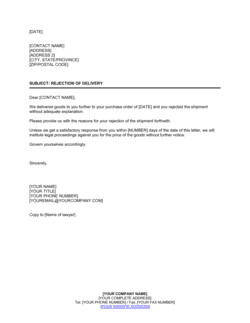
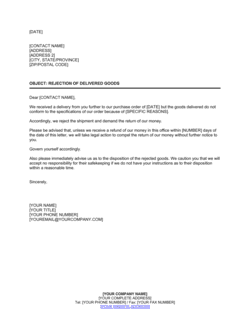
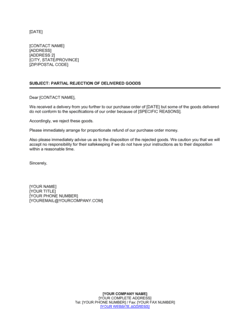
A Delivery Rejection Notice is a formal letter a buyer sends to a supplier upon receipt of a shipment that does not conform to the purchase order — whether due to defects, short shipment, wrong items, or late delivery. This free Word download gives you a ready-to-send template you can edit online and export as PDF in minutes.
When you need it
Send it on the day of receipt — or as soon as the defect is discovered — when a delivery fails to meet the contracted specifications, quantity, or deadline. Prompt written notice is required under the UCC and the Sale of Goods Act to preserve your right to reject and claim remedies.
What's inside
Reference to the original purchase order and delivery details, a clear statement of rejection, specific grounds for rejection with supporting evidence, return or hold instructions for the goods, and a demand for replacement, correction, or credit within a stated deadline.

What is a Delivery Rejection Notice?

A Delivery Rejection Notice is a formal letter a buyer sends to a supplier upon receipt of a shipment that does not conform to the purchase order — whether because the goods are defective, the quantity is short, the wrong items were shipped, or the delivery arrived after the contracted deadline. It creates a written record that rejection occurred on a specific date, documents the grounds in factual detail, and triggers the supplier's obligation to cure, replace, or issue a credit. Under UCC Article 2 in the United States and the Sale of Goods Act in the UK and Canada, written rejection within a reasonable time after delivery is a prerequisite for preserving the buyer's right to refuse the goods and claim remedies.

Why You Need This Document

Without a written rejection notice sent promptly on receipt, a buyer risks being deemed to have accepted non-conforming goods by default — losing the right to return them, demand replacement, or claim damages for any downstream losses the defective delivery caused. Verbal complaints or informal emails that do not explicitly state rejection are routinely treated by suppliers as service requests rather than formal refusals, resetting the clock and weakening your negotiating position. A properly completed rejection notice — citing the purchase order, quantifying the defect, attaching inspection evidence, and reserving all rights — gives you a documented legal foundation if the dispute escalates. This template produces a notice you can complete in under 15 minutes, send the same day as receipt, and file as a permanent procurement record.

Which variant fits your situation?

If your situation is…Use this template
Rejecting goods that arrived in a damaged or broken conditionDelivery Rejection Notice (Damaged Goods)
Receiving fewer units than the purchase order specifiedDelivery Rejection Notice (Short Shipment)
Goods arrived on time but fail quality inspectionDelivery Rejection Notice (Non-Conformance)
Shipment arrived after the contracted delivery deadlineDelivery Rejection Notice (Late Delivery)
Accepting a partial delivery under protest to keep operations runningAcceptance Under Protest Letter
Following up after rejection with a formal claim for lossesSupplier Dispute Letter
Seeking a credit rather than replacement for the rejected goodsCredit Note Request Letter

Common mistakes to avoid

❌ Delaying the notice past the inspection period

Why it matters: Under the UCC and Sale of Goods Act, the right to reject lapses if the buyer fails to inspect and notify the seller within a reasonable time. Delay can convert a rejection into a forced acceptance.

Fix: Inspect deliveries on receipt and send the rejection notice the same day or the next business day. Do not wait to see whether the supplier will offer a fix voluntarily.
❌ Using vague or tentative rejection language

Why it matters: Phrases like 'we may need to return this' or 'we are concerned about this shipment' do not constitute formal rejection — the supplier can treat them as complaints rather than rejection notices.

Fix: Use the word 'reject' explicitly and state it is a formal notice. The opening clause in this template is drafted specifically for that purpose.

❌ Failing to document the defect before handling the goods

Why it matters: If you move, sort, or partially use the goods before documenting the defect, the supplier can claim the damage or discrepancy occurred after delivery.

Fix: Photograph goods in their original packaging before any movement. Attach photos to the notice and store them in your records alongside the signed delivery note.

❌ Omitting the reservation-of-rights clause

Why it matters: A rejection notice that demands only a credit or replacement — without reserving other rights — can be read as a full settlement of the dispute, waiving claims for consequential losses.

Fix: Always include the reservation-of-rights clause in the final paragraph, even if you do not anticipate pursuing further claims.

The 8 key clauses, explained

Header and parties

In plain language: Identifies the buyer sending the notice, the supplier receiving it, and the date — establishing the formal record of when rejection was communicated.

Sample language
[BUYER COMPANY NAME] | [ADDRESS] | [DATE] | To: [SUPPLIER COMPANY NAME] | Attn: [CONTACT NAME / ACCOUNTS / CUSTOMER SERVICE]

Common mistake: Sending to a general company email rather than a named contact in accounts receivable or customer service — the notice can be lost and the supplier later claims they never received it.

Reference line

In plain language: Cites the purchase order number, invoice number, and delivery date so the supplier can immediately locate the transaction in their system.

Sample language
Re: Rejection of Delivery — Purchase Order No. [PO NUMBER] | Invoice No. [INVOICE NUMBER] | Delivered: [DATE]

Common mistake: Omitting the PO number and relying on a product description alone — suppliers with high shipment volumes cannot match the rejection to the right order without a reference number.

Opening statement of rejection

In plain language: A clear, unambiguous declaration that the buyer rejects the delivery in whole or in part, with the rejection date stated explicitly.

Sample language
[BUYER COMPANY NAME] hereby formally rejects the delivery received on [DATE] under Purchase Order No. [PO NUMBER], in whole / in part, on the grounds set out below.

Common mistake: Using tentative language like 'we may need to return this shipment.' Ambiguous wording can be treated as conditional acceptance, not rejection, forfeiting your remedies.

Grounds for rejection

In plain language: Lists the specific, factual reasons for rejection — defect type, quantity discrepancy, wrong product, or missed delivery date — with reference to the contracted specification.

Sample language
The grounds for rejection are as follows: (a) [X] units received versus [Y] units ordered per PO; (b) [DESCRIBE DEFECT] — does not conform to specification [SPEC REF]; (c) delivery received [DATE], [X] days after the contracted deadline of [DATE].

Common mistake: Stating only 'the goods are defective' without specifics. Vague grounds give the supplier room to dispute the rejection; specific, numbered defects with quantities and photos are much harder to challenge.

Supporting evidence

In plain language: References the attachments — inspection report, photographs, delivery note, or bill of lading — that document the defect or discrepancy.

Sample language
Please find attached in support of this notice: (a) delivery inspection report dated [DATE]; (b) photographs of [DEFECT / DAMAGE]; (c) copy of delivery note No. [NUMBER] signed by [NAME].

Common mistake: Sending the letter without any attachments and promising to follow up — if the supplier disputes the rejection, undocumented claims are difficult to sustain in a dispute.

Instructions for the rejected goods

In plain language: Tells the supplier whether the goods are being held for collection, returned freight-collect, or disposed of — and who bears the storage cost.

Sample language
The rejected goods are being held at [ADDRESS] at your risk and expense. Please arrange collection within [X] business days or provide a return merchandise authorization (RMA) number and prepaid return shipping label.

Common mistake: Accepting or using part of the rejected goods before the supplier responds — partial use is treated as acceptance in many jurisdictions, extinguishing the right to reject that portion.

Remedy demanded

In plain language: States exactly what the buyer requires — full replacement, partial replacement, price reduction, or credit note — and the deadline for the supplier's response.

Sample language
We require [full replacement of [X] conforming units / a credit note for $[AMOUNT] / a price reduction of [X]%] no later than [DATE]. Failure to respond by this date will result in [cancellation of the order / referral to our legal team / sourcing from an alternative supplier].

Common mistake: Asking for a remedy without a deadline — open-ended demands are routinely deprioritized by supplier customer-service teams.

Reservation of rights

In plain language: Preserves all the buyer's legal rights and remedies beyond those specifically requested, preventing the supplier from arguing the notice was a full settlement.

Sample language
This notice is issued without prejudice to any other rights or remedies available to [BUYER COMPANY NAME] under the applicable contract, Purchase Order No. [PO NUMBER], or applicable law, all of which are expressly reserved.

Common mistake: Omitting a reservation-of-rights clause — if you state only a credit demand, the supplier may argue you waived the right to claim consequential losses caused by the defective delivery.

How to fill it out

  1. 1

    Complete the header with both parties' details

    Enter your company name, address, and the date. Then add the supplier's legal name and the specific contact — accounts receivable, quality manager, or customer service — who handles delivery disputes.

    💡 Call the supplier before sending to confirm the correct email address for formal notices — many companies have a dedicated dispute or claims inbox.

  2. 2

    Fill in the reference line with all transaction identifiers

    Enter the purchase order number, invoice number (if one was issued), and the exact date the delivery was received. If you have a carrier tracking number or bill of lading reference, include it.

    💡 Cross-reference the PO number on the original purchase order document — a single digit error here delays the supplier's ability to act.

  3. 3

    State the rejection clearly in the opening paragraph

    Confirm whether you are rejecting the entire shipment or only the non-conforming portion. Specify the rejection date as the date of inspection, not the date of writing the letter.

    💡 If you are accepting a conforming portion and rejecting the rest, state the accepted quantity explicitly so there is no later dispute about what was retained.

  4. 4

    List each ground for rejection with specifics

    Use numbered sub-points for each defect, discrepancy, or missed requirement. Include the contracted specification versus what was received, and the unit counts affected.

    💡 Photograph defective items before any further handling and reference the photos by filename in this section — this creates a contemporaneous record that is difficult to dispute.

  5. 5

    Attach supporting evidence

    Attach your inspection report, photographs, the signed delivery note, and any relevant page from the purchase order. List each attachment by name in the evidence clause.

    💡 Store copies of all attachments in your procurement records system before sending — suppliers occasionally claim attachments were missing from the email.

  6. 6

    Specify instructions for the goods and your remedy demand

    Tell the supplier whether to collect the goods or issue an RMA, how many days they have to act, and what remedy you require — replacement, credit, or price reduction — with a firm response deadline.

    💡 Set a collection deadline of 5–10 business days. If goods sit uncollected beyond your stated period, document the continued storage cost for any later claim.

Frequently asked questions

What is a delivery rejection notice?

A delivery rejection notice is a formal written communication from a buyer to a supplier stating that a shipment has been refused on receipt. It documents the specific grounds for rejection — defects, short shipment, wrong goods, or late arrival — and demands a remedy such as replacement, credit, or collection of the returned goods. Sending it promptly preserves the buyer's legal remedies under the UCC and Sale of Goods Act.

When should I send a delivery rejection notice?

Send it on the day of receipt or, at the latest, the next business day after inspection reveals a problem. Under UCC Article 2, a buyer must reject within a reasonable time after tender of delivery. Waiting more than a few days without notifying the supplier in writing risks losing the right to reject and being deemed to have accepted the non-conforming goods.

Does a delivery rejection notice need to be signed?

No signature is required for the notice to be legally effective. What matters is that it is sent in writing — ideally by email with read receipt or by tracked post — to a named contact at the supplier, and that you retain a copy. Some purchase orders specify a notice address or method; follow that if it exists.

Can I reject only part of a delivery?

Yes. Under UCC §2-601 and equivalent Sale of Goods Act provisions, a buyer may accept the conforming units and reject the non-conforming portion. Your notice should state the quantity accepted, the quantity rejected, and the grounds for partial rejection. Be careful not to use or process the rejected portion, as doing so may constitute acceptance of those units.

What happens to the rejected goods while I wait for the supplier to respond?

Rejected goods should be segregated, clearly labeled, and held at the supplier's risk and expense pending collection or return authorization. State this in your notice with a collection deadline. Keep a log of storage dates and any costs incurred — if the goods are hazardous or perishable, you may have the right to dispose of or sell them and deduct the proceeds from any amount owed.

Does sending a rejection notice cancel the purchase order?

Not automatically. The notice rejects the specific delivery; it does not cancel the underlying purchase order unless you explicitly state that cancellation is the remedy you are seeking. If you want a replacement delivery, ask for one. If you want to cancel and source elsewhere, state that clearly and check whether your contract gives you that right upon breach by the supplier.

What if the supplier disputes the rejection?

If the supplier disagrees with your grounds for rejection, they may invoke their right to cure under the UCC and offer to replace or repair within the contract period. Your supporting evidence — inspection report, photographs, delivery note — will be critical. If the dispute cannot be resolved directly, escalate to a formal supplier dispute letter and, if necessary, mediation or legal proceedings under the governing law of your purchase order.

Is this template suitable for international shipments?

The template language is appropriate for domestic US, Canadian, and UK transactions governed by the UCC or Sale of Goods Act. For international shipments governed by the UN Convention on Contracts for the International Sale of Goods (CISG), the inspection and notice obligations are similar but timeframes differ — the CISG requires notice within a reasonable time after the buyer discovered or ought to have discovered the non-conformity, typically interpreted as 2–4 weeks. Consider noting the governing law in your reference line for cross-border transactions.

How this compares to alternatives

vs Acceptance Under Protest Letter

An acceptance under protest letter is used when the buyer takes delivery of non-conforming goods because stopping operations would be more costly than waiting for replacement, but still wants to preserve the right to claim for the defect. A delivery rejection notice is used when the buyer refuses to take or retain the goods at all. The two documents are mutually exclusive for the same shipment.

vs Purchase Order

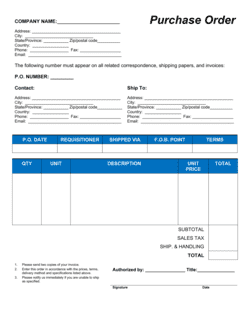
A purchase order is the buyer's upfront document authorizing a purchase and setting the specification the delivery must meet. A delivery rejection notice is the downstream response when the supplier fails to meet those specifications. The rejection notice should always reference the original purchase order by number.

vs Supplier Dispute Letter

A delivery rejection notice is sent immediately on receipt to refuse non-conforming goods and trigger a remedy. A supplier dispute letter is a later-stage escalation used when the supplier has failed to respond to the rejection or has refused the claimed remedy. The rejection notice typically precedes the dispute letter in the same transaction.

vs Credit Note

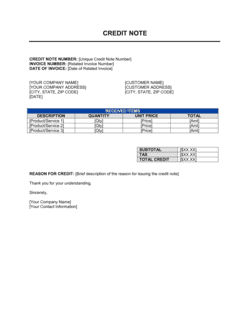
A credit note is issued by the supplier to reduce or cancel an invoice after a rejection has been agreed. The buyer sends the delivery rejection notice to initiate the process; the supplier issues the credit note to close it. If the supplier does not issue a credit note voluntarily, the buyer may follow up with a formal credit note request letter.

Industry-specific considerations

Manufacturing

Raw material and component deliveries are held to precise grade and dimensional specifications; rejection notices trigger supplier quality corrective action reports (SCARs) and affect supplier scorecards.

Retail and wholesale

Seasonal stock arriving late or short can miss a sell window entirely; the notice quantifies the commercial impact and supports a claim for markdown allowances or cancellation.

Construction

Off-spec materials rejected on site must be documented before the contractor proceeds, as substitution costs and project delays are consequential losses claimable from the supplier.

Food and beverage

Temperature excursions, contamination, or short-dated stock require same-day rejection and documented disposal; food safety regulations require a paper trail for traceability purposes.

Template vs pro — what fits your needs?

PathBest forCostTime
Use the templateBuyers handling routine supplier rejections for defects, short shipments, or late deliveryFree10–15 minutes per notice
Template + professional reviewHigh-value rejections where consequential loss claims are likely, or where the supplier relationship is at risk$150–$400 (brief solicitor or procurement consultant review)1–2 business days
Custom draftedRejections involving international shipments under CISG, large contract values, or anticipated litigation$500–$1,500+3–5 business days

Glossary

Right of Rejection
A buyer's legal right to refuse non-conforming goods upon delivery, typically required to be exercised promptly after inspection.
Non-Conforming Goods
Goods that do not match the description, quantity, quality, or specifications stated in the purchase order or contract.
UCC (Uniform Commercial Code)
US commercial law governing the sale of goods; Article 2 sets out the buyer's right to inspect and reject non-conforming shipments.
Sale of Goods Act
UK and Canadian legislation implying terms into contracts for the sale of goods, including conditions of satisfactory quality and fitness for purpose.
Perfect Tender Rule
A UCC principle giving buyers the right to reject an entire shipment if any part of it fails to conform exactly to the contract.
Cure
A supplier's right under the UCC to correct a non-conforming delivery within the original contract time or a reasonable period thereafter.
Return Merchandise Authorization (RMA)
A number issued by the supplier authorizing the buyer to return rejected goods, used to track the return and associated credit or replacement.
Short Shipment
A delivery where the quantity received is less than the quantity ordered and confirmed on the purchase order.
Goods on Hold
Rejected goods segregated and stored by the buyer at the supplier's risk and expense, pending return instructions or collection.
Bill of Lading
A shipping document issued by the carrier listing the goods transported; used as evidence of what was dispatched versus what was ordered.

Part of your Business Operating System

This document is one of 3,000+ business & legal templates included in Business in a Box.

  • Fill-in-the-blanks — ready in minutes
  • 100% customizable Word document
  • Compatible with all office suites
  • Export to PDF and share electronically

Create your document in 3 simple steps.

From template to signed document — all inside one Business Operating System.
1
Download or open template

Access over 3,000+ business and legal templates for any business task, project or initiative.

2
Edit and fill in the blanks with AI

Customize your ready-made business document template and save it in the cloud.

3
Save, Share, Send, Sign

Share your files and folders with your team. Create a space of seamless collaboration.

Save time, save money, and create top-quality documents.

★★★★★

"Fantastic value! I'm not sure how I'd do without it. It's worth its weight in gold and paid back for itself many times."

Managing Director · Mall Farm
Robert Whalley
Managing Director, Mall Farm Proprietary Limited
★★★★★

"I have been using Business in a Box for years. It has been the most useful source of templates I have encountered. I recommend it to anyone."

Business Owner · 4+ years
Dr Michael John Freestone
Business Owner
★★★★★

"It has been a life saver so many times I have lost count. Business in a Box has saved me so much time and as you know, time is money."

Owner · Upstate Web
David G. Moore Jr.
Owner, Upstate Web

Run your business with a system — not scattered tools

Stop downloading documents. Start operating with clarity. Business in a Box gives you the Business Operating System used by over 250,000 companies worldwide to structure, run, and grow their business.

Start free · No credit card required