Daily Habit Worksheet

Free download • Use as a template • Print or share

3 pages20–25 min to useDifficulty: StandardSignature requiredLegal review recommended
Learn more ↓
FreeDaily Habit Worksheet Template

At a glance

What it is
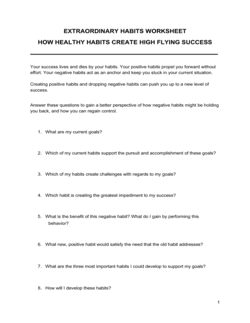
A Daily Habit Worksheet is a structured tracking document that records an individual's or team's target habits, daily completion status, frequency goals, and progress notes in a single reusable form. This free Word download lets you define specific habits, set measurable targets, log daily results, and review streaks — all in a format you can print, edit online, or export as PDF in minutes.
When you need it
Use it whenever you need to establish a consistent routine, hold yourself or a team member accountable to a defined set of daily behaviors, or document habit compliance as part of a wellness, productivity, or performance improvement program.
What's inside
Participant identification fields, defined habit entries with frequency targets, a daily check-in grid for the full week or month, a notes and reflection section, a progress summary with streak counts, and an accountability sign-off block for supervised programs.

What is a Daily Habit Worksheet?

A Daily Habit Worksheet is a structured tracking document that lists a person's target habits, records whether each habit was completed on each day of a defined period, and summarizes performance through streak counts, completion rates, and reflection notes. It transforms vague intentions — "exercise more," "read daily," "follow up with clients" — into specific, observable behaviors with a written record of whether they actually happened. In formal programs, the worksheet includes a participant sign-off and an accountability partner countersignature, creating documentation suitable for performance reviews, coaching records, and compliance audits.

Why You Need This Document

Without a written habit tracking record, accountability depends entirely on memory and self-report — both of which are unreliable over periods longer than a few days. Coaches and HR managers who rely on verbal check-ins cannot identify the specific days or circumstances where habit completion breaks down, which makes targeted intervention impossible. In employer-administered wellness programs, an undocumented program creates data privacy exposure: if you are collecting behavioral health information without a clear privacy notice and consent record, you may be non-compliant with HIPAA in the US or GDPR in the EU before a single worksheet is filed. For individual users, the worksheet's value is equally concrete: research consistently shows that people who write down their habits and track completion daily are significantly more likely to maintain those habits past the 30-day mark than those who track mentally. This template gives you a ready-to-use, accountability-ready format that takes ten minutes to configure and works for personal use, team programs, and formal clinical or HR contexts alike.

Which variant fits your situation?

If your situation is…Use this template
Tracking habits over a full calendar month with daily check-insMonthly Habit Tracker
Logging weekly goals and reviewing progress at week's endWeekly Goal-Setting Worksheet
Managing employee performance improvement with documented behavioral targetsPerformance Improvement Plan
Setting and reviewing quarterly personal or professional goalsGoal Setting Worksheet
Tracking multiple team members' habits across a coaching cohortTeam Productivity Tracker
Documenting daily routines as part of a clinical or therapeutic programDaily Activity Log
Planning and reviewing a structured morning or evening routineDaily Planner Template

Common mistakes to avoid

❌ Defining habits too vaguely

Why it matters: A habit defined as 'stay healthy' or 'be productive' cannot be objectively marked complete, which makes the entire grid meaningless as a tracking or accountability tool.

Fix: Rewrite each habit as a specific, time-bound, observable action — 'complete a 20-minute walk before 8 a.m.' is trackable; 'exercise more' is not.

❌ Tracking too many habits at once

Why it matters: Worksheets with eight or more habits routinely show declining completion rates after week two as the cognitive load of daily logging compounds the difficulty of execution.

Fix: Cap the initial period at three to five habits. Add new habits only after at least two consecutive periods with 80% or higher completion across all existing habits.

❌ Skipping the accountability sign-off in supervised programs

Why it matters: An unsigned worksheet carries no evidential weight in a performance improvement review, a wellness program audit, or an insurance compliance check — the record exists but cannot be formally relied upon.

Fix: Make the accountability sign-off a required step before the worksheet is filed. For digital workflows, use an eSignature tool so the signature timestamp is automatically recorded.

❌ Omitting the privacy notice in employer-administered programs

Why it matters: In the US, employer-administered wellness programs that collect health-related habit data may trigger HIPAA obligations. In the EU, any personal behavioral data collected by an employer requires a lawful basis and transparent notice under GDPR.

Fix: Add a one-paragraph privacy and data use notice to every worksheet used in an employer or clinical context, specifying who can access the data, how it is stored, and how long it is retained.

The 9 key clauses, explained

Participant identification

In plain language: Records the full name, role or position, program or coaching relationship name, and the date the worksheet period begins.

Sample language
Participant: [FULL NAME] | Role / Position: [JOB TITLE OR CONTEXT] | Program: [COACHING / WELLNESS / PERFORMANCE PROGRAM NAME] | Period Start Date: [DATE]

Common mistake: Omitting the participant's role or program context, which makes it impossible to match the worksheet to a specific accountability relationship when reviewing records weeks later.

Habit definitions and frequency targets

In plain language: Lists each target habit by name with a plain description of what completing it looks like and how many times per day or week it must be performed.

Sample language
Habit: [HABIT NAME] | Definition: [SPECIFIC DESCRIPTION OF WHAT COUNTS AS COMPLETION] | Frequency Target: [X times per day / week] | Start Cue: [TRIGGER EVENT OR TIME]

Common mistake: Defining habits too vaguely — writing 'exercise' instead of '30-minute walk before 9 a.m.' makes it easy to rationalize partial completion as full completion.

Daily check-in grid

In plain language: A row-and-column table where each row is a habit and each column is a calendar day, allowing the participant to mark each habit as completed, missed, or skipped.

Sample language
Habit | Mon [DATE] | Tue [DATE] | Wed [DATE] | Thu [DATE] | Fri [DATE] | Sat [DATE] | Sun [DATE] — Mark each cell: C (Complete), M (Missed), S (Skipped/N/A)

Common mistake: Using a binary yes/no grid with no distinction between a missed habit and a legitimately skipped one, which inflates failure rates for habits not applicable on certain days.

Streak counter

In plain language: A field where the running count of consecutive completion days is recorded for each habit, updated at the end of each day or week.

Sample language
Habit: [HABIT NAME] | Current Streak: [X] days | Longest Streak This Period: [X] days | Last Missed: [DATE]

Common mistake: Leaving the streak counter blank for weeks and then trying to reconstruct it from the grid — a single missed entry makes the count unreliable and undermines the motivational function of streaks.

Weekly reflection and notes

In plain language: A free-text section at the end of each week where the participant records what supported completion, what caused missed days, and any adjustments to the habit definition or cue.

Sample language
Week of [DATE RANGE] — What worked: [NOTES] | What caused misses: [NOTES] | Adjustments for next week: [NOTES]

Common mistake: Skipping the reflection section when the week went well. Documenting what worked is as valuable as diagnosing misses — it creates a repeatable playbook for high-performance weeks.

Progress summary

In plain language: An end-of-period summary table showing each habit's total completion count, completion rate percentage, streak high, and a pass/fail against the frequency target.

Sample language
Habit | Days Completed | Days Missed | Completion Rate | Streak High | Target Met (Y/N)

Common mistake: Calculating completion rate against total calendar days rather than applicable days, which penalizes participants for habits that were correctly skipped on non-applicable days.

Goal adjustment section

In plain language: A structured field for revising habit definitions, frequency targets, or cues at the end of a tracking period based on what the progress summary reveals.

Sample language
Habit reviewed: [HABIT NAME] | Original target: [X times/week] | Revised target: [X times/week] | Reason for revision: [NOTES] | Effective date: [DATE]

Common mistake: Changing habit targets mid-period without documenting the revision date, making it impossible to evaluate performance against a consistent standard.

Accountability sign-off block

In plain language: A signature section where the participant confirms the log is accurate and the accountability partner or supervisor countersigns to acknowledge review.

Sample language
I confirm that the entries in this worksheet accurately reflect my daily habit practice for the period stated above. Participant Signature: ___________ Date: [DATE] | Accountability Partner / Supervisor: ___________ Date: [DATE]

Common mistake: Treating the sign-off as optional for supervised programs. An unsigned worksheet cannot be used as documentation in a performance improvement review or insurance-related wellness program.

Privacy and data use notice

In plain language: A brief statement explaining how the completed worksheet will be stored, who may review it, and how long it will be retained — required when the worksheet is used in an employer-administered or clinical program.

Sample language
This worksheet may be reviewed by [SUPERVISOR / COACH / PROGRAM ADMINISTRATOR]. Records will be retained for [X months/years] and stored [securely / in your personnel file / on the program platform]. Access is limited to [NAMED PARTIES].

Common mistake: Omitting any privacy notice in employer-administered wellness programs, which can create HIPAA compliance issues in the US or data protection obligations under GDPR in the EU.

How to fill it out

  1. 1

    Complete the participant identification block

    Enter the participant's full name, their role or position, the name of the program or accountability relationship, and the start date of the tracking period.

    💡 If the worksheet will be used in a formal program, match the participant name exactly to the name on any related agreement or performance plan to ensure records link correctly.

  2. 2

    Define each target habit with precision

    Write each habit as a specific, observable action — include the activity, duration or quantity, time of day, and the triggering cue. Aim for a description specific enough that a third party could confirm completion without ambiguity.

    💡 Limit the worksheet to three to five habits per period. More than five habits tracked simultaneously significantly reduces average completion rates.

  3. 3

    Set measurable frequency targets

    For each habit, enter the number of times per day or per week it must be performed to count as on-track. If a habit is not applicable on certain days, mark those days in the grid as 'S' (Skipped) at the start of the period.

    💡 Start frequency targets at a level the participant has already reached 70% of the time — beginning above current performance creates discouragement rather than momentum.

  4. 4

    Fill in the daily check-in grid each day

    At the end of each day, mark each habit cell as C (completed), M (missed), or S (skipped/not applicable). Update the streak counter for any habit with an active consecutive run.

    💡 Complete the grid within 30 minutes of the day ending — same-day logging is 40% more accurate than next-morning reconstruction.

  5. 5

    Complete the weekly reflection section

    At the end of each seven-day block, write at least one sentence each for what supported completion and what caused any misses. Note any adjustments to cues, timing, or definitions that would improve the following week.

    💡 Focus the reflection on environmental factors and scheduling — habit misses are almost always a systems failure, not a willpower failure.

  6. 6

    Calculate the progress summary at period end

    Tally each habit's completed days, missed days, and completion rate against applicable days only. Flag any habit that fell below its frequency target for the goal adjustment section.

    💡 A completion rate of 80% or above across all habits for a full period is a strong signal to increase either the frequency target or add a new habit in the next period.

  7. 7

    Sign the accountability block

    Both the participant and the accountability partner or supervisor should sign and date the worksheet before filing it. For employer-administered programs, attach the signed worksheet to the relevant performance or wellness file.

    💡 Countersignature by a supervisor or coach increases reported completion rates by approximately 20% compared to self-certified worksheets — the awareness of review drives accountability.

  8. 8

    Archive and start the next period

    Save the completed worksheet as a PDF and file it under the participant's name and period dates. Open a fresh copy of the template and carry forward any revised habit definitions and frequency targets from the goal adjustment section.

    💡 Keep at least three consecutive periods on file — a single-period snapshot is rarely sufficient to identify meaningful trends in habit consistency.

Frequently asked questions

What is a daily habit worksheet?

A daily habit worksheet is a structured tracking form that lists a person's target habits, records whether each habit was completed each day, and summarizes progress over a defined period — typically one week or one month. It is used in personal productivity, coaching programs, employee wellness initiatives, and clinical behavior-change interventions to create a documented record of habit adherence and improvement over time.

How many habits should I track on a single worksheet?

Three to five habits per tracking period is the range most consistently associated with high completion rates. Tracking more than five habits simultaneously increases cognitive load and reduces average completion across all tracked behaviors. Once you have maintained 80% or higher completion for two consecutive periods, you can add one new habit to the next period's worksheet.

Does a daily habit worksheet need to be signed?

For personal use, a signature is optional. For employer-administered wellness programs, performance improvement plans, or clinical behavior programs, a participant signature and a countersignature from a supervisor or coach are important for the worksheet to serve as valid documentation. Unsigned worksheets carry limited evidential weight in formal review processes.

Can a daily habit worksheet be used in a workplace wellness program?

Yes, and it is commonly used in this context. When an employer uses the worksheet as part of a formal wellness or performance program, it should include a privacy and data use notice explaining who can access the completed worksheet, how it is stored, and how long records are retained. In the US, programs that collect health-related habit data may have HIPAA implications; employers should review compliance obligations before rolling out a program at scale.

What is the difference between a daily habit worksheet and a habit tracker app?

A daily habit worksheet is a static document — Word, PDF, or printed — that requires manual entry. A habit tracker app automates streaks, sends reminders, and generates charts. The worksheet's advantage is that it doubles as a formal record suitable for performance reviews, coaching documentation, and program audits. App data is generally not formatted for formal review processes and may not be exportable in a legally useful format.

How long should a single habit worksheet tracking period be?

One week is the most common period for active review and coaching contexts, because it allows timely reflection and adjustment. One month is better for independent tracking where the goal is to observe longer trend lines. For formal performance improvement programs, a four-week period aligned to monthly review cycles is standard. Periods shorter than five days rarely produce meaningful completion-rate data.

What is a habit streak and why does it matter?

A habit streak is the count of consecutive days on which a target habit was completed without interruption. Research in behavioral psychology consistently shows that streak awareness increases daily completion rates because the perceived cost of breaking the streak grows with its length. Recording and displaying the streak count on the worksheet is one of the simplest ways to increase short-term adherence.

Can I use this worksheet to track team habits rather than individual ones?

Yes. Create one worksheet per team member and use a shared summary sheet to aggregate completion rates across the group. For team coaching programs, some facilitators use anonymized aggregate data to show the group its collective performance without exposing individual results. When using the worksheet in a team context, the privacy and data use notice should clarify whether results will be shared in aggregate, anonymized, or individually reviewed by a manager.

How do I know when to revise a habit's frequency target?

Revise upward when the participant achieves 90% or higher completion for two consecutive full periods — this signals the habit is adequately embedded and the target is no longer stretching. Revise downward when completion falls below 50% for two consecutive periods and the reflection notes do not identify a correctable situational cause. All revisions should be documented in the goal adjustment section with an effective date.

How this compares to alternatives

vs Goal Setting Worksheet

A goal setting worksheet defines the outcomes a person wants to achieve and the high-level actions required to get there. A daily habit worksheet focuses on the recurring daily behaviors that will produce those outcomes. Use the goal setting worksheet to establish the destination, then use the daily habit worksheet to log the consistent daily practice that gets you there.

vs Performance Improvement Plan

A performance improvement plan (PIP) is a formal HR document that defines measurable performance targets and a structured timeline for an underperforming employee. A daily habit worksheet can be attached to a PIP to track the specific daily behaviors supporting those targets, but the PIP itself carries the formal employment and disciplinary weight that a habit worksheet does not.

vs Daily Planner Template

A daily planner schedules tasks and appointments across specific time blocks for a single day. A daily habit worksheet tracks whether recurring target behaviors were completed over a multi-day or multi-week period. Use the planner to organize what you will do each day and the habit worksheet to measure whether you are consistently doing the things that matter most.

vs Weekly Schedule Template

A weekly schedule allocates time blocks to activities across a seven-day view. A daily habit worksheet logs binary completion data for defined recurring behaviors across the same period. The schedule tells you when to do something; the habit worksheet tells you whether you did it and how consistently.

Industry-specific considerations

Human Resources

Used in performance improvement plans to document behavioral habit targets alongside quantitative KPIs, providing a holistic record for manager reviews.

Healthcare and Wellness

Clinicians and wellness coaches use signed habit worksheets to document patient adherence to prescribed daily behaviors such as medication timing, hydration, and physical activity.

Education

Teachers and school counselors assign daily habit worksheets to students in academic support programs to track study routines, attendance behaviors, and self-regulation practices.

Coaching and Training

Executive coaches and personal development trainers use countersigned daily habit worksheets as the primary accountability artifact for individual and group coaching engagements.

Jurisdictional notes

United States

Employer-administered wellness programs that collect health-related daily habit data may trigger obligations under HIPAA, the ADA, and GINA. The EEOC has issued guidance on participatory versus health-contingent wellness programs. A privacy and data use notice should specify that participation is voluntary and that health information will not be used in employment decisions. State laws in California and Illinois impose additional employee privacy protections that apply to behavioral data collected in the workplace.

Canada

Federal PIPEDA and provincial privacy legislation (notably PIPA in Alberta and BC, and Law 25 in Quebec) require employers to have a lawful basis for collecting personal behavioral data and to inform employees of the purpose. Quebec's Law 25, effective September 2023, imposes the strictest provincial requirements, including mandatory privacy impact assessments for programs collecting sensitive personal information. Signed consent on the worksheet supports compliance documentation.

United Kingdom

Under the UK GDPR and the Data Protection Act 2018, health and wellness habit data collected by employers is likely to constitute special category data requiring explicit consent or another Schedule 1 condition. Employers should ensure the worksheet's privacy notice meets the transparency requirements of Article 13 UK GDPR. The ICO recommends a data protection impact assessment before deploying any employee wellness program that collects behavioral health data at scale.

European Union

Health-related daily habit data collected by employers in the EU is classified as special category data under GDPR Article 9 and requires explicit consent or a qualifying exception. The worksheet's privacy notice must satisfy GDPR Articles 13 and 14 transparency requirements. Member states including Germany, France, and the Netherlands impose additional works council or employee representative consultation requirements before an employer can introduce systematic behavioral monitoring programs. Data retention periods must be defined and documented.

Template vs lawyer — what fits your deal?

PathBest forCostTime
Use the templateIndividuals, coaches, and small teams tracking personal or professional habits without a formal program structureFree10 minutes to set up per participant
Template + legal reviewEmployer-administered wellness programs or clinical settings where data privacy compliance and formal documentation are required$150–$400 for an HR or compliance advisor review1–3 business days
Custom draftedLarge-scale corporate wellness programs, regulated clinical behavior programs, or multi-jurisdiction employer rollouts requiring legal sign-off$500–$2,000+ for legal and compliance drafting1–2 weeks

Glossary

Habit Loop
The neurological pattern underlying every habit, consisting of a cue, a routine, and a reward that reinforces the behavior over time.
Habit Streak
A consecutive sequence of days on which a target habit was completed without interruption, used as a motivational tracking metric.
Frequency Target
The defined number of times per day, week, or month a habit must be performed to count as on-track toward the participant's goal.
Accountability Partner
A second person — coach, manager, or peer — who reviews the worksheet, countersigns it, and holds the participant to their stated commitments.
Baseline Assessment
A record of the participant's current habit frequency before the program begins, used as the reference point for measuring improvement.
Keystone Habit
A single high-leverage habit whose consistent practice tends to trigger positive changes in other unrelated areas of behavior or performance.
Completion Rate
The percentage of days in a tracking period on which a target habit was marked as completed, calculated as completed days divided by total tracking days.
Reflection Prompt
A structured question embedded in the worksheet that asks the participant to assess why a habit was missed or what made completion easier on a given day.
Sign-Off Block
A section at the bottom of the worksheet where the participant and any accountable supervisor or coach add their names and signatures to confirm the log is accurate.
Cue Identification
The process of naming the specific trigger — time of day, location, emotional state, or preceding action — that will reliably prompt the target habit.

Part of your Business Operating System

This document is one of 3,000+ business & legal templates included in Business in a Box.

  • Fill-in-the-blanks — ready in minutes
  • 100% customizable Word document
  • Compatible with all office suites
  • Export to PDF and share electronically

Create your document in 3 simple steps.

From template to signed document — all inside one Business Operating System.
1
Download or open template

Access over 3,000+ business and legal templates for any business task, project or initiative.

2
Edit and fill in the blanks with AI

Customize your ready-made business document template and save it in the cloud.

3
Save, Share, Send, Sign

Share your files and folders with your team. Create a space of seamless collaboration.

Save time, save money, and create top-quality documents.

★★★★★

"Fantastic value! I'm not sure how I'd do without it. It's worth its weight in gold and paid back for itself many times."

Managing Director · Mall Farm
Robert Whalley
Managing Director, Mall Farm Proprietary Limited
★★★★★

"I have been using Business in a Box for years. It has been the most useful source of templates I have encountered. I recommend it to anyone."

Business Owner · 4+ years
Dr Michael John Freestone
Business Owner
★★★★★

"It has been a life saver so many times I have lost count. Business in a Box has saved me so much time and as you know, time is money."

Owner · Upstate Web
David G. Moore Jr.
Owner, Upstate Web

Run your business with a system — not scattered tools

Stop downloading documents. Start operating with clarity. Business in a Box gives you the Business Operating System used by over 250,000 companies worldwide to structure, run, and grow their business.

Start free · No credit card required