- Contract Manufacturer
- A third-party company that produces goods to the specifications of another company, typically using the buyer's formulas, designs, or tooling.
- Specifications
- The detailed written requirements — dimensions, materials, tolerances, performance standards, and labeling — that define an acceptable finished product.
- Minimum Order Quantity (MOQ)
- The smallest number of units a manufacturer will produce in a single production run, below which the per-unit economics are unviable for the manufacturer.
- Tooling
- Molds, dies, jigs, and fixtures used in the manufacturing process, which may be owned by the Company, the Manufacturer, or jointly depending on who paid for them.
- Quality Control (QC)
- Systematic inspection and testing procedures applied during and after production to verify that goods meet the agreed specifications.
- Regulatory Compliance
- The manufacturer's obligation to produce goods that meet all applicable laws and standards — such as FDA, CE marking, or RoHS — in the target market.
- Intellectual Property Assignment
- A clause transferring ownership of any product improvements, derivative formulas, or production innovations back to the Company during the manufacturing relationship.
- Indemnification
- A contractual obligation by one party to compensate the other for losses, damages, or legal costs arising from specified events such as product defects or IP infringement.
- Force Majeure
- A clause excusing a party's performance when extraordinary events outside its control — natural disasters, war, or government shutdowns — make performance impossible.
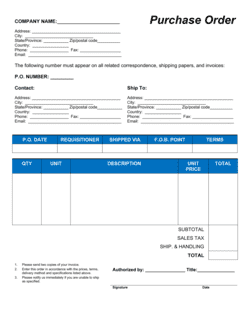
- Purchase Order
- A buyer-issued document authorizing a specific production run under the master manufacturing agreement, specifying quantity, delivery date, and price.
- Transition Assistance
- Post-termination obligations requiring the outgoing manufacturer to transfer tooling, specifications, and production know-how to the Company or a successor manufacturer.