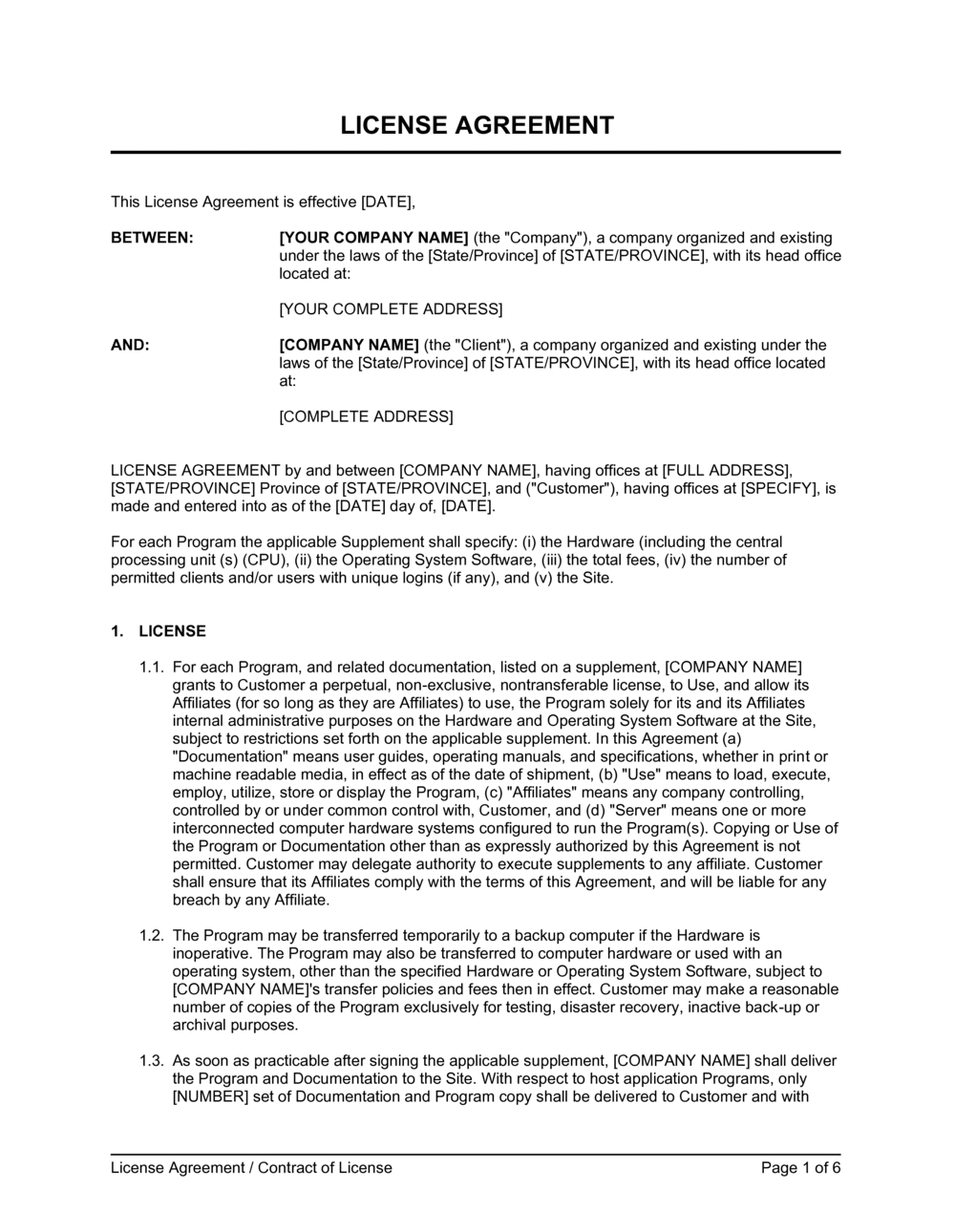
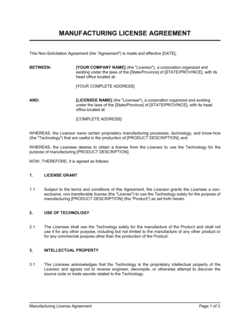
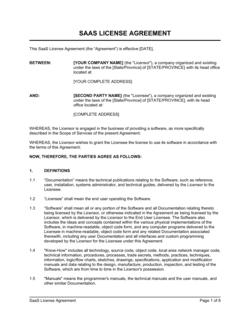
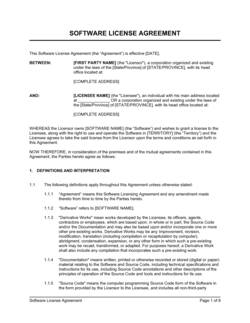
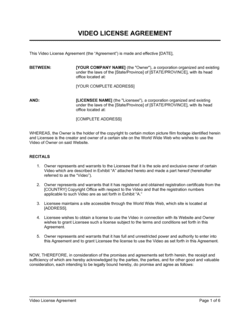
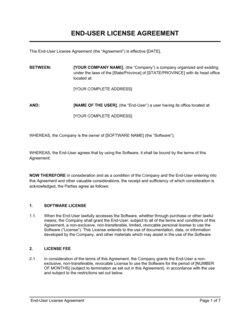
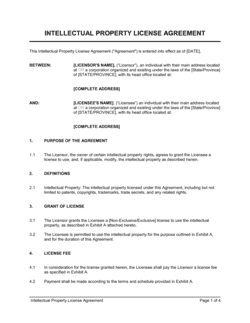
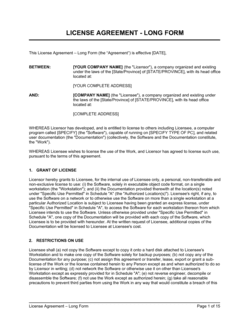
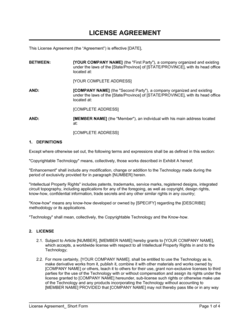
License Agreement Contract of License_Right to Customer Template

Free Word download β€’ Edit online β€’ Save & share with Drive β€’ Export to PDF

6 pagesβ€’25–35 min to fillβ€’Difficulty: Complexβ€’Signature requiredβ€’Legal review recommended
Learn more ↓
FreeLicense Agreement Contract of License_Right to Customer Template

At a glance

What it is
A License Agreement Contract of License Right to Customer is a legally binding document in which an intellectual property owner (the licensor) grants a customer or business (the licensee) the right to use, distribute, or sublicense specific IP β€” such as software, trademarks, patents, or creative content β€” under defined conditions. This free Word download gives you a structured, enforceable starting point you can edit online and export as PDF for signature.
When you need it
Use it whenever you grant a paying customer the right to use proprietary software, branded content, patented technology, or other IP assets, and you need to define exactly what they can and cannot do with it. It is also required when receiving IP from a third party whose usage terms must be documented in writing.
What's inside
Grant of license and permitted scope, license type (exclusive vs. non-exclusive), permitted uses and restrictions, fees and royalty schedule, term and renewal conditions, IP ownership and warranties, indemnification, limitation of liability, confidentiality, and termination triggers.

What is a License Agreement Contract of License Right to Customer?

A License Agreement Contract of License Right to Customer is a legally binding document in which the owner of intellectual property β€” the licensor β€” grants a customer or business partner β€” the licensee β€” the right to use, reproduce, distribute, or otherwise exploit that IP under a defined set of conditions. The licensor retains full ownership of the underlying IP; the licensee receives only the rights expressly enumerated in the agreement. This structure applies to software, trademarks, patents, proprietary processes, creative content, and any other form of protectable intellectual property. Unlike an IP assignment, which transfers ownership outright, a license creates an ongoing relationship governed by the agreed terms, fees, and restrictions.

Why You Need This Document

Without a signed license agreement, granting a customer access to your IP exposes you to three compounding risks. First, there is no enforceable basis to collect royalties or license fees β€” a licensee who received access informally can argue that use was permitted without conditions. Second, the licensee faces no restrictions on sublicensing, modifying, or using your IP outside the intended field β€” each of which can dilute your IP's value or expose you to third-party infringement claims. Third, if a dispute arises, courts will fill every gap in the relationship with jurisdiction-specific defaults that rarely favor the IP owner. A properly drafted license agreement defines permitted use, royalty obligations, improvement ownership, termination rights, and post-termination duties in a single enforceable document β€” protecting the revenue stream your IP generates and the ownership rights you worked to establish.

Which variant fits your situation?

If your situation is…Use this template
Licensing proprietary software to end usersSoftware License Agreement (End User)
Licensing a trademark or brand to a third-party retailerTrademark License Agreement
Granting an exclusive license to a single commercial partnerExclusive License Agreement
Licensing patented technology to a manufacturerPatent License Agreement
Licensing creative content such as photos, music, or written worksContent License Agreement
Distributing software under open-source termsOpen Source License Agreement
Permitting a sublicensee to relicense IP to end usersSublicense Agreement

Common mistakes to avoid

❌ Delivering IP before the agreement is signed

Why it matters: Once the licensee has access to the IP, they may argue an implied license exists on whatever terms they assumed β€” courts have found such arrangements enforceable even without a written contract.

Fix: Gate all access, file delivery, and credential sharing behind a fully executed agreement. Use DocuSign or a similar platform to confirm timestamped execution before release.

❌ No definition of the royalty base

Why it matters: If the agreement says '5% of revenue' without defining revenue, the licensee will deduct every possible cost and the licensor will dispute every deduction β€” resulting in underpayment and litigation.

Fix: Define 'Net Revenue' or 'Net Sales' explicitly, listing every deduction permitted (returns, taxes, shipping) and capping aggregate deductions as a percentage of gross.

❌ Omitting an improvement ownership clause

Why it matters: If the licensee builds on or enhances the licensed IP and ownership is not addressed, the licensor may be unable to freely license or sell the underlying technology β€” which is now entangled with the licensee's contributions.

Fix: Include an improvement assignment clause that vests all improvements in the licensor, paired with a license-back to the licensee for use within the permitted scope.

❌ Granting sublicensing rights by default

Why it matters: If the agreement is silent on sublicensing, some jurisdictions imply the right exists β€” meaning the licensee can pass your IP to third parties you have never vetted or approved.

Fix: State explicitly whether sublicensing is permitted. If it is, require the licensor's prior written consent for each sublicense and mandate that sublicenses contain at least the same restrictions as the master agreement.

❌ No carve-out for injunctive relief in the dispute resolution clause

Why it matters: If the dispute resolution clause requires arbitration for all disputes, the licensor cannot seek an emergency injunction in court to stop ongoing IP misuse β€” a delay that can cause irreparable harm while arbitration proceedings run for months.

Fix: Add a carve-out permitting either party to seek injunctive or other equitable relief in any court of competent jurisdiction without waiving their right to arbitrate the underlying dispute.

❌ Auto-renewal without a conspicuous notice window

Why it matters: Licensees who miss the non-renewal window are automatically bound for another full term and typically argue the clause was unconscionable or not adequately disclosed β€” generating disputes over fees already paid.

Fix: State the renewal notice window in bold in the term clause and confirm it in the signature block. Set a calendar reminder to notify the counterparty 60 days before the notice deadline.

The 10 key clauses, explained

Grant of license

In plain language: Defines the specific rights being transferred β€” what the licensee may do with the IP β€” including whether the license is exclusive or non-exclusive, the permitted territory, and the field of use.

Sample language
Licensor hereby grants to Licensee a [non-exclusive / exclusive], non-transferable license to [USE / REPRODUCE / DISTRIBUTE] the [LICENSED IP] solely within [TERRITORY] and solely for [FIELD OF USE], during the Term of this Agreement.

Common mistake: Failing to specify the field of use and territory. Without these limits, the licensee may argue they can use the IP in markets or industries the licensor never intended to open.

License type and scope

In plain language: States whether the license is exclusive (only this licensee) or non-exclusive (licensor may grant others the same rights), and specifies any sublicensing permissions.

Sample language
The license granted herein is non-exclusive. Licensee shall have no right to sublicense the Licensed IP to any third party without the prior written consent of Licensor.

Common mistake: Granting an exclusive license without restricting the licensor's own use. Unless the clause explicitly prevents the licensor from using the IP in the same territory and field, courts may interpret the arrangement differently than intended.

License fees and royalties

In plain language: Sets out the financial consideration β€” upfront fees, recurring license fees, royalty rates, reporting obligations, and the schedule and method of payment.

Sample language
Licensee shall pay Licensor a royalty of [X]% of Net Revenue derived from the exploitation of the Licensed IP, payable within [30] days following the end of each calendar quarter, together with a written royalty statement.

Common mistake: Omitting a definition of 'Net Revenue' or 'Net Sales.' Ambiguity in the royalty base leads to underpayment disputes β€” define every deduction (returns, taxes, shipping) permitted before the royalty is calculated.

IP ownership and reservation of rights

In plain language: Confirms that all title, ownership, and goodwill in the licensed IP remain with the licensor, and that any improvements or derivative works created by the licensee vest in the licensor unless otherwise agreed.

Sample language
Licensor retains all right, title, and interest in and to the Licensed IP. Nothing in this Agreement shall be construed to transfer ownership of the Licensed IP to Licensee. All improvements to the Licensed IP developed by Licensee shall be promptly disclosed to Licensor and are hereby assigned to Licensor.

Common mistake: No improvement ownership clause. If the licensee enhances or builds on the IP, ambiguity over who owns the improvement can invalidate the licensor's ability to license or sell the same technology to others.

Permitted uses and restrictions

In plain language: Lists what the licensee is explicitly allowed to do and what is prohibited β€” including copying, modifying, reverse-engineering, transferring, or using the IP outside the defined field.

Sample language
Licensee may not: (a) reverse engineer, decompile, or disassemble the Licensed IP; (b) use the Licensed IP outside of [FIELD OF USE]; (c) remove or alter any proprietary notices; or (d) use the Licensed IP to develop a competing product.

Common mistake: Using only a positive grant without a corresponding restriction list. Courts interpret silence as permission β€” enumerate prohibited uses explicitly.

Confidentiality

In plain language: Obligates both parties to protect non-public information disclosed in connection with the license β€” source code, formulas, business processes, and pricing β€” and specifies how long the obligation survives termination.

Sample language
Each party agrees to hold in confidence and not disclose to any third party any Confidential Information of the other party, using at least the same degree of care as it uses to protect its own confidential information, but no less than reasonable care. This obligation survives termination for [5] years.

Common mistake: A confidentiality clause that expires on the contract termination date. Trade secrets and source code require ongoing protection β€” include a survival period of at least 3–5 years, or indefinitely for genuine trade secrets.

Warranties and representations

In plain language: The licensor warrants that it owns or has the right to license the IP, that the IP does not infringe third-party rights, and that the licensee's permitted use will not expose them to third-party IP claims.

Sample language
Licensor represents and warrants that: (a) it has full authority to grant the rights set forth herein; (b) the Licensed IP does not infringe any third-party intellectual property rights to Licensor's knowledge; and (c) there are no pending or threatened claims challenging Licensor's ownership of the Licensed IP.

Common mistake: A licensor disclaiming all warranties entirely. While warranty disclaimers protect the licensor, a complete disclaimer on ownership and non-infringement makes the license commercially unusable β€” licensees will reject it or treat it as unenforceable.

Indemnification

In plain language: Allocates liability if a third party claims the licensed IP infringes their IP rights or if the licensee's use causes harm β€” defining who defends the claim and who pays any resulting damages.

Sample language
Licensor shall indemnify, defend, and hold harmless Licensee from and against any third-party claims alleging that the Licensed IP, as delivered by Licensor and used in accordance with this Agreement, infringes any third-party intellectual property right. Licensee shall indemnify Licensor for claims arising from Licensee's use of the Licensed IP outside the permitted scope.

Common mistake: No carve-out for licensee misuse. If the licensee modifies the IP or uses it outside the permitted scope and a third-party claim results, the licensor should not bear that indemnification cost.

Term and termination

In plain language: Sets the duration of the license, conditions for early termination (breach, insolvency, or convenience), required notice periods, and the obligations of both parties upon expiration or termination.

Sample language
This Agreement commences on [START DATE] and continues for [X] years ('Initial Term'), automatically renewing for successive [1]-year periods unless either party provides [30] days' written notice of non-renewal. Either party may terminate for material breach if the breach remains uncured [30] days after written notice.

Common mistake: Auto-renewal without a notice window. Licensees who forget to cancel end up bound for another full term and cannot recover fees already paid β€” state the renewal notice window prominently and confirm it in the signature block.

Governing law and dispute resolution

In plain language: Specifies which jurisdiction's law governs the agreement and how disputes are resolved β€” arbitration, mediation, or litigation β€” including the venue and applicable procedural rules.

Sample language
This Agreement shall be governed by the laws of [STATE / PROVINCE / COUNTRY], without regard to its conflict-of-laws principles. Any dispute arising hereunder shall be submitted to binding arbitration administered by [AAA / JAMS / ICC] in [CITY], except that either party may seek injunctive relief in any court of competent jurisdiction.

Common mistake: Choosing a governing law with no connection to either party's location. Some courts will refuse to enforce a choice-of-law clause that has no legitimate relationship to the parties or the subject matter, introducing uncertainty at exactly the moment a dispute arises.

How to fill it out

  1. 1

    Identify the parties and describe the licensed IP precisely

    Enter the full legal names of the licensor and licensee, their registered addresses, and a precise description of the intellectual property being licensed β€” include version numbers for software, registration numbers for patents or trademarks, or file identifiers for creative works.

    πŸ’‘ Attach the IP description as Schedule A and reference it in the grant clause. Vague descriptions β€” 'all technology owned by licensor' β€” create scope disputes later.

  2. 2

    Choose exclusive or non-exclusive and define the territory and field

    Decide whether the license is exclusive (only this customer) or non-exclusive (multiple licensees permitted). Set the geographic territory and the specific industry or application field the licensee may exploit the IP within.

    πŸ’‘ If the license is exclusive, confirm whether the licensor itself is restricted from using the IP in the same territory and field β€” courts presume the licensor retains use rights unless the contract says otherwise.

  3. 3

    Set the fee structure and define the royalty base

    Enter the upfront license fee (if any), the royalty rate or recurring fee, the payment schedule, and the exact definition of the revenue base the royalty is calculated on. Include any minimum annual royalty obligations.

    πŸ’‘ Define every permitted deduction from gross revenue before the royalty base is calculated β€” taxes, returns, shipping, and discounts. Each undefined deduction is a future dispute.

  4. 4

    List permitted uses and prohibited activities explicitly

    Write out what the licensee may do (install, reproduce, distribute, sublicense) and what is expressly prohibited (reverse engineering, modification, use outside the field, transfer to third parties).

    πŸ’‘ Add a catch-all restriction: 'Any use not expressly authorized in Section [X] is prohibited.' This reverses the default that silence equals permission.

  5. 5

    Draft the IP ownership and improvement assignment clause

    Confirm that the licensor retains all ownership of the licensed IP and specify what happens to any improvements or derivative works the licensee creates during the term.

    πŸ’‘ If the licensee's business model depends on customizing or extending the IP, negotiate a license-back provision β€” the licensor owns the improvement but grants the licensee a license to use it.

  6. 6

    Set the term, renewal mechanism, and termination triggers

    Enter the start date, initial term length, renewal conditions, notice period for non-renewal, and the specific events that trigger immediate termination β€” such as material breach, insolvency, or unauthorized sublicensing.

    πŸ’‘ Flag the auto-renewal notice window in the signature block and in any summary cover sheet you send to the licensee. Missed renewal windows generate disputes and refund demands.

  7. 7

    Define post-termination obligations

    State what the licensee must do when the agreement ends β€” return or destroy all copies of the licensed IP, cease use immediately, provide a final royalty statement, and confirm destruction in writing.

    πŸ’‘ For software licenses, require the licensee to provide a certified deletion confirmation from a named IT officer. Verbal assurances are difficult to enforce.

  8. 8

    Sign before any IP is delivered or access is granted

    Both parties must execute the agreement before the licensor transfers any files, credentials, or access. Delivering IP before signature weakens your ability to enforce restrictions and royalty obligations.

    πŸ’‘ Use a timestamped eSignature platform and store the fully executed copy alongside the IP delivery confirmation β€” both documents together establish the date the license relationship began.

Frequently asked questions

What is a license agreement?

A license agreement is a legally binding contract in which the owner of intellectual property β€” the licensor β€” grants another party β€” the licensee β€” the right to use, reproduce, distribute, or otherwise exploit that IP under defined conditions. The licensor retains ownership; the licensee receives only the rights expressly granted. License agreements are used for software, trademarks, patents, creative content, and proprietary processes across virtually every industry.

What is the difference between an exclusive and non-exclusive license?

An exclusive license grants one licensee the sole right to use the IP within a defined territory and field β€” meaning the licensor cannot grant the same rights to anyone else. A non-exclusive license allows the licensor to grant identical rights to multiple parties simultaneously. Exclusive licenses typically command higher fees and minimum royalty commitments. If exclusivity is granted, confirm in writing whether the licensor itself is also restricted from using the IP in the same scope.

Does a license agreement transfer ownership of the IP?

No. A license agreement grants rights to use the IP but does not transfer ownership. The licensor retains full title and all residual rights not expressly granted. If the intent is to transfer ownership permanently, the correct document is an IP assignment agreement β€” not a license. This distinction matters legally: a licensee cannot sell, assign, or sublicense the IP unless the agreement explicitly permits it.

What should a license agreement include?

At minimum: precise identification of the licensed IP, grant of license (exclusive or non-exclusive), territory and field of use, fees and royalty structure with a defined royalty base, permitted uses and prohibited activities, IP ownership and improvement assignment, confidentiality, warranties and representations, indemnification, limitation of liability, term and termination conditions, and governing law. Missing any of these creates gaps that courts fill with jurisdiction-specific defaults β€” usually unfavorable to the licensor.

Can a licensee sublicense the IP to others?

Only if the agreement expressly permits it. Sublicensing rights are not implied β€” they must be affirmatively granted in writing. If the agreement is silent, most jurisdictions treat sublicensing as prohibited. When sublicensing is permitted, require the licensor's prior written consent for each sublicense and mandate that sublicense terms are at least as restrictive as the master agreement.

What happens when a license agreement is terminated?

Upon termination, the licensee must immediately cease all use of the licensed IP, return or destroy all copies of any licensed materials, and provide a final royalty accounting statement. Any outstanding fees become immediately due. Confidentiality obligations, indemnification, and IP ownership provisions typically survive termination. Failure to comply with post-termination obligations exposes the licensee to claims for continued infringement, not merely breach of contract.

Is a license agreement enforceable without a lawyer?

A well-drafted template can be enforceable for straightforward licensing arrangements β€” for example, a non-exclusive content license with simple royalty terms. However, for exclusive licenses, software licenses covering significant revenue, patent licenses, or cross-border arrangements, legal review is strongly recommended. Gaps in royalty definitions, improvement ownership, and governing law can cost far more to litigate than the cost of a 1–2 hour attorney review at the drafting stage.

How are royalties typically calculated in a license agreement?

Royalties are most commonly calculated as a percentage of net revenue, net sales, or net profits attributable to the licensed IP β€” typically ranging from 2–15% depending on the industry, IP type, and exclusivity. Some agreements use a flat per-unit or per-seat fee instead of a percentage. The agreement must define exactly what counts as the royalty base, including which deductions (returns, taxes, discounts) are permitted before the percentage is applied.

What governing law should I choose for a license agreement?

Choose the law of a jurisdiction that has a meaningful connection to at least one of the parties β€” typically where the licensor is incorporated or where the IP is primarily exploited. For US-based licensors, Delaware and New York offer well-developed commercial case law. Avoid choosing a jurisdiction solely for perceived legal advantages β€” courts in other jurisdictions may refuse to apply a choice-of-law clause with no legitimate connection to the parties or transaction.

How this compares to alternatives

vs IP Assignment Agreement

An IP assignment permanently transfers full ownership of the intellectual property from the assignor to the assignee β€” there is no ongoing relationship or residual rights for the original owner. A license agreement keeps ownership with the licensor and grants only the right to use. Choose an assignment when you intend to sell the IP outright; choose a license when you want to retain ownership and generate ongoing royalty income.

vs Non-Disclosure Agreement

An NDA protects confidential information from being disclosed or used outside a defined purpose β€” it does not grant any right to use IP. A license agreement grants usage rights and typically includes confidentiality as one clause among many. Use an NDA during early-stage discussions before any license is granted; use a license agreement when you are ready to formally authorize use and establish a commercial relationship.

vs Software Development Agreement

A software development agreement governs the creation of custom software by one party for another, including ownership of the resulting code. A license agreement governs the right to use already-existing software. If you are commissioning new software, use a development agreement that addresses IP ownership of the output; if you are granting access to existing software, use a license agreement.

vs Franchise Agreement

A franchise agreement bundles a trademark license with an entire business system β€” including operating procedures, training, quality standards, and ongoing support obligations. A standalone license agreement grants only the specific rights enumerated, without the operational framework of franchising. Use a franchise agreement when you are replicating a full business model; use a license agreement when you are granting rights to a single IP asset.

Industry-specific considerations

Software and SaaS

Per-seat or per-instance licensing, version-specific grants, source code escrow provisions, and API usage restrictions are standard considerations.

Manufacturing and industrial technology

Patent licenses for production processes often include field-of-use restrictions by product category, territory exclusivity tied to output volumes, and minimum annual royalty floors.

Media and entertainment

Synchronization rights, print runs, distribution channel limits, credit obligations, and moral rights waivers are specific to music, film, and publishing licenses.

Retail and consumer goods

Trademark licenses for branded merchandise require quality control clauses, approval rights over licensed products, and inspection rights to protect brand integrity and licensor liability.

Healthcare and life sciences

Patent licenses covering medical devices or therapeutics must address FDA or regulatory pathway obligations, milestone-triggered royalty adjustments, and sublicensing to clinical trial partners.

Professional services and consulting

Methodology and framework licenses require confidentiality around proprietary processes, output ownership clarity, and restrictions on client delivery beyond the engagement.

Jurisdictional notes

United States

US license agreements are primarily governed by state contract law and federal IP statutes (Copyright Act, Patent Act, Lanham Act for trademarks). California and New York are the most commonly chosen governing law states for commercial licenses. Non-compete and field-of-use restrictions in patent licenses are scrutinized under antitrust principles β€” overly broad restrictions can trigger DOJ or FTC review. The US does not recognize moral rights for most works except fine visual art under the Visual Artists Rights Act.

Canada

Canadian license agreements are governed by a combination of federal IP statutes (Copyright Act, Patent Act, Trademarks Act) and provincial contract law. Quebec-based licensors or licensees may require bilingual agreements for documents used commercially in Quebec. Canada recognizes moral rights in copyright that cannot be waived by assignment β€” they must be expressly waived in the agreement. Royalty payments to non-resident licensors are subject to Part XIII withholding tax under the Income Tax Act, typically 25% absent a tax treaty.

United Kingdom

UK license agreements are governed by the Patents Act 1977, Copyright Designs and Patents Act 1988, and Trade Marks Act 1994. Exclusive patent licenses must be registered at the UK Intellectual Property Office to be enforceable against third parties. Post-Brexit, EU trademark and design registrations no longer cover the UK β€” separate UK IP registrations may be needed. UK courts can imply terms into a license where the agreement is silent, often on the basis of business efficacy.

European Union

EU license agreements must comply with both member state contract law and EU competition law β€” particularly Article 101 TFEU, which prohibits anti-competitive restrictions in IP licensing agreements. The EU Technology Transfer Block Exemption Regulation (TTBER) provides a safe harbor for certain patent and software licenses between non-competing parties. GDPR applies when the licensed IP involves personal data processing, requiring a data processing addendum. Moral rights are broadly recognized across EU member states and generally cannot be waived contractually.

Template vs lawyer β€” what fits your deal?

PathBest forCostTime
Use the templateNon-exclusive content or software licenses with straightforward royalty terms and a single domestic counterpartyFree30–60 minutes
Template + legal reviewExclusive licenses, software licenses covering significant recurring revenue, or licensees in regulated industries$400–$9002–5 days
Custom draftedPatent licenses, cross-border arrangements, licenses with complex royalty structures or sublicensing rights, or enterprise SaaS agreements$2,000–$8,000+2–4 weeks

Glossary

Licensor
The party who owns the intellectual property and grants the right to use it under the terms of the agreement.
Licensee
The party who receives the right to use the intellectual property in accordance with the license agreement.
Exclusive License
A grant that gives one licensee the sole right to use the IP within a defined scope, preventing the licensor from granting the same rights to others.
Non-Exclusive License
A grant that allows the licensor to license the same IP to multiple parties simultaneously.
Royalty
A periodic payment made by the licensee to the licensor, typically calculated as a percentage of revenue or a fixed fee per unit sold or used.
Sublicense
A secondary license granted by the original licensee to a third party, permitted only if expressly authorized in the agreement.
Field of Use
A contractual limitation restricting the licensee to using the IP only within a specified industry, application, or market segment.
Perpetual License
A license with no defined end date, granting the right to use the IP indefinitely unless the agreement is terminated for cause.
Territory
The geographic area within which the licensee is permitted to exercise the licensed rights.
Moral Rights
The right of a creator to be credited as the author of a work and to object to modifications that damage their reputation β€” commonly relevant in copyright licenses outside the US.
IP Ownership Retention
A clause confirming that the licensor retains all title and ownership of the underlying IP, regardless of any improvements or derivative works created by the licensee.

Part of your Business Operating System

This document is one of 3,000+ business & legal templates included in Business in a Box.

  • Fill-in-the-blanks β€” ready in minutes
  • 100% customizable Word document
  • Compatible with all office suites
  • Export to PDF and share electronically

Create your document in 3 simple steps.

From template to signed document β€” all inside one Business Operating System.
1
Download or open template

Access over 3,000+ business and legal templates for any business task, project or initiative.

2
Edit and fill in the blanks with AI

Customize your ready-made business document template and save it in the cloud.

3
Save, Share, Send, Sign

Share your files and folders with your team. Create a space of seamless collaboration.

Save time, save money, and create top-quality documents.

β˜…β˜…β˜…β˜…β˜…

"Fantastic value! I'm not sure how I'd do without it. It's worth its weight in gold and paid back for itself many times."

Managing Director Β· Mall Farm
Robert Whalley
Managing Director, Mall Farm Proprietary Limited
β˜…β˜…β˜…β˜…β˜…

"I have been using Business in a Box for years. It has been the most useful source of templates I have encountered. I recommend it to anyone."

Business Owner Β· 4+ years
Dr Michael John Freestone
Business Owner
β˜…β˜…β˜…β˜…β˜…

"It has been a life saver so many times I have lost count. Business in a Box has saved me so much time and as you know, time is money."

Owner Β· Upstate Web
David G. Moore Jr.
Owner, Upstate Web

Run your business with a system β€” not scattered tools

Stop downloading documents. Start operating with clarity. Business in a Box gives you the Business Operating System used by over 250,000 companies worldwide to structure, run, and grow their business.

Free Forever PlanΒ Β·Β No credit card required