Product Supply Agreement Template

Free Word download β€’ Edit online β€’ Save & share with Drive β€’ Export to PDF

15 pagesβ€’30–45 min to fillβ€’Difficulty: Complexβ€’Signature requiredβ€’Legal review recommended
Learn more ↓
FreeProduct Supply Agreement Template

At a glance

What it is
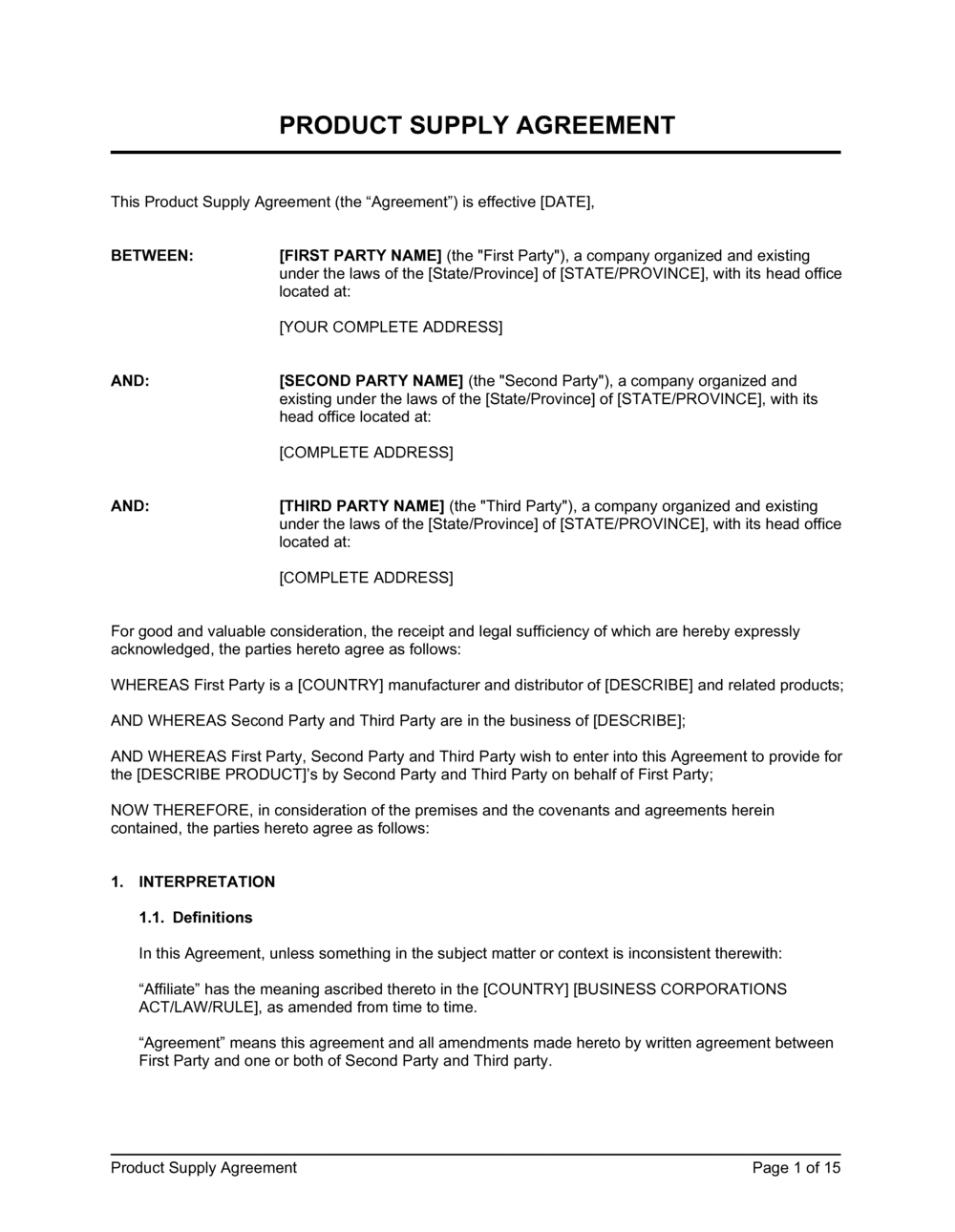
A Product Supply Agreement is a legally binding contract between a supplier and a buyer that governs the ongoing sale and purchase of goods over a defined period. This free Word download gives you a structured, attorney-informed starting point covering pricing, minimum order quantities, delivery terms, quality standards, warranties, IP ownership, and termination β€” all in a single document you can edit online and export as PDF.
When you need it
Use it whenever you are entering a recurring supplier relationship β€” whether you are a manufacturer supplying a distributor, a brand sourcing from a contract manufacturer, or a wholesaler supplying retail accounts β€” and need enforceable terms in writing before the first order ships.
What's inside
Parties and recitals, product specifications and scope, pricing and payment terms, minimum order quantities, delivery and risk of loss, quality assurance and warranties, intellectual property ownership, confidentiality, indemnification and liability limitations, and termination and dispute resolution provisions.

What is a Product Supply Agreement?

A Product Supply Agreement is a legally binding contract between a Supplier and a Buyer that establishes the terms under which products are sold and purchased on a recurring basis over a defined contract period. Unlike a one-off purchase order, a supply agreement creates an ongoing commercial framework β€” fixing the product specifications, pricing, minimum order quantities, delivery obligations, quality standards, warranty rights, IP ownership, and the conditions under which either party can exit the relationship. It functions simultaneously as a commercial contract, a quality assurance document, and a risk-allocation instrument, ensuring both parties understand their obligations before the first shipment leaves the warehouse.

Why You Need This Document

Operating a supply relationship without a written product supply agreement exposes both parties to avoidable financial and legal risk from the moment the first order ships. Without agreed quality specifications and an inspection procedure, a buyer who receives defective goods may have already waived their warranty rights under applicable sales law simply by failing to reject in time. Without a written IP clause, a buyer who funds custom tooling or product development may find that the supplier owns the moulds and formulations β€” and can supply the same product to a competitor. Without a price-adjustment mechanism, a multi-year relationship built on fixed pricing can collapse when input costs rise and the supplier can no longer fulfill orders profitably. A properly drafted product supply agreement closes each of these gaps, creates an enforceable framework for managing disputes before they escalate, and gives both parties the certainty they need to invest in the relationship for the long term. This template gives you a professional, attorney-informed starting point you can adapt in under an hour β€” with the option to add legal review for complex or high-value arrangements.

Which variant fits your situation?

If your situation is…Use this template
Ongoing supply of goods at negotiated volume pricingProduct Supply Agreement
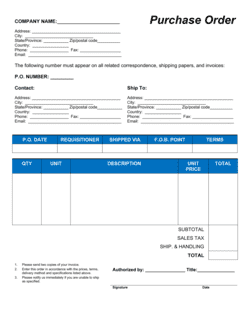
Single or one-off purchase of goodsPurchase Order
Supplier granted exclusive rights to supply a territory or accountExclusive Supply Agreement
Manufacturer producing goods to buyer's specifications under buyer's brandContract Manufacturing Agreement
Reseller authorized to distribute a supplier's products in a regionDistribution Agreement
Supplier providing raw materials to a manufacturerRaw Materials Supply Agreement
Services and goods bundled together in a single engagementSupply and Services Agreement

Common mistakes to avoid

❌ Attaching an unsigned or incomplete specification schedule

Why it matters: If Schedule A is missing or unsigned, quality disputes have no objective standard to measure against β€” the buyer cannot prove non-conformance and the supplier cannot prove compliance.

Fix: Ensure Schedule A is fully drafted, version-stamped, and initialed by both parties before or at execution. Treat it as inseparable from the main contract.

❌ No price-adjustment mechanism in a multi-year contract

Why it matters: Raw material, labor, and freight costs fluctuate significantly over a 2–3 year period. A fixed price with no adjustment mechanism makes the agreement commercially unviable for the supplier within 12–18 months, triggering renegotiation or breach.

Fix: Include an annual price-adjustment clause tied to a named index (CPI, PPI, or a commodity-specific index) with a cap β€” typically 3–5% per year β€” to protect the buyer.

❌ No inspection window or written rejection procedure

Why it matters: Under UCC Article 2 (US) and equivalent statutes in other jurisdictions, a buyer who fails to reject goods within a reasonable time is deemed to have accepted them β€” waiving defect and warranty claims.

Fix: Set a specific inspection window (e.g., 10 business days from delivery) and require written rejection notice with a description of the defect within that window.

❌ Missing or mutual-only IP allocation in a contract manufacturing context

Why it matters: When a buyer funds the development of custom tooling, moulds, or formulations with no written IP clause, ownership defaults to the creator β€” the supplier β€” leaving the buyer unable to switch manufacturers without losing their own product design.

Fix: Explicitly state that tooling and custom product IP funded by the buyer vest in the buyer upon payment, and that the supplier retains a manufacturing license only for the duration of the agreement.

❌ Treating a rolling forecast as a binding purchase commitment

Why it matters: Suppliers sometimes build inventory to forecast volumes. If the agreement does not clearly state whether forecasts are binding, a dispute arises when the buyer's actual orders fall short and the supplier seeks payment for unsold stock.

Fix: State clearly in the ordering clause whether rolling forecasts create binding obligations. If they do, include a take-or-pay remedy. If they do not, label them 'indicative only' and state that no obligation arises until a purchase order is issued.

❌ Automatic renewal with no notice-period tracking

Why it matters: A 90-day non-renewal notice window missed by even one day binds both parties to another full contract year at current pricing β€” a common and costly oversight when pricing or supply needs have changed.

Fix: Set a calendar reminder for 120 days before the renewal notice deadline on the day of signing, and note the deadline in a contract management system or shared calendar.

The 10 key clauses, explained

Parties, recitals, and defined terms

In plain language: Identifies the supplier and buyer as legal entities, states the commercial context and purpose, and defines key terms used throughout the agreement.

Sample language
This Product Supply Agreement ('Agreement') is entered into as of [DATE] by and between [SUPPLIER LEGAL NAME], a [STATE/COUNTRY] [ENTITY TYPE] ('Supplier'), and [BUYER LEGAL NAME], a [STATE/COUNTRY] [ENTITY TYPE] ('Buyer').

Common mistake: Using trade names instead of registered legal entity names. If the entity names do not match the signing parties on record, enforcing indemnification or IP clauses against the right legal person becomes complicated.

Product scope and specifications

In plain language: Defines exactly which products are covered, incorporates the specification sheet or Schedule A by reference, and states the process for agreeing to specification changes.

Sample language
Supplier shall supply to Buyer the products described in Schedule A ('Products'). Any modification to the specifications in Schedule A requires written agreement signed by both parties at least [30] days before the affected order.

Common mistake: Incorporating specifications by reference to a document that has not been finalized or attached. Courts have voided quality-dispute claims when the referenced spec sheet was missing or ambiguous.

Pricing, payment terms, and price adjustment

In plain language: States the unit price for each product, the payment deadline, accepted payment methods, and the mechanism for adjusting prices over the contract term β€” such as annual CPI escalation or raw-material index clauses.

Sample language
Buyer shall pay the unit prices set out in Schedule B. Payment is due net [30] days from the date of invoice. Supplier may adjust prices no more than once per calendar year by up to [X]% upon [60] days' written notice.

Common mistake: Fixing a price for the full contract term with no adjustment mechanism. Supplier cost increases β€” materials, freight, energy β€” that exceed the fixed price can make the contract commercially unviable and trigger breach or renegotiation.

Ordering, minimum quantities, and forecasts

In plain language: Sets out how orders are placed (purchase orders, blanket orders, or rolling forecasts), the minimum order quantity per order or per contract year, and whether forecasts are binding or indicative.

Sample language
Buyer shall submit purchase orders via [EMAIL / PORTAL] at least [X] business days before the required delivery date. Buyer commits to a minimum annual purchase volume of [X] units. Rolling 90-day forecasts are provided for planning purposes only and are not binding.

Common mistake: Treating a rolling forecast as a binding commitment without saying so explicitly. Suppliers often carry inventory based on forecasts β€” if they are non-binding, the buyer has no obligation to take or pay for that stock.

Delivery, risk of loss, and Incoterms

In plain language: Specifies the delivery location, agreed Incoterms, delivery timeline, what constitutes late delivery, and when title and risk transfer from supplier to buyer.

Sample language
Products shall be delivered [FOB / DDP / EXW] [NAMED LOCATION] as defined under Incoterms [2020]. Risk of loss passes to Buyer upon [DELIVERY EVENT]. Delivery more than [X] business days late constitutes a material breach.

Common mistake: Omitting an Incoterms year (2010 vs. 2020 have different rules) or naming a city without specifying whether it is origin or destination. A single ambiguous Incoterm has triggered six-figure freight insurance disputes.

Quality assurance, inspection, and non-conforming goods

In plain language: Establishes the quality standards the products must meet, the buyer's right to inspect on delivery, the process for rejecting non-conforming goods, and the supplier's remedy obligations β€” replacement, credit, or refund.

Sample language
Buyer shall inspect all Products within [10] business days of delivery. Non-conforming Products must be notified to Supplier in writing within [5] business days of discovery. Supplier shall, at its option, replace or credit non-conforming Products within [30] days of written notice.

Common mistake: No defined inspection window and no written rejection process. Without these, buyers in most jurisdictions are deemed to have accepted goods as conforming once a reasonable time has passed, waiving defect claims.

Warranties and limitation of liability

In plain language: States the supplier's express warranties (conformance to spec, merchantability, title), the warranty period, and caps each party's maximum aggregate liability β€” typically to the value of orders placed in the prior 12 months.

Sample language
Supplier warrants that Products will conform to the specifications in Schedule A and be free from material defects in materials and workmanship for [12] months from delivery. Neither party's aggregate liability shall exceed the total fees paid by Buyer in the [12] months preceding the claim.

Common mistake: No liability cap at all, or a cap that applies only to one party. Without mutual caps, a single defective shipment causing a downstream recall could expose the supplier to unlimited consequential damages.

Intellectual property ownership and licensing

In plain language: Allocates ownership of product designs, formulations, tooling, and trade dress β€” distinguishing pre-existing IP each party brings from new IP developed during the relationship.

Sample language
Each party retains ownership of its pre-existing IP. Any tooling, moulds, or product designs created by Supplier specifically for Buyer's Products shall be owned by [BUYER / SUPPLIER], and Supplier grants Buyer a [non-exclusive / exclusive] license to use such IP solely in connection with the Products.

Common mistake: No IP clause at all in a contract manufacturing context. When a supplier develops tooling or formulations to a buyer's brief with no written IP allocation, ownership defaults to the creator β€” the supplier β€” in most jurisdictions.

Confidentiality

In plain language: Prohibits each party from disclosing the other's product specifications, pricing, formulations, or business information to third parties during and for a defined period after the agreement.

Sample language
Each party agrees to hold the other's Confidential Information in strict confidence and not to disclose it to any third party without prior written consent. This obligation survives termination of this Agreement for [3] years.

Common mistake: Mutual confidentiality clauses that apply equally to both parties when only one party β€” typically the buyer β€” holds genuinely sensitive information. Courts may find an overbroad clause unenforceable if it is unreasonably burdensome on the party with no real secrets.

Term, termination, and dispute resolution

In plain language: Defines the contract duration and renewal mechanism, the events that trigger a right to terminate (breach, insolvency, force majeure), the cure period, and the forum and method for resolving disputes.

Sample language
This Agreement commences on [DATE] and continues for [2] years, renewing automatically for successive [1]-year terms unless either party provides [90] days' written notice. Either party may terminate for cause upon [30] days' written notice if the breaching party fails to cure within that period. Disputes shall be resolved by binding arbitration under [AAA / ICC] rules in [CITY, STATE].

Common mistake: Automatic renewal clauses with no notice-period reminder mechanism. Parties routinely miss the 60- or 90-day notice window and are locked into another full term on unfavorable pricing.

How to fill it out

  1. 1

    Insert the legal entity names and execution date

    Enter the full registered legal name of both the supplier and the buyer β€” not trade names or brand names. Confirm entity types (LLC, Inc., Ltd.) and jurisdiction of incorporation. Set the effective date.

    πŸ’‘ Run a quick corporate registry search on both parties before signing. A name discrepancy between the contract and the registry can void an indemnification claim.

  2. 2

    Complete Schedule A β€” product specifications

    Attach a detailed specification sheet covering every material attribute β€” dimensions, materials, chemical composition, packaging, labeling, and applicable regulatory standards. Both parties must initial the schedule.

    πŸ’‘ Reference the specification version number and date in the schedule. When specs are updated, issue a new version and amend the agreement β€” do not overwrite the original.

  3. 3

    Set pricing, payment terms, and the adjustment mechanism

    Enter unit prices for each SKU in Schedule B. Choose a payment term (Net 30, Net 45, or another agreed term). Decide whether to include an annual price-adjustment clause tied to CPI or a named commodity index.

    πŸ’‘ For contracts longer than 12 months, a price-adjustment cap of 3–5% per year is standard and protects both sides from commodity price volatility.

  4. 4

    Define order quantities, forecasting obligations, and lead times

    State the minimum order quantity per purchase order and the annual volume commitment. Specify whether rolling forecasts are binding or indicative. Set the lead time between order placement and expected delivery.

    πŸ’‘ If the supplier is tooling up to meet your volumes, make the annual minimum binding β€” a non-binding forecast provides no protection against underutilized capacity.

  5. 5

    Specify delivery terms and Incoterms

    Choose the applicable Incoterm (FOB, DDP, EXW, or another) and name the specific location β€” port, warehouse, or city. State the Incoterms year (2020). Confirm who arranges and pays for freight, insurance, and customs clearance.

    πŸ’‘ DDP (Delivered Duty Paid) puts maximum responsibility on the supplier β€” useful when the buyer lacks import infrastructure. FOB shifts risk and logistics to the buyer from the origin port.

  6. 6

    Draft the quality and inspection provisions

    Set the inspection window β€” typically 5–10 business days from delivery. State the written rejection procedure and the supplier's remedy obligations: replacement, credit, or refund within a defined timeframe.

    πŸ’‘ Require the supplier to provide a Certificate of Analysis or inspection report with each shipment. This creates a contemporaneous quality record that is invaluable in disputes.

  7. 7

    Confirm IP ownership and licensing

    Identify all pre-existing IP each party brings to the relationship. Specify who owns tooling, moulds, packaging designs, and formulations developed under the agreement. Grant back any licenses necessary for each party to perform.

    πŸ’‘ If you are paying for custom tooling, specify in the agreement that title vests in the buyer upon full payment β€” otherwise the supplier retains a lien on the equipment.

  8. 8

    Set the term, renewal, and termination provisions

    Choose the initial contract term (1–3 years is typical) and the automatic-renewal mechanism. Set the notice period for non-renewal (60–90 days) and for termination for cause (30 days with a matching cure period).

    πŸ’‘ Calendar a reminder 120 days before the non-renewal notice deadline on signing day. Missing a 90-day window locks both parties into another full term.

Frequently asked questions

What is a product supply agreement?

A product supply agreement is a legally binding contract between a supplier and a buyer that governs the ongoing purchase and sale of goods over a defined period. It establishes the product specifications, pricing, order quantities, delivery terms, quality standards, warranty obligations, IP ownership, and termination conditions β€” replacing individual purchase orders as the authoritative framework for the supply relationship.

What is the difference between a product supply agreement and a purchase order?

A purchase order is a transactional document that authorizes a single purchase of specific goods at a specific price. A product supply agreement is the overarching contract that governs the entire supply relationship, including how purchase orders are placed, minimum volumes, quality requirements, warranties, and what happens if either party defaults. In practice, purchase orders issued under a supply agreement are governed by the agreement's terms β€” not the boilerplate on the back of the PO form.

When do I need a product supply agreement?

Use a product supply agreement whenever you expect to place recurring orders from the same supplier over a period of six months or more, when custom product specifications or tooling are involved, when you need enforceable quality and warranty obligations, or when you are granting or receiving exclusivity in a product category or territory. For one-off purchases, a purchase order with standard terms is usually sufficient.

Does a product supply agreement need to be signed by both parties?

Yes. A product supply agreement is a bilateral contract and requires signatures from authorized representatives of both the supplier and the buyer to be enforceable. Unsigned agreements are treated as draft documents in most jurisdictions and cannot support breach or warranty claims. Electronic signatures are generally enforceable under the US E-SIGN Act, Canada's PIPEDA-related provincial statutes, and the EU's eIDAS regulation.

How long should a product supply agreement last?

Most product supply agreements run for 1–3 years with an automatic-renewal clause. Shorter initial terms (12 months) are common for new supplier relationships where quality and reliability have not yet been established. Longer terms (2–3 years) are appropriate when the buyer is funding tooling or custom development and needs supply continuity to recoup that investment. Always pair the term length with a matching notice period for non-renewal.

What Incoterms should I use in a product supply agreement?

The right Incoterm depends on your logistics capabilities and risk preference. FOB (Free on Board) is the most common for international supply β€” the buyer takes risk and arranges freight from the origin port, giving them control over shipping costs. DDP (Delivered Duty Paid) shifts maximum responsibility to the supplier, including customs clearance and import duties, and suits buyers without import infrastructure. Always specify the Incoterms year (2020) and the named location to avoid interpretation disputes.

Who owns the tooling and product specifications under a supply agreement?

Without an explicit IP clause, ownership of tooling, moulds, and custom formulations typically defaults to the creator β€” the supplier β€” under most common-law principles. If the buyer funds the tooling or provides the specifications, the agreement should explicitly state that IP and tooling vest in the buyer upon full payment, with the supplier retaining only a manufacturing license for the duration of the agreement. This is critical for maintaining the ability to switch manufacturers.

Can a product supply agreement include exclusivity?

Yes. Exclusivity provisions can restrict the supplier from selling the same or substantially similar products to competing buyers, or restrict the buyer to purchasing only from that supplier within a defined territory or category. Exclusive terms typically require minimum purchase commitments in exchange for the exclusivity grant and should include a clause allowing the non-exclusive party to terminate if performance thresholds are not met.

What happens if the supplier delivers non-conforming goods?

The remedy depends entirely on what the agreement says. A well-drafted supply agreement gives the buyer the right to reject non-conforming goods within a defined inspection window and requires the supplier to replace, re-deliver, or credit the buyer within a specified timeframe. Without written rejection and remedy procedures, buyers in most jurisdictions must rely on statutory warranty remedies β€” which are slower to enforce and often less favorable than negotiated contractual rights.

How this compares to alternatives

vs Purchase Order

A purchase order is a transactional document authorizing a single delivery of goods at a stated price. A product supply agreement is the governing framework under which multiple purchase orders are issued over time. The supply agreement sets quality, warranty, and termination standards that apply to every PO placed under it β€” the PO alone provides none of these protections.

vs Distribution Agreement

A distribution agreement governs a reseller's right to market and sell a supplier's products to end customers within a territory. A product supply agreement governs the upstream transaction β€” how the buyer sources product from the supplier. Both agreements may coexist in the same supply chain, with the distribution agreement layered on top of the supply agreement.

vs Contract Manufacturing Agreement

A contract manufacturing agreement engages a manufacturer to produce goods to the buyer's specifications, with a heavy focus on IP ownership, tooling, and quality control procedures. A product supply agreement is broader β€” it applies whether the supplier manufactures the products itself or sources them, and focuses more on commercial terms than production process. Use a contract manufacturing agreement when the supplier is producing exclusively to your design.

vs Vendor Agreement

A vendor agreement is a general-purpose contract for procuring goods or services from a third party. It typically covers lighter-touch commercial terms without the product-specification schedules, Incoterms provisions, or quality-assurance mechanisms of a product supply agreement. Use a product supply agreement when the goods being sourced have defined specifications, recurring volumes, and warranty obligations that require dedicated contractual treatment.

Industry-specific considerations

Consumer Goods and Retail

Retailer-specific packaging and labeling requirements, compliance with safety and testing standards (e.g., CPSC, CE mark), seasonal minimum order volumes, and promotional pricing windows.

Food and Beverage

Food safety certifications (HACCP, SQF, BRC), shelf-life and cold-chain delivery requirements, ingredient and allergen disclosure obligations, and recall and indemnification protocols.

Manufacturing and Industrial

Component and raw material specifications with tolerances, just-in-time delivery schedules, ISO quality management system requirements, and tooling ownership and maintenance obligations.

Healthcare and Medical Devices

FDA and CE regulatory compliance as a condition of supply, batch traceability and lot-number documentation, adverse-event reporting obligations, and enhanced indemnification for product liability.

Technology and Electronics

RoHS and REACH compliance for hazardous materials, firmware and embedded software IP allocation, component lifecycle and obsolescence management, and counterfeit-parts prevention protocols.

Professional Services and Distribution

Multi-tier distribution channel restrictions, authorized reseller compliance, territory exclusivity tied to annual volume targets, and co-op marketing fund obligations.

Jurisdictional notes

United States

UCC Article 2 governs the sale of goods in all US states and sets default rules for acceptance, rejection, and warranties that apply when the contract is silent. Parties can modify most UCC defaults by contract β€” which is why written supply agreements matter. Non-compete and exclusivity clauses must comply with state antitrust and trade-practice laws; California and New York impose heightened scrutiny. Product liability exposure varies significantly by state, making liability caps and indemnification language especially important.

Canada

Sale of goods is governed by provincial statutes (e.g., Ontario's Sale of Goods Act, BC's Sale of Goods Act) that impose implied conditions of merchantability and fitness for purpose β€” these can be excluded by contract but only with clear, explicit language. Quebec civil law applies to agreements with Quebec-domiciled parties and imposes distinct warranty and implied-term rules. French-language contracts may be required for agreements with Quebec entities under the Charter of the French Language.

United Kingdom

The Sale of Goods Act 1979 and the Consumer Rights Act 2015 (for B2C) impose statutory implied terms on quality and fitness that cannot be excluded in consumer contracts and can only be excluded in B2B contracts if the exclusion passes a reasonableness test under the Unfair Contract Terms Act 1977. Post-Brexit, UK product regulations now diverge from EU CE-mark and UKCA-marking requirements β€” supply agreements for physical goods should specify which conformity standards apply.

European Union

The UN Convention on Contracts for the International Sale of Goods (CISG) applies automatically to cross-border supply agreements between parties in different EU member states unless explicitly excluded. EU product liability rules under the Product Liability Directive impose strict liability on manufacturers and importers for defective goods β€” indemnification clauses should address this exposure explicitly. GDPR applies if personal data is exchanged in connection with the supply relationship, such as customer lists for drop-ship arrangements.

Template vs lawyer β€” what fits your deal?

PathBest forCostTime
Use the templateEstablished supplier relationships with domestic parties, standard products, and straightforward pricingFree30–60 minutes
Template + legal reviewCross-border supply, custom product specifications, exclusivity grants, or contract values above $100K per year$500–$1,500 for a commercial lawyer review2–5 days
Custom draftedComplex manufacturing arrangements, regulated industries (food, healthcare, medical devices), or multi-party supply chains with significant IP at stake$2,000–$8,000+2–4 weeks

Glossary

Supplier
The party that manufactures, sources, or otherwise provides the products being sold under the agreement.
Buyer
The party purchasing the products from the supplier for resale, distribution, or end use.
Product Specifications
A detailed written description of the agreed physical, chemical, or functional attributes a product must meet at the time of delivery.
Minimum Order Quantity (MOQ)
The smallest number of units the buyer is contractually obligated β€” or permitted β€” to purchase in a single order or over a defined period.
Incoterms
Internationally recognized trade terms (e.g., FOB, CIF, DDP) that define where risk and cost transfer from seller to buyer in a shipment.
FOB (Free on Board)
A delivery term under which risk and cost transfer to the buyer once goods are loaded onto the carrier at the named port or location.
Warranty
A supplier's enforceable promise that the products will conform to agreed specifications and be free from defects for a defined period.
Indemnification
A contractual obligation requiring one party to compensate the other for specific losses, liabilities, or claims arising from defined events.
Force Majeure
A clause excusing a party's non-performance when caused by extraordinary events outside its control β€” such as natural disasters, wars, or pandemics.
Exclusivity
A contractual restriction limiting the supplier from selling the same products to competing buyers, or limiting the buyer to purchasing only from that supplier, within a defined market or territory.
Cure Period
The time allowed for a breaching party to remedy a default before the non-breaching party may exercise termination rights.
Right of First Refusal
A provision giving one party the right to match any third-party offer before the other party can accept it β€” commonly used in exclusive or semi-exclusive supply arrangements.

Part of your Business Operating System

This document is one of 3,000+ business & legal templates included in Business in a Box.

  • Fill-in-the-blanks β€” ready in minutes
  • 100% customizable Word document
  • Compatible with all office suites
  • Export to PDF and share electronically

Create your document in 3 simple steps.

From template to signed document β€” all inside one Business Operating System.
1
Download or open template

Access over 3,000+ business and legal templates for any business task, project or initiative.

2
Edit and fill in the blanks with AI

Customize your ready-made business document template and save it in the cloud.

3
Save, Share, Send, Sign

Share your files and folders with your team. Create a space of seamless collaboration.

Save time, save money, and create top-quality documents.

β˜…β˜…β˜…β˜…β˜…

"Fantastic value! I'm not sure how I'd do without it. It's worth its weight in gold and paid back for itself many times."

Managing Director Β· Mall Farm
Robert Whalley
Managing Director, Mall Farm Proprietary Limited
β˜…β˜…β˜…β˜…β˜…

"I have been using Business in a Box for years. It has been the most useful source of templates I have encountered. I recommend it to anyone."

Business Owner Β· 4+ years
Dr Michael John Freestone
Business Owner
β˜…β˜…β˜…β˜…β˜…

"It has been a life saver so many times I have lost count. Business in a Box has saved me so much time and as you know, time is money."

Owner Β· Upstate Web
David G. Moore Jr.
Owner, Upstate Web

Run your business with a system β€” not scattered tools

Stop downloading documents. Start operating with clarity. Business in a Box gives you the Business Operating System used by over 250,000 companies worldwide to structure, run, and grow their business.

Start freeΒ Β·Β No credit card required