Collection Letter_Following Promissory Note Template

Free Word download β€’ Edit online β€’ Save & share with Drive β€’ Export to PDF

1 pageβ€’20–30 min to fillβ€’Difficulty: Standardβ€’Signature requiredβ€’Legal review recommended
Learn more ↓
FreeCollection Letter_Following Promissory Note Template

At a glance

What it is
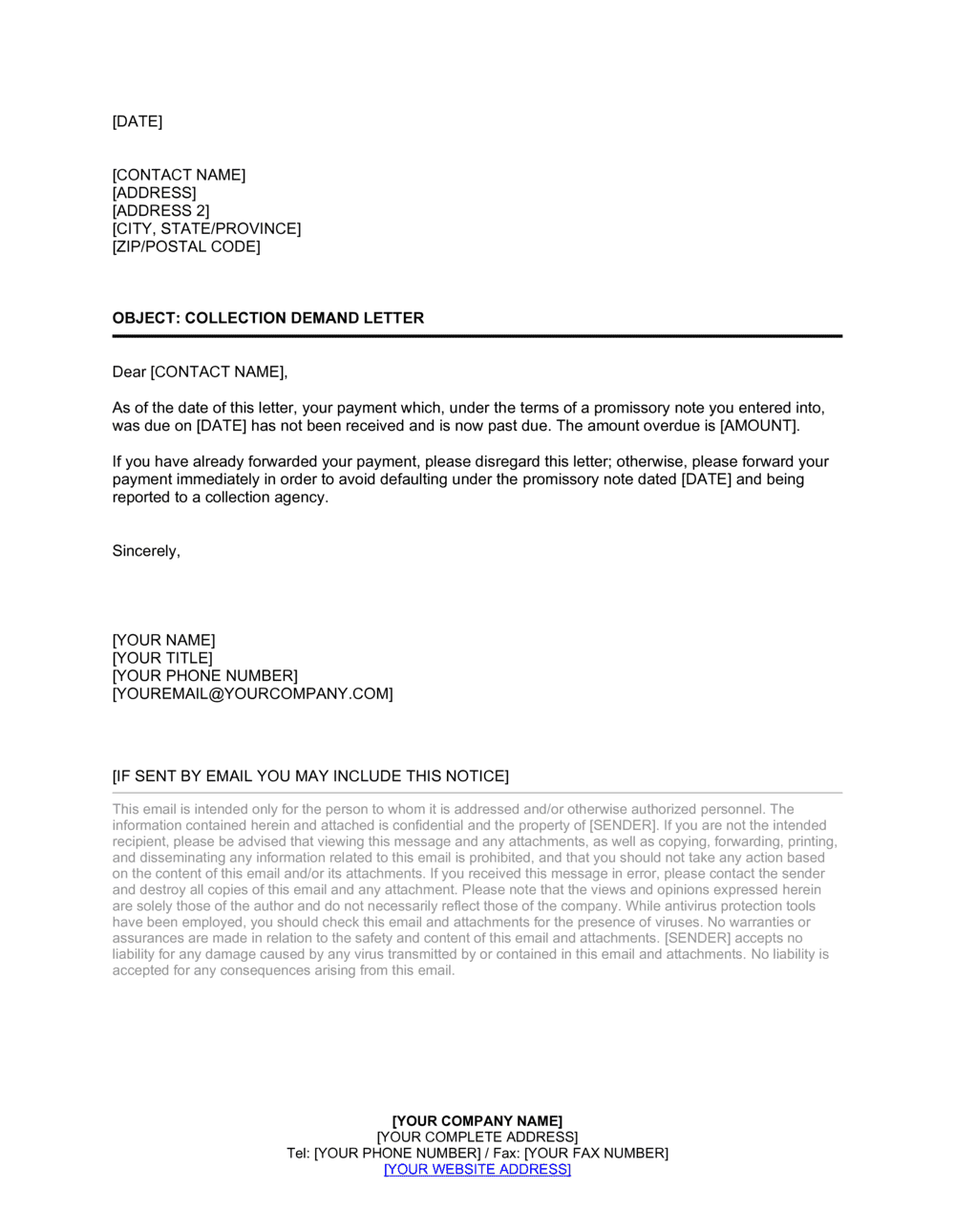
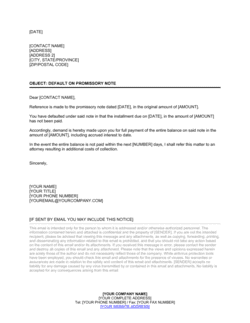
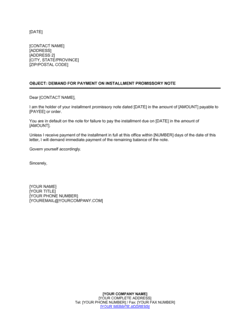
A Collection Letter Following a Promissory Note is a formal written demand sent by a lender or creditor to a borrower who has defaulted on a signed promissory note. This free Word download gives you a legally structured letter you can edit online and export as PDF β€” referencing the original note, stating the outstanding balance, and demanding repayment within a defined deadline before further collection action is taken.
When you need it
Use it when a borrower has missed one or more payments on a promissory note and informal reminders have not produced payment. Sending a formal collection letter is typically the last written step before engaging a collections agency or filing a civil lawsuit to enforce the note.
What's inside
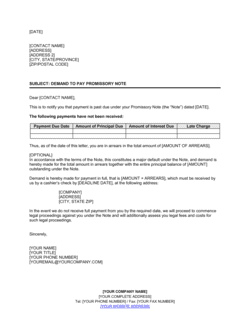
Identification of the original promissory note by date and amount, a statement of the outstanding balance including any accrued interest and late fees, a firm deadline for repayment, a description of the consequences of continued non-payment, and the creditor's signature and contact information.

What is a Collection Letter Following a Promissory Note?

A Collection Letter Following a Promissory Note is a formal written demand issued by a creditor to a borrower who has defaulted on a signed promissory note. It functions as the legal bridge between an unmet payment obligation and formal enforcement action β€” citing the original note by date and amount, itemizing the full outstanding balance including accrued interest and authorized late fees, invoking any acceleration clause that makes the entire balance immediately due, and setting a firm repayment deadline with explicit consequences for non-compliance. Unlike a casual payment reminder, this letter is a structured legal document whose content and delivery method directly affect the creditor's ability to enforce the note in court.

Why You Need This Document

Without a properly drafted collection letter, creditors face two serious risks: procedural defects that delay or block legal enforcement, and evidentiary gaps that weaken their position if the matter goes to court. Most promissory notes require formal written notice of default before the creditor can invoke acceleration, refer the debt to collections, or file suit β€” skipping this step can restart the clock and give the borrower grounds to challenge the entire collection effort. A well-documented demand letter also establishes the cure period required by many jurisdictions, creates an unambiguous record of what was owed and when payment was demanded, and signals to the borrower that the creditor is prepared to escalate. For amounts above a few thousand dollars β€” or any note secured by real property β€” a formally structured collection letter is not optional; it is the foundation on which every subsequent enforcement action rests. This template gives you a legally grounded starting point that covers every required element, reducing the risk of procedural error and the cost of starting from scratch with legal counsel.

Which variant fits your situation?

If your situation is…Use this template
First missed payment with no prior communicationPayment Reminder Letter
Borrower has missed multiple payments and informal contact has failedCollection Letter Following Promissory Note
Demanding full outstanding balance with a hard legal deadlineDemand Letter for Payment
Offering a structured repayment plan to resolve the defaultDebt Settlement Agreement
Formally notifying the borrower of intent to pursue legal actionNotice of Intent to Sue
Collecting a debt after a judgment has been entered in courtPost-Judgment Collection Letter
Involving a collections agency for third-party enforcementDebt Collection Agency Authorization

Common mistakes to avoid

❌ Claiming fees not authorized by the original note

Why it matters: Demanding amounts beyond what the promissory note expressly permits β€” such as attorney's fees without an attorney's fees clause β€” can constitute a violation of the FDCPA or equivalent statutes, exposing the creditor to counterclaims that exceed the original debt.

Fix: Review the original note before drafting the balance calculation. Only include principal, interest at the stated rate, and late fees expressly authorized by the note's terms.

❌ Threatening collection actions the creditor cannot legally take

Why it matters: Threatening criminal prosecution, arrest, or immediate wage garnishment for non-payment of a civil debt exposes the creditor to regulatory complaints and civil liability β€” and undermines the enforceability of any legitimate demand.

Fix: Limit consequence language to civil remedies the creditor has the right to pursue: filing suit, engaging a collections agency, or reporting the default to credit bureaus β€” all of which must be factually accurate at the time of writing.

❌ Accepting partial payment without a written reservation of rights

Why it matters: Courts in many jurisdictions interpret acceptance of a partial payment as accord and satisfaction β€” a legal settlement that extinguishes the creditor's right to collect the remaining balance.

Fix: If you accept any partial payment, include a written statement β€” signed by the borrower β€” that the payment does not constitute full satisfaction of the debt and that the creditor reserves all rights to collect the remainder.

❌ Sending the letter without proof of delivery

Why it matters: Without documented delivery, a borrower can claim they never received the demand, potentially invalidating the notice and resetting any cure period that must precede legal action.

Fix: Send the collection letter by certified mail with return receipt requested, and retain the tracking number and delivery confirmation. For high-value notes, also send a copy by email to create a secondary delivery record.

❌ Using the wrong party name as the sender

Why it matters: If the note has been assigned or the creditor's business name has changed, sending the letter under a different name without documenting the assignment creates a chain-of-title gap that the borrower can exploit to challenge the demand.

Fix: Ensure the sender is the payee named in the original note, or attach a copy of any assignment agreement and reference it explicitly in the letter as the basis for the sender's authority to collect.

❌ Setting a cure period shorter than the note or statute requires

Why it matters: Many promissory notes include a minimum notice period before legal action can commence, and several jurisdictions impose statutory minimums on top of contractual terms. A demand with an illegally short deadline may be legally defective and require re-sending β€” delaying collection and alerting the borrower to a procedural error.

Fix: Check both the promissory note's default and cure provisions and the applicable state, provincial, or national law before setting the repayment deadline. When in doubt, a 15-to-30-day cure period is conservative and broadly defensible.

The 9 key clauses, explained

Identification of the Promissory Note

In plain language: Cites the original promissory note by execution date, principal amount, and the parties involved to establish the legal basis for the demand.

Sample language
This letter constitutes formal notice of default under the Promissory Note dated [DATE], executed by [BORROWER FULL NAME] in favor of [LENDER FULL NAME], in the original principal amount of $[AMOUNT] ('Note').

Common mistake: Referencing the note by an informal description rather than its exact execution date and amount. A mismatch between the letter and the signed note can weaken enforcement in court if the debtor disputes which obligation is being collected.

Statement of Default

In plain language: Clearly states that the borrower has failed to make required payments, specifying which payments were missed and the dates they were due.

Sample language
As of [DATE], you have failed to remit the payment of $[AMOUNT] due on [DUE DATE] and $[AMOUNT] due on [DUE DATE], constituting a material default under the terms of the Note.

Common mistake: Using vague language like 'you have not been paying as agreed.' Listing specific missed payment dates and amounts creates an unambiguous record and is far more defensible if the collection effort escalates to litigation.

Outstanding Balance Calculation

In plain language: Itemizes the total amount now owed, broken down into principal, accrued interest, and any late fees charged under the note.

Sample language
The total amount currently outstanding under the Note is as follows: Principal: $[AMOUNT]; Accrued Interest at [X]% per annum through [DATE]: $[AMOUNT]; Late Fees: $[AMOUNT]; Total Due: $[TOTAL AMOUNT].

Common mistake: Overstating the balance by including fees not authorized by the original note. Claiming amounts beyond what the note permits can expose the creditor to counterclaims under federal and state debt collection laws.

Acceleration of the Full Balance

In plain language: Invokes any acceleration clause in the original note, declaring the entire unpaid principal and interest immediately due and payable as a result of the default.

Sample language
Pursuant to the acceleration clause in Section [X] of the Note, the entire outstanding principal balance of $[AMOUNT], together with all accrued interest and fees, is hereby declared immediately due and payable in full.

Common mistake: Invoking acceleration when the original note contains no acceleration clause. If the note does not authorize acceleration, demanding the full balance prematurely may constitute a breach by the creditor rather than the borrower.

Deadline for Payment (Cure Period)

In plain language: Sets a specific calendar date by which the borrower must pay the full outstanding balance to avoid further collection action.

Sample language
You are hereby demanded to remit payment of the total amount due of $[TOTAL AMOUNT] no later than [SPECIFIC DATE β€” e.g., 15 days from the date of this letter]. Failure to pay in full by this date will result in [CONSEQUENCE].

Common mistake: Setting a cure period shorter than what the original note or applicable law requires. Many jurisdictions mandate a minimum notice period before a creditor can pursue legal remedies β€” sending a 3-day demand when the law requires 10 days can invalidate the notice.

Consequences of Non-Payment

In plain language: Informs the borrower of the specific actions the creditor will take if payment is not received by the deadline β€” civil lawsuit, credit reporting, collections referral, or asset seizure.

Sample language
If payment is not received in full by [DATE], [LENDER NAME] reserves the right to pursue all available legal remedies, including filing a civil lawsuit, reporting the default to credit bureaus, and seeking recovery of court costs and attorney's fees as permitted by the Note and applicable law.

Common mistake: Threatening actions the creditor has no legal right to take β€” such as criminal prosecution for non-payment of a civil debt. False threats expose the creditor to liability under the Fair Debt Collection Practices Act (FDCPA) and equivalent statutes in other jurisdictions.

Payment Instructions

In plain language: Specifies exactly how and where the borrower must submit payment β€” bank transfer, certified check, or online portal β€” to ensure there is no ambiguity about what constitutes valid payment.

Sample language
Payment must be made via wire transfer to [BANK NAME], Account No. [ACCOUNT], Routing No. [ROUTING], or by certified check payable to [LENDER NAME], mailed to [ADDRESS], referencing Note dated [DATE] in the memo line.

Common mistake: Omitting payment instructions from the letter and expecting the borrower to contact the creditor. Ambiguous payment mechanics give borrowers grounds to claim they were unable to tender payment, complicating enforcement.

Reservation of Rights

In plain language: Preserves all of the creditor's legal rights and remedies under the promissory note and applicable law, ensuring that sending this letter does not waive any right or constitute an agreement to accept partial payment.

Sample language
[LENDER NAME] expressly reserves all rights and remedies available under the Note and applicable law. Nothing in this letter shall be construed as a waiver of any right, remedy, or default, or as an agreement to accept less than the full amount owed.

Common mistake: Accepting a partial payment without a written reservation of rights. Courts in many jurisdictions treat acceptance of a partial payment as accord and satisfaction β€” extinguishing the right to collect the remainder.

Creditor Signature and Contact Information

In plain language: Identifies the creditor by name, provides contact details for the borrower to respond or arrange payment, and includes a dated signature block to establish when the letter was issued.

Sample language
Sincerely, [LENDER FULL NAME] | [TITLE, if applicable] | [ADDRESS] | [PHONE] | [EMAIL] | Date: [DATE]

Common mistake: Sending the letter without a dated signature or on behalf of a party other than the named payee in the note. If the letter is signed by an agent or assignee, the authority to collect must be stated β€” otherwise the borrower has grounds to dispute the legitimacy of the demand.

How to fill it out

  1. 1

    Retrieve and review the original promissory note

    Locate the signed promissory note and confirm the execution date, principal amount, interest rate, payment schedule, late fee terms, and any acceleration or cure-period clauses. Every figure in the collection letter must trace back to the signed note.

    πŸ’‘ Make a photocopy of the note to attach to your records β€” if this escalates to court, you will need the original signed document as evidence.

  2. 2

    Calculate the total amount outstanding

    Tally the unpaid principal, interest accrued from the last payment date to today at the note's stated rate, and any late fees expressly authorized by the note. Do not include fees not specified in the note.

    πŸ’‘ Use a simple interest formula: Principal Γ— Annual Rate Γ· 365 Γ— Days Elapsed. Document your calculation in a separate worksheet in case the borrower disputes the amount.

  3. 3

    Enter the borrower's full legal name and address

    Use the borrower's name exactly as it appears on the original promissory note. Send the letter to the borrower's last known address and, if different, their registered business address.

    πŸ’‘ Send by both certified mail (return receipt requested) and first-class mail to create a record of delivery. Some jurisdictions require certified mail to trigger statutory cure periods.

  4. 4

    Identify and cite the promissory note precisely

    Reference the note by its full execution date and original principal amount in the opening paragraph. If the note has a title or reference number, include it.

    πŸ’‘ Quoting the specific section numbers of the note's payment, default, and acceleration clauses strengthens the legal basis of the demand and signals to the borrower β€” and any subsequent court β€” that the creditor knows the document well.

  5. 5

    Set a specific repayment deadline

    Choose a cure period that meets or exceeds what the note requires and any applicable statutory minimum β€” typically 10 to 30 days from the letter date. State the exact calendar date, not a relative timeframe like '15 days from receipt.'

    πŸ’‘ Use the letter's date, not the expected delivery date, as the starting point for the cure period β€” this is more defensible if delivery timing is disputed.

  6. 6

    State consequences clearly and accurately

    List only the collection actions you are legally authorized to take under the note and applicable law β€” civil lawsuit, collections referral, or credit reporting. Do not threaten criminal prosecution, arrest, or wage garnishment before obtaining a judgment.

    πŸ’‘ If you are a business collecting a commercial debt, FDCPA restrictions may not apply directly, but state consumer protection laws often do β€” verify the applicable rules before drafting this section.

  7. 7

    Sign, date, and send the letter by certified mail

    Sign the letter as the payee named in the promissory note, or include an explicit statement of authority if signing as an agent or assignee. Date the letter on the day it is mailed and retain a copy.

    πŸ’‘ Keep the certified mail receipt and delivery confirmation with the letter copy in a dedicated file β€” these become your proof of notice if the collection escalates to a lawsuit.

Frequently asked questions

What is a collection letter following a promissory note?

A collection letter following a promissory note is a formal written demand sent by a creditor to a borrower who has defaulted on a signed promissory note. It identifies the original note by date and amount, states the total balance outstanding including accrued interest and late fees, sets a firm repayment deadline, and describes the legal consequences of continued non-payment. It is typically the final written step before the creditor files a civil lawsuit or refers the debt to a collections agency.

When should I send a collection letter for a promissory note?

Send a collection letter after the borrower has missed one or more scheduled payments and informal reminders β€” phone calls or standard emails β€” have not produced payment. Most creditors send a payment reminder letter first, then escalate to a formal collection letter after the account is 30 to 60 days past due. Review the promissory note for any specific default and notice requirements before sending, as the note may dictate the timing and form of demand.

Does a collection letter create a legally binding obligation?

The collection letter itself is not a new contract β€” the binding obligation already exists in the signed promissory note. The letter functions as a formal notice of default and demand for payment that activates the note's enforcement provisions, including any acceleration clause. Sending it also starts the clock on the cure period and creates a documented record that is essential if the creditor later files suit.

What should the collection letter include to be legally effective?

At minimum, the letter should identify the original promissory note by date and amount, specify which payments were missed and the amounts, state the total balance due broken down into principal, interest, and authorized fees, set a specific repayment deadline, describe the consequences of non-payment, provide clear payment instructions, and include a dated signature from the payee named in the note. Missing any of these elements weakens the demand and can complicate enforcement.

Can I collect attorney's fees through a collection letter?

You can demand attorney's fees only if the promissory note expressly includes an attorney's fees clause. In the United States, the American Rule generally requires each party to pay its own legal costs unless a contract or statute provides otherwise. If the note includes such a clause, you may reference it in the letter β€” but the actual fee amount typically must be determined after litigation concludes, not demanded upfront in a fixed sum.

What is the difference between a collection letter and a demand letter?

The terms are often used interchangeably, but in the context of promissory notes, a collection letter specifically follows a prior signed note and is grounded in the note's default provisions. A general demand letter can relate to any disputed amount β€” a contract breach, an unpaid invoice, or a tort claim β€” without necessarily referencing a promissory note. The collection letter following a promissory note is more precisely structured because the underlying debt instrument defines the exact amounts, interest rate, and enforcement rights.

What happens if the borrower ignores the collection letter?

If the borrower does not pay or respond by the stated deadline, the creditor's typical next steps are filing a civil lawsuit to obtain a judgment, referring the debt to a licensed collections agency, or reporting the default to credit bureaus. Once a judgment is obtained, the creditor may be able to garnish wages, levy bank accounts, or place a lien on real property, depending on the jurisdiction. The collection letter creates the paper trail that supports all of these actions.

Does the Fair Debt Collection Practices Act apply to this letter?

The FDCPA applies to third-party debt collectors β€” agencies or attorneys collecting on behalf of another creditor. If you are the original lender collecting your own debt, the FDCPA generally does not apply to you directly. However, many states have enacted their own debt collection statutes that cover original creditors, and several of those are stricter than the federal law. Always verify the applicable state law before making collection threats or representations in the letter.

How long do I have to collect on a promissory note?

The statute of limitations for promissory notes varies by jurisdiction and note type. In the United States, most states allow 3 to 6 years for written contracts, with some states extending to 10 years for notes under seal. In Canada, the basic limitation period is 2 years in most provinces. In the UK, the Limitation Act 1980 sets a 6-year period. The clock typically starts running from the date of default, though partial payments or written acknowledgments of the debt can restart the period. Consult a local attorney to confirm the applicable limitation period before proceeding.

How this compares to alternatives

vs Payment Reminder Letter

A payment reminder letter is an informal notice sent shortly after a missed payment β€” it assumes good faith and prompts the borrower to pay without implying legal consequences. A collection letter following a promissory note is a formal legal demand that invokes the note's default provisions, states the full outstanding balance, and sets a hard deadline before enforcement. Use a reminder first; escalate to the collection letter when the reminder goes unanswered.

vs Demand for Payment Letter

A general demand for payment letter can be used for any overdue obligation β€” an unpaid invoice, a disputed contract, or a verbal agreement. A collection letter following a promissory note is anchored to a specific signed instrument and incorporates that note's exact interest rate, late fees, and default provisions. The promissory note collection letter carries more legal weight because the underlying obligation is already in writing and signed by the borrower.

vs Promissory Note

A promissory note is the original debt instrument β€” the borrower's signed promise to repay. The collection letter is the enforcement document sent when that promise is broken. The collection letter cannot exist without a prior signed promissory note, and its legal authority derives entirely from the note's terms. Both documents should be retained together in the event of litigation.

vs Debt Settlement Agreement

A debt settlement agreement is a negotiated resolution β€” the creditor agrees to accept less than the full amount owed in exchange for immediate payment and release of the remaining balance. A collection letter makes the demand for full payment and precedes any settlement negotiation. Send the collection letter first; if the borrower responds with a settlement offer, the debt settlement agreement documents the resolution.

Industry-specific considerations

Financial Services and Private Lending

Private lenders and peer-to-peer financing platforms rely on formally structured collection letters to trigger acceleration clauses and preserve their priority position before referring defaulted notes to collections counsel.

Real Estate

Seller-financed transactions and hard-money bridge loans frequently use promissory notes secured by deeds of trust; collection letters must reference both the note and any security instrument to preserve foreclosure rights.

Professional Services

Law firms, consultancies, and agencies that issue notes for deferred fee arrangements use collection letters to formally document default before writing off the receivable or pursuing arbitration under the engagement agreement.

Small Business and Startups

Founders who extend intercompany loans or shareholder notes need collection letters to establish arm's-length enforcement, which is critical for tax treatment and to avoid the note being recharacterized as a capital contribution.

Jurisdictional notes

United States

Promissory notes in the US are governed by Article 3 of the Uniform Commercial Code as adopted by each state. Statutes of limitations for written contracts range from 3 to 10 years depending on the state. The Fair Debt Collection Practices Act regulates third-party collectors but generally not original creditors; however, many states β€” including California, New York, and Texas β€” impose additional restrictions on all collectors. If the borrower is a consumer rather than a business, verify state-specific notice requirements before sending.

Canada

Canadian promissory notes are governed by the federal Bills of Exchange Act for basic enforceability, but collection procedures and limitation periods are set provincially. Ontario and most common-law provinces impose a 2-year basic limitation period from the date of default, with a 15-year ultimate limitation period. Quebec civil law applies different rules under the Civil Code. Provincial consumer protection legislation β€” such as Ontario's Collection and Debt Settlement Services Act β€” regulates collection communications and may require specific disclosures.

United Kingdom

In England and Wales, promissory notes are governed by the Bills of Exchange Act 1882, and the Limitation Act 1980 sets a 6-year limitation period from the date of default. The Financial Conduct Authority regulates debt collection firms, and the Consumer Credit Act 1974 imposes additional requirements when collecting consumer debts. Pre-action protocols under the Civil Procedure Rules encourage parties to exchange formal letters before issuing court proceedings, making the collection letter an important procedural step. Scotland has its own limitation regime under the Prescription and Limitation (Scotland) Act 1973.

European Union

Debt collection law in the EU varies significantly by member state β€” France, Germany, and Spain each have distinct procedural requirements and limitation periods ranging from 3 to 30 years depending on the debt type. The EU Late Payments Directive (2011/7/EU) sets minimum rules for commercial transactions, including automatic entitlement to interest at 8 percentage points above the ECB reference rate for overdue commercial debts. GDPR requires that any personal data included in the letter β€” borrower name, address, financial details β€” be processed lawfully and with a documented legal basis.

Template vs lawyer β€” what fits your deal?

PathBest forCostTime
Use the templateCreditors collecting on straightforward promissory notes under $10,000 where the note terms are clear and the borrower is domesticFree30–45 minutes
Template + legal reviewNotes above $10,000, notes with complex acceleration or collateral provisions, or borrowers in jurisdictions with strict debt collection statutes$200–$500 (one-hour attorney review)1–3 business days
Custom draftedHigh-value notes, secured lending with real property collateral, commercial disputes, or cross-border collection where the applicable law is uncertain$750–$2,500+3–7 business days

Glossary

Promissory Note
A signed written promise by one party (the maker) to pay a specific sum of money to another party (the payee) on a defined date or on demand.
Default
The failure of a borrower to meet one or more obligations set out in a promissory note, most commonly a missed payment or failure to pay the full amount due.
Demand Letter
A formal written notice from a creditor to a debtor stating the amount owed and demanding payment by a specific deadline before further legal action is taken.
Acceleration Clause
A provision in a promissory note that makes the entire outstanding balance immediately due and payable when the borrower defaults on any payment.
Accrued Interest
Interest that has accumulated on the principal balance of the promissory note from the last payment date to the date of the collection letter.
Late Fee
A penalty charge applied to a borrower's account after a payment is not received by the due date, as specified in the original promissory note.
Cure Period
A defined window of time β€” typically 10 to 30 days β€” given to a borrower to remedy a default before the creditor takes further enforcement action.
Statute of Limitations
The maximum period of time during which a creditor can file a legal action to collect on a promissory note, which varies by jurisdiction and debt type.
Judgment
A court order confirming that a debtor owes a specified amount to a creditor, enabling enforcement through wage garnishment, bank levies, or property liens.
Deficiency Balance
The remaining amount owed on a promissory note after collateral has been liquidated, when the proceeds did not fully cover the outstanding debt.

Part of your Business Operating System

This document is one of 3,000+ business & legal templates included in Business in a Box.

  • Fill-in-the-blanks β€” ready in minutes
  • 100% customizable Word document
  • Compatible with all office suites
  • Export to PDF and share electronically

Create your document in 3 simple steps.

From template to signed document β€” all inside one Business Operating System.
1
Download or open template

Access over 3,000+ business and legal templates for any business task, project or initiative.

2
Edit and fill in the blanks with AI

Customize your ready-made business document template and save it in the cloud.

3
Save, Share, Send, Sign

Share your files and folders with your team. Create a space of seamless collaboration.

Save time, save money, and create top-quality documents.

β˜…β˜…β˜…β˜…β˜…

"Fantastic value! I'm not sure how I'd do without it. It's worth its weight in gold and paid back for itself many times."

Managing Director Β· Mall Farm
Robert Whalley
Managing Director, Mall Farm Proprietary Limited
β˜…β˜…β˜…β˜…β˜…

"I have been using Business in a Box for years. It has been the most useful source of templates I have encountered. I recommend it to anyone."

Business Owner Β· 4+ years
Dr Michael John Freestone
Business Owner
β˜…β˜…β˜…β˜…β˜…

"It has been a life saver so many times I have lost count. Business in a Box has saved me so much time and as you know, time is money."

Owner Β· Upstate Web
David G. Moore Jr.
Owner, Upstate Web

Run your business with a system β€” not scattered tools

Stop downloading documents. Start operating with clarity. Business in a Box gives you the Business Operating System used by over 250,000 companies worldwide to structure, run, and grow their business.

Start freeΒ Β·Β No credit card required