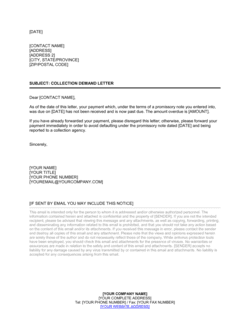
Demand for Payment on Installment Promissory Note Template

Free Word download β€’ Edit online β€’ Save & share with Drive β€’ Export to PDF

1 pageβ€’20–30 min to fillβ€’Difficulty: Standardβ€’Signature requiredβ€’Legal review recommended
Learn more ↓
FreeDemand for Payment on Installment Promissory Note Template

At a glance

What it is
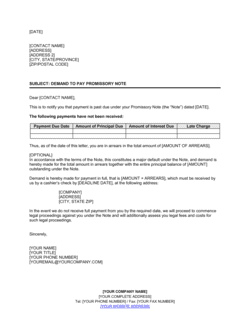
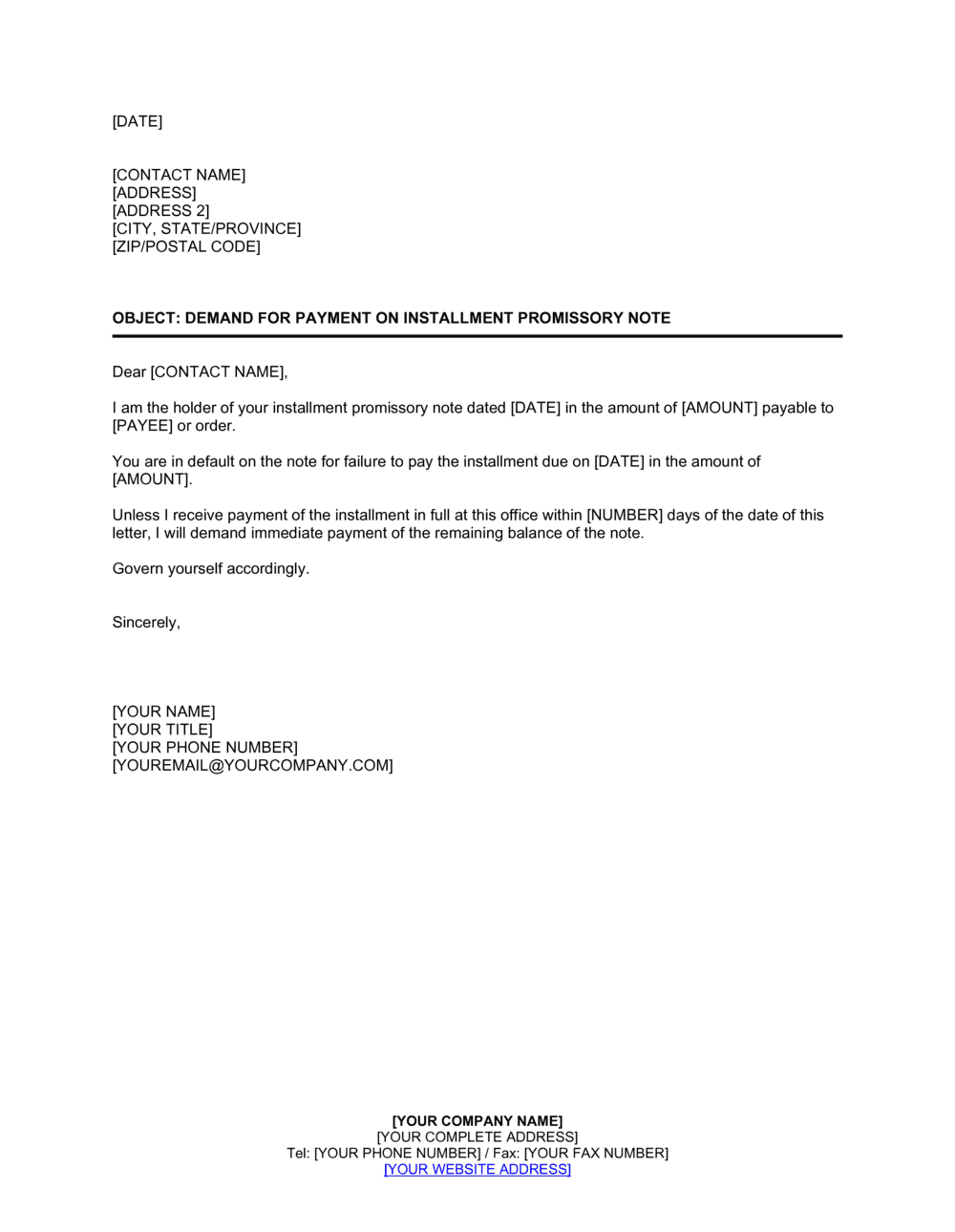
A Demand for Payment on Installment Promissory Note is a formal written notice a note holder (lender or creditor) sends to a borrower who has missed one or more scheduled installment payments. This free Word download lets you document the default, invoke the acceleration clause to call the entire remaining balance due, and set a firm deadline β€” all in a single legally structured letter you can edit online and export as PDF.
When you need it
Use it as soon as a borrower misses a payment and the cure period stated in the original promissory note has elapsed without remedy. Sending this demand is typically a contractual prerequisite before pursuing collections, filing suit, or enforcing collateral.
What's inside
Identification of both parties and the original note, a statement of the default and overdue amounts, invocation of the acceleration clause, calculation of the total balance now due including principal, accrued interest, and late fees, a firm payment deadline, and a warning of legal remedies if payment is not received.

What is a Demand for Payment on Installment Promissory Note?

A Demand for Payment on Installment Promissory Note is a formal legal notice sent by a note holder to a borrower who has defaulted on one or more scheduled installment payments under a written promissory note. It does more than remind the borrower of an overdue balance β€” it formally establishes the default on the record, invokes the note's acceleration clause to declare the entire remaining principal immediately due, and calculates the total amount owed including accrued interest and late fees as of the demand date. By setting a firm payment deadline and citing the consequences of non-payment, the letter satisfies the contractual notice requirements that most promissory notes impose before the holder may pursue legal remedies such as filing suit or enforcing collateral.

Why You Need This Document

Without a properly structured written demand, a note holder who moves directly to litigation or collections risks having the case dismissed β€” many courts require evidence of a formal demand and a reasonable opportunity to cure before they will hear a collection action. Beyond the procedural requirement, a vague or incomplete demand gives the borrower's attorney grounds to dispute the amount owed, challenge the acceleration, or argue that notice was never properly delivered β€” each of which can delay recovery by months and increase legal costs significantly. A clearly itemized, correctly delivered demand letter eliminates these procedural vulnerabilities, creates an unambiguous paper trail, and demonstrates the commercial good faith courts expect before a lender resorts to enforcement. This template provides the complete structure β€” parties, default statement, acceleration language, total-due calculation, payment deadline, and remedy warning β€” so you can act decisively the moment the cure period expires.

Which variant fits your situation?

If your situation is…Use this template
Borrower missed a single payment but the full balance is not yet being acceleratedPast Due Payment Reminder Letter
Borrower has defaulted and the full accelerated balance is now being demandedDemand For Payment On Installment Promissory Note
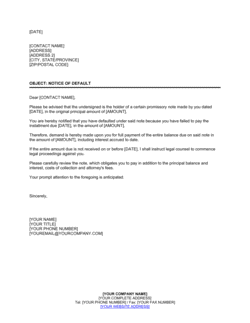
The promissory note is secured by real property and foreclosure may followNotice of Default on Secured Promissory Note
Borrower has not repaid a lump-sum (balloon) note on its maturity dateDemand For Payment On Promissory Note
Debt is disputed and you want to propose a settlement before litigationDebt Settlement Agreement
Borrower is unable to pay and you need to restructure the repayment scheduleLoan Modification Agreement
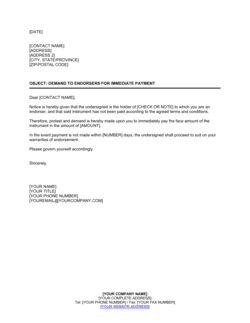
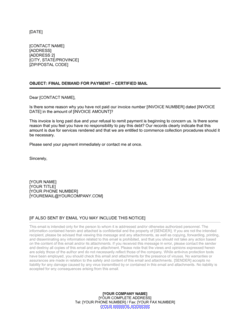
All collection efforts have failed and you are referring the debt to an attorney or agencyFinal Demand Letter

Common mistakes to avoid

❌ Sending the demand before the cure period expires

Why it matters: A premature demand violates the note's own terms, giving the borrower grounds to challenge the default and potentially triggering a counterclaim for wrongful acceleration.

Fix: Check the note for any grace or cure period language and calculate the exact expiration date before preparing the demand. Send only after that date has passed with no payment received.

❌ Failing to itemize each missed installment

Why it matters: A demand that states only a total overdue amount is easy for a borrower or their attorney to dispute β€” one contested figure can delay collection proceedings by months.

Fix: List every missed installment with its due date and amount in a table within the demand letter, then sum to the total. Attach the payment ledger as an exhibit.

❌ Using the wrong delivery method

Why it matters: If the note specifies certified mail and the demand is sent only by email, a court may find the demand was never legally delivered β€” requiring the entire notice process to restart.

Fix: Re-read the notice provision of the original note before sending. Match the delivery method exactly, and send by two methods (e.g., certified mail plus email) when the note permits either.

❌ Omitting the acceleration clause invocation

Why it matters: Without formal acceleration, only the currently overdue installments are legally collectible β€” future installments remain on their original schedule, forcing repeated demands.

Fix: Include explicit language invoking the note's acceleration clause and declaring the entire outstanding principal immediately due. Reference the clause number if the note is numbered.

❌ Overstating the interest or applying the wrong rate

Why it matters: Demanding more than is contractually owed β€” especially at a penalty rate the note does not authorize β€” can expose the note holder to usury claims or unfair debt collection challenges.

Fix: Apply the rate specified in the note for the relevant period. If a higher default rate applies post-default, confirm the note expressly states it and that the default has been properly established.

❌ Not retaining proof of delivery

Why it matters: Without documented proof that the demand was received, a borrower can claim they never got it β€” undermining the payment deadline and potentially voiding any subsequent legal action.

Fix: Use certified mail with a return receipt card, a courier with signature confirmation, or email with a read receipt. Save all delivery records in the borrower's file immediately.

The 9 key clauses, explained

Parties and note identification

In plain language: Identifies the note holder (creditor) and the borrower by full legal name and states the key details of the original promissory note β€” date, original principal amount, and maturity date.

Sample language
This Demand for Payment is made by [NOTE HOLDER FULL NAME] ('Holder') to [BORROWER FULL NAME] ('Borrower') with respect to that certain Installment Promissory Note dated [NOTE DATE], in the original principal amount of $[ORIGINAL PRINCIPAL], maturing on [MATURITY DATE] ('Note').

Common mistake: Referencing only a loan amount without citing the note date or parties precisely. If the borrower held multiple notes with the same lender, the demand becomes ambiguous and potentially unenforceable against the specific instrument.

Statement of default

In plain language: States the specific installment(s) the borrower failed to pay, the amount(s) due, and the date(s) on which payment was required under the note.

Sample language
Borrower has failed to make the installment payment of $[INSTALLMENT AMOUNT] due on [DUE DATE], and the following additional installments: [LIST MISSED PAYMENTS WITH DATES AND AMOUNTS]. As of the date of this Demand, the total overdue installments amount to $[TOTAL OVERDUE].

Common mistake: Stating only a total overdue figure without listing each missed installment separately. Courts and borrowers frequently challenge the accuracy of a lump-sum figure; an itemized list is far easier to defend.

Expiration of cure period

In plain language: Confirms that any cure or grace period provided by the note has elapsed without the borrower remedying the default, thereby entitling the holder to exercise remedies.

Sample language
The Note provides a cure period of [X] days following a missed payment. As of [DATE], the cure period for the payment(s) described above has expired without Borrower having made the required payment(s) or otherwise cured the default.

Common mistake: Sending the demand before the cure period has actually elapsed. Premature demands can be challenged as a breach of the note's own terms and may reset the default clock.

Acceleration of the full balance

In plain language: Formally invokes the note's acceleration clause, declaring the entire remaining unpaid principal immediately due and payable as of the demand date.

Sample language
Pursuant to the acceleration clause of the Note, Holder hereby declares the entire outstanding principal balance of $[OUTSTANDING PRINCIPAL] immediately due and payable as of the date of this Demand.

Common mistake: Omitting the acceleration clause invocation and demanding only the overdue installments. Without acceleration, future installments technically remain on their original schedule β€” recovering only arrears leaves the holder in the same position the next month.

Calculation of total amount due

In plain language: Provides a complete, itemized breakdown of the total sum demanded β€” outstanding principal, accrued interest calculated to the demand date, any late fees, and other permitted charges.

Sample language
The total amount due as of [DEMAND DATE] is calculated as follows: Outstanding Principal: $[X]; Accrued Interest at [RATE]% per annum from [DATE] to [DATE]: $[X]; Late Fees: $[X]; Other Charges: $[X]; TOTAL DUE: $[TOTAL AMOUNT].

Common mistake: Calculating interest to the wrong date or applying the wrong rate. If the note specifies a default interest rate higher than the standard rate, failing to apply it undercollects β€” but overstating it exposes the holder to usury claims.

Payment deadline

In plain language: Sets a firm date by which the borrower must pay the total amount due in full, typically 10 to 30 days from the demand date.

Sample language
Borrower must remit payment of the full amount of $[TOTAL AMOUNT] in immediately available funds on or before [DEADLINE DATE] ('Payment Deadline'), being [X] days from the date of this Demand.

Common mistake: Setting a deadline that is shorter than any minimum notice period required by the note itself or by applicable state or provincial law. Courts have dismissed collection actions where the demand gave less notice than the contract required.

Payment instructions

In plain language: Specifies exactly how and where the borrower must remit payment β€” wire transfer details, certified check payable to, or other accepted method β€” to leave no ambiguity.

Sample language
Payment must be made by wire transfer to: Bank: [BANK NAME]; Account Name: [NAME]; Account Number: [NUMBER]; Routing Number: [NUMBER]; Reference: Note dated [DATE]. Alternatively, a certified check payable to [NOTE HOLDER NAME] may be delivered to [ADDRESS].

Common mistake: Providing payment instructions in the cover email but not in the demand letter itself. The letter is the legally operative document β€” if it is printed, forwarded, or filed in court, the borrower's 'I didn't know how to pay' defense evaporates only if the instructions are in the letter.

Reservation of rights and legal remedies

In plain language: States that if the borrower fails to pay by the deadline, the note holder reserves all rights under the note and applicable law β€” including filing suit, seizing collateral, and recovering attorneys' fees.

Sample language
If Borrower fails to remit full payment by the Payment Deadline, Holder reserves all rights and remedies available under the Note and applicable law, including without limitation the right to commence legal proceedings, enforce any collateral security, and recover attorneys' fees and court costs as provided in the Note.

Common mistake: Promising a specific next action (e.g., 'we will file suit on [DATE]') in the demand letter. Committing to a specific remedy and then not following through can be used against the holder in subsequent litigation as evidence of waiver or bad faith.

Governing law and delivery

In plain language: States the jurisdiction whose law governs the demand and the note, and confirms the method and date of delivery to establish that the borrower received proper notice.

Sample language
This Demand is governed by the laws of [STATE / PROVINCE]. This Demand is delivered to Borrower by [certified mail / courier / email with read receipt] on [DATE] at the address specified in the Note: [BORROWER ADDRESS].

Common mistake: Sending the demand only by email when the note requires written notice by certified mail or courier. Delivery method defects can nullify the demand entirely and require the entire notice process to be restarted.

How to fill it out

  1. 1

    Gather the original promissory note and payment history

    Locate the signed promissory note and compile a full payment ledger showing every scheduled installment, the date each was due, the date each was received (if at all), and the amount paid. You will need these figures to complete the default statement and total-due calculation.

    πŸ’‘ If payments were made by check, match check dates β€” not clearing dates β€” to the scheduled due dates to accurately identify the first missed payment.

  2. 2

    Confirm the cure period has elapsed

    Review the note for any grace period or cure period language. Calculate the date on which the cure period expired. Do not send the demand until that date has passed and no payment has been received.

    πŸ’‘ Set a calendar reminder 2 days before the cure period expires so you can send the demand on day one of the holder's entitlement to act β€” waiting longer can inadvertently create an implied waiver argument.

  3. 3

    Identify the note holder and borrower precisely

    Use the exact legal names and addresses of both parties as they appear in the original note. If the note has been assigned, use the assignee's name as holder and attach a copy of the assignment.

    πŸ’‘ If the borrower is a business entity, confirm its current legal name and registered address β€” entities sometimes change names or dissolve, which affects where and how service must be made.

  4. 4

    Calculate the total amount due

    Add the outstanding principal balance, accrued interest calculated at the note's stated rate (or default rate, if applicable) from the last payment date to the demand date, and any contractual late fees. Show each component separately in the demand letter.

    πŸ’‘ Use a simple daily interest formula: (Principal Γ— Annual Rate Γ· 365) Γ— Number of Days. Document the calculation in a separate worksheet to attach if you proceed to litigation.

  5. 5

    Invoke the acceleration clause

    Insert explicit language calling the entire remaining principal due immediately. Reference the specific clause number or section of the note that grants this right, if one is numbered.

    πŸ’‘ Acceleration is a right, not an obligation β€” if you prefer to keep the installment schedule and pursue only the arrears, you can omit the acceleration clause and demand only the overdue amounts. Make a deliberate choice and be consistent.

  6. 6

    Set the payment deadline and instructions

    Choose a deadline that is no shorter than any minimum period stated in the note or required by law β€” 10 to 30 days is typical. Include complete wire transfer details or check delivery instructions in the body of the letter.

    πŸ’‘ Net 15 days (from confirmed delivery) is the most commonly enforced deadline in US collection demand practice. Net 10 is often challenged as insufficient notice for borrowers who need to arrange funds.

  7. 7

    Sign and deliver using the method required by the note

    The note holder or an authorized representative must sign the demand. Deliver it by the method specified in the note β€” typically certified mail with return receipt, courier, or (if permitted) email with a read receipt. Retain proof of delivery.

    πŸ’‘ Send the demand by both certified mail and email simultaneously to create a redundant delivery record. Courts accept either as evidence of notice, and dual delivery eliminates 'I never received it' defenses.

  8. 8

    Document everything and set a follow-up date

    Save signed copies of the demand letter, proof of delivery, and your interest calculation worksheet. Docket the payment deadline date and assign responsibility for reviewing whether payment is received.

    πŸ’‘ If no payment is received by the deadline, consult a collections attorney immediately β€” delay after a valid demand can sometimes be construed as accepting a new informal payment arrangement.

Frequently asked questions

What is a demand for payment on an installment promissory note?

A demand for payment on an installment promissory note is a formal written notice from a lender or note holder to a borrower who has missed one or more scheduled installment payments. It documents the default, invokes the note's acceleration clause to call the entire remaining balance immediately due, itemizes the total amount owed including principal, accrued interest, and fees, and sets a firm payment deadline. It is typically a contractual prerequisite before the holder may pursue legal remedies.

When should I send a demand for payment letter on a promissory note?

Send the demand after the borrower has missed a scheduled installment and any cure or grace period specified in the note has elapsed without remedy. Sending too early β€” before the cure period expires β€” can be challenged as a breach of the note's own terms. Most notes provide a 10- to 30-day cure window. Waiting longer than necessary after the period expires can be construed as an implied waiver of the default.

Does a demand letter on a promissory note need to be signed?

Yes. The demand should be signed by the note holder or an authorized representative of the holding entity. An unsigned demand may be challenged as an informal communication rather than a formal legal notice. If an attorney is sending the demand on behalf of the holder, the attorney's signature is generally sufficient in most jurisdictions.

What is an acceleration clause, and do I need to invoke it?

An acceleration clause allows the note holder to declare the entire unpaid principal balance immediately due upon default β€” rather than waiting for each remaining installment to come due individually. Invoking it is optional but generally advisable: without acceleration, you can only collect overdue installments, leaving future payments on their original schedule and requiring repeated demands. If the note contains an acceleration clause, explicitly invoking it in the demand letter is the most efficient collection posture.

What should the demand letter include to be legally effective?

At minimum, the demand should identify both parties and the specific note by date and original principal amount, describe the default with each missed installment itemized, confirm the cure period has elapsed, invoke the acceleration clause, provide a precise total-due calculation broken down by principal, interest, and fees, set a specific payment deadline, include payment instructions, and state the remedies the holder will pursue if payment is not received. Missing any of these components weakens the demand and may require a corrected notice to be sent.

How long should the payment deadline in the demand letter be?

The deadline must be no shorter than any minimum notice period stated in the promissory note or required by applicable law in the borrower's jurisdiction. In practice, 10 to 30 days from confirmed delivery is the standard range for US collection demands. Net 15 days is the most commonly used deadline. A deadline of fewer than 10 days is frequently challenged as commercially unreasonable unless the note expressly authorizes it.

Is a demand for payment letter required before filing a lawsuit?

In many jurisdictions and under most promissory notes, yes β€” the note itself typically requires a written demand and a reasonable opportunity to cure before the holder may sue. Even where not contractually required, sending a formal demand is strongly advisable because courts expect creditors to have made reasonable efforts to resolve the debt before resorting to litigation. Some states also have pre-litigation notice requirements for certain loan types.

Can I send a demand for payment by email?

Only if the original promissory note expressly permits notice by email. Many older notes specify certified mail as the required delivery method. Sending by email when the note requires certified mail can invalidate the demand. Best practice is to send by the method the note requires and also by email as a secondary channel, retaining proof of both deliveries.

What happens if the borrower ignores the demand letter?

If the borrower does not pay or respond by the deadline, the note holder may proceed to file a civil lawsuit to obtain a judgment, enforce any collateral security interest, refer the debt to a collections attorney or agency, or β€” in applicable jurisdictions β€” initiate non-judicial foreclosure if the note is secured by real property. A documented, properly delivered demand letter is a critical prerequisite for each of these remedies and strengthens the holder's position significantly.

How this compares to alternatives

vs Demand for payment on promissory note (lump-sum)

A demand on a lump-sum promissory note is used when the borrower failed to repay the entire principal on a single maturity date β€” there are no installments to itemize. The installment version must account for multiple missed payments, an accrued-interest calculation over varying periods, and the acceleration of future installments that have not yet come due. Use the lump-sum version for balloon or demand notes; use this template for any note with a scheduled repayment plan.

vs Past due payment reminder letter

A past due reminder is an informal, non-accelerating notice sent shortly after a missed payment β€” it asks the borrower to catch up on arrears without declaring a formal default. A demand for payment on an installment note is a formal legal notice that invokes the default provisions of the note and accelerates the full balance. The reminder is appropriate in the first days after a missed payment; the demand is appropriate once the cure period has expired and you are preparing to enforce the note.

vs Debt settlement agreement

A debt settlement agreement is used when both parties agree to resolve the outstanding debt for less than the full amount owed β€” it is a negotiated resolution document, not a collection tool. A demand for payment calls the full balance due and preserves all remedies. If the borrower responds to the demand by proposing a settlement, a debt settlement agreement documents the agreed terms. The demand comes first; the settlement agreement follows if the parties negotiate rather than litigate.

vs Final demand letter

A final demand letter is a last-notice document sent after earlier collection efforts have failed β€” it signals that litigation or external collections are imminent. A demand for payment on an installment note is the first formal legal notice of default and acceleration. In a typical collection sequence, the installment note demand comes first; if the borrower still does not pay, a final demand letter escalates the urgency before the holder files suit.

Industry-specific considerations

Real estate and mortgage

Seller-financed transactions, land contracts, and private mortgage notes frequently use installment structures; a formal demand with acceleration is the required first step before foreclosure proceedings in most states.

Small business lending

Intercompany loans, owner-financed acquisitions, and business-to-business credit arrangements often use promissory notes; a written demand preserves the lender's priority and documents the default for accounting write-off purposes.

Professional services

Law firms, accounting practices, and consultancies sometimes accept promissory notes for deferred fees; a formal demand letter preserves the debt's character as a note obligation rather than a disputed invoice.

Financial services and private credit

Non-bank lenders, credit funds, and family offices holding portfolios of installment notes rely on standardized demand letters to trigger acceleration uniformly across their loan books and satisfy investor reporting requirements.

Jurisdictional notes

United States

Notice requirements vary by state β€” many states require a specific minimum cure period (commonly 10–30 days) before acceleration is permitted, and some states impose additional protections for residential mortgage notes. California, New York, and Texas each have specific statutory provisions governing notice of default on secured instruments. The Fair Debt Collection Practices Act (FDCPA) applies if the note holder is a third-party collector rather than the original lender, requiring specific disclosures in the demand letter.

Canada

Demand and notice requirements are governed provincially. Ontario's Limitations Act imposes a two-year basic limitation period from the date the demand is made, making timely delivery critical. Quebec civil law governs promissory note obligations differently from common-law provinces and may require specific formal notice procedures. For consumer credit agreements in most provinces, additional disclosure requirements under provincial consumer protection statutes may apply before acceleration is enforceable.

United Kingdom

Promissory notes are governed by the Bills of Exchange Act 1882, which imposes specific requirements on presentment and notice of dishonour for negotiable instruments. Consumer credit agreements regulated under the Consumer Credit Act 1974 require a formal Default Notice (Form CCA) with a minimum 14-day remedy period before the lender may accelerate or enforce. For business-to-business notes outside consumer credit regulation, contractual notice terms typically govern.

European Union

Promissory note enforcement is primarily governed by member state law, with no single EU-wide regime. The EU Consumer Credit Directive (2008/48/EC, updated by Directive 2023/2225) imposes mandatory pre-default notice and remedy periods for consumer loan agreements across member states. Germany requires a formal Mahnung (formal demand) before a debt is deemed in legal default. France distinguishes between instruments under private law (under seal) and notarial acts β€” notarially executed notes carry immediate enforceability without a court judgment.

Template vs lawyer β€” what fits your deal?

PathBest forCostTime
Use the templateNote holders with a straightforward default on a clearly documented installment note where the amount owed is uncontestedFree20–30 minutes
Template + legal reviewLarger balances (above $10,000), notes with complex default interest provisions, or borrowers likely to dispute the demand$150–$400 for a brief attorney review1–2 days
Custom draftedSecured notes with real property collateral, cross-border lending arrangements, or situations where litigation is already anticipated$500–$2,000+3–7 days

Glossary

Promissory Note
A written, signed promise by a borrower to repay a specific sum to a lender under defined terms β€” it is itself a negotiable instrument and creates a legally enforceable debt obligation.
Installment Note
A promissory note structured so the borrower repays the debt in scheduled periodic payments β€” typically monthly β€” rather than in a single lump sum at maturity.
Acceleration Clause
A provision in a promissory note or loan agreement that allows the lender to declare the entire remaining unpaid balance immediately due and payable upon the borrower's default.
Default
The borrower's failure to perform a material obligation under the note β€” most commonly, missing a scheduled payment by the date specified or within any grace period.
Cure Period
A contractually defined window of time β€” often 10 to 30 days β€” during which a borrower may correct a default before the lender exercises remedies.
Accrued Interest
Interest that has accumulated on the outstanding principal from the last payment date to the date of the demand, calculated at the note's stated interest rate.
Late Fee
A fixed charge or percentage of the missed payment amount that becomes due when the borrower fails to pay by the due date or within the grace period.
Principal Balance
The remaining unpaid original loan amount, excluding accrued interest and fees, owed by the borrower at the time of the demand.
Note Holder
The party currently entitled to receive payment under the promissory note β€” either the original lender or a subsequent assignee who acquired the note.
Demand Date
The date on which the note holder formally delivers the demand letter, from which the payment deadline and any post-demand interest calculation typically run.
Collateral
Property or assets pledged by the borrower to secure repayment of the note; the lender may seize or sell collateral if the borrower fails to pay after a valid demand.

Part of your Business Operating System

This document is one of 3,000+ business & legal templates included in Business in a Box.

  • Fill-in-the-blanks β€” ready in minutes
  • 100% customizable Word document
  • Compatible with all office suites
  • Export to PDF and share electronically

Create your document in 3 simple steps.

From template to signed document β€” all inside one Business Operating System.
1
Download or open template

Access over 3,000+ business and legal templates for any business task, project or initiative.

2
Edit and fill in the blanks with AI

Customize your ready-made business document template and save it in the cloud.

3
Save, Share, Send, Sign

Share your files and folders with your team. Create a space of seamless collaboration.

Save time, save money, and create top-quality documents.

β˜…β˜…β˜…β˜…β˜…

"Fantastic value! I'm not sure how I'd do without it. It's worth its weight in gold and paid back for itself many times."

Managing Director Β· Mall Farm
Robert Whalley
Managing Director, Mall Farm Proprietary Limited
β˜…β˜…β˜…β˜…β˜…

"I have been using Business in a Box for years. It has been the most useful source of templates I have encountered. I recommend it to anyone."

Business Owner Β· 4+ years
Dr Michael John Freestone
Business Owner
β˜…β˜…β˜…β˜…β˜…

"It has been a life saver so many times I have lost count. Business in a Box has saved me so much time and as you know, time is money."

Owner Β· Upstate Web
David G. Moore Jr.
Owner, Upstate Web

Run your business with a system β€” not scattered tools

Stop downloading documents. Start operating with clarity. Business in a Box gives you the Business Operating System used by over 250,000 companies worldwide to structure, run, and grow their business.

Start freeΒ Β·Β No credit card required