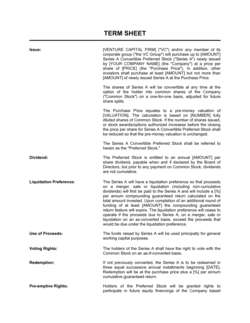
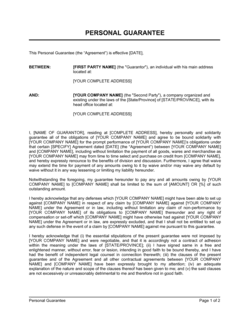
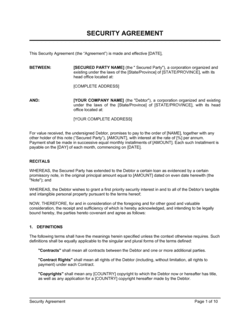
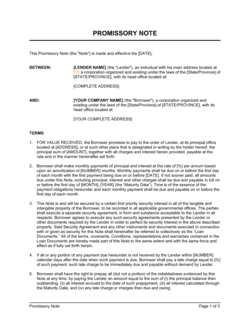
Promissory Note With Acknowledgment Template

Free Word download • Edit online • Save & share with Drive • Export to PDF

3 pages25–30 min to fillDifficulty: ComplexSignature requiredLegal review recommended
Learn more ↓
FreePromissory Note With Acknowledgment Template

At a glance

What it is
A Promissory Note With Acknowledgment is a legally binding written promise by one party (the maker) to repay a specified sum of money to another party (the payee) under agreed terms, accompanied by a formal notarized acknowledgment block that authenticates the signatures. This free Word download covers the full loan amount, interest rate, repayment schedule, default conditions, and acknowledgment clause — ready to edit online and export as PDF.
When you need it
Use it whenever one party lends money to another and both parties want a court-enforceable written record — including business loans between companies, owner loans to a corporation, shareholder loans, and inter-company advances where the lender requires a notarized instrument for recording or enforcement purposes.
What's inside
Parties and loan amount, interest rate and calculation method, repayment schedule, prepayment rights, default and acceleration clause, governing law, signature block, and a notary acknowledgment section that confirms the identities and voluntary execution of both parties.

What is a Promissory Note With Acknowledgment?

A Promissory Note With Acknowledgment is a legally binding written instrument in which the maker unconditionally promises to pay a specified sum of money to the payee — including principal, interest, and any applicable fees — according to a defined repayment schedule, with a formal notary acknowledgment block that certifies the signer's identity and confirms the note was executed voluntarily. Unlike a simple informal IOU or a basic loan memo, this document carries the full legal weight of a negotiable instrument under the Uniform Commercial Code in the US and equivalent statutes in other jurisdictions, meaning it can be transferred to third parties, filed with courts, and enforced against the maker's assets through summary proceedings in many states. The acknowledgment component elevates the note beyond a basic signed promise by creating an authenticated record that is difficult to repudiate and is accepted for recording in public registries.

Why You Need This Document

Operating without a written promissory note — even between trusted business partners or related entities — exposes the lender to a complete loss of legal standing if the borrower disputes the terms, denies the loan exists, or becomes insolvent. Courts require clear written evidence of the principal amount, interest rate, and repayment terms before entering a judgment in a collection action; an oral agreement or a bank wire confirmation alone rarely satisfies that standard. The acknowledgment block specifically closes the most common defense in note-enforcement litigation — the maker's claim that they did not sign the document — because a notary's certification of identity and voluntary execution is treated as presumptive proof that requires clear and convincing evidence to overcome. For inter-company loans, related-party advances, and private lending transactions, a properly structured promissory note also satisfies IRS documentation requirements, prevents the loan from being recharacterized as a taxable dividend or contribution, and gives both parties a clean audit trail. This template provides the complete structure — parties, rate, schedule, default, acceleration, waiver, and acknowledgment — in a format that is ready to sign and legally sound in most common-law jurisdictions.

Which variant fits your situation?

If your situation is…Use this template
Straightforward loan with no collateral securing repaymentUnsecured Promissory Note
Loan backed by real property or business assets as collateralSecured Promissory Note
Loan that may convert to equity at a future funding eventConvertible Promissory Note
Demand loan with no fixed repayment dateDemand Promissory Note
Business loan between two companies requiring full contract termsBusiness Loan Agreement
Personal loan between individuals with simple repayment termsPersonal Loan Agreement
Installment loan with equal monthly payments over a fixed termInstallment Promissory Note

Common mistakes to avoid

❌ Setting an interest rate above the usury ceiling

Why it matters: A rate that violates the applicable usury statute can render all interest unenforceable — or in some states void the entire note — leaving the lender with no return on the loan and potentially no right to collect at all.

Fix: Check the maximum permissible interest rate for business loans in the governing jurisdiction before drafting. For US federal law, confirm whether the National Bank Act preemption applies to your lender's charter type.

❌ Omitting a grace period before acceleration

Why it matters: Courts in several US states and in Canada have refused to enforce immediate-acceleration clauses triggered by a single missed payment, treating the result as an unconscionable forfeiture with no opportunity to cure.

Fix: Include a grace period of at least 5 business days after a missed payment before the acceleration right is triggered, and require written notice to the maker.

❌ Completing the notary acknowledgment block before the maker appears

Why it matters: A pre-filled acknowledgment is fraudulent and void, invalidating the notarization. Courts have dismissed collection actions based on a note with a defective acknowledgment, and the notary risks losing their commission.

Fix: Leave the acknowledgment block entirely blank until the maker physically appears before the notary, presents identification, and signs in the notary's presence.

❌ Using a trade name instead of the maker's full legal entity name

Why it matters: A note naming 'Acme Ventures' instead of 'Acme Ventures LLC, a Delaware limited liability company' creates an ambiguity about who is obligated to pay. If the maker disputes identity, enforcement proceedings stall while the court resolves the question.

Fix: Confirm the maker's exact registered legal name from a state corporate registry search and use it verbatim in the parties clause and the signature block.

❌ No prepayment clause

Why it matters: Without an explicit prepayment right, the lender may argue the maker is locked into the full payment schedule, and some jurisdictions support that position — preventing early payoff or triggering a make-whole penalty the maker did not expect.

Fix: Add an explicit prepayment clause stating whether prepayment is permitted without penalty, and specify how partial prepayments are applied (interest first, then principal).

❌ Describing repayment as 'monthly' without specifying the payment date and maturity date

Why it matters: Ambiguous repayment terms make it impossible to pinpoint the exact date a payment is overdue, giving the maker grounds to dispute when default occurred and delaying or defeating collection efforts.

Fix: State the specific day of the month payments are due (e.g., the 1st), the date of the first payment, and the final maturity date on which all remaining principal and interest must be paid.

The 10 key clauses, explained

Parties and loan amount

In plain language: Identifies the maker and payee by full legal name and address, and states the exact principal amount being borrowed.

Sample language
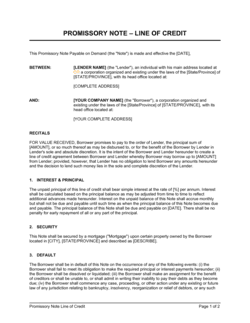
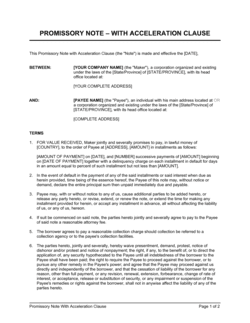
FOR VALUE RECEIVED, [MAKER FULL LEGAL NAME] ('Maker'), located at [MAKER ADDRESS], promises to pay to the order of [PAYEE FULL LEGAL NAME] ('Payee'), located at [PAYEE ADDRESS], the principal sum of [DOLLAR AMOUNT] ([WRITTEN AMOUNT] DOLLARS).

Common mistake: Using a trade name or nickname instead of the maker's or payee's full legal name. A note payable to 'ABC Ventures' instead of 'ABC Ventures LLC, a Delaware limited liability company' creates an ambiguity that can delay enforcement or court filing.

Interest rate

In plain language: States the annual interest rate, whether it is fixed or variable, and how interest is calculated — simple or compound, and the day-count convention used.

Sample language
This Note shall bear interest on the outstanding principal at the rate of [INTEREST RATE]% per annum, calculated on the basis of a 365-day year, from the date of this Note until paid in full.

Common mistake: Setting an interest rate without checking the jurisdiction's usury ceiling. Many US states cap rates on business loans between 10% and 25% per annum; exceeding the cap can render the interest — or the entire note — unenforceable.

Repayment schedule

In plain language: Defines when and how payments must be made — lump sum at maturity, monthly installments, or interest-only with a balloon — and specifies the maturity date.

Sample language
Maker shall repay this Note in [NUMBER] equal monthly installments of $[AMOUNT] each, commencing on [FIRST PAYMENT DATE] and continuing on the [DAY] of each month thereafter, with the final installment due on [MATURITY DATE].

Common mistake: Stating 'monthly payments' without specifying the day of the month and the maturity date. Ambiguous timing makes it impossible to determine when default has occurred and gives the maker room to dispute the due date.

Prepayment

In plain language: States whether the maker may repay all or part of the loan early and whether a prepayment penalty applies.

Sample language
Maker may prepay all or any part of the outstanding principal at any time without penalty. Any partial prepayment shall be applied first to accrued interest and then to the outstanding principal balance.

Common mistake: Omitting the prepayment clause entirely. Without it, some jurisdictions apply a default rule that the lender can refuse early repayment or demand a make-whole premium, which surprises both parties.

Default and acceleration

In plain language: Defines what constitutes a default, any grace period, and the lender's right to declare the full outstanding balance immediately due upon default.

Sample language
If Maker fails to make any payment within [NUMBER] days of the due date, or if Maker becomes insolvent or files for bankruptcy protection, Payee may declare the entire unpaid principal balance and all accrued interest immediately due and payable without further notice.

Common mistake: No grace period before acceleration. Courts in several jurisdictions have refused to enforce immediate-acceleration clauses applied after a single missed payment where no cure period was provided, treating it as an unreasonable forfeiture.

Late charges

In plain language: Sets a fixed or percentage penalty applied to any payment not received by a specified number of days after the due date.

Sample language
If any payment is not received within [NUMBER] days of its due date, Maker shall pay a late charge equal to [X]% of the overdue payment amount, not to exceed $[CAP] per occurrence.

Common mistake: Setting a late charge so high it is characterized as a penalty rather than a genuine pre-estimate of loss. Courts may refuse to enforce punitive late fees and can reduce or void them, leaving the lender with no late-payment remedy at all.

Costs of collection and attorney's fees

In plain language: Entitles the payee to recover reasonable attorney's fees and court costs if legal action is required to collect on the note.

Sample language
In the event of default, Maker agrees to pay all costs of collection, including reasonable attorney's fees actually incurred by Payee in enforcing this Note, whether or not litigation is commenced.

Common mistake: Using a one-sided fee clause in a jurisdiction that requires mutuality. California and several other states convert unilateral fee clauses into mutual obligations by statute, exposing the lender to the borrower's fees if the lender loses.

Governing law and jurisdiction

In plain language: Specifies which state's or country's law governs the note and where any legal proceedings must be brought.

Sample language
This Note shall be governed by and construed in accordance with the laws of the State of [STATE], without regard to its conflict-of-law principles. Maker consents to personal jurisdiction in [COUNTY], [STATE].

Common mistake: Choosing a governing law with no connection to either party's location. Courts will sometimes disregard a chosen law that has no reasonable relationship to the transaction, especially in consumer lending contexts.

Waiver of presentment and demand

In plain language: The maker gives up the right to require the payee to formally demand payment or present the note before the payee can declare default or sue.

Sample language
Maker hereby waives presentment for payment, demand, notice of demand, protest, and notice of dishonor, and consents to any extension of time for payment or other modification without affecting Maker's liability under this Note.

Common mistake: Omitting this clause and then relying on informal demand via email. Without a waiver, failure to make formal presentment in jurisdictions that require it can bar enforcement of the note entirely.

Notary acknowledgment block

In plain language: A formal certification completed and signed by a notary public confirming the date, location, and voluntary execution of the note by the identified maker.

Sample language
STATE OF [STATE] | COUNTY OF [COUNTY] | On [DATE], before me, [NOTARY NAME], a Notary Public, personally appeared [MAKER NAME], known to me (or proved to me on the basis of satisfactory evidence) to be the person whose name is subscribed above, and acknowledged to me that they executed this Note freely and voluntarily. NOTARY SIGNATURE: __________ | Commission Expires: [DATE]

Common mistake: Having the notary complete the acknowledgment in advance, before the maker actually appears and signs. Pre-filled acknowledgment blocks are fraudulent, void the notarization, and can expose both parties to criminal liability for false certification.

How to fill it out

  1. 1

    Enter the parties' full legal names and addresses

    Use the maker's and payee's complete registered legal names — individual or entity — and current mailing addresses. For business entities, include the entity type and state of formation.

    💡 If the maker is a business entity, confirm that the signatory has authority to bind the entity — a corporate resolution or operating agreement excerpt should be kept on file with the executed note.

  2. 2

    Set the principal amount and loan date

    Enter the exact dollar amount in both numerals and written words to prevent alteration disputes. Record the date the funds are or will be disbursed — this is the date from which interest begins accruing.

    💡 If funds are disbursed in tranches rather than a single advance, use a line-of-credit promissory note or attach a disbursement schedule as an exhibit.

  3. 3

    Define the interest rate and confirm it does not exceed the usury ceiling

    Enter the annual interest rate, specify whether it is fixed or variable, and state the day-count convention. Before finalizing, verify the maximum permissible rate for business loans in the governing jurisdiction.

    💡 For loans between related businesses or affiliates, the IRS Applicable Federal Rate (AFR) sets the minimum interest rate required to avoid imputed interest treatment under US tax law — check the current AFR before drafting.

  4. 4

    Complete the repayment schedule

    Choose a repayment structure — lump sum at maturity, equal monthly installments, interest-only with a balloon, or demand — and specify the first payment date, payment day of the month, and maturity date.

    💡 If you choose monthly installments, use the template's amortization table to verify that the payment amount actually retires the full principal plus interest by the maturity date.

  5. 5

    Set default, grace period, and acceleration terms

    Enter the number of days after a missed payment before default is declared (commonly 5–15 days), the events that trigger acceleration beyond missed payments (insolvency, bankruptcy, change of control), and any cure rights.

    💡 Include at least a 5-day grace period before acceleration to reduce the risk that a court will treat the clause as an unenforceable penalty in common-law jurisdictions.

  6. 6

    Choose the governing law and venue

    Select the state or country whose law governs the note and the county where any legal proceedings must be filed. Choose a jurisdiction where at least one party is located or the transaction is centered.

    💡 For multi-state transactions, the payee's state is generally preferable as governing law because the payee controls enforcement and litigates in a home court.

  7. 7

    Execute signatures before a notary public

    Both parties should sign in the presence of a licensed notary public who then completes the acknowledgment block with their commission details and official seal. The maker must appear in person before the notary.

    💡 Remote online notarization (RON) is now permitted in over 40 US states — confirm your state's RON statute before scheduling a remote session, and retain the audio-video recording required by most RON laws.

Frequently asked questions

What is a promissory note with acknowledgment?

A promissory note with acknowledgment is a written, signed promise by a borrower to repay a specific sum of money to a lender under defined terms — interest rate, repayment schedule, and default conditions — with an added notary acknowledgment block that formally certifies the identity of the signer and confirms voluntary execution. The acknowledgment makes the note eligible for recording in public records and strengthens its enforceability in court.

What is the difference between a promissory note and a loan agreement?

A promissory note is a relatively concise negotiable instrument — the maker's unconditional promise to pay. A loan agreement is a fuller bilateral contract that also covers the lender's obligations, conditions for disbursement, representations and warranties, covenants, and events of default in greater detail. For straightforward business loans, a promissory note is often sufficient; for larger or more complex financings, a loan agreement paired with a note is standard practice.

Is a notarized promissory note more enforceable than an unnotarized one?

In most US jurisdictions, a promissory note does not need to be notarized to be legally binding — the maker's signature is generally sufficient. However, the notary acknowledgment adds a layer of authentication that makes it harder for the maker to later claim they did not sign the note, satisfies recording requirements in many states, and is required for certain secured transactions and real estate loans. Notarization is particularly important when the note may need to be filed with a court or recorder's office.

What interest rate should I use in a promissory note?

The rate depends on the nature of the loan and applicable law. For business loans in the US, market rates typically range from 5% to 15% per annum depending on creditworthiness and term. The rate must not exceed the usury ceiling in the governing state — which varies widely, from 10% in California for non-bank lenders to higher caps in states like Delaware and New York for business loans. For loans between related parties or affiliates, the IRS Applicable Federal Rate sets the minimum rate to avoid imputed interest treatment under US tax law.

Can a promissory note be transferred to another party?

Yes — a promissory note is generally a negotiable instrument under Article 3 of the Uniform Commercial Code in the US, meaning the payee can endorse and transfer it to a third party (called a holder). A party who acquires the note in good faith, for value, and without notice of defects becomes a holder in due course and generally takes it free of defenses the maker could have raised against the original lender. To restrict transferability, include a non-negotiable or non-assignable clause.

What happens if the maker defaults on a promissory note?

Upon default, the payee typically has the right to declare the full outstanding balance immediately due and payable under the acceleration clause, pursue legal action to obtain a judgment, and then enforce that judgment against the maker's assets — bank accounts, receivables, or property. If the note is secured, the lender can also foreclose on or repossess the collateral. Collection proceedings timelines vary by jurisdiction, but a notarized note with clear default and acceleration language significantly speeds up the court process.

Do I need a lawyer to draft a promissory note?

For routine business loans between established entities with straightforward terms, a high-quality template is generally sufficient. Legal review is advisable when the loan exceeds $100,000, when collateral is involved, when the note may be convertible to equity, when the parties are in different jurisdictions, or when the maker is an individual rather than a business entity. A lawyer reviewing a promissory note typically takes 1–2 hours and costs $200–$500.

What is an acceleration clause and why does it matter?

An acceleration clause allows the lender to demand the entire remaining loan balance immediately upon a triggering event — typically a missed payment, bankruptcy filing, or breach of a covenant. Without one, a lender can only sue for missed installments as they fall due, not for the full outstanding balance. Including a well-drafted acceleration clause is one of the most important protections a lender can have, provided it includes a reasonable grace period and written-notice requirement.

How does a promissory note interact with a security agreement or mortgage?

A promissory note records the debt obligation and the promise to repay. A security agreement (for personal property) or mortgage/deed of trust (for real property) records the collateral that secures the debt. Both documents are typically executed together for secured loans — the note references the security agreement, and the security agreement references the note. The note alone is an unsecured obligation; without the security agreement, the lender's claim ranks equally with unsecured creditors in a bankruptcy or insolvency proceeding.

How this compares to alternatives

vs Loan Agreement

A loan agreement is a bilateral contract covering both the lender's and borrower's obligations in detail — covenants, representations, conditions precedent, and events of default — and is typically 10–30 pages. A promissory note is a concise negotiable instrument focused on the borrower's payment promise. For loans above $500K or those with collateral and conditions, a loan agreement paired with a note is standard; for simpler advances, the note alone is usually sufficient.

vs IOU

An IOU is an informal written acknowledgment of a debt — typically a single sentence with no repayment schedule, interest rate, or default terms. It is rarely enforceable in a meaningful way. A promissory note is a formal negotiable instrument with legal structure that courts recognize and enforce, making it the appropriate choice for any loan where repayment is not certain to happen voluntarily.

vs Demand Promissory Note

A demand note has no fixed maturity date — the lender can call the full balance at any time with notice. A promissory note with a fixed repayment schedule gives the borrower certainty about payment dates and prevents surprise acceleration. Demand notes are appropriate for revolving credit or informal short-term advances; fixed-schedule notes are better suited to loans with a defined business purpose and planned repayment source.

vs Convertible Note Term Sheet

A convertible note is a promissory note that includes a mechanism for the principal to convert to equity at a future financing event, typically at a discount to the next round's price. A standard promissory note is a pure debt instrument with no equity component. Use a convertible note when the lender expects upside participation in a startup's growth; use a standard note when the lender wants a fixed return and no ownership stake.

Industry-specific considerations

Real estate

Promissory notes in real estate transactions are almost always notarized to satisfy recording requirements and are paired with a deed of trust or mortgage securing the loan against the property.

Private lending and finance

Private lenders rely on acknowledged promissory notes as standalone enforceable instruments for business-purpose loans that fall outside regulated banking channels, where a full loan agreement would be disproportionate to the deal size.

Technology and startups

Early-stage companies frequently use promissory notes to document bridge loans and convertible debt from angel investors, with the acknowledgment block satisfying diligence requirements for subsequent institutional investors reviewing the cap table.

Professional services

Law firms, accounting practices, and consulting firms use promissory notes to formalize partner buyouts, deferred compensation arrangements, and client financing plans where a notarized instrument strengthens enforceability without the cost of a full loan agreement.

Jurisdictional notes

United States

Promissory notes are governed by Article 3 of the Uniform Commercial Code (UCC) in all US states, which defines negotiability, transfer, and holder-in-due-course status. Usury limits vary dramatically by state — California caps non-bank lender rates at 10% for most loans, while Delaware imposes no ceiling on business-purpose loans. For related-party loans, the IRS Applicable Federal Rate establishes the minimum rate required to avoid imputed interest under IRC Section 7872.

Canada

Promissory notes in Canada are governed by the federal Bills of Exchange Act, which applies uniformly across all provinces. Interest rates must comply with the Criminal Code's 60% per annum maximum effective annual rate for all lenders. Quebec civil law applies a distinct framework for notes executed in that province, and French-language versions may be required for provincially regulated transactions. Notarization is not legally required for enforceability but is standard practice for notes involving real property.

United Kingdom

Promissory notes in the UK are governed by the Bills of Exchange Act 1882, which requires the note to be in writing, signed by the maker, and contain an unconditional promise to pay a fixed sum. There is no general statutory usury cap for business loans, but the Consumer Credit Act 1974 applies to loans to individuals and imposes unfair relationship provisions that courts can use to reopen oppressive terms. Notarization is not required for enforceability but may be needed if the note is to be used outside the UK.

European Union

There is no unified EU promissory note statute; each member state has its own negotiable instruments law derived from the 1930 Geneva Conventions on Bills of Exchange and Promissory Notes, which most EU members have ratified. Interest rate regulation varies by country — France and Germany impose usury ceilings benchmarked to central bank reference rates, while other member states are more permissive for business loans. GDPR considerations apply to the extent the note contains personal data of an individual maker that is processed or stored by the lender.

Template vs lawyer — what fits your deal?

PathBest forCostTime
Use the templateStandard business loans under $100,000 between established entities with simple fixed repayment termsFree20–30 minutes
Template + legal reviewLoans above $100,000, cross-border transactions, related-party loans with IRS rate implications, or deals involving collateral$200–$5001–3 days
Custom draftedComplex secured financings, convertible instruments, syndicated loans, or notes intended for securitization or public recording$1,000–$5,000+1–3 weeks

Glossary

Maker
The party who signs the promissory note and promises to repay the loan — also called the borrower or obligor.
Payee
The party to whom the loan is owed and to whom repayment must be made — also called the lender or holder.
Principal
The original sum of money lent, before interest or fees are added.
Acknowledgment
A formal declaration, typically made before a notary public, confirming that the signer executed the document voluntarily and is who they claim to be.
Acceleration Clause
A provision that makes the entire remaining loan balance immediately due and payable upon a triggering event, such as a missed payment or breach of terms.
Default
Failure by the maker to meet any obligation under the note — most commonly missing a scheduled payment — which triggers the lender's remedies.
Usury
Charging an interest rate that exceeds the maximum rate permitted by law in the applicable jurisdiction — making the excess interest unenforceable or the note voidable.
Amortization
The process of spreading loan repayment across equal periodic payments that cover both principal and interest, so the balance reaches zero at maturity.
Notary Public
A state- or government-commissioned official authorized to witness signatures, administer oaths, and certify that a document was signed voluntarily by the identified parties.
Recourse
The lender's legal right to pursue the borrower's personal or business assets beyond the collateral in the event of default — as opposed to a non-recourse note where recovery is limited to the pledged collateral.
Holder in Due Course
A party who acquires a negotiable promissory note in good faith, for value, and without notice of defects — generally taking the note free of most defenses the maker could raise against the original payee.

Part of your Business Operating System

This document is one of 3,000+ business & legal templates included in Business in a Box.

  • Fill-in-the-blanks — ready in minutes
  • 100% customizable Word document
  • Compatible with all office suites
  • Export to PDF and share electronically

Create your document in 3 simple steps.

From template to signed document — all inside one Business Operating System.
1
Download or open template

Access over 3,000+ business and legal templates for any business task, project or initiative.

2
Edit and fill in the blanks with AI

Customize your ready-made business document template and save it in the cloud.

3
Save, Share, Send, Sign

Share your files and folders with your team. Create a space of seamless collaboration.

Save time, save money, and create top-quality documents.

★★★★★

"Fantastic value! I'm not sure how I'd do without it. It's worth its weight in gold and paid back for itself many times."

Managing Director · Mall Farm
Robert Whalley
Managing Director, Mall Farm Proprietary Limited
★★★★★

"I have been using Business in a Box for years. It has been the most useful source of templates I have encountered. I recommend it to anyone."

Business Owner · 4+ years
Dr Michael John Freestone
Business Owner
★★★★★

"It has been a life saver so many times I have lost count. Business in a Box has saved me so much time and as you know, time is money."

Owner · Upstate Web
David G. Moore Jr.
Owner, Upstate Web

Run your business with a system — not scattered tools

Stop downloading documents. Start operating with clarity. Business in a Box gives you the Business Operating System used by over 250,000 companies worldwide to structure, run, and grow their business.

Free Forever Plan · No credit card required