Movable Hypothec Promissory Note Template

Free Word download • Edit online • Save & share with Drive • Export to PDF

13 pages30–40 min to fillDifficulty: ComplexSignature requiredLegal review recommended
Learn more ↓
FreeMovable Hypothec Promissory Note Template

At a glance

What it is
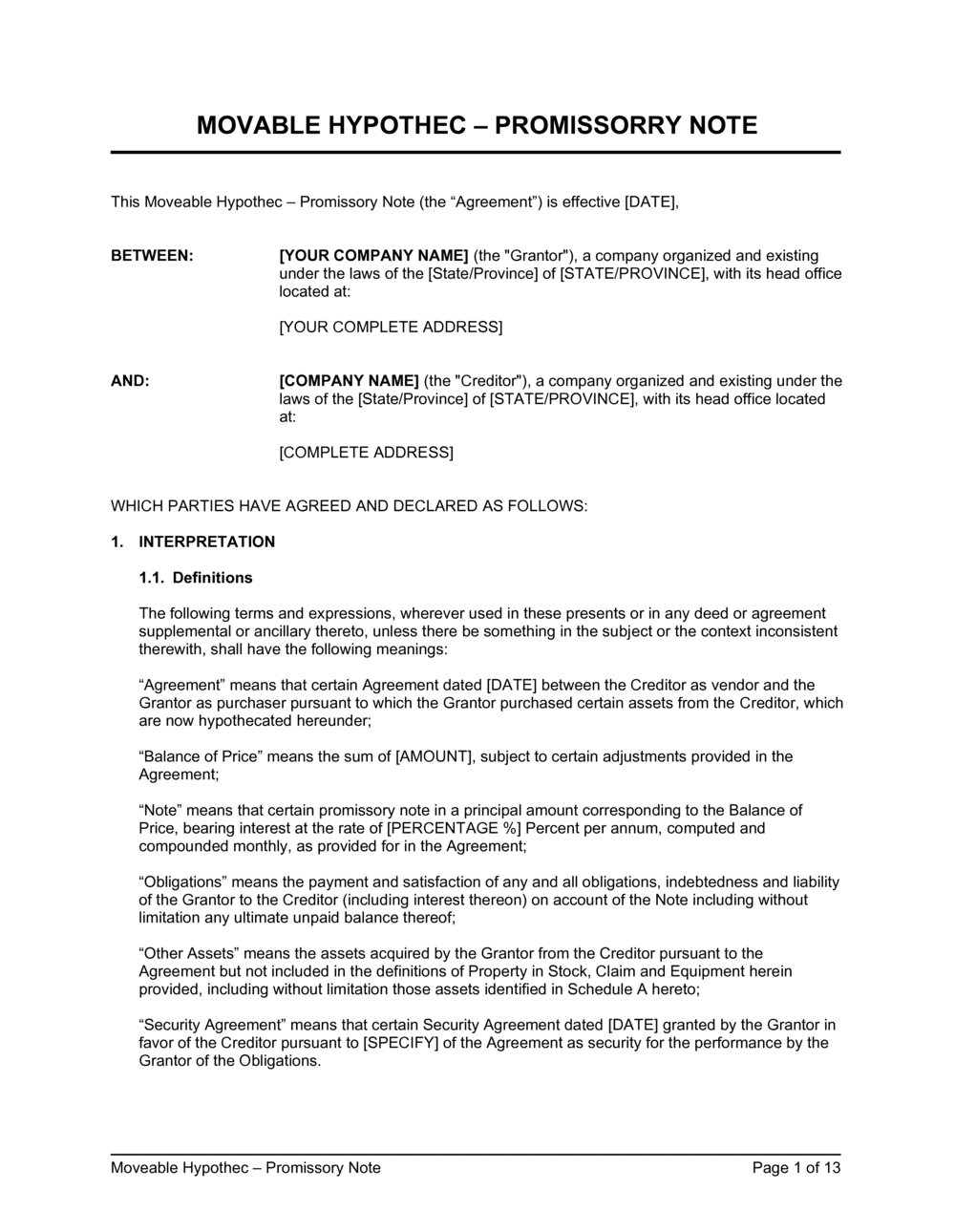
A Movable Hypothec Promissory Note is a legally binding instrument that combines a written promise to repay a loan with a security interest (hypothec) granted over the borrower's movable — that is, personal or non-real-estate — property. This free Word download gives lenders and borrowers a structured, attorney-informed starting point they can edit online and export as PDF, covering principal amount, interest rate, repayment schedule, collateral description, and enforcement rights in a single document.
When you need it
Use it when a lender advances funds to a borrower and requires a registered or unregistered security interest over movable assets — such as equipment, inventory, vehicles, accounts receivable, or intellectual property — as collateral for repayment. It is common in Quebec civil-law transactions, cross-border secured lending, and asset-based financing arrangements where real property is not available as security.
What's inside
Borrower and lender identification, principal amount and disbursement date, interest rate and calculation method, repayment schedule, collateral description and hypothec grant, representations and warranties, default and acceleration provisions, registration obligations, and governing law.

What is a Movable Hypothec Promissory Note?

A Movable Hypothec Promissory Note is a legally binding instrument that combines two distinct legal mechanisms into a single document: a promissory note — an unconditional written promise by a borrower to repay a specified sum with interest — and a movable hypothec — a civil-law security interest granted over the borrower's non-real-estate property as collateral for that repayment obligation. Rooted in Quebec's Civil Code and functionally similar to a secured promissory note under common-law systems, it gives the lender both a personal claim against the borrower and a real right against defined assets — equipment, inventory, vehicles, intellectual property, or receivables — that can be enforced through seizure or sale upon default. Unlike an unsecured note, it establishes a priority ranking against other creditors when registered in the applicable public registry, making it a foundational instrument in asset-based and private lending transactions.

Why You Need This Document

Advancing funds without a signed movable hypothec promissory note leaves a lender in a vulnerable position on multiple fronts simultaneously. Without the promissory note component, there is no clear, enforceable record of the repayment obligation — interest rate, payment schedule, and maturity date become matters of disputed recollection rather than contract. Without the hypothec component, the lender is an unsecured creditor: if the borrower becomes insolvent, secured creditors with registered interests recover first, and unsecured lenders typically receive cents on the dollar, if anything. Without registration, even a properly drafted hypothec may rank behind a later-registered competing security interest, stripping the lender of the priority they believed they held. For borrowers, the document provides equal certainty: agreed terms are fixed in writing, prepayment rights are documented, and there is no ambiguity about what assets are encumbered and on what conditions they can be released. This template provides a structured, attorney-informed starting point that addresses all of these risks — reducing drafting time, prompting the key decisions both parties must make before funds change hands, and ensuring the note is ready for registration from day one.

Which variant fits your situation?

If your situation is…Use this template
Securing a loan against real estate or immovable propertyImmovable Hypothec Promissory Note
Unsecured personal or business loan with no collateralPromissory Note
Securing a loan against a specific vehicleVehicle Security Agreement
Pledge of shares or securities as collateralShare Pledge Agreement
Ongoing revolving credit secured by accounts receivableRevolving Credit Agreement
Equipment lease with purchase option and security interestEquipment Lease Agreement
Multi-creditor syndicated secured loanLoan Agreement

Common mistakes to avoid

❌ Failing to register the hypothec before advancing funds

Why it matters: An unregistered security interest may rank behind a subsequently registered creditor, leaving the lender effectively unsecured in an insolvency — even if their note was signed first.

Fix: File the registration in the applicable registry on or before the disbursement date and retain a confirmed filing number as proof of priority.

❌ Describing collateral too narrowly

Why it matters: A hypothec covering only currently owned assets leaves any property acquired after signing outside the security, giving the lender no claim against the borrower's growing asset base.

Fix: Use 'all present and after-acquired' language for movable asset classes like inventory, equipment, and receivables, and update Schedule A as new high-value assets are acquired.

❌ Omitting a cure period in the default clause

Why it matters: Acceleration triggered by technical defaults — a missed payment cleared the next day — exposes the lender to bad-faith claims and can make enforcement proceedings unenforceable in court.

Fix: Build in a minimum 5-day cure period for payment defaults and 30 days for most covenant breaches, with written notice required before acceleration is triggered.

❌ Choosing a governing law that conflicts with the collateral's location

Why it matters: Enforcement rights against physical assets are governed by the law of the jurisdiction where those assets sit — a note governed by New York law cannot override Quebec's Civil Code enforcement rules for collateral located in Montreal.

Fix: Align the governing law with the primary jurisdiction where the collateral is located, or add a specific clause addressing multi-jurisdiction collateral separately.

❌ No board resolution for a corporate borrower

Why it matters: A corporate officer signing without proper board authorization may render the hypothec voidable as an ultra vires act, leaving the lender with an unenforceable security interest.

Fix: Require the borrower to deliver a certified copy of a board resolution specifically authorizing the loan and the hypothec grant before releasing funds.

❌ Silence on prepayment rights and penalties

Why it matters: Statutory prepayment rights in several jurisdictions allow borrowers to repay early without penalty — if the note does not address this, the lender cannot collect a break fee even if one was agreed verbally.

Fix: Address prepayment explicitly: either confirm the right without penalty or state a specific prepayment premium formula that the borrower acknowledges in writing at signing.

The 10 key clauses, explained

Parties and recitals

In plain language: Identifies the lender and borrower as legal entities, states the date of execution, and sets out the background purpose of the loan.

Sample language
This Movable Hypothec Promissory Note is entered into as of [DATE] between [LENDER LEGAL NAME], a [ENTITY TYPE] incorporated under the laws of [JURISDICTION] ('Lender'), and [BORROWER LEGAL NAME], a [ENTITY TYPE] ('Borrower').

Common mistake: Using a trade name instead of the registered legal entity name — enforcement proceedings require the exact legal name, and a mismatch can delay or void seizure of collateral.

Promise to pay (principal and interest)

In plain language: States the borrower's unconditional obligation to repay the principal amount plus interest at a specified rate, calculated on a defined basis.

Sample language
For value received, Borrower unconditionally promises to pay to the order of Lender the principal sum of $[AMOUNT] [CURRENCY], together with interest at the rate of [X]% per annum, calculated [monthly / daily] on the outstanding balance.

Common mistake: Omitting the interest calculation basis (daily vs. monthly compounding) — the difference can represent thousands of dollars over a multi-year term and becomes a source of dispute at maturity.

Repayment schedule

In plain language: Sets out when and how the borrower must repay — whether in equal instalments, a balloon payment, or on demand — and the currency of payment.

Sample language
Borrower shall repay the principal and accrued interest in [NUMBER] equal [monthly / quarterly] instalments of $[INSTALMENT AMOUNT], commencing [DATE], with the final instalment due on [MATURITY DATE]. All payments shall be made in [CURRENCY] to [PAYMENT ACCOUNT DETAILS].

Common mistake: Using 'on demand' language without also specifying a maximum term — in several jurisdictions, an undated demand note can be called immediately, which may not reflect the parties' intent and can trigger unintended default.

Hypothec grant and collateral description

In plain language: Creates the security interest by having the borrower grant the lender a hypothec over described movable property as collateral for the loan.

Sample language
As security for all amounts owing under this Note, Borrower hereby grants to Lender a hypothec on all present and future [DESCRIPTION OF COLLATERAL — e.g., equipment, inventory, accounts receivable] of Borrower, described in Schedule A, for the amount of $[HYPOTHEC AMOUNT] bearing interest at [X]% per annum.

Common mistake: Describing collateral too narrowly — for example, listing only currently owned equipment rather than 'all present and after-acquired equipment' — leaves newly purchased assets outside the security and creates gaps in the lender's protection.

Registration obligations

In plain language: Identifies which party is responsible for registering the hypothec in the applicable public registry and within what timeframe, to perfect the security interest and establish priority.

Sample language
Lender may, at Borrower's expense, register this hypothec in the [RPMRR / applicable PPSA registry / UCC filing office] within [X] business days of execution. Borrower shall execute all further documents and take all steps reasonably required to perfect and maintain such registration.

Common mistake: Failing to register at all or registering after advancing funds — an unregistered hypothec may rank behind subsequently registered creditors, leaving the lender unsecured in an insolvency.

Representations and warranties

In plain language: The borrower confirms that it owns the collateral free and clear of other encumbrances, has authority to grant the hypothec, and that no default or insolvency event has occurred.

Sample language
Borrower represents and warrants that: (a) it has good and marketable title to the Collateral, free of all liens and encumbrances except as disclosed; (b) it has full legal authority to grant this hypothec; and (c) no event of default or insolvency proceeding is pending or threatened.

Common mistake: Omitting a warranty that the collateral is free of prior encumbrances — if the borrower has already pledged the same assets to another lender, the new lender's security may be subordinate or worthless.

Events of default and acceleration

In plain language: Lists specific triggering events — missed payments, insolvency, breach of covenants, material adverse change — that allow the lender to declare the full outstanding balance immediately due.

Sample language
Each of the following constitutes an Event of Default: (a) failure to pay any amount due within [X] days of its due date; (b) Borrower becoming insolvent or subject to any bankruptcy or reorganization proceeding; (c) breach of any representation, warranty, or covenant herein; (d) any material adverse change in Borrower's financial condition.

Common mistake: Drafting an excessively broad material adverse change clause without a cure period — courts in several jurisdictions have refused to enforce acceleration triggered by ambiguous MAC definitions, rendering the clause ineffective.

Enforcement rights

In plain language: Specifies what the lender may do upon default — including seizing the collateral, selling it by private sale or public auction, or taking the property in payment — and the notice required before doing so.

Sample language
Upon an Event of Default, Lender may, after giving [X] days' prior written notice to Borrower, exercise any or all of the following remedies: (a) declare the entire outstanding balance immediately due; (b) seize and sell the Collateral by private sale or public auction; (c) take the Collateral in payment of all amounts owed, subject to applicable law.

Common mistake: No notice period before enforcement — most civil-law and common-law jurisdictions require minimum notice to the borrower before seizure; skipping it can void the enforcement proceeding entirely.

Prepayment

In plain language: States whether the borrower may repay the loan before maturity and whether a prepayment penalty applies.

Sample language
Borrower may prepay the outstanding principal balance, in whole or in part, upon [X] days' written notice to Lender, [without penalty / subject to a prepayment fee of [X]% of the amount prepaid].

Common mistake: Silence on prepayment — in Quebec and several other civil-law jurisdictions, a borrower may have a statutory right to prepay; failing to address this in the note leaves the lender unable to collect a prepayment premium.

Governing law and dispute resolution

In plain language: Specifies which jurisdiction's law governs the note and how disputes are resolved — courts, arbitration, or mediation.

Sample language
This Note is governed by the laws of [PROVINCE / STATE / COUNTRY]. Any dispute arising hereunder shall be submitted to the exclusive jurisdiction of the courts of [CITY / PROVINCE], except that Lender may seek injunctive or enforcement relief in any competent court.

Common mistake: Choosing a governing law that does not correspond to where the collateral is located — in rem enforcement rights are governed by the law of the jurisdiction where the asset physically sits, not necessarily the law governing the underlying note.

How to fill it out

  1. 1

    Enter the legal names of both parties

    Use the full registered legal names — not trade names or abbreviations — for both lender and borrower. Include the entity type (corporation, partnership, individual) and jurisdiction of incorporation.

    💡 Cross-check the borrower's name against a corporate registry search before executing — a name mismatch between the note and the registry filing can invalidate enforcement.

  2. 2

    State the principal amount, currency, and disbursement date

    Enter the exact loan amount in numerals and words, the currency, and the date funds will be advanced. If disbursement occurs in tranches, attach a disbursement schedule as an appendix.

    💡 For cross-border transactions, specify whether exchange rate fluctuations are absorbed by the borrower or fixed at the disbursement-date rate.

  3. 3

    Define the interest rate and calculation method

    Set the annual interest rate and specify whether it compounds daily or monthly. For variable rates, define the reference rate (e.g., prime + X%) and the reset frequency.

    💡 In Canada, criminal interest provisions cap the effective annual rate at 60% — confirm your all-in rate does not exceed this ceiling, including any fees.

  4. 4

    Set the repayment schedule

    Choose the payment structure — equal monthly instalments, quarterly payments, interest-only with balloon, or on-demand — and enter the first payment date and maturity date.

    💡 On-demand notes are callable immediately in most jurisdictions; use a fixed-term schedule unless you genuinely need demand repayment flexibility.

  5. 5

    Describe the collateral precisely

    Complete Schedule A with a specific description of the hypothecated movable property. For equipment, include make, model, serial number, and location. For floating charges over inventory or receivables, use 'all present and after-acquired' language.

    💡 The collateral description in the note must match what you register in the applicable public registry exactly — discrepancies can defeat priority claims.

  6. 6

    List the events of default and cure periods

    Review and customize the default triggers to match the transaction's risk profile. Set cure periods of 5–15 days for payment defaults and 30 days for covenant breaches, unless the risk warrants immediate acceleration.

    💡 For borrowers in regulated industries, add sector-specific default triggers — loss of a key licence or permit is a material event that standard templates may not capture.

  7. 7

    Confirm registration jurisdiction and assign responsibility

    Identify the correct registry — the RPMRR in Quebec, the applicable provincial PPSA registry elsewhere in Canada, or UCC Article 9 filings in the US — and confirm which party bears registration costs.

    💡 Registration must occur before or immediately after advancing funds; delay creates a window during which the borrower could grant a competing security to another lender.

  8. 8

    Execute before advancing funds

    Both parties must sign the note and any schedules before or on the date of disbursement. For corporate borrowers, obtain a board resolution authorizing execution alongside the signed note.

    💡 Notarization of the hypothec is required for enforcement without court proceedings in Quebec (acte authentique) — confirm with local counsel whether notarial form is needed for your transaction.

Frequently asked questions

What is a movable hypothec promissory note?

A movable hypothec promissory note is a single legal instrument that combines two functions: a promissory note (an unconditional written promise to repay a loan) and a hypothec (a civil-law security interest) granted over the borrower's movable — non-real-estate — property. It gives the lender both a personal obligation from the borrower and a real right against specific assets if the borrower defaults. The document is particularly common in Quebec and other civil-law jurisdictions, as well as cross-border transactions where movable assets serve as the primary collateral.

What is the difference between a hypothec and a mortgage?

A mortgage is a common-law security interest typically granted over real estate (immovable property). A hypothec is the civil-law equivalent but applies to both movable and immovable property. In Quebec, the hypothec is the primary security instrument for all types of collateral. In other Canadian provinces and in the US, the equivalent over movable property is a security interest governed by PPSA or UCC Article 9 — functionally similar but governed by different registration and enforcement rules.

Does a movable hypothec need to be registered to be enforceable?

Registration is not required for the hypothec to exist between the parties, but it is required to make the security interest enforceable against third parties — including other creditors, a trustee in bankruptcy, and a subsequent purchaser of the collateral. In Quebec, registration in the Register of Personal and Movable Real Rights (RPMRR) is necessary to perfect the hypothec and establish priority. In common-law provinces, registration under the applicable PPSA serves the same purpose. An unregistered hypothec is effectively unsecured in an insolvency.

What types of movable property can be hypothecated?

Virtually any movable asset can be hypothecated, including equipment and machinery, vehicles and fleets, inventory, accounts receivable, intellectual property (patents, trademarks, software), financial instruments, and claims against third parties. In Quebec, a hypothec can also be granted over a universality of movable assets — all present and future assets of a business — making it functionally similar to a general security agreement in common-law jurisdictions.

What happens when a borrower defaults on a movable hypothec promissory note?

Upon default, the lender must typically give advance written notice to the borrower before exercising enforcement rights. In Quebec, the Civil Code requires a 20-day prior notice before taking in payment or selling the collateral, except where the collateral is at risk of depreciation. The lender may then seize and sell the collateral by private sale or public auction, apply the proceeds to the outstanding debt, and pursue the borrower personally for any deficiency balance under the promissory note.

Is notarization required for a movable hypothec in Quebec?

In Quebec, a movable hypothec on an enterprise's assets can be created by a private document — notarization is not required for it to be valid between the parties. However, a hypothec granted by a natural person (not an enterprise) over certain classes of assets, or one intended to be enforced without court proceedings, may need to be executed before a notary as an authentic act. Consult a Quebec notary or lawyer to confirm which form is required for your specific transaction.

How is a movable hypothec promissory note different from a general security agreement?

A general security agreement (GSA) is a common-law instrument used in provinces outside Quebec and in the US to create a security interest over movable property under PPSA or UCC Article 9. A movable hypothec is the civil-law equivalent used primarily in Quebec under the Civil Code of Quebec. Both achieve similar commercial outcomes — securing a loan against personal property — but they differ in terminology, registration regimes, enforcement procedures, and the degree of judicial oversight required before enforcement. Cross-border lenders sometimes use both instruments when collateral spans Quebec and other provinces.

Who typically uses a movable hypothec promissory note?

Private lenders, equipment financing companies, and commercial banks use this document to secure loans against a business's movable assets. Small and medium-sized businesses use it when borrowing against equipment, inventory, or receivables without real estate to offer as security. Startups may use it to pledge intellectual property or future receivables as bridge financing collateral. It is also common in intercompany loans within corporate groups operating in Quebec.

Do I need a lawyer to prepare a movable hypothec promissory note?

For straightforward transactions with clearly identified collateral and a domestic borrower, a high-quality template provides a solid foundation. Legal review is strongly recommended when the loan exceeds $100,000, the collateral spans multiple jurisdictions, the borrower is a natural person (consumer protection rules apply), enforcement without court proceedings is anticipated, or the hypothec must be notarized for full effect in Quebec. A Quebec notary or commercial lawyer typically charges $500–$2,000 for a review and registration filing.

How this compares to alternatives

vs Promissory Note

A standard promissory note is an unsecured written promise to repay a loan — the lender has no claim against specific assets if the borrower defaults, only a personal obligation. A movable hypothec promissory note adds a security interest over defined collateral, giving the lender priority over that property in an insolvency. Use a simple promissory note only for low-risk, trust-based loans where collateral is unnecessary or unavailable.

vs Loan Agreement

A loan agreement is a comprehensive multi-party contract governing a lending relationship — it typically includes detailed covenants, representations, conditions precedent, and drawdown mechanics. A movable hypothec promissory note is a more streamlined instrument combining the payment obligation and security grant in one document. Loan agreements suit complex or syndicated facilities; a hypothec note suits bilateral secured loans where simplicity and enforceability are the priority.

vs General Security Agreement

A general security agreement (GSA) is the common-law equivalent of a movable hypothec, used in Canadian provinces outside Quebec and in the US under PPSA or UCC Article 9. The instruments achieve the same commercial outcome but differ in governing law, registration regime, and enforcement process. A movable hypothec is the correct instrument for Quebec-governed transactions; a GSA applies in Ontario, British Columbia, and other common-law provinces.

vs Equipment Lease Agreement

An equipment lease agreement transfers use — not ownership — of an asset to the lessee for a defined term in exchange for rental payments; the lessor retains title and repossesses the equipment on default. A movable hypothec note involves a true loan: the borrower owns the asset, grants a security interest to the lender, and must repay the principal plus interest. Use a lease when the borrower does not want to own the asset outright; use a hypothec note when the borrower is purchasing or already owns the collateral.

Industry-specific considerations

Manufacturing

Hypothecs over production equipment, machinery, and raw material inventory are standard collateral in equipment financing and working capital facilities for manufacturers.

Transportation and Logistics

Vehicle fleets, trailers, and logistics equipment are commonly hypothecated; lenders require VIN-level collateral descriptions and may register against each vehicle separately.

Technology / SaaS

IP assets — patents, trademarks, proprietary software, and domain names — are increasingly used as hypothec collateral for bridge loans and venture debt in tech companies.

Retail / Wholesale

Floating hypothecs over present and after-acquired inventory are standard for retailers and distributors; lenders require periodic inventory reports as a covenant condition.

Jurisdictional notes

United States

In the US, the functional equivalent of a movable hypothec is a security agreement governed by UCC Article 9. Perfection requires filing a UCC-1 financing statement with the Secretary of State in the borrower's state of organization. There is no concept of a 'hypothec' in US law, but the instrument is recognized for cross-border transactions involving Quebec-based borrowers. Usury laws vary by state — confirm the interest rate does not exceed the applicable cap.

Canada

The movable hypothec is a creature of Quebec's Civil Code (Articles 2660–2802 CCQ) and is the primary security instrument for movable property in that province. Registration in the RPMRR is required for perfection. Outside Quebec, the equivalent is a PPSA security interest filed in the applicable provincial registry. Cross-province transactions may require both a hypothec and a PPSA registration. Quebec's 20-day prior notice rule before enforcement (Article 2758 CCQ) is mandatory and cannot be contracted out of.

United Kingdom

England and Wales do not use the term 'hypothec' for movable property — the equivalent instruments are a fixed charge (over specific assets) or a floating charge (over a class of assets), typically contained in a debenture. Scottish law does recognize a limited form of hypothec over certain movable property. Charges granted by UK companies must be registered at Companies House within 21 days of creation under the Companies Act 2006 or they are void against liquidators and creditors.

European Union

Civil-law EU member states — France, Belgium, Luxembourg, and others — recognize movable hypothecs or functionally equivalent pledges (nantissement in France, gage in Belgium) under their respective civil codes. The EU Financial Collateral Directive (2002/47/EC) facilitates cross-border security over financial instruments and cash. Registration requirements, priority rules, and enforcement procedures vary significantly by member state; French loi Macron reforms in 2015 simplified movable security registration via the Registre national des sûretés mobilières (RNSM). GDPR considerations apply where borrower personal data is processed in connection with enforcement.

Template vs lawyer — what fits your deal?

PathBest forCostTime
Use the templateBilateral secured loans under $100,000 with clearly identified, single-jurisdiction movable collateralFree30–60 minutes
Template + legal reviewLoans over $100,000, Quebec notarization requirements, or collateral spanning multiple asset classes$500–$2,0002–5 business days
Custom draftedCross-border transactions, syndicated facilities, natural-person borrowers subject to consumer protection rules, or enforcement-without-court-proceedings anticipated$2,000–$8,000+1–3 weeks

Glossary

Hypothec
A civil-law security right granted over property — movable or immovable — that allows a creditor to seize and sell the property if the debtor defaults, without requiring physical possession.
Movable Property
Property that is not fixed to land — including equipment, vehicles, inventory, accounts receivable, intellectual property, and financial instruments.
Promissory Note
A written, unconditional promise by a borrower to repay a specified sum to a lender at a defined time or on demand, under stated interest and payment terms.
Principal Amount
The original sum of money lent, before interest or fees accrue.
Acceleration Clause
A provision that makes the entire outstanding loan balance immediately due and payable upon a defined event of default.
Registration (PPSA / CCQ)
The act of filing a security interest in a public registry — such as a provincial PPSA registry in Canada or the Register of Personal and Movable Real Rights (RPMRR) in Quebec — to establish priority over other creditors.
Default
Any borrower failure or breach — including missed payments, insolvency, or breach of a covenant — that triggers the lender's enforcement rights under the note.
Priority
The order in which competing secured creditors have claims against the same collateral, generally determined by the date of registration.
Collateral
The specific movable assets described in the hypothec grant over which the lender holds a security interest as repayment assurance.
Enforcement
The legal process — including seizure, sale, or taking in payment — by which a secured creditor realizes on collateral after a borrower's default.
Floating Charge
A security interest that attaches to a changing pool of assets — such as all present and after-acquired inventory — rather than specific identified items.
Subordination
An agreement by one creditor to rank its security interest behind that of another, allowing a senior lender to have first claim on collateral proceeds.

Part of your Business Operating System

This document is one of 3,000+ business & legal templates included in Business in a Box.

  • Fill-in-the-blanks — ready in minutes
  • 100% customizable Word document
  • Compatible with all office suites
  • Export to PDF and share electronically

Create your document in 3 simple steps.

From template to signed document — all inside one Business Operating System.
1
Download or open template

Access over 3,000+ business and legal templates for any business task, project or initiative.

2
Edit and fill in the blanks with AI

Customize your ready-made business document template and save it in the cloud.

3
Save, Share, Send, Sign

Share your files and folders with your team. Create a space of seamless collaboration.

Save time, save money, and create top-quality documents.

★★★★★

"Fantastic value! I'm not sure how I'd do without it. It's worth its weight in gold and paid back for itself many times."

Managing Director · Mall Farm
Robert Whalley
Managing Director, Mall Farm Proprietary Limited
★★★★★

"I have been using Business in a Box for years. It has been the most useful source of templates I have encountered. I recommend it to anyone."

Business Owner · 4+ years
Dr Michael John Freestone
Business Owner
★★★★★

"It has been a life saver so many times I have lost count. Business in a Box has saved me so much time and as you know, time is money."

Owner · Upstate Web
David G. Moore Jr.
Owner, Upstate Web

Run your business with a system — not scattered tools

Stop downloading documents. Start operating with clarity. Business in a Box gives you the Business Operating System used by over 250,000 companies worldwide to structure, run, and grow their business.

Start free · No credit card required