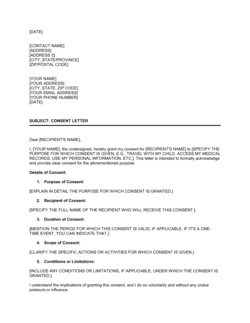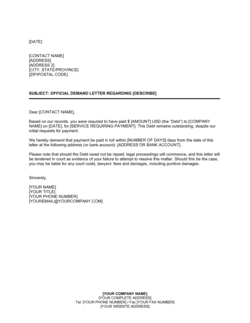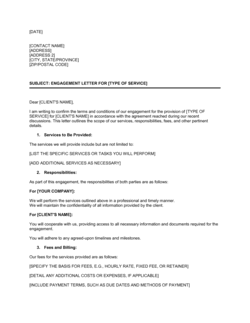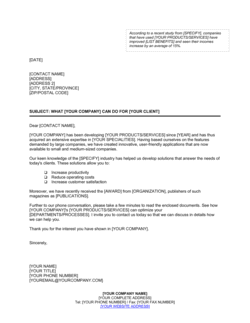
Acknowledgement Letter Template

Free Word download β€’ Edit online β€’ Save & share with Drive β€’ Export to PDF

1 pageβ€’15–20 min to fillβ€’Difficulty: Standard
Learn more ↓
FreeAcknowledgement Letter Template

At a glance

What it is
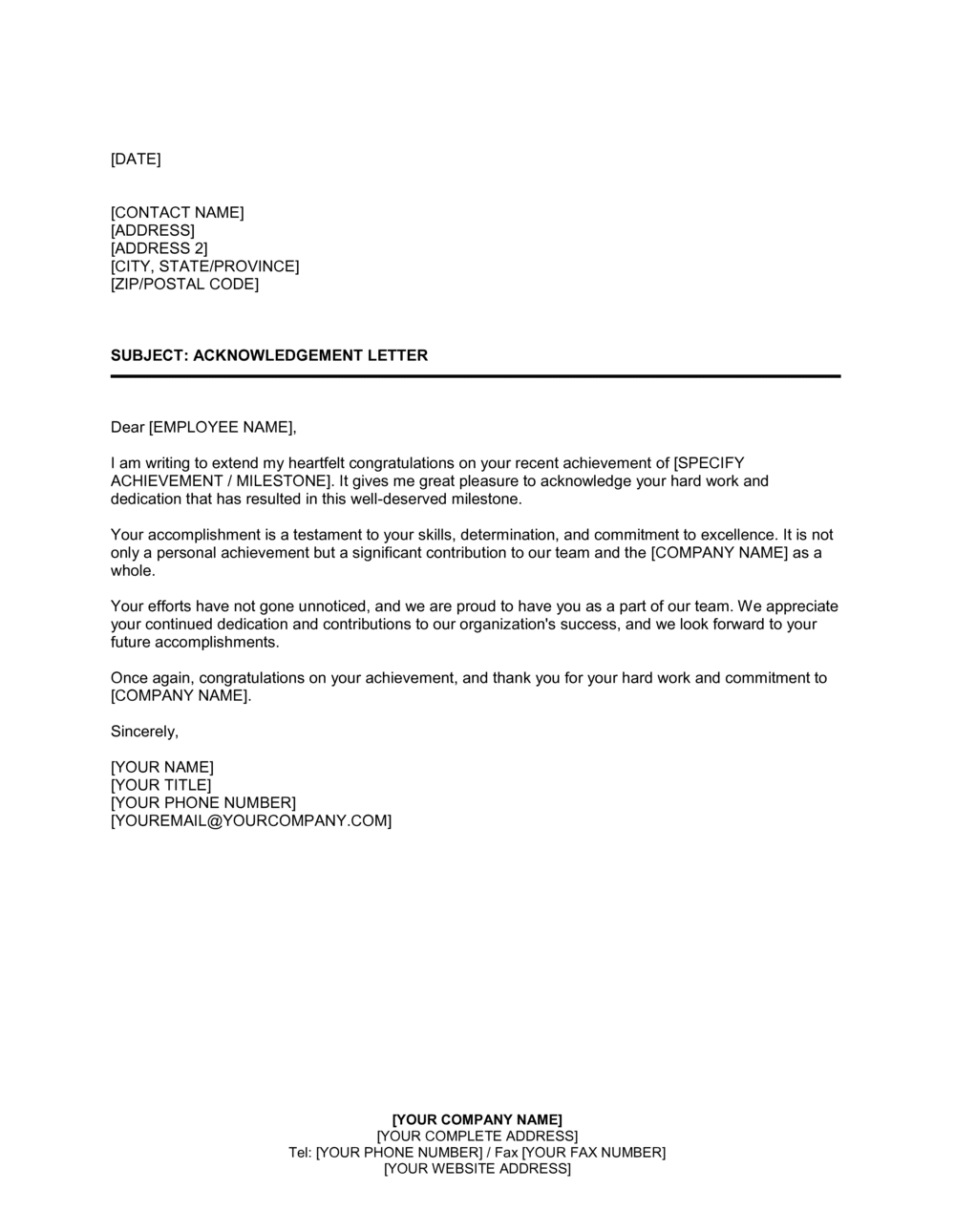
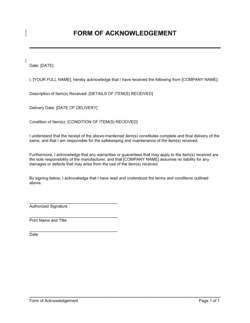
An Acknowledgement Letter is a formal business letter that confirms receipt of a document, payment, application, request, or other item from another party. This template is a free Word download you can edit online and export as PDF β€” covering sender details, recipient details, a clear confirmation statement, and any relevant next steps in a single concise document.
When you need it
Use it any time you need to formally confirm that something has been received β€” a job application, a payment, a complaint, a contract, or a business proposal. It protects both parties by creating a written record that the item arrived and was noted.
What's inside
Sender and recipient details, date, a subject line identifying what is being acknowledged, a clear confirmation statement, any relevant context or next steps, a professional closing, and a signature block.

What is an Acknowledgement Letter?

An Acknowledgement Letter is a formal business letter confirming that a document, payment, application, complaint, or other item has been received by the intended party. It names what was received, records the date of receipt, and β€” where relevant β€” outlines the next steps or expected timeline for a substantive response. Unlike a response letter, it does not provide a decision or answer; its sole purpose is to create a clear, dated written record that the submission arrived and was noted by the receiving organization.

Why You Need This Document

Without a formal acknowledgement letter, both parties are left to rely on verbal assurances or unreliable email threads as proof that something was received. This creates real problems: job applicants follow up repeatedly when they hear nothing; payment disputes escalate because there is no written record of when funds were acknowledged; legal notices go unaddressed because no one can prove they arrived. A prompt, well-formatted acknowledgement letter closes that gap in seconds β€” it protects the receiving organization by demonstrating timely response, and it protects the sender by providing documented proof of delivery. This template gives you a professional, ready-to-send format that takes under five minutes to complete for any routine acknowledgement your business needs to issue.

Which variant fits your situation?

If your situation is…Use this template
Confirming receipt of a job applicationJob Application Acknowledgement Letter
Acknowledging a customer complaint before resolutionComplaint Acknowledgement Letter
Confirming a payment or deposit has been receivedPayment Acknowledgement Letter
Acknowledging receipt of a signed contract or agreementContract Receipt Acknowledgement Letter
Confirming receipt of a resignation letterResignation Acknowledgement Letter
Acknowledging receipt of a business proposal or bidProposal Acknowledgement Letter
Formally acknowledging a notice or legal documentNotice Acknowledgement Letter

Common mistakes to avoid

❌ Vague description of what was received

Why it matters: A letter that says 'we have received your documents' without naming the specific item creates ambiguity β€” the sender cannot be certain the correct submission was noted.

Fix: Name the exact item, its date, and any reference number in the body of the letter. One sentence of specificity eliminates the ambiguity.
❌ Promising an unrealistic response deadline

Why it matters: Committing to a 3-day review when the actual process takes 2 weeks sets up a breach of the expectation you just created in writing.

Fix: State a realistic range β€” 'within 10 to 15 business days' β€” or make the timeline conditional: 'We will contact you within 5 business days to confirm next steps.'

❌ Sending to the wrong contact at the recipient's organization

Why it matters: An acknowledgement letter sent to the project manager instead of accounts payable or HR may never reach the file where it is needed, defeating its purpose as a formal record.

Fix: Confirm who should receive formal correspondence before sending. For payments, route to AP; for applications, route to HR; for legal notices, route to the named representative.

❌ Omitting a reference number

Why it matters: Without a reference number, both parties lose the ability to link the acknowledgement to the original item, especially if multiple submissions are in progress simultaneously.

Fix: Assign a reference number at the time of receipt and include it in the subject line and body. If the sender already provided one, use theirs.

The 8 key clauses, explained

Sender information and date

In plain language: The sender's name, title, organization, address, and the date the letter is issued.

Sample language
[SENDER NAME] | [TITLE] | [COMPANY NAME] | [ADDRESS] | [DATE]

Common mistake: Using an informal name or nickname instead of the sender's full legal name and title β€” this undermines the letter's credibility as a formal record.

Recipient details

In plain language: The full name, title, and address of the person or organization receiving the acknowledgement.

Sample language
[RECIPIENT NAME] | [TITLE] | [ORGANIZATION] | [ADDRESS]

Common mistake: Omitting the recipient's title or organization name, which can cause the letter to be misrouted or ignored by an accounts-payable or HR department.

Subject line

In plain language: A single line identifying exactly what is being acknowledged, including any reference numbers.

Sample language
Re: Acknowledgement of Receipt β€” [DOCUMENT/PAYMENT/APPLICATION TYPE], Reference No. [REF NUMBER]

Common mistake: Writing a vague subject line such as 'Re: Your correspondence.' A specific subject line allows both parties to file and retrieve the record instantly.

Opening acknowledgement statement

In plain language: The first paragraph that clearly states what was received and on what date.

Sample language
We are writing to confirm that we have received your [DOCUMENT/PAYMENT/APPLICATION] dated [DATE], submitted in connection with [MATTER/PROJECT/REFERENCE].

Common mistake: Burying the confirmation in the second paragraph. The acknowledgement should appear in the first sentence so the reader immediately understands the letter's purpose.

Description of the item received

In plain language: A brief, specific description of what was received β€” including any key details such as amount, document title, or application ID.

Sample language
The [DOCUMENT TITLE / PAYMENT AMOUNT OF $X / APPLICATION FOR POSITION OF [ROLE]] has been logged under reference number [REF NUMBER] and forwarded to [DEPARTMENT/TEAM] for review.

Common mistake: Using generic language like 'your documents' without specifying what was received β€” leaving both parties uncertain about whether the correct item was acknowledged.

Next steps or expected timeline

In plain language: A clear statement of what happens next and, where possible, the expected timeframe for a response or action.

Sample language
We will review [THE ITEM] and respond with our findings within [X] business days. Should we require additional information, we will contact you at [EMAIL/PHONE].

Common mistake: Promising a specific deadline the sender cannot meet. If the timeline is uncertain, state a realistic range rather than a firm date.

Contact information for follow-up

In plain language: The name, phone number, and email address of the person the recipient should contact with any questions.

Sample language
If you have any questions in the meantime, please do not hesitate to contact [CONTACT NAME] at [EMAIL ADDRESS] or [PHONE NUMBER].

Common mistake: Providing a general department inbox without a named contact. Recipients are more likely to follow up β€” and less likely to escalate β€” when they have a direct point of contact.

Complimentary close and signature block

In plain language: A professional sign-off followed by the sender's printed name, title, and organization.

Sample language
Yours sincerely, [SENDER NAME] | [TITLE] | [COMPANY NAME]

Common mistake: Closing with an overly casual phrase such as 'Thanks' or 'Best.' In a formal acknowledgement letter, 'Yours sincerely' (named recipient) or 'Yours faithfully' (unnamed recipient) maintains the professional tone.

How to fill it out

  1. 1

    Enter the sender's details and date

    Add your full name, job title, company name, and address at the top of the letter. Enter the date the letter is being sent, not the date the item was received.

    πŸ’‘ Save a pre-filled version with your company's standard letterhead so you only need to update the recipient and body for each new acknowledgement.

  2. 2

    Add the recipient's full details

    Enter the recipient's full name, title, and organization address. If the item came from an individual at a company, address the letter to that person directly.

    πŸ’‘ Double-check the recipient's name spelling β€” a misspelled name on a formal letter signals carelessness and can weaken the record's credibility.

  3. 3

    Write a specific subject line

    Identify exactly what is being acknowledged in the subject line, including any reference or case number issued by your organization or the sender's organization.

    πŸ’‘ Use the same reference number on all subsequent correspondence about the same matter β€” this creates a traceable file thread.

  4. 4

    State the acknowledgement clearly in the first paragraph

    Confirm receipt in the opening sentence, naming the item and the date it was received. Avoid preamble β€” get to the confirmation immediately.

    πŸ’‘ Include the date of receipt, not just the date of the letter. These can differ by several days for mailed documents.

  5. 5

    Describe what was received and what happens next

    Briefly identify the specific item received and state the next action β€” review, processing, forwarding to another team β€” and a realistic timeframe where possible.

    πŸ’‘ If the matter involves a regulated timeline (e.g., a complaint that must be acknowledged within 5 business days under consumer law), note that deadline explicitly.

  6. 6

    Provide a direct follow-up contact

    Name a specific person and provide their email and phone number for any questions. Avoid routing the recipient to a general department inbox.

    πŸ’‘ If the named contact changes before the matter is resolved, send a brief follow-up letter updating the recipient on who to contact.

  7. 7

    Proofread and send on company letterhead

    Review the letter for spelling, correct dates, and accurate reference numbers. Send on official company letterhead β€” either printed and mailed, or as a PDF exported from the template.

    πŸ’‘ Retain a date-stamped copy of every acknowledgement letter in the relevant file. It is your proof that you responded promptly.

Frequently asked questions

What is an acknowledgement letter?

An acknowledgement letter is a formal business letter confirming that a document, payment, application, or request has been received by the intended party. It creates a written record of receipt, reassures the sender that their submission arrived, and typically outlines any next steps or expected timeline. It is one of the most common forms of formal business correspondence.

When should I send an acknowledgement letter?

Send one whenever formal confirmation of receipt is useful or expected β€” after receiving a job application, a customer complaint, a signed contract, a payment, a legal notice, or a business proposal. In some industries and jurisdictions, acknowledging certain communications within a defined timeframe is a regulatory or contractual requirement.

Is an acknowledgement letter legally binding?

An acknowledgement letter is not a contract and does not typically create new legal obligations. Its value is evidentiary β€” it establishes that an item was received on a specific date by a specific party. In disputes about whether a notice or document was delivered, a dated acknowledgement letter is strong evidence. Always retain a copy for your records.

What is the difference between an acknowledgement letter and a confirmation letter?

An acknowledgement letter confirms that something was received. A confirmation letter confirms that an agreement, arrangement, or decision has been made and is proceeding. For example, you acknowledge receipt of a job application but confirm an appointment or a booking. The two documents serve different functions, though the format is similar.

How quickly should an acknowledgement letter be sent?

Best practice is to send it within 1 to 3 business days of receipt. For customer complaints, many consumer protection frameworks expect acknowledgement within 5 business days. For job applications, 2 to 5 business days is standard. Prompt acknowledgement signals professionalism and reduces follow-up inquiries from the sender.

Does an acknowledgement letter need a signature?

A physical signature is not legally required for an acknowledgement letter to serve its purpose, but signing it adds formality and accountability. A printed name and title in the signature block is the minimum. For high-stakes matters β€” legal notices, large payments, or formal complaints β€” a handwritten or electronic signature is advisable.

Can I use an email instead of a formal acknowledgement letter?

Email acknowledgements are common for routine matters and are generally sufficient for most business purposes. A formal letter on company letterhead is preferable when acknowledging legal notices, significant payments, formal complaints, or any matter likely to become part of a formal record or dispute. The letter format carries more evidentiary weight than an informal email.

What should I include in the next-steps section?

State what action follows the acknowledgement β€” who will review the item, what the review process involves, and a realistic timeframe for a substantive response. If no action is required beyond filing the item, say so plainly. Leaving the next-steps section blank forces the sender to follow up unnecessarily and creates confusion about whether anything is happening.

How this compares to alternatives

vs Confirmation Letter

A confirmation letter confirms that an arrangement, booking, or agreement is proceeding as planned. An acknowledgement letter confirms only that something was received β€” it does not imply approval or agreement. Use an acknowledgement when you need a receipt record; use a confirmation when a decision or commitment has been made.

vs Cover Letter

A cover letter accompanies a submission to introduce the sender and explain its purpose. An acknowledgement letter is the response sent by the recipient to confirm the submission arrived. They are written by opposite parties: the sender writes the cover letter; the receiver writes the acknowledgement.

vs Thank-You Letter

A thank-you letter expresses gratitude and builds a relationship. An acknowledgement letter creates a formal record of receipt without a relational tone. For most business and HR purposes, an acknowledgement letter is more appropriate than a thank-you because it establishes a timestamped record rather than a sentiment.

vs Response Letter

A response letter provides a substantive answer or decision in reply to a communication. An acknowledgement letter confirms receipt and outlines next steps but does not provide the substantive answer itself. In practice, an acknowledgement letter is often sent first, followed by a response letter once a review is complete.

Industry-specific considerations

Human Resources

Acknowledging job applications, resignation letters, grievances, and disciplinary responses within defined HR process timelines.

Financial Services

Confirming receipt of loan applications, payment instructions, compliance documents, and regulatory filings with timestamped records.

Legal and Professional Services

Formally acknowledging receipt of notices, evidence, contracts, and legal submissions to establish a clear evidentiary record.

Retail and E-commerce

Confirming customer orders, returns, complaints, and warranty claims to manage expectations and reduce inbound follow-up inquiries.

Template vs pro β€” what fits your needs?

PathBest forCostTime
Use the templateAny business or individual needing to confirm receipt of routine correspondence, payments, or applicationsFree5 minutes per letter
Template + professional reviewOrganizations acknowledging formal complaints, legal notices, or regulated submissions requiring precise language$50–$150 (legal or compliance review)30–60 minutes
Custom draftedHigh-stakes acknowledgements tied to litigation, regulatory enforcement, or complex contractual obligations$200–$600 (lawyer-drafted)1–2 days

Glossary

Acknowledgement
A formal confirmation that an item, document, or communication has been received by the intended party.
Receipt Confirmation
A written statement specifying that a particular item arrived and was noted on a given date.
Subject Line
A short header in a formal letter that identifies the specific matter being addressed, helping the recipient file and locate the correspondence quickly.
Reference Number
A unique identifier assigned to a transaction, application, or case that both parties use to track the matter in their records.
Next Steps
A brief statement in the letter body describing what action, if any, will follow the acknowledgement β€” such as a review period or a follow-up call.
Salutation
The opening greeting of a formal letter, such as 'Dear [NAME],' that addresses the recipient directly.
Complimentary Close
The sign-off phrase before the sender's signature, such as 'Yours sincerely' or 'Kind regards,' that signals the letter is ending.
Enclosure Notation
A note at the bottom of a letter indicating that additional documents are included with the correspondence.
Date of Receipt
The specific calendar date on which the sender confirms the item was received, which may differ from the letter's issue date.

Part of your Business Operating System

This document is one of 3,000+ business & legal templates included in Business in a Box.

  • Fill-in-the-blanks β€” ready in minutes
  • 100% customizable Word document
  • Compatible with all office suites
  • Export to PDF and share electronically

Create your document in 3 simple steps.

From template to signed document β€” all inside one Business Operating System.
1
Download or open template

Access over 3,000+ business and legal templates for any business task, project or initiative.

2
Edit and fill in the blanks with AI

Customize your ready-made business document template and save it in the cloud.

3
Save, Share, Send, Sign

Share your files and folders with your team. Create a space of seamless collaboration.

Save time, save money, and create top-quality documents.

β˜…β˜…β˜…β˜…β˜…

"Fantastic value! I'm not sure how I'd do without it. It's worth its weight in gold and paid back for itself many times."

Managing Director Β· Mall Farm
Robert Whalley
Managing Director, Mall Farm Proprietary Limited
β˜…β˜…β˜…β˜…β˜…

"I have been using Business in a Box for years. It has been the most useful source of templates I have encountered. I recommend it to anyone."

Business Owner Β· 4+ years
Dr Michael John Freestone
Business Owner
β˜…β˜…β˜…β˜…β˜…

"It has been a life saver so many times I have lost count. Business in a Box has saved me so much time and as you know, time is money."

Owner Β· Upstate Web
David G. Moore Jr.
Owner, Upstate Web

Run your business with a system β€” not scattered tools

Stop downloading documents. Start operating with clarity. Business in a Box gives you the Business Operating System used by over 250,000 companies worldwide to structure, run, and grow their business.

Free Forever PlanΒ Β·Β No credit card required