1
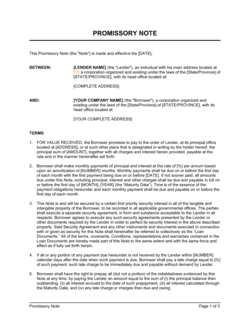
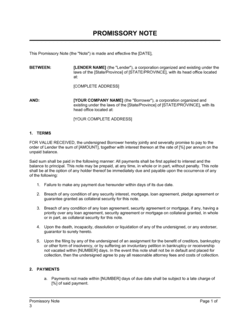
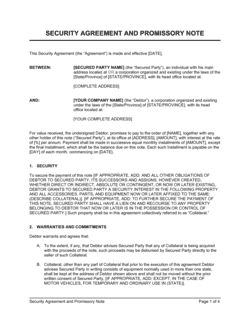
Identify both parties with their full legal names
Enter the borrower's and lender's complete legal names — individual or registered entity — along with addresses. For businesses, use the exact name on the incorporation or registration certificate.
💡 For LLC or corporate borrowers, confirm the signing officer has authority to bind the entity; attach a board resolution or member consent if the loan is material.
2
Set the principal amount and loan date
Enter the exact dollar amount being lent and the date funds are or will be advanced. If funding occurs in tranches, use the date of the first advance and attach a disbursement schedule.
💡 Write the amount in both numerals and words — e.g., '$50,000 (Fifty Thousand Dollars)' — to prevent disputes over transcription errors.
3
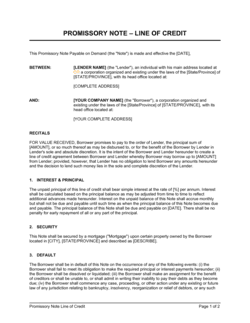
Define the interest rate and confirm it is below your jurisdiction's usury ceiling
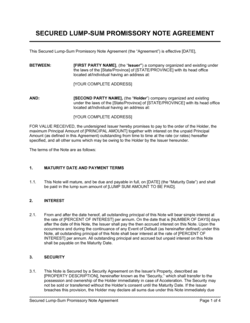
State the annual rate, whether fixed or variable, and the calculation basis (365-day year is most common). Check your state or provincial usury limit before setting the rate.
💡 For variable-rate notes, tie the rate to a published index (e.g., Wall Street Journal Prime Rate) plus a spread, and cap the maximum rate to reduce borrower default risk.
4
Build the repayment schedule
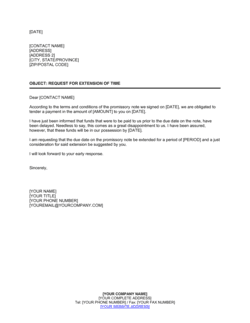
Specify payment frequency, the dollar amount of each installment, the first payment date, and the maturity date. Decide whether the note is fully amortizing, interest-only with a balloon, or structured differently.
💡 Attach a full amortization table as Exhibit A so both parties can verify each payment reduces principal as expected — this prevents disputes mid-term.
5
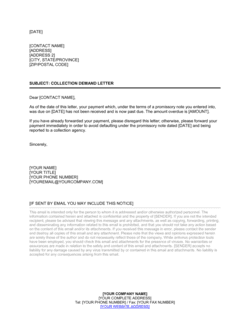
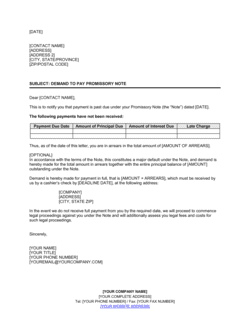
Draft the events of default and cure period
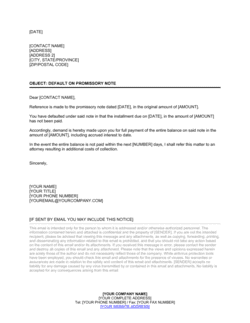
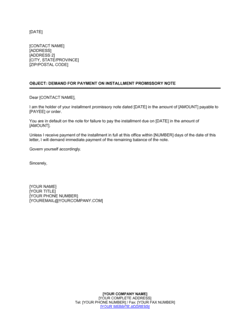
List every trigger that will constitute a default — missed payment, insolvency, bankruptcy, breach of related agreements — and specify the number of days the borrower has to cure after written notice.
💡 A 10-day cure period for payment default and a 30-day period for non-payment defaults is a commonly accepted commercial standard that balances lender protection with borrower fairness.
6
Confirm the acceleration clause is at the lender's option
Review the acceleration provision to ensure it says 'at the option of Payee' rather than triggering automatically. Add language specifying that failure to exercise acceleration on one default does not waive the right on a later default.
💡 Include an anti-waiver clause: 'No failure or delay by Payee in exercising any right shall constitute a waiver of that right.' This protects lenders who accept a late payment without intending to forgive future defaults.
7
State prepayment and late-fee terms explicitly
Decide whether early repayment is allowed without penalty, and set your late-fee rate as a percentage of the overdue amount with a grace period of 5 to 10 days.
💡 Courts scrutinize late fees as potential penalties — framing them as 'liquidated damages reflecting estimated collection costs' strengthens enforceability.
8
Execute before funds are advanced
Both parties must sign the note before or simultaneously with the transfer of funds. Date the note accurately and retain the original signed copy in a secure location.
💡 Have the note notarized even if not legally required — notarization authenticates signatures and simplifies enforcement if the borrower later denies signing.