1
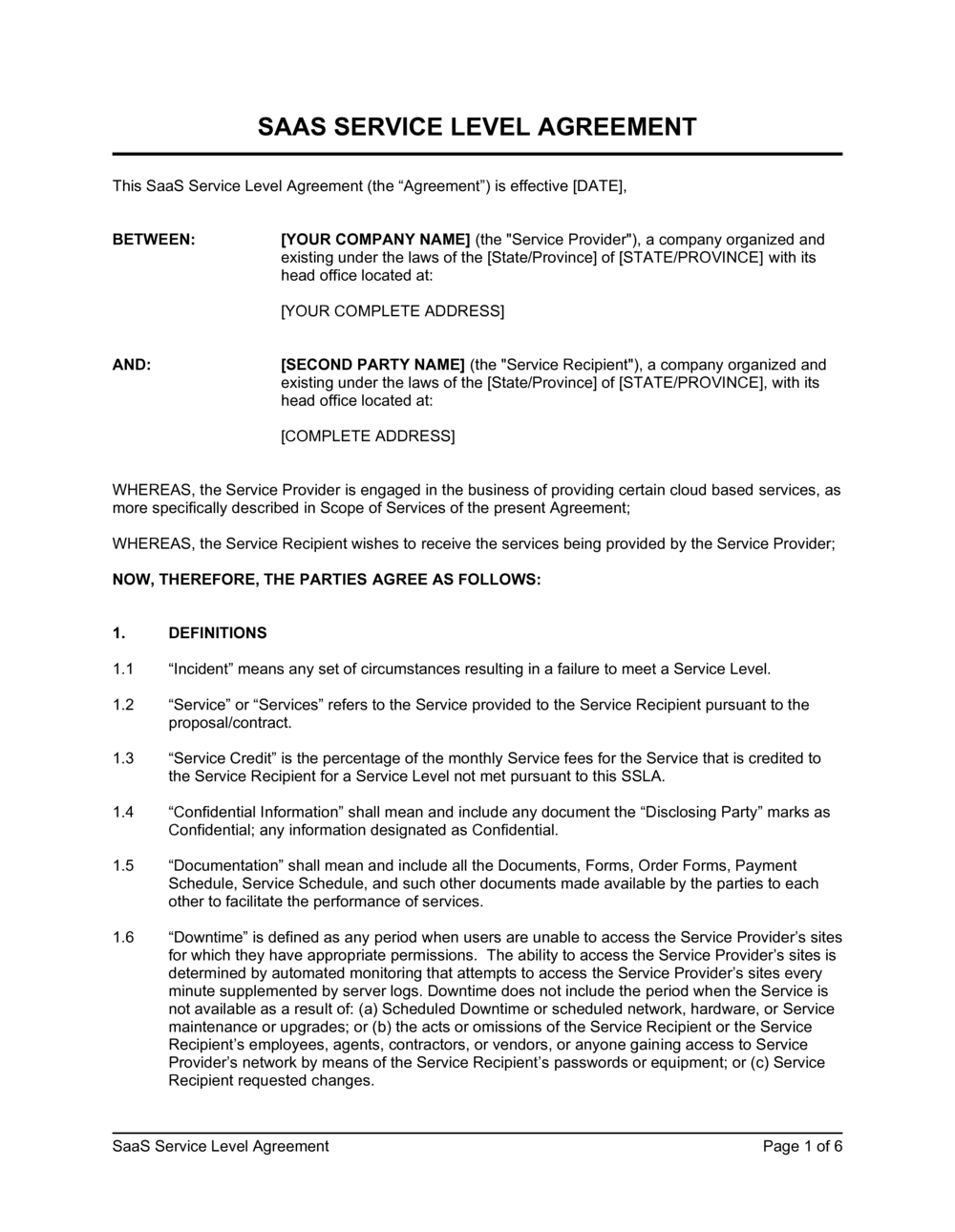
Identify the parties and the services in scope
Enter the provider's full legal entity name, the customer's legal entity name, and a precise description of the SaaS platform or service modules covered. Attach a Schedule A if multiple service tiers carry different SLA commitments.
💡 Name the specific modules or APIs with distinct uptime requirements separately — bundling everything under one availability target creates disputes when only a non-critical component fails.
2
Set the uptime commitment and measurement methodology
Choose your uptime percentage (99.9% = ~44 minutes downtime/month; 99.99% = ~4 minutes), define the measurement period (calendar month is standard), and specify how uptime is tracked — third-party monitoring tool, internal pinging, or status-page data.
💡 Use an independent third-party monitoring service (Pingdom, Datadog, or similar) as the authoritative source. Disputes over whether an outage occurred are eliminated when both parties agreed in advance on the measurement tool.
3
Define severity levels and target response times
Create four severity tiers aligned to business impact — complete outage, significant degradation, minor impairment, and informational. Assign specific acknowledgment and target resolution times to each, and confirm your support infrastructure can actually meet them before committing.
💡 Back-test your proposed response time targets against your last 12 months of incident data. Targets that were missed 30% of the time historically will generate immediate credit claims and damage customer trust.
4
Draft the service credit formula and cap
Set the credit percentage per percentage point of missed uptime, define the monthly credit cap (typically 20–30% of that month's fee), and write the claim submission process including the deadline (30 days is standard).
💡 Do not set credits as cash refunds — structure them as credits against future invoices. Cash refund language can trigger different accounting treatment and complicates revenue recognition for SaaS companies.
5
List all exclusions explicitly
Document every circumstance that removes time from the uptime calculation: customer-caused issues, third-party integrations, scheduled maintenance, and force majeure. Be specific — 'acts of Customer' is more defensible than a vague 'circumstances outside Provider's control.'
💡 Have your engineering team review the exclusions list. They will identify edge cases — like a DDoS attack on a shared infrastructure component — that legal teams routinely miss.
6
Define support tiers and match them to the subscription plan
Map each support tier to a specific subscription plan or fee level. Specify channels (email, chat, phone), hours of coverage, and named escalation contacts for enterprise tiers.
💡 Avoid promising a dedicated customer success manager in the SLA unless it is reflected in the pricing model. Understaffed CSM commitments are a leading source of customer churn and credit disputes.
7
Set the termination right trigger
Define the number of months of SLA failure (typically 3 in a rolling 12-month window) that entitles the customer to terminate without a termination-for-convenience fee and receive a pro-rata prepaid fee refund.
💡 Require the customer to have submitted valid credit claims for each failed month as a condition of exercising the termination right — this prevents a customer from stockpiling unasserted failures as a termination lever.
8
Cross-reference the master agreement before execution
Confirm the SLA references the governing master service or subscription agreement, that the limitation-of-liability cap in the MSA explicitly covers SLA claims, and that the integration clause names this SLA as part of the contract.
💡 Execute the SLA at or before go-live — not after the customer first experiences an outage. Post-incident SLA negotiations almost always result in more favorable customer terms.