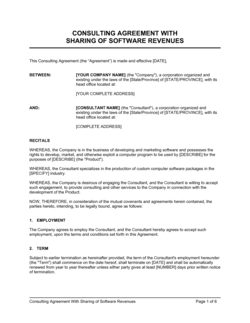
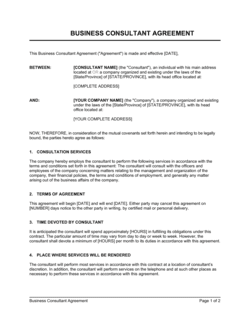
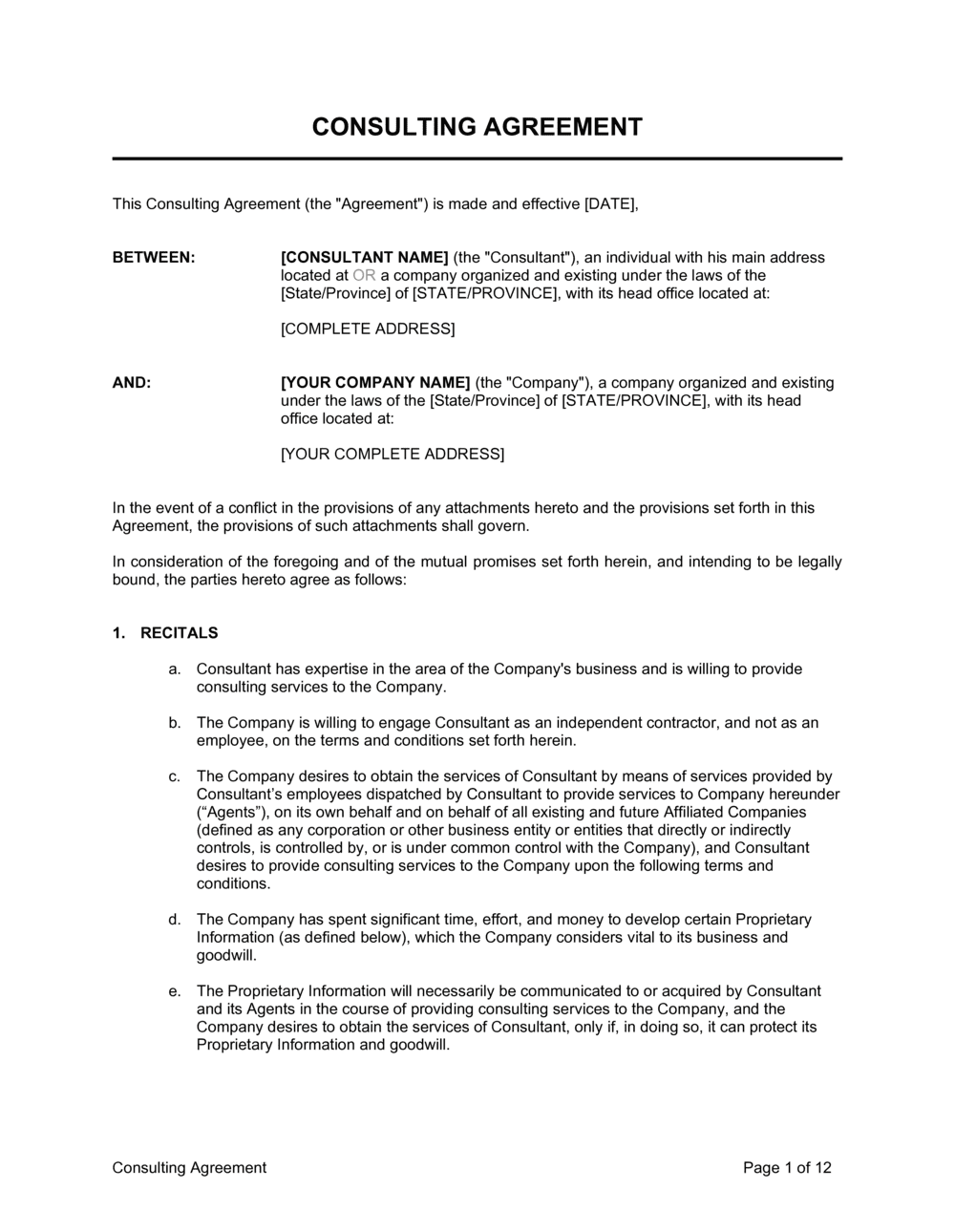
Consulting Agreement Long Template

Free Word download • Edit online • Save & share with Drive • Export to PDF

12 pages30–45 min to fillDifficulty: ComplexSignature requiredLegal review recommended
Learn more ↓
FreeConsulting Agreement Long Template

At a glance

What it is
A Consulting Agreement (Long Form) is a legally binding contract between a client company and an independent consultant that governs a professional services engagement in full detail. This free Word download covers scope of work, fees, payment terms, IP ownership, confidentiality, non-solicitation, indemnification, and termination — everything needed to protect both parties from the first day of engagement through final payment.
When you need it
Use it whenever you engage an external consultant for a material project — particularly when the engagement involves access to confidential information, creation of deliverables you intend to own, or a relationship lasting more than a few weeks. It is also appropriate when the consulting fees exceed a threshold that makes a handshake or simple letter of engagement inadequate.
What's inside
Scope of work and deliverables, fee structure and payment milestones, intellectual property assignment, confidentiality obligations, independent contractor classification, non-solicitation restrictions, limitation of liability, indemnification, termination rights, and governing law.

What is a Consulting Agreement (Long Form)?

A Consulting Agreement (Long Form) is a legally binding contract between a client company and an independent consultant that governs a professional services engagement in comprehensive detail. It establishes the full legal framework for the relationship — defining the scope of work and acceptance criteria, setting fees and payment milestones, assigning ownership of all deliverables and intellectual property to the client, imposing confidentiality and non-solicitation obligations, capping each party's liability exposure, and providing clear mechanisms for termination and dispute resolution. Unlike a letter of engagement or a simple contractor agreement, the long form addresses every foreseeable friction point before work begins, so that both parties have a single authoritative document to reference if something goes wrong.

Why You Need This Document

Without a written consulting agreement, three categories of risk materialize immediately. First, any deliverables, code, reports, or strategies the consultant creates belong to the consultant by default under copyright law in the US, Canada, the UK, and most of the EU — the client pays for the work but does not own it. Second, a departing consultant faces no legal barrier to taking proprietary information to a competitor, working for that competitor the next day, or recruiting the client's staff. Third, if the engagement goes wrong, the client has no contractual basis to limit its financial exposure or compel the consultant to remedy defective work within a defined timeline. A properly executed long-form consulting agreement closes all three gaps before the first invoice is issued, and the investment of 30 to 60 minutes completing this template is a fraction of the cost of a single disputed deliverable or misappropriated trade secret.

Which variant fits your situation?

If your situation is…Use this template
Short project or one-time deliverable with minimal confidentiality riskConsulting Agreement (Short Form)
Engaging a freelancer for creative, design, or writing workFreelance Contract
Ongoing retainer with no defined project end dateRetainer Agreement
Contracting with a self-employed individual where worker classification is a concernIndependent Contractor Agreement
Software or IT consulting with source code deliverablesIT Consulting Agreement
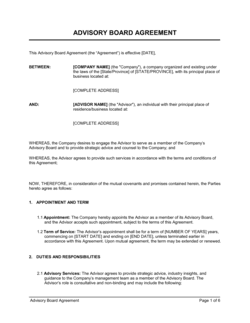
Management consulting or advisory board arrangement with equityAdvisory Board Agreement
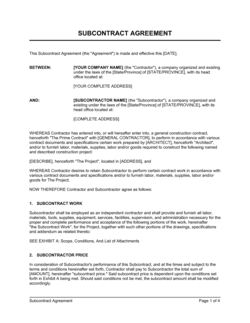
Engaging a subcontractor on behalf of a prime contractorSubcontractor Agreement

Common mistakes to avoid

❌ No written scope of work or vague deliverable descriptions

Why it matters: Without a defined scope, the client and consultant will disagree on what 'done' looks like — leading to endless revision cycles, disputes over final payment, and no contractual mechanism to resolve them.

Fix: Attach a Schedule A that lists each deliverable with a description, acceptance criteria, and deadline. Require a signed Change Order for any addition to scope.

❌ Missing IP assignment clause

Why it matters: Under US copyright law, work created by an independent contractor is owned by the contractor by default unless a written assignment exists. The same default applies in Canada, the UK, and most of the EU.

Fix: Include an explicit assignment clause transferring all deliverables and work product to the client, and add a carve-out for the consultant's pre-existing Background IP.

❌ Signing after work has already started

Why it matters: In common-law jurisdictions, a consultant who has already begun work gave no new consideration for IP assignment, non-solicitation, or confidentiality clauses added after the fact — courts have voided these clauses on this basis.

Fix: Execute the agreement before the consultant performs any billable work. If that window has passed, provide documented additional compensation as fresh consideration at the time of signing.

❌ No limitation-of-liability clause

Why it matters: Without a liability cap, a consultant could face a claim for the full downstream financial impact of a flawed deliverable — an amount that could dwarf the project fee by orders of magnitude.

Fix: Include a mutual limitation-of-liability clause capping each party's exposure at the total fees paid in the preceding 12 months and excluding consequential, indirect, and punitive damages.

❌ Behavioral control language that mimics employment

Why it matters: Specifying required work hours, mandatory on-site presence, or day-to-day supervision in the contract is the primary indicator courts use to reclassify a contractor as an employee — triggering back taxes, benefit liability, and statutory entitlements.

Fix: State only the deliverables and deadlines. Remove language dictating how, when, or where the consultant works. If that level of control is operationally necessary, the engagement may require employment, not a consulting contract.

❌ Open-ended or undefined confidentiality obligation

Why it matters: Courts in several jurisdictions treat indefinite or perpetual confidentiality clauses as unreasonably broad and unenforceable — leaving the client with no protection at all rather than a limited one.

Fix: Define a specific post-engagement confidentiality period (2–5 years for general business information; perpetual only for documented trade secrets) and state explicitly that the obligation survives termination.

The 10 key clauses, explained

Parties and engagement details

In plain language: Identifies the client and the consultant as legal entities, states the effective date of the agreement, and describes the nature of the engagement at a high level.

Sample language
This Consulting Agreement ('Agreement') is entered into as of [DATE] between [CLIENT LEGAL NAME], a [STATE/PROVINCE] [ENTITY TYPE] ('Client'), and [CONSULTANT LEGAL NAME / FULL NAME], [a [STATE] [ENTITY TYPE] / an individual] ('Consultant').

Common mistake: Using a trade name instead of the registered legal entity for either party. If the named party doesn't match the legal person who signs, the contract may be unenforceable against the right entity.

Scope of work and deliverables

In plain language: Defines precisely what the consultant will do, what outputs will be produced, the timeline, and how completion or acceptance is determined.

Sample language
Consultant shall perform the services described in Schedule A ('Services'). Deliverables, milestones, and acceptance criteria are set out in Schedule A. Any changes to the scope require a written Change Order signed by both parties.

Common mistake: Embedding scope details in the contract body rather than a Schedule A. Detailed scope changes frequently — a Schedule allows updates without amending the master agreement.

Fees, expenses, and payment terms

In plain language: States the consultant's compensation — hourly, project-based, or retainer — the invoicing schedule, payment due date, and the consequences of late payment.

Sample language
Client shall pay Consultant [an hourly rate of $[X] / a fixed project fee of $[X] / a monthly retainer of $[X]], payable within [30] days of invoice. Invoices not paid within [30] days accrue interest at [1.5]% per month.

Common mistake: Omitting a late-payment interest clause. Without it, the consultant has no contractual basis to charge interest and must resort to collections or litigation for overdue amounts.

Independent contractor status

In plain language: Confirms that the consultant is not an employee, is responsible for their own taxes, and receives no employment benefits — protecting the client from worker-misclassification liability.

Sample language
Consultant is an independent contractor and not an employee, partner, or agent of Client. Consultant is solely responsible for all taxes, insurance, and statutory contributions arising from compensation received under this Agreement.

Common mistake: Including language that gives the client control over when, where, and how the consultant works. Courts treat behavioral control as the primary indicator of employment, which can trigger back taxes and benefit liability.

Intellectual property ownership

In plain language: Assigns ownership of all deliverables, work product, and inventions created during the engagement to the client, while preserving the consultant's rights to pre-existing tools and general methodologies.

Sample language
All work product and deliverables created by Consultant under this Agreement ('Work Product') shall be the sole property of Client and are hereby irrevocably assigned to Client. Consultant retains ownership of pre-existing tools, methodologies, and intellectual property ('Background IP') used in performing the Services.

Common mistake: No carve-out for the consultant's Background IP. Without one, the consultant may unknowingly transfer ownership of proprietary frameworks or tools they use across multiple client engagements.

Confidentiality

In plain language: Prohibits the consultant from disclosing or misusing the client's confidential information — including trade secrets, financials, and client data — during and after the engagement.

Sample language
Consultant shall not, during or after the Term, disclose or use any Confidential Information of Client without prior written consent. 'Confidential Information' means any non-public information disclosed by Client in connection with this Agreement, including business plans, technical data, customer lists, and financial information.

Common mistake: A confidentiality clause with no defined term for the obligation. Courts in some jurisdictions treat open-ended confidentiality as unenforceable — a 2–5 year post-engagement term is generally safer.

Non-solicitation

In plain language: Prevents the consultant from recruiting the client's employees or contractors, and optionally prevents the client from hiring the consultant's personnel, for a defined period after the engagement.

Sample language
During the Term and for [12] months thereafter, Consultant shall not directly or indirectly solicit or hire any employee or contractor of Client. Client shall not solicit or hire Consultant's personnel for the same period.

Common mistake: Making the non-solicit mutual on paper but negotiating away the client-side restriction. Mutual terms create goodwill and are generally upheld; one-sided restrictions on consultants alone are more frequently challenged.

Limitation of liability

In plain language: Caps each party's total liability under the contract — typically to the total fees paid in the preceding 3–12 months — and excludes consequential, indirect, and punitive damages.

Sample language
In no event shall either party's total liability under this Agreement exceed the total fees paid by Client in the [12] months preceding the claim. Neither party shall be liable for indirect, consequential, incidental, or punitive damages.

Common mistake: No limitation-of-liability clause at all on either side. Without a cap, a consultant could face a claim for the full financial impact of a flawed deliverable — far exceeding any project fee.

Termination and wind-down

In plain language: States the notice period required to terminate the agreement, the conditions under which either party may terminate immediately for cause, and the obligations (payment, return of materials) on wind-down.

Sample language
Either party may terminate this Agreement for convenience on [30] days' written notice. Either party may terminate immediately for material breach that remains uncured [10] business days after written notice. Upon termination, Client shall pay all fees earned through the termination date.

Common mistake: Omitting payment obligations on early termination. Without explicit language, consultants who are terminated mid-project may have no contractual right to payment for work completed but not yet invoiced.

Governing law and dispute resolution

In plain language: Specifies which jurisdiction's law governs the contract and how disputes are resolved — arbitration, mediation, or litigation — and in which venue.

Sample language
This Agreement is governed by the laws of [STATE / PROVINCE / COUNTRY], without regard to conflict-of-law principles. Any dispute shall be resolved by binding arbitration administered by [AAA / JAMS] in [CITY], except that either party may seek injunctive relief in any court of competent jurisdiction.

Common mistake: Choosing a governing-law jurisdiction with no connection to where either party operates or the work is performed. Some jurisdictions will decline to apply a governing-law clause that has no rational nexus to the dispute.

How to fill it out

  1. 1

    Identify both parties with full legal names

    Enter the client's registered entity name and the consultant's full legal name or registered business name. Include entity type (LLC, corporation, sole proprietor) and state or province of formation.

    💡 Ask the consultant for a copy of their business registration or W-9 (US) before the engagement begins — this confirms the correct legal name and tax ID for the contract and any 1099 filing.

  2. 2

    Draft Schedule A with specific deliverables and timelines

    Move all project details — task list, deliverables, acceptance criteria, and milestones — to Schedule A rather than the contract body. Define acceptance criteria clearly so both parties agree on when a deliverable is 'done'.

    💡 Add a Change Order clause to the main body and include a blank Change Order form as Schedule B — this makes scope additions trackable and prevents verbal agreements from overriding the contract.

  3. 3

    Set the fee structure and payment schedule

    Choose hourly, fixed-fee, milestone-based, or retainer billing. State the exact amounts, invoicing frequency, payment due date (Net 15 or Net 30), and the interest rate on late payments.

    💡 For fixed-fee projects, tie at least 10–20% of the total fee to final client acceptance of deliverables — this gives the client leverage to ensure quality and the consultant a clear trigger for final payment.

  4. 4

    Confirm the independent contractor classification

    Review the behavioral control language. The contract should not specify when or where the consultant works, require exclusive availability, or impose employee-style supervision. If it does, revise those terms or reclassify the engagement.

    💡 Run the engagement through the IRS 20-factor test (US) or the applicable provincial or national test before signing. Misclassification penalties can include back taxes, interest, and employment benefit liability.

  5. 5

    Define IP ownership and Background IP carve-outs

    Confirm all deliverables are assigned to the client. Then explicitly list or describe any pre-existing consultant tools, code libraries, templates, or methodologies that are excluded from the assignment.

    💡 If the consultant's Background IP is embedded in the deliverable, negotiate a perpetual, royalty-free license to use it rather than attempting a full transfer — this is more realistic and avoids disputes.

  6. 6

    Set confidentiality duration and non-solicitation terms

    Define the post-engagement confidentiality period (2–5 years is typical; perpetual for trade secrets). Set the non-solicitation window — 12 months is standard for most engagements; 24 months for senior or executive consulting roles.

    💡 Make confidentiality obligations survive termination explicitly — state 'obligations under this Section survive the expiration or termination of this Agreement' — otherwise a court may treat them as lapsing.

  7. 7

    Insert the limitation-of-liability cap

    Set the liability cap to the total fees paid in the preceding 12 months or the total project fee, whichever is higher. Exclude consequential and punitive damages for both parties.

    💡 Some clients in regulated industries (financial services, healthcare) require the consultant to carry professional liability (E&O) insurance — add a certificate-of-insurance requirement to Schedule A if applicable.

  8. 8

    Execute before work begins

    Both parties must sign before the consultant starts any billable work. Post-start signatures create a fresh-consideration problem for IP assignment and restrictive covenants in common-law jurisdictions.

    💡 Use an e-signature tool and timestamp execution. Store the fully executed agreement alongside the consultant's W-9 or equivalent tax form in a single vendor file.

Frequently asked questions

What is a consulting agreement?

A consulting agreement is a legally binding contract between a client and an independent consultant that defines the terms of a professional services engagement. It sets out the scope of work, fees, payment schedule, intellectual property ownership, confidentiality obligations, and termination rights. Unlike a simple letter of engagement, a long-form consulting agreement provides enforceable protections for both parties across the full lifecycle of the project.

What is the difference between a consulting agreement and an independent contractor agreement?

A consulting agreement is tailored for knowledge-work engagements — strategy, marketing, IT, finance, HR — where the deliverable is advice, analysis, or a project output. An independent contractor agreement is a broader term covering any self-employed worker, including tradespeople and gig workers. Consulting agreements typically include more detailed IP assignment, confidentiality, and deliverable-acceptance provisions than a standard contractor agreement.

Who should sign a consulting agreement?

Both the client and the consultant must sign. If either party is a legal entity (LLC, corporation, partnership), the signatory must be an authorized representative — typically an officer, director, or managing member with authority to bind the entity. Signing in a personal capacity when the contracting party is a company can expose the individual to personal liability and creates ambiguity about which entity owns the resulting IP.

Does a consulting agreement need to be notarized?

No. A consulting agreement is generally enforceable in most jurisdictions when signed by authorized representatives of both parties without notarization. Notarization may be required in specific contexts — for example, if the agreement is being recorded in a public registry or if local law requires it for contracts above a certain value — but this is uncommon for standard consulting engagements.

Who owns the intellectual property created under a consulting agreement?

Ownership depends entirely on what the contract says. Under the default rules in the US, Canada, the UK, and most of the EU, work created by an independent contractor belongs to the contractor, not the client. To transfer ownership to the client, the agreement must include an explicit written IP assignment clause. Without one, the client may have a license to use the deliverables but will not own them outright.

Can a consulting agreement include a non-compete clause?

Yes, but enforceability depends on jurisdiction, scope, and duration. Courts generally disfavor broad non-competes in consulting agreements more than in employment contracts, because consultants often rely on industry-specific expertise across multiple clients. A well-drafted restriction limits the consultant's competitive activity to a specific sector, geography, and time period — typically 6 to 12 months. California, Minnesota, and several EU jurisdictions restrict or ban post-engagement non-competes entirely.

What payment terms are typical in a consulting agreement?

Net 30 from invoice date is the most common standard for B2B consulting engagements. For longer or higher-value projects, milestone-based payments tied to deliverable acceptance are standard — typically 30–40% on signing, 30–40% at a midpoint milestone, and 20–30% on final acceptance. Monthly retainers are billed in advance at the start of each period. Always include a late-payment interest clause — 1.5% per month is typical.

What is the difference between a short-form and a long-form consulting agreement?

A short-form consulting agreement covers the basics — scope, fees, IP, confidentiality, and termination — in 2 to 4 pages. A long-form agreement adds detailed provisions for limitation of liability, indemnification, insurance requirements, dispute resolution, force majeure, audit rights, and subcontracting. Use the long form for engagements involving sensitive IP, significant fees, regulated industries, or multi-party arrangements where full legal clarity is worth the additional complexity.

Can a consultant use subcontractors under a consulting agreement?

Only if the agreement expressly permits it. Many clients restrict subcontracting to maintain control over who accesses their confidential information and performs the work. If subcontracting is permitted, the agreement should require the consultant to impose equivalent confidentiality and IP assignment obligations on any subcontractor and remain fully responsible to the client for the subcontractor's performance.

How this compares to alternatives

vs Consulting Agreement (Short Form)

The short-form agreement covers scope, fees, IP, and confidentiality in 2–4 pages — sufficient for low-risk, short-duration engagements with trusted counterparties. The long form adds limitation of liability, indemnification, insurance requirements, audit rights, and detailed dispute resolution. Use the long form whenever the engagement involves sensitive IP, significant fees, a regulated industry, or multiple subcontractors.

vs Independent Contractor Agreement

An independent contractor agreement is a general-purpose document for self-employed workers across industries — tradespeople, gig workers, and knowledge workers alike. A consulting agreement is purpose-built for professional advisory engagements, with deeper deliverable-acceptance mechanics, IP carve-outs for Background IP, and liability caps calibrated to fee size. For any engagement involving complex deliverables or significant confidential information, the consulting agreement provides materially stronger protection.

vs Statement of Work

A Statement of Work (SOW) is a scope document — it defines what will be done, by when, and at what cost — but it is not a standalone contract. An SOW is typically issued under a master consulting agreement that supplies the governing legal terms. If no master agreement exists, the consulting agreement template includes a Schedule A that functions as an integrated SOW, eliminating the need for a separate document.

vs Employment Contract

An employment contract creates an employer-employee relationship with all associated statutory obligations — payroll taxes, benefits, notice periods, and termination protections. A consulting agreement establishes an independent contractor relationship with none of those obligations, provided the behavioral-control and economic-dependence tests are satisfied. Misclassifying an employee as a consultant triggers significant tax penalties and benefit liability; when in doubt, seek legal advice before choosing the consulting structure.

Industry-specific considerations

Technology and SaaS

Source code ownership, Background IP carve-outs for reusable libraries, and data-security obligations for consultants accessing production systems or customer data.

Financial services

Regulatory compliance obligations, professional indemnity insurance minimums, and enhanced confidentiality covering proprietary trading strategies and client financial data.

Healthcare and life sciences

HIPAA business associate obligations incorporated by reference, credentialing prerequisites, and indemnification provisions covering regulatory penalties arising from consultant error.

Professional services and management consulting

Deliverable-based milestone payments, client non-solicitation protecting long-term fee relationships, and joint-deliverable ownership provisions for co-developed frameworks.

Construction and engineering

Design liability and professional negligence indemnification, site-access and safety compliance obligations, and lien-waiver coordination with the prime contract.

Marketing and creative agencies

Third-party content licensing obligations, moral rights waivers for creative deliverables, and usage-rights definitions specifying channels, territories, and durations.

Jurisdictional notes

United States

Under US copyright law (17 U.S.C. § 101), work created by an independent contractor is owned by the contractor unless it qualifies as 'work for hire' under a narrow list of categories and is expressly designated in writing — making an explicit IP assignment clause essential. Worker classification is tested under IRS, Department of Labor, and state-level standards (notably California AB5). Non-compete enforceability varies sharply by state — California, Minnesota, and North Dakota ban most post-engagement restrictions.

Canada

Canada has no federal 'work for hire' doctrine equivalent to the US provision — IP created by a contractor defaults to the contractor in all provinces under the Copyright Act, making a written assignment mandatory. Worker misclassification is assessed by the CRA using a multi-factor control test; penalties include back CPP contributions, EI premiums, and interest. Quebec contracts must be drafted or translated into French for provincially regulated employers, and Quebec courts apply civil law principles rather than common law.

United Kingdom

UK copyright law vests first ownership in the creator — an independent consultant — unless a contract assigns it to the client; always include an express assignment. IR35 rules require clients to assess whether the consultant is effectively an employee and, if so, to deduct income tax and National Insurance at source; off-payroll working rules have applied to medium and large private-sector clients since April 2021. Post-engagement restrictive covenants are enforceable if reasonable in scope, duration, and geographic reach.

European Union

EU member states vary significantly in their approach to contractor classification, IP ownership, and post-engagement restrictions. Several countries — France, Germany, Netherlands — have 'bogus self-employment' regimes that can reclassify frequent or dependent consultants as employees, triggering social security contributions retroactively. The GDPR applies to any consultant who processes personal data on behalf of the client; a Data Processing Agreement must accompany or be incorporated into the consulting agreement. Non-compete compensation requirements vary by country — France requires financial compensation equal to a percentage of average monthly salary.

Template vs lawyer — what fits your deal?

PathBest forCostTime
Use the templateStandard domestic consulting engagements with clearly defined scope, moderate fees, and no unusual IP or regulatory complexityFree30–60 minutes
Template + legal reviewEngagements involving sensitive IP, fees above $25,000, regulated industries, or cross-border work$300–$800 for a 1–2 hour attorney review1–3 business days
Custom draftedComplex multi-party engagements, executive-level advisory arrangements with equity, heavily regulated industries, or international consulting with multi-jurisdiction IP$1,500–$5,000+1–3 weeks

Glossary

Scope of Work
The defined set of tasks, deliverables, timelines, and acceptance criteria that the consultant agrees to complete under the contract.
Independent Contractor
A self-employed individual or business engaged to perform services without the legal status of an employee — no benefits, no tax withholding, and no employer control over how the work is performed.
Intellectual Property Assignment
A clause that transfers ownership of all work product, deliverables, and inventions created during the engagement from the consultant to the client.
Retainer
A recurring fixed fee paid to the consultant — typically monthly — to secure their availability for an ongoing or undefined scope of work.
Milestone Payment
A payment triggered when a defined deliverable or project phase is completed and accepted, rather than paid on a fixed schedule.
Limitation of Liability
A clause that caps the maximum financial exposure of one or both parties — typically to the total fees paid under the agreement — in the event of a breach or dispute.
Indemnification
An obligation by one party to compensate the other for losses, damages, or legal costs arising from a specified breach, act, or omission.
Non-Solicitation Clause
A restriction preventing the consultant from recruiting the client's employees, or the client from poaching the consultant's staff, for a defined period after the engagement ends.
Work for Hire
A US copyright doctrine under which work created by an independent contractor can be designated as owned by the commissioning party — but only for specific categories of work and when agreed in writing.
Governing Law
The jurisdiction whose laws will be used to interpret the contract and resolve any disputes arising from it.
Force Majeure
A clause excusing non-performance when an extraordinary event outside either party's control — such as a natural disaster or government action — prevents fulfillment of contractual obligations.

Part of your Business Operating System

This document is one of 3,000+ business & legal templates included in Business in a Box.

  • Fill-in-the-blanks — ready in minutes
  • 100% customizable Word document
  • Compatible with all office suites
  • Export to PDF and share electronically

Create your document in 3 simple steps.

From template to signed document — all inside one Business Operating System.
1
Download or open template

Access over 3,000+ business and legal templates for any business task, project or initiative.

2
Edit and fill in the blanks with AI

Customize your ready-made business document template and save it in the cloud.

3
Save, Share, Send, Sign

Share your files and folders with your team. Create a space of seamless collaboration.

Save time, save money, and create top-quality documents.

★★★★★

"Fantastic value! I'm not sure how I'd do without it. It's worth its weight in gold and paid back for itself many times."

Managing Director · Mall Farm
Robert Whalley
Managing Director, Mall Farm Proprietary Limited
★★★★★

"I have been using Business in a Box for years. It has been the most useful source of templates I have encountered. I recommend it to anyone."

Business Owner · 4+ years
Dr Michael John Freestone
Business Owner
★★★★★

"It has been a life saver so many times I have lost count. Business in a Box has saved me so much time and as you know, time is money."

Owner · Upstate Web
David G. Moore Jr.
Owner, Upstate Web

Run your business with a system — not scattered tools

Stop downloading documents. Start operating with clarity. Business in a Box gives you the Business Operating System used by over 250,000 companies worldwide to structure, run, and grow their business.

Start free · No credit card required