Notice to Stop Goods in Transit Template

Free Word download β€’ Edit online β€’ Save & share with Drive β€’ Export to PDF

1 pageβ€’15–25 min to fillβ€’Difficulty: Standard
Learn more ↓
FreeNotice to Stop Goods in Transit Template

At a glance

What it is
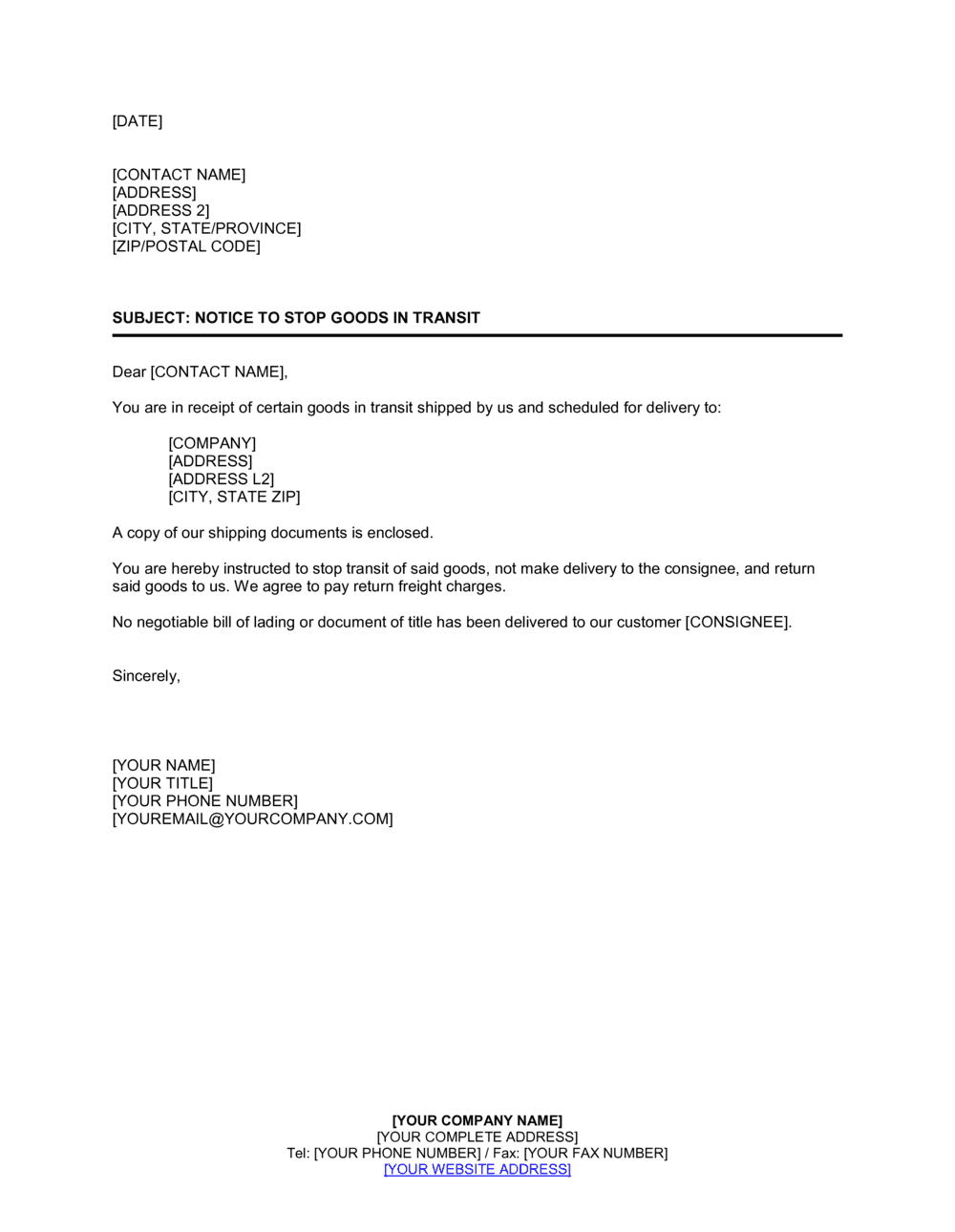
A Notice To Stop Goods In Transit is a formal business letter an unpaid seller sends to a carrier, freight forwarder, or shipping agent instructing them to halt delivery of goods that are currently en route to the buyer. This free Word download gives you a ready-to-edit template you can complete in minutes and send immediately when a buyer's financial position changes after goods have already shipped.
When you need it
Use it as soon as you learn that the buyer has become insolvent, entered bankruptcy proceedings, or defaulted on payment β€” while the goods are still in the carrier's possession and have not yet been delivered to the buyer. Speed is critical: once the carrier hands the goods to the buyer, the right to stop them is generally lost.
What's inside
Sender and carrier identification details, a precise description of the shipment being stopped, the legal and commercial grounds for the stoppage, a clear instruction to the carrier to hold and return the goods, and acknowledgement and confirmation requirements. The letter is typically one to two pages and is sent by the fastest available means β€” email, fax, or courier β€” with a written follow-up.

What is a Notice To Stop Goods In Transit?

A Notice To Stop Goods In Transit is a formal written instruction an unpaid seller issues to a carrier, freight forwarder, or shipping agent directing them to halt delivery of a specific consignment while it is still physically in transit between the seller and the buyer. It invokes the seller's right of stoppage in transit β€” a remedy that allows an unpaid seller to intercept goods and retake possession as security for payment when the buyer has become insolvent or has materially defaulted on payment obligations. The notice identifies the shipment by bill of lading or waybill number, states the grounds for the stoppage, directs the carrier to hold or return the goods, and provides an indemnity to the carrier against claims from the buyer for non-delivery.

Why You Need This Document

The right of stoppage in transit is one of the few practical remedies available to a seller whose goods have left the warehouse but not yet reached an insolvent buyer β€” but it is a remedy that disappears the moment the carrier completes delivery. Every hour of delay increases the risk that goods worth thousands or hundreds of thousands of dollars are handed to a buyer who will never pay for them. A clear, complete stoppage notice sent immediately to the carrier β€” by email and fax simultaneously β€” is what preserves that right. Without it, you are an unsecured creditor in a bankruptcy queue. With a properly executed notice, you recover your goods, retain your inventory, and avoid converting a bad debt into a total loss. This template gives you the structure to act within 30 minutes of learning of a buyer's insolvency, including the indemnity language carriers require before they will comply.

Which variant fits your situation?

If your situation is…Use this template
Buyer has formally entered insolvency or bankruptcy proceedingsNotice To Stop Goods In Transit (Insolvency)
Buyer has simply failed to pay an invoice by its due dateNotice To Stop Goods In Transit (Non-Payment)
Goods are held at a warehouse rather than in active transitNotice of Lien on Goods
Seller wants to formally demand return of goods already deliveredDemand Letter for Return of Goods
Carrier refuses to comply and seller must escalate formallyFormal Demand Letter to Carrier
Seller needs to notify the buyer simultaneously about the stoppageNotice of Stoppage and Rescission of Contract

Common mistakes to avoid

❌ Delaying the notice while seeking legal advice

Why it matters: Once the carrier delivers the goods to the buyer, the right of stoppage is permanently extinguished and cannot be revived by any subsequent notice.

Fix: Send the notice immediately using the template, even before receiving legal guidance β€” you can always follow up with a more formal letter once counsel is engaged.
❌ Omitting the bill of lading number

Why it matters: Without a specific shipment reference, the carrier cannot identify which consignment is affected and may continue delivery while seeking clarification.

Fix: Always include the bill of lading or waybill number, container ID, and the consignee name exactly as they appear on the shipping documents.

❌ Giving no instruction on what to do with the goods after stopping

Why it matters: A carrier who stops delivery but has no return or warehousing instruction will incur storage costs β€” sometimes charged to the seller β€” or may resume delivery after a short hold period.

Fix: Include a clear direction: return to the seller's address or hold at a specified warehouse, with a contact name and number for the carrier to coordinate with.

❌ Failing to include an indemnity to the carrier

Why it matters: Carriers are exposed to claims from the consignee for non-delivery and will often refuse to act without written indemnity from the seller, causing critical delays.

Fix: Include the indemnity paragraph in every notice. If possible, have the authorized signatory confirm in writing that the indemnity is given on behalf of the company.

The 9 key clauses, explained

Header and Parties Identification

In plain language: States the sender's full name and address, the date, and the carrier's name and address. Establishes who is giving the instruction and to whom it is directed.

Sample language
[SENDER COMPANY NAME] | [ADDRESS] | [DATE] | To: [CARRIER / FREIGHT FORWARDER NAME] | [CARRIER ADDRESS]

Common mistake: Addressing the notice to a generic 'Carrier' or the shipper's account manager instead of the carrier's registered legal name and operations contact β€” causing delays in actioning the instruction.

Reference to Shipment and Bill of Lading

In plain language: Identifies the specific goods being stopped by bill of lading number, waybill number, container number, or other shipment reference, along with origin, destination, and estimated transit dates.

Sample language
We refer to shipment of [GOODS DESCRIPTION] currently in transit under Bill of Lading No. [NUMBER], issued [DATE], from [ORIGIN PORT/LOCATION] to [DESTINATION PORT/LOCATION], consigned to [BUYER NAME].

Common mistake: Using a vague goods description such as 'our recent shipment' without citing the bill of lading number β€” leaving the carrier uncertain which consignment is affected and delaying action.

Statement of Grounds for Stoppage

In plain language: Sets out the factual and legal basis for the notice β€” typically the buyer's insolvency, bankruptcy filing, or payment default β€” and asserts the seller's right as an unpaid seller to stop the goods.

Sample language
We have been informed that [BUYER NAME] has [become insolvent / filed for bankruptcy / failed to make payment due on DATE]. As unpaid sellers, we hereby exercise our right of stoppage in transit pursuant to [applicable law / our contract dated DATE].

Common mistake: Omitting the specific legal basis and stating only that 'payment has not been received' β€” a non-payment ground is weaker than insolvency and may not be sufficient on its own in some jurisdictions.

Instruction to Halt Delivery

In plain language: The operative instruction telling the carrier not to deliver the goods to the consignee or any person acting on the consignee's behalf, pending further written instructions from the seller.

Sample language
You are hereby instructed to cease and desist from delivering the above-described goods to [BUYER/CONSIGNEE NAME] or any representative thereof, and to hold the goods securely pending further written instructions from [SENDER COMPANY NAME].

Common mistake: Failing to explicitly prohibit delivery to the buyer's agents or representatives β€” a buyer in financial difficulty may send a warehouse agent or affiliate to collect the goods, circumventing a narrowly worded notice.

Instruction for Return or Warehousing

In plain language: Directs the carrier to either return the goods to the seller's designated address or hold them at a nominated warehouse at the seller's cost, specifying the preferred action clearly.

Sample language
Please arrange for the goods to be [returned to [SELLER ADDRESS] / held at [WAREHOUSE NAME AND ADDRESS]] at our account. Please confirm receipt of this instruction and provide the estimated cost and timeline within [24 / 48] hours.

Common mistake: Leaving the carrier with no instruction on what to do after stopping β€” without a return or hold directive, the carrier may warehouse the goods on the buyer's account or at a location the seller cannot access.

Indemnity to Carrier

In plain language: Assures the carrier that the seller will indemnify them against any claim from the buyer or third parties arising from compliance with the stoppage instruction, reducing the carrier's reluctance to act.

Sample language
[SENDER COMPANY NAME] hereby undertakes to indemnify and hold harmless [CARRIER NAME] against all reasonable costs, claims, and liabilities arising directly from compliance with this instruction.

Common mistake: Omitting the indemnity clause β€” without it, carriers are often reluctant to act on a verbal or written instruction because they fear a claim from the consignee for non-delivery.

Urgency and Means of Communication

In plain language: Flags the time-sensitive nature of the notice and confirms that it is being sent simultaneously by the fastest available means β€” email, fax, or courier β€” with a written original to follow.

Sample language
This notice is being transmitted to you by [EMAIL / FAX] as a matter of urgency. A signed original will follow by [courier / post] within [24] hours. Please treat this communication as effective immediately upon receipt.

Common mistake: Sending only a physical letter by standard post β€” if the goods are close to destination, a letter arriving days later is worthless because delivery will have already occurred.

Request for Acknowledgement

In plain language: Asks the carrier to confirm receipt of the notice and their intention to comply, creating a written record that the carrier was duly notified.

Sample language
Please confirm receipt of this notice and your compliance by return email to [EMAIL ADDRESS] no later than [TIME] on [DATE]. If you have any questions, please contact [NAME] at [PHONE / EMAIL].

Common mistake: Not requesting written acknowledgement β€” without confirmation, the seller has no proof the carrier received and acted on the notice if the matter proceeds to dispute or litigation.

Sender Signature and Authorization

In plain language: Identifies the authorized signatory at the seller's company β€” name, title, and contact details β€” confirming the instruction carries organizational authority.

Sample language
Signed on behalf of [SENDER COMPANY NAME] by: [AUTHORIZED SIGNATORY NAME] | [TITLE] | [EMAIL] | [PHONE]

Common mistake: Signing with a first name only or an illegible signature and no printed name or title β€” carriers need to verify that the instruction comes from an authorized representative of the seller.

How to fill it out

  1. 1

    Gather the shipment reference details immediately

    Pull the bill of lading number, waybill, container number, and the carrier's contact details before opening the template. You need these to identify the correct shipment without ambiguity.

    πŸ’‘ Check your logistics management system or the shipping confirmation email first β€” bill of lading numbers are often buried in attachments.

  2. 2

    Confirm the grounds for stoppage

    Establish whether the trigger is buyer insolvency, bankruptcy, or payment default, and note the specific date you became aware of it. Insolvency is the strongest ground; note the source β€” official filing, creditor notice, or news.

    πŸ’‘ If you have a screenshot or reference number from an insolvency filing or bankruptcy court notice, reference it in the letter to strengthen your stated grounds.

  3. 3

    Identify the correct carrier contact

    Address the notice to the carrier's legal entity name and the specific operations or cargo department handling the shipment. For international shipments, contact the freight forwarder if they are managing the leg where goods are currently located.

    πŸ’‘ Call the carrier's customer service line as you send the written notice β€” verbal notification followed by written confirmation creates the clearest audit trail.

  4. 4

    Complete the instruction to halt and hold

    Fill in the buyer and consignee names exactly as they appear on the bill of lading, and specify whether you want the goods returned to your premises or held at a nominated warehouse.

    πŸ’‘ If you do not yet have a warehousing arrangement in place, instruct the carrier to hold pending further instructions β€” do not delay sending the notice while arranging storage.

  5. 5

    Include the indemnity paragraph

    Confirm that the indemnity clause is included and references the carrier by name. This is the most effective way to overcome a carrier's hesitation to act on your instruction.

    πŸ’‘ If your company has a standard indemnity wording approved by your legal team, substitute it here rather than using the template default.

  6. 6

    Send by the fastest available means and request acknowledgement

    Email the notice immediately, then send a signed PDF or fax if the carrier requires it. Set a response deadline of no more than 24 hours for acknowledgement of receipt.

    πŸ’‘ Request a read receipt on the email and screenshot the sent timestamp β€” you may need to prove the carrier received timely notice.

Frequently asked questions

What is a notice to stop goods in transit?

A notice to stop goods in transit is a formal written instruction an unpaid seller sends to a carrier, freight forwarder, or shipping agent directing them to halt delivery of goods currently en route to the buyer. It is used when a buyer becomes insolvent or defaults on payment after goods have already shipped but before they are physically delivered. The notice asserts the seller's right of stoppage in transit and asks the carrier to hold or return the goods.

When can a seller stop goods in transit?

A seller can stop goods in transit while the goods are still in the possession of a carrier and have not yet been delivered to the buyer or the buyer's agent. The right typically arises when the buyer becomes insolvent. In most jurisdictions, once the carrier completes delivery, the right is lost permanently β€” so speed is critical. Check whether the buyer has taken symbolic possession (e.g., through a warehouse receipt) as this can also end the transit period.

Does the notice to stop goods in transit need to be signed?

No formal signature is required for the notice to be effective in most jurisdictions β€” it is an operational instruction rather than a binding legal instrument. However, the notice should be signed by an authorized representative of the seller and sent on company letterhead to confirm its authority. A signed PDF sent by email is standard practice.

What should I do if the carrier refuses to stop the goods?

If the carrier refuses to comply, escalate immediately to their senior management in writing, restate the indemnity, and document every communication. In parallel, seek urgent legal advice β€” you may need to apply for an interim court injunction to prevent delivery. If the carrier proceeds to deliver despite a valid notice, they may be liable to the seller for conversion of goods.

Does stopping goods in transit cancel the sale contract?

No β€” exercising the right of stoppage in transit does not automatically rescind the sale contract. It simply allows the seller to retake possession as security for payment. The seller can then choose to hold the goods and demand payment, resell them to a third party, or separately rescind the contract and seek damages. Consult a lawyer before taking any of these follow-on steps.

Can I stop goods in transit if the buyer simply has not paid yet?

The classical right of stoppage in transit is typically tied to buyer insolvency rather than mere non-payment. A buyer who is late on a payment but solvent may have contractual defenses against the stoppage. Some sale contracts include express stoppage rights for any payment default β€” check your contract terms. If insolvency is not the trigger, consider issuing a formal demand letter and reviewing your contractual remedies before instructing the carrier.

How quickly does the carrier have to comply with the notice?

There is no fixed statutory period, but the expectation is that carriers act promptly on receipt of a valid stoppage notice β€” typically within hours for active road or rail shipments and within one business day for sea freight at intermediate ports. Including a specific response deadline in the notice (e.g., 24 hours) and following up by phone increases compliance speed significantly.

Can I stop goods in transit for an international shipment?

Yes β€” the right of stoppage in transit applies to international shipments, but the legal framework varies by jurisdiction. The UN Convention on Contracts for the International Sale of Goods (CISG) addresses seller remedies for international sales. The governing law of your sale contract determines which country's rules apply. For cross-border shipments, send the notice to every carrier and freight forwarder handling a leg of the journey, not only the primary carrier.

How this compares to alternatives

vs Demand Letter for Payment

A demand letter for payment asks the buyer to settle an overdue invoice and is addressed to the buyer directly. A notice to stop goods in transit is addressed to the carrier and instructs them to halt delivery. Both may be issued simultaneously, but the stoppage notice is urgent and time-sensitive in a way that a payment demand is not.

vs Notice of Contract Termination

A contract termination notice cancels the underlying sale agreement and notifies the buyer. A stoppage in transit notice does not cancel the contract β€” it secures the goods pending resolution. Termination typically follows the stoppage once the seller decides how to proceed, not the other way around.

vs Notice of Lien on Goods

A notice of lien is used when goods are already held at a warehouse or storage facility rather than actively moving between locations. A stoppage in transit notice applies specifically while goods are in the carrier's possession during carriage. The legal basis and addressee differ: lien notices go to warehouse operators; stoppage notices go to carriers.

vs Repossession Notice

A repossession notice is used after delivery to recover goods from a buyer who has defaulted β€” typically under a retention-of-title or hire-purchase arrangement. A stoppage in transit notice acts before delivery and does not require a retention-of-title clause. Once delivered, a stoppage notice is too late and a repossession notice becomes the relevant remedy.

Industry-specific considerations

Wholesale and Distribution

High-value bulk orders make stoppage critical when a retail buyer enters insolvency; notices often cover multiple containers under a single bill of lading.

Manufacturing

Manufacturers shipping finished goods to OEM customers or distributors use this notice when a customer's payment default is discovered mid-shipment.

Import and Export

International exporters face added complexity with multi-leg carriers and freight forwarders; the notice must reach every party controlling the goods at each transit point.

Food and Beverage

Perishable goods require an especially fast stoppage notice and clear warehousing instructions β€” delay risks both loss of the goods and loss of the right to recover their value.

Template vs pro β€” what fits your needs?

PathBest forCostTime
Use the templateSellers issuing a stoppage notice for a straightforward domestic shipment with a clear insolvency triggerFree15–30 minutes
Template + professional reviewSellers dealing with international shipments, disputed grounds, or high-value cargo where carrier resistance is anticipated$150–$400 for a lawyer or trade credit specialist to review and adapt the noticeSame day
Custom draftedComplex multi-jurisdiction shipments, CISG-governed contracts, or cases where simultaneous court injunction is required$500–$2,000+ depending on urgency and complexityHours to 1 business day

Glossary

Stoppage in Transit (Stoppage in Transitu)
An unpaid seller's right to reclaim goods from a carrier before they reach the buyer, typically exercisable when the buyer becomes insolvent.
Carrier
Any person or company β€” trucker, rail operator, freight forwarder, or shipping line β€” in possession of the goods while transporting them from seller to buyer.
Bill of Lading
A document issued by the carrier acknowledging receipt of goods and setting out the terms of carriage; the reference document used to identify the shipment in a stoppage notice.
Insolvency
A buyer's financial state in which they cannot meet their debts as they fall due β€” the primary trigger for exercising the right of stoppage in transit.
Unpaid Seller
A seller who has transferred goods to a buyer but has not yet received full payment of the agreed price, giving rise to certain rights including stoppage in transit.
Right of Stoppage
The legal right of an unpaid seller to intercept goods while still in transit and retake possession, preserving a lien over them until payment is received.
Freight Forwarder
An agent who arranges carriage on behalf of the seller or buyer; they may need to receive the stoppage notice if they are controlling the logistics.
Delivery
The point at which the carrier physically hands the goods to the buyer or the buyer's agent β€” once delivery occurs, the right of stoppage is extinguished.
Consignee
The named recipient of the goods on the bill of lading β€” typically the buyer β€” to whom the carrier is instructed to deliver unless directed otherwise.
Rescission
The cancellation of a contract, restoring both parties to their pre-contract positions; a seller who stops goods may also rescind the underlying sale contract.

Part of your Business Operating System

This document is one of 3,000+ business & legal templates included in Business in a Box.

  • Fill-in-the-blanks β€” ready in minutes
  • 100% customizable Word document
  • Compatible with all office suites
  • Export to PDF and share electronically

Create your document in 3 simple steps.

From template to signed document β€” all inside one Business Operating System.
1
Download or open template

Access over 3,000+ business and legal templates for any business task, project or initiative.

2
Edit and fill in the blanks with AI

Customize your ready-made business document template and save it in the cloud.

3
Save, Share, Send, Sign

Share your files and folders with your team. Create a space of seamless collaboration.

Save time, save money, and create top-quality documents.

β˜…β˜…β˜…β˜…β˜…

"Fantastic value! I'm not sure how I'd do without it. It's worth its weight in gold and paid back for itself many times."

Managing Director Β· Mall Farm
Robert Whalley
Managing Director, Mall Farm Proprietary Limited
β˜…β˜…β˜…β˜…β˜…

"I have been using Business in a Box for years. It has been the most useful source of templates I have encountered. I recommend it to anyone."

Business Owner Β· 4+ years
Dr Michael John Freestone
Business Owner
β˜…β˜…β˜…β˜…β˜…

"It has been a life saver so many times I have lost count. Business in a Box has saved me so much time and as you know, time is money."

Owner Β· Upstate Web
David G. Moore Jr.
Owner, Upstate Web

Run your business with a system β€” not scattered tools

Stop downloading documents. Start operating with clarity. Business in a Box gives you the Business Operating System used by over 250,000 companies worldwide to structure, run, and grow their business.

Start freeΒ Β·Β No credit card required