Rules For Hiring Template

Free Word download • Edit online • Save & share with Drive • Export to PDF

2 pages25–30 min to fillDifficulty: StandardSignature requiredLegal review recommended
Learn more ↓
FreeRules For Hiring Template

At a glance

What it is
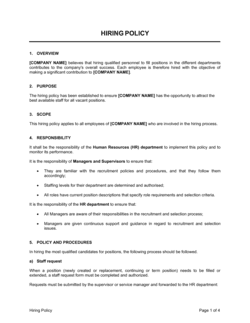
A Rules For Hiring document is a formal policy that establishes the legally binding procedures, standards, and obligations governing how a company recruits, screens, interviews, and selects job candidates. This free Word download gives you an editable, ready-to-sign framework you can adapt to your organization's size and jurisdiction, then export as PDF for internal distribution or HR record-keeping.
When you need it
Use it when formalizing your recruitment process for the first time, updating existing ad hoc practices after a complaint or audit, or building an HR policy library ahead of rapid headcount growth. It is also required by many government contracting agencies and institutional clients as a condition of doing business.
What's inside
The document covers equal opportunity and non-discrimination commitments, job posting and sourcing standards, candidate screening and background check procedures, interview panel requirements, offer and approval workflows, and recordkeeping obligations. It also includes prohibited inquiries, internal referral rules, and a signature block for employer acknowledgment.

What is a Rules For Hiring Document?

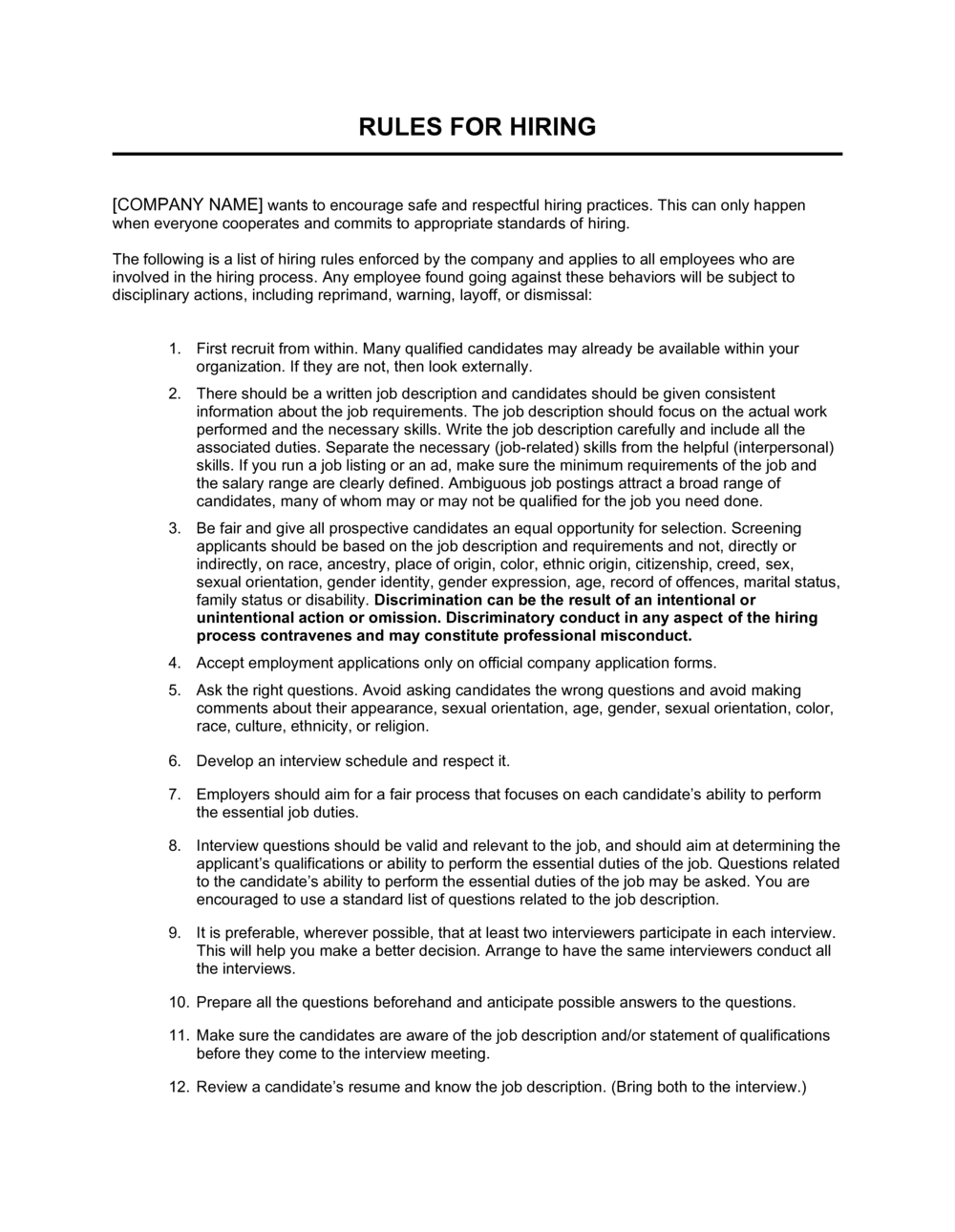
A Rules For Hiring document is a formal written policy that establishes the legally binding procedures, standards, and obligations an employer and its hiring staff must follow when recruiting, screening, interviewing, and selecting job candidates. It codifies equal opportunity commitments, defines who may authorize a job requisition, specifies which interview questions are prohibited, sets the timing and consent requirements for background checks, and creates a documented approval chain for extending offers. Unlike an employee handbook or a general HR policy, a rules for hiring document is structured to function as an auditable record of the company's commitment to fair, consistent, and legally compliant selection practices — one that can be produced directly in response to an EEOC charge, an OFCCP audit, or employment litigation.

Why You Need This Document

Without documented hiring rules, every recruitment decision is an undocumented judgment call — and undocumented judgment calls are the primary raw material of employment discrimination claims. When a rejected applicant files a charge with the EEOC or a provincial human rights tribunal, the first thing investigators ask for is the hiring file: the job posting, the screening criteria, the interview notes, the evaluation scores, and the documented reason for each selection decision. Companies that cannot produce a consistent paper trail face a presumption that their process was arbitrary or discriminatory. A formal Rules For Hiring policy closes that exposure by requiring that criteria be set before applications are reviewed, that evaluations be documented in writing, and that background checks follow — never precede — a conditional offer. It also protects against internal risk: hiring managers who extend verbal offers with non-standard terms, interviewers who ask prohibited questions, and HR staff who discard rejected applicant records before the statutory retention period all create liability that a signed, distributed policy directly addresses. This template gives you a defensible, jurisdiction-aware starting point in under an hour.

Which variant fits your situation?

If your situation is…Use this template
Formalizing hiring rules for a small business with under 25 employeesRules For Hiring (Small Business)
Establishing diversity and inclusion hiring commitmentsDiversity Recruitment Policy
Documenting a structured interview process with scoring rubricsInterview Evaluation Form
Capturing the full employee onboarding sequence after a hireEmployee Onboarding Checklist
Engaging a staffing agency or external recruiter under contractRecruitment Agency Agreement
Formalizing a referral bonus program for current employeesEmployee Referral Program Policy
Communicating hiring decisions to unsuccessful candidatesJob Application Rejection Letter

Common mistakes to avoid

❌ Changing minimum qualifications after applications are received

Why it matters: Adjusting criteria mid-review to favor a predetermined candidate is the most frequently cited basis for EEOC discrimination charges in recruitment. It creates a documented inconsistency between the job posting and the selection decision.

Fix: Document all screening criteria in the Job Requisition Form before any applications are opened and treat the form as a locked record for that posting cycle.

❌ Running background checks before a conditional offer is made

Why it matters: Under the FCRA and most state Ban the Box statutes, criminal history checks must follow — not precede — a conditional offer. Pre-offer checks that disqualify candidates expose the company to individual and class-action liability.

Fix: Build a hard procedural gate into your applicant tracking workflow: the background check authorization form is only released after the offer letter is countersigned by the candidate.

❌ Training only HR on prohibited interview questions

Why it matters: Line managers and department heads conduct the majority of interviews. A single prohibited question asked by an untrained interviewer creates full employer liability regardless of who asked it.

Fix: Require all employees who participate in any interview — even a 15-minute screening call — to complete annual prohibited-inquiry training and document that training in their personnel file.

❌ Discarding rejected applicant records after the position is filled

Why it matters: EEOC regulations require retention of all applicant records for one year from the date of the personnel action; federal contractors must retain them for two years. Premature destruction can be treated as spoliation of evidence in litigation.

Fix: Establish a calendar-based retention schedule and store all application materials — including interview notes and evaluation forms — in a centralized, access-controlled HR system for the full retention period.

❌ Allowing verbal offers with non-standard terms

Why it matters: A hiring manager who verbally promises a guaranteed bonus, a specific schedule, or remote-work arrangements that contradict the written offer creates an enforceable oral contract claim when the employee accepts.

Fix: State in the policy that no offer of employment is binding until issued in writing using the approved template, and that any verbal representations not reflected in the written offer are not terms of employment.

❌ Omitting a violations and reporting channel clause

Why it matters: Without a named reporting mechanism, employees who witness policy violations — discriminatory screening, falsified requisitions, retaliation — have no clear path to escalate, leaving the company without the internal-complaint defense in subsequent discrimination claims.

Fix: Name a specific reporting contact (HR Director title, not an individual's name) and an alternative confidential channel (ethics hotline or external ombudsperson) in the policy, and confirm both are active and monitored.

The 10 key clauses, explained

Purpose and scope

In plain language: States the document's objective — to govern all recruitment and selection activity — and identifies which positions, locations, and employment types it covers.

Sample language
These Rules For Hiring apply to all full-time, part-time, and fixed-term positions at [COMPANY NAME] across all [LOCATIONS / DEPARTMENTS] and govern every stage of the recruitment process from job requisition through offer acceptance.

Common mistake: Limiting scope to only full-time permanent roles. Leaving contractors, interns, or temporary workers outside the policy creates compliance gaps that regulators specifically audit.

Equal opportunity and non-discrimination commitment

In plain language: Affirms the company's legal obligation to make hiring decisions based solely on job-relevant qualifications, listing all protected characteristics covered by applicable law.

Sample language
[COMPANY NAME] is an equal opportunity employer. All hiring decisions are made without regard to race, color, religion, sex, national origin, age, disability, veteran status, sexual orientation, gender identity, or any other characteristic protected by applicable law.

Common mistake: Copying a generic EEO statement without updating the protected-class list to include characteristics added by recent state, provincial, or national legislation — leaving the company exposed to claims it didn't intend to exclude.

Job requisition and posting standards

In plain language: Defines who must authorize a new hire, how job descriptions are reviewed for bias, where positions must be posted, and the minimum posting period before a candidate is selected.

Sample language
All open positions require an approved Job Requisition Form signed by [HIRING MANAGER TITLE] and [HR DIRECTOR TITLE] before posting. Positions must be advertised for a minimum of [X] business days on [INTERNAL PORTAL] and at least one external channel before an offer is extended.

Common mistake: Authorizing a hire verbally and backdating the requisition. This creates a paper trail inconsistency that is routinely flagged in employment discrimination audits and OFCCP reviews.

Candidate screening and minimum qualifications

In plain language: Sets the criteria for advancing candidates from application to interview, specifies who conducts the initial screen, and requires that evaluation criteria be documented in advance.

Sample language
Screening criteria, including minimum qualifications and preferred qualifications, must be documented in the Job Requisition Form before any applications are reviewed. Applications shall be evaluated solely against these pre-established criteria by [HR COORDINATOR / RECRUITER].

Common mistake: Changing the minimum qualifications after reviewing applications to justify a predetermined preferred candidate. This is the single most common trigger for discrimination claims and EEOC charges.

Prohibited interview inquiries

In plain language: Lists the specific questions and topics interviewers may not ask or raise, directly or indirectly, because they solicit information about a protected characteristic.

Sample language
Interviewers shall not ask about or allow candidates to volunteer information regarding: age or date of birth, marital or family status, pregnancy or plans to have children, religion or religious observance, national origin or citizenship, disability unrelated to job performance, or arrest record without conviction.

Common mistake: Training only HR staff on prohibited questions while leaving line managers — who conduct most interviews — uninformed. A single unlawful question asked by a department head creates full employer liability.

Structured interview and evaluation process

In plain language: Requires that all candidates for the same role be asked the same predetermined questions, scored on a consistent rubric, and that written evaluations be retained in the hiring file.

Sample language
Each candidate for [POSITION TITLE] shall be assessed using the standardized Interview Evaluation Form attached as Schedule A. All interviewers must submit completed evaluation forms to HR within [2] business days of the interview. Verbal-only feedback is not permitted.

Common mistake: Using informal unscored interviews for early-stage candidates and only applying structured scoring to finalists. Inconsistent evaluation methodology across the funnel is treated as evidence of discriminatory screening.

Background check and reference check procedures

In plain language: Specifies the types of checks conducted, the timing (post-offer only), required written consent, and the individualized assessment process before any adverse action is taken on the basis of check results.

Sample language
Background checks shall be conducted only after a conditional offer of employment has been extended. Candidates must sign the Background Check Authorization Form before any check is initiated. Adverse action based on background check results requires a written individualized assessment considering the nature of the offense, time elapsed, and relevance to the role.

Common mistake: Running background checks before making an offer and using criminal history to screen applicants before the individualized-assessment stage — a violation of FCRA pre-adverse-action notice requirements and Ban the Box laws in more than 35 US states and cities.

Offer approval and issuance

In plain language: Defines the internal approval chain for extending an offer, the form the offer must take, and which terms require sign-off before the offer is sent.

Sample language
Offers of employment must be approved by [HIRING MANAGER], [HR DIRECTOR], and [CFO / BUDGET AUTHORITY] before issuance. All offers must be made in writing using the Company's standard offer letter template. Verbal offers not followed by a written offer within [2] business days are not binding on the Company.

Common mistake: Allowing hiring managers to extend verbal offers with non-standard terms — such as a guaranteed bonus or a specific remote-work arrangement — that the written offer later contradicts, creating an enforceable oral contract.

Recordkeeping and data retention

In plain language: Sets the minimum period for retaining application materials, interview notes, evaluation forms, and offer documentation for each posted position, including positions filled and those that were not.

Sample language
All application materials, interview evaluation forms, background check authorizations, and hiring decisions for each posted position must be retained for a minimum of [3] years from the date the position is filled or closed, regardless of whether an offer was made.

Common mistake: Discarding applications and interview notes for candidates who were not hired as soon as the position is filled. EEOC regulations require retention of all applicant records for one year from the personnel action; federal contractors must retain them for two years.

Policy violations and disciplinary consequences

In plain language: States that violations of these hiring rules — including unauthorized offers, prohibited inquiries, or falsified requisitions — are subject to disciplinary action up to and including termination.

Sample language
Any employee who violates these Rules For Hiring, including by making unauthorized offers, conducting prohibited inquiries, falsifying requisition approvals, or retaliating against a candidate who raises a complaint, is subject to disciplinary action up to and including immediate termination of employment.

Common mistake: Including a violation clause without a named reporting channel. Employees who witness a violation need a specific, confidential contact — typically HR or a compliance hotline — or the clause functions as a deterrent only on paper.

How to fill it out

  1. 1

    Insert the company's legal name and scope

    Replace all [COMPANY NAME] placeholders with the registered legal entity name. Confirm which positions, locations, and employment types are covered and update the scope clause accordingly.

    💡 If you operate in multiple states, provinces, or countries, list each jurisdiction in the scope clause — it protects you against claims that the policy didn't apply to a particular office.

  2. 2

    Update the protected-class list for your jurisdiction

    Start with the federal or national EEO baseline, then add characteristics protected under state, provincial, or municipal law in each location where you hire. Common additions include sexual orientation, gender identity, source of income, and arrest record.

    💡 Cross-reference your jurisdiction's current human rights or employment standards statute annually — protected classes are added more often than removed.

  3. 3

    Define the job requisition approval chain

    Enter the specific job titles — not department names — required to authorize a new hire. Include budget authority sign-off for any role above a salary threshold you define.

    💡 A two-signature minimum (hiring manager plus HR) is sufficient for most roles; add a CFO or CEO signature requirement for director-level and above.

  4. 4

    Set the minimum posting period and required channels

    Enter the number of business days a position must be posted internally before external candidates are considered, and list the mandatory external posting channels (company website, LinkedIn, job boards).

    💡 Federal contractors subject to OFCCP must list most jobs with the state employment service — confirm whether your contracts trigger this obligation before setting your channel list.

  5. 5

    Attach or reference the Interview Evaluation Form as Schedule A

    Either embed the evaluation rubric directly in Schedule A or reference a separately maintained form by title and version number. Confirm that the form is role-specific or has a configurable section for each position's core competencies.

    💡 Behavior-based questions scored on a 1–5 scale outperform yes/no checklists in predicting job performance and are more defensible in discrimination claims.

  6. 6

    Confirm background check timing and consent language

    Verify that the policy positions all background checks as post-conditional-offer, and that the Background Check Authorization Form referenced in the policy is a standalone document meeting FCRA (or local equivalent) requirements — not embedded in the application.

    💡 A background check consent buried in a multi-page application is often challenged as insufficiently conspicuous under FCRA and its state analogs — use a separate single-page authorization.

  7. 7

    Set the recordkeeping retention period

    Enter the retention period in years. Set a minimum of one year for non-federal-contractor employers and two years for federal contractors. Add a destruction protocol — secure shredding or certified digital deletion — for when records reach the end of their retention period.

    💡 Tie record destruction to a calendar-based purge cycle (e.g., every January 1) rather than individual file dates — this is far easier to administer consistently.

  8. 8

    Obtain signatures and distribute

    Have the HR Director or CHRO sign the policy to acknowledge company adoption, then distribute to all employees with hiring authority and retain signed acknowledgment forms in each employee's personnel file.

    💡 Reissue for signature whenever the policy is materially amended — undated or stale acknowledgments are treated the same as no acknowledgment in employment litigation.

Frequently asked questions

What is a rules for hiring document?

A rules for hiring document is a formal written policy that establishes the legally binding procedures an employer must follow when recruiting, screening, interviewing, and selecting candidates. It covers equal opportunity commitments, posting requirements, prohibited interview inquiries, background check timing, offer approval workflows, and recordkeeping obligations. It protects the company from discrimination claims by creating a documented, consistent, and auditable recruitment process.

Is a hiring policy legally required?

In the US, no federal law mandates a written hiring policy for private employers, but federal contractors with 50 or more employees and contracts of $50,000 or more must maintain written affirmative action plans under OFCCP regulations. In Canada, federally regulated employers and those subject to provincial human rights codes are expected to document non-discriminatory hiring practices. In the UK and EU, equal treatment directives effectively require documented, consistent procedures. Even where not strictly required, a written policy is the primary defense in employment discrimination claims.

What questions are illegal to ask in a job interview?

In most jurisdictions, interviewers may not ask about age, date of birth, marital or family status, pregnancy or childcare arrangements, religion or religious practices, national origin or citizenship, disability unrelated to the essential functions of the role, or arrest record without conviction. The exact list varies by country, state, and province — some jurisdictions also prohibit questions about salary history, credit history, and social media passwords. Rules For Hiring documents should list all prohibited inquiries applicable to each location where the company recruits.

When must background checks be conducted relative to a job offer?

Under the US Fair Credit Reporting Act and the Ban the Box ordinances in effect in more than 35 states and cities, criminal background checks must generally be conducted only after a conditional offer of employment has been made. Running checks before an offer — or using criminal history to screen applications before the individualized-assessment stage — violates both FCRA pre-adverse-action notice requirements and state-specific fair-chance hiring laws. Canada and the UK have equivalent restrictions under their respective privacy and human rights frameworks.

How long must applicant records be retained?

Under EEOC regulations, most US employers must retain all applicant records — including applications, interview notes, and evaluation forms for candidates who were not hired — for one year from the date of the personnel action. Federal contractors and subcontractors must retain them for two years. In Canada, most provincial human rights codes require retention for one year. In the UK, the ICO recommends retaining unsuccessful applicant data for no longer than six months unless longer retention is justifiable. EU GDPR guidance generally limits retention of candidate data to six months absent a legitimate business purpose.

What is the difference between a hiring policy and an employment contract?

A hiring policy governs the internal process the employer follows when selecting candidates — it is a procedural document binding on the company's employees who participate in hiring. An employment contract is a bilateral agreement between the employer and a specific new hire that governs the terms of the employment relationship. The hiring policy applies before an offer is made; the employment contract governs what happens after acceptance. Both documents are needed for a complete HR framework.

Do hiring rules apply to internal promotions and transfers?

Yes, in most well-drafted policies and in practice under EEO law. Internal candidates competing for a posted position must be evaluated against the same documented criteria as external applicants. Failing to apply consistent standards to internal and external candidates is a common basis for promotion-related discrimination claims. The policy should explicitly state whether internal-only postings require the same structured evaluation process as external searches.

What is adverse impact and how does a hiring policy address it?

Adverse impact occurs when a facially neutral hiring practice — a standardized test, a physical requirement, or a minimum education threshold — disproportionately screens out candidates from a protected class at a rate more than four-fifths (80%) of the majority group's selection rate. The EEOC's four-fifths rule is the primary analytical tool. A well-drafted hiring policy requires that all screening criteria be validated as job-related before use and that HR monitor selection rates by protected class on an annual basis.

Can a small business use a standard hiring rules template without legal review?

For a domestic employer with fewer than 15 employees and a single location, a well-drafted template typically covers the core requirements. Legal review is advisable when the employer is a federal contractor, operates in multiple jurisdictions with differing protected-class lists or Ban the Box ordinances, has more than 50 employees (triggering AAP obligations), or has previously received an EEOC charge or audit inquiry. A 1–2 hour employment attorney review costs $300–$600 and is worthwhile before the policy is formally adopted.

How this compares to alternatives

vs Employment Contract

An employment contract governs the terms of the working relationship between employer and a specific hire — compensation, duties, IP, and termination. Rules For Hiring govern the internal process used to reach the decision to extend that contract. The hiring policy applies before an offer is made; the employment contract applies after it is accepted. Both are required for a complete HR legal framework.

vs Job Offer Letter

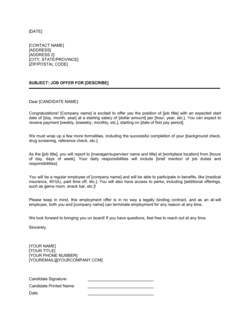
A job offer letter communicates the terms of employment to a specific candidate and invites acceptance. Rules For Hiring establish the internal standards and approval workflow that must be completed before that letter can be issued. The offer letter is a candidate-facing document; the hiring rules are an internal governance document. One cannot substitute for the other.

vs Employee Handbook

An employee handbook documents workplace policies that govern existing employees — conduct, benefits, PTO, and performance expectations. Rules For Hiring specifically govern the pre-employment recruitment and selection process. While the handbook may reference hiring practices at a high level, it lacks the procedural specificity — requisition approvals, prohibited inquiries, background check timing — that a standalone hiring policy provides.

vs Independent Contractor Agreement

An independent contractor agreement engages a self-employed worker for project-based work and deliberately avoids creating an employment relationship. Rules For Hiring apply to the selection of employees — not independent contractors — and the procedural protections they establish (EEO, structured interviews, FCRA-compliant background checks) are not legally required for contractor engagements. Misclassifying an employee as a contractor while bypassing hiring-policy protections compounds liability.

Industry-specific considerations

Technology / SaaS

High-volume technical screening pipelines require documented scoring rubrics for coding assessments to defend against adverse impact claims on standardized technical tests.

Healthcare

Licensing and credentialing verification must be built into the conditional-offer stage, and background checks must address OIG exclusion list screening in addition to standard criminal history.

Construction and Trades

Physical fitness requirements and pre-employment drug testing must be structured as post-offer medical examinations under ADA to avoid disability discrimination claims.

Financial Services

FINRA registration checks, credit history reviews for roles with fiduciary duties, and enhanced background check procedures require individualized assessment documentation tailored to regulatory standards.

Professional Services

Bar admission, CPA licensure, and professional certification verification are bona fide occupational qualifications that must be documented in job descriptions and requisition forms before screening begins.

Retail / Hospitality

High turnover and seasonal hiring volume make consistent structured interviews and standardized evaluation forms especially important for defending against systemic discrimination claims across large applicant pools.

Jurisdictional notes

United States

Title VII, the ADA, the ADEA, and the FCRA form the federal baseline for US hiring practices. Ban the Box ordinances restricting pre-offer criminal history inquiries are in effect in more than 35 states and cities. Federal contractors with 50 or more employees and contracts of $50,000 or more must maintain written Affirmative Action Plans under OFCCP regulations. State and municipal protected-class lists frequently exceed the federal baseline — California, New York City, and Illinois each add salary history bans, credit check restrictions, and additional protected characteristics.

Canada

The Canadian Human Rights Act prohibits discrimination in federally regulated workplaces; each province has its own human rights code governing provincially regulated employers. The Personal Information Protection and Electronic Documents Act (PIPEDA) and provincial privacy statutes restrict how applicant data is collected, used, and retained. Background check consent must comply with PIPEDA requirements. Quebec's Act Respecting the Protection of Personal Information in the Private Sector imposes additional requirements for employers operating in Quebec.

United Kingdom

The Equality Act 2010 prohibits discrimination across nine protected characteristics at every stage of recruitment. Employers must not ask about health or disability before making a conditional offer except in specific permitted circumstances. The UK GDPR and the Data Protection Act 2018 govern the collection and retention of applicant data — the ICO recommends retaining unsuccessful applicant data for no longer than six months. References and background checks must comply with data protection obligations, and candidates have a right of access to information held about them.

European Union

The EU Equal Treatment Framework Directive and member-state employment laws prohibit discrimination in recruitment across a broad set of protected grounds. GDPR Article 6 requires a lawful basis for processing candidate personal data — typically legitimate interest or consent — and Article 17 gives candidates the right to erasure once the recruitment purpose is fulfilled. Data protection impact assessments may be required for automated applicant screening tools. Member-state implementations vary significantly in enforcement approach; France, Germany, and the Netherlands impose some of the strictest documentation and transparency requirements.

Template vs lawyer — what fits your deal?

PathBest forCostTime
Use the templatePrivate employers under 50 employees, single domestic location, no government contractsFree30–60 minutes to customize
Template + legal reviewMulti-state employers, federal contractors, or companies that have received an EEOC inquiry$300–$600 (1–2 hours of employment attorney review)2–5 business days
Custom draftedEmployers with AAP obligations, multi-country hiring, regulated industries, or prior discrimination litigation$1,500–$5,000+2–4 weeks

Glossary

Equal Employment Opportunity (EEO)
A legal principle requiring that all hiring decisions be based on job-relevant qualifications, free from discrimination based on race, color, sex, religion, national origin, disability, or age.
Bona Fide Occupational Qualification (BFOQ)
A narrow legal exception that permits a job requirement that would otherwise be discriminatory when it is genuinely essential to perform the role — for example, requiring a specific age for certain safety-sensitive positions.
Adverse Impact
When a neutral hiring practice — such as a standardized test — disproportionately screens out candidates from a protected class at a rate significantly higher than the majority group.
Structured Interview
An interview process in which every candidate is asked the same predetermined, job-relevant questions in the same order, with responses scored against a consistent rubric.
Background Check Authorization
Written consent obtained from a candidate before the employer conducts a criminal history, credit, or reference check — required by the FCRA in the US and by privacy laws in most jurisdictions.
Reasonable Accommodation
An adjustment to the application or interview process that allows a qualified candidate with a disability to participate equally, required under the ADA in the US and equivalent legislation elsewhere.
Affirmative Action Plan (AAP)
A written program that federal contractors and certain large employers use to proactively increase representation of underrepresented groups in their workforce through documented hiring goals and outreach.
Applicant Tracking
The practice of maintaining a record of all applicants, screening decisions, and selection reasons for each posted position — required for EEO compliance and audit defense.
Prohibited Inquiry
A question that an interviewer is legally barred from asking because it solicits information about a protected characteristic — such as age, marital status, pregnancy, religion, or national origin.
Conditional Offer of Employment
A job offer made contingent on the successful completion of post-offer requirements such as a background check, drug test, or medical examination before the start date.
Internal Referral Policy
Rules governing when and how current employees may recommend candidates for open positions, including disclosure requirements and any bonus or incentive structure.

Part of your Business Operating System

This document is one of 3,000+ business & legal templates included in Business in a Box.

  • Fill-in-the-blanks — ready in minutes
  • 100% customizable Word document
  • Compatible with all office suites
  • Export to PDF and share electronically

Create your document in 3 simple steps.

From template to signed document — all inside one Business Operating System.
1
Download or open template

Access over 3,000+ business and legal templates for any business task, project or initiative.

2
Edit and fill in the blanks with AI

Customize your ready-made business document template and save it in the cloud.

3
Save, Share, Send, Sign

Share your files and folders with your team. Create a space of seamless collaboration.

Save time, save money, and create top-quality documents.

★★★★★

"Fantastic value! I'm not sure how I'd do without it. It's worth its weight in gold and paid back for itself many times."

Managing Director · Mall Farm
Robert Whalley
Managing Director, Mall Farm Proprietary Limited
★★★★★

"I have been using Business in a Box for years. It has been the most useful source of templates I have encountered. I recommend it to anyone."

Business Owner · 4+ years
Dr Michael John Freestone
Business Owner
★★★★★

"It has been a life saver so many times I have lost count. Business in a Box has saved me so much time and as you know, time is money."

Owner · Upstate Web
David G. Moore Jr.
Owner, Upstate Web

Run your business with a system — not scattered tools

Stop downloading documents. Start operating with clarity. Business in a Box gives you the Business Operating System used by over 250,000 companies worldwide to structure, run, and grow their business.

Start free · No credit card required