Recruitment and Hiring Policy Template

Free Word download β€’ Edit online β€’ Save & share with Drive β€’ Export to PDF

3 pagesβ€’20–25 min to fillβ€’Difficulty: Standard
Learn more ↓
FreeRecruitment and Hiring Policy Template

At a glance

What it is
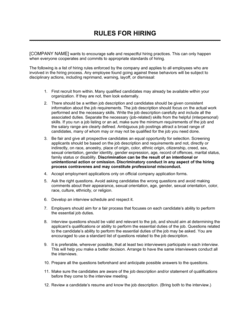
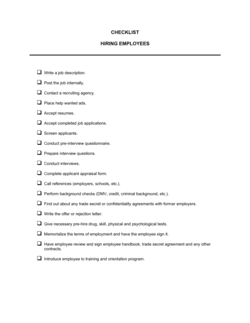
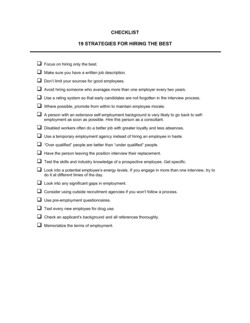
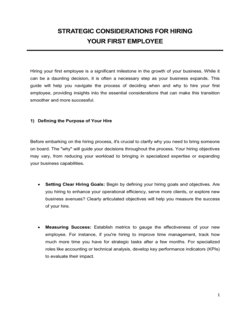
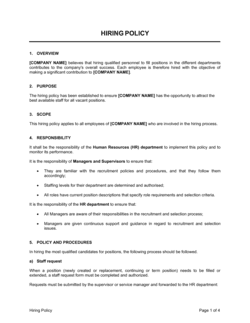
A Recruitment and Hiring Policy is an internal operational document that standardizes every stage of the hiring process β€” from opening a requisition to making an offer β€” so that all hiring managers follow the same procedures and criteria. This free Word download gives you a structured, editable starting point you can tailor to your company's size, industry, and compliance requirements, then export as PDF for distribution to your HR team.
When you need it
Use it when your company is growing beyond informal hiring practices and needs consistent, documented procedures. It is also required when preparing for an HR audit, responding to an equal-opportunity compliance review, or onboarding a dedicated HR function for the first time.
What's inside
The policy covers purpose and scope, equal opportunity and non-discrimination commitments, job requisition and approval workflows, job posting standards, candidate screening and interview procedures, selection criteria, background check requirements, offer letter and onboarding handoff processes, and record-keeping obligations.

What is a Recruitment and Hiring Policy?

A Recruitment and Hiring Policy is an internal operational document that standardizes every stage of the hiring process β€” from submitting a job requisition through extending an offer letter β€” so that all hiring managers and HR staff follow the same approved procedures and evaluation criteria. It defines who can open a position, how roles are advertised, how candidates are screened and interviewed, who holds final selection authority, when background checks are run, and how long applicant records must be retained. By documenting these steps in a single reference document, the policy replaces informal, manager-by-manager hiring practices with a consistent, auditable process that applies equally across all departments and locations.

Why You Need This Document

Without a written recruitment policy, your hiring process is only as consistent as the manager running it. Inconsistent practices create measurable risks: pay-equity gaps emerge when different managers negotiate compensation differently; EEO audits reveal that candidates for the same role were asked different questions and evaluated on different criteria; and background checks run at the wrong stage of the process expose the company to ban-the-box violations. Beyond compliance, undocumented processes slow hiring down β€” every new requisition triggers a fresh round of debates about who approves what and which job boards to use. A formal recruitment and hiring policy eliminates that friction, gives every hiring manager a clear playbook, and creates the paper trail you need to defend any selection decision if it is later challenged.

Which variant fits your situation?

If your situation is…Use this template
Company with under 15 employees needing a lightweight processSimple Hiring Checklist
Government contractor required to maintain OFCCP-compliant recordsAffirmative Action Hiring Policy
Company that engages independent contractors in addition to employeesContractor Engagement and Hiring Policy
Organization running structured campus or graduate recruitment programsCampus Recruitment Policy
Company needing to document internal promotion and transfer proceduresInternal Mobility and Promotion Policy
Business that relies heavily on seasonal or temporary staffTemporary Staffing Policy
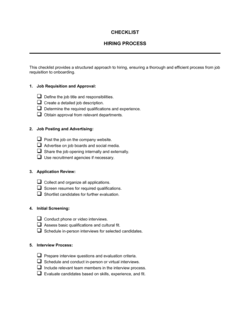
HR team needing a step-by-step checklist to accompany the policyRecruitment Process Checklist

Common mistakes to avoid

❌ Skipping the requisition approval step

Why it matters: Hiring managers who post roles without budget approval create headcount commitments the company cannot honor. Rescinded offers damage employer brand and can trigger legal claims in some jurisdictions.

Fix: Add a hard gate in your ATS or HRIS: no job posting can be published without a requisition ID linked to an approved form.

❌ Using unstructured interviews across all roles

Why it matters: Unstructured interviews produce inconsistent, undocumented feedback that makes candidate comparisons unreliable and selection decisions indefensible in an EEO audit.

Fix: Build and reference a role-specific question bank for each department, and require completed scorecards from every interviewer before the debrief meeting.

❌ Running background checks before a conditional offer

Why it matters: Ban-the-box laws in many US cities and states prohibit inquiring into criminal history before a conditional offer is made. Violations carry fines and discrimination claim exposure.

Fix: Sequence background checks explicitly as a post-offer step in the policy and train all hiring managers on this sequence during onboarding.

❌ Discarding rejected applicant records immediately after a hiring decision

Why it matters: EEOC regulations require employers to retain applicant records for one year from the date of the hiring decision; federal contractors must retain them for two years. Early deletion eliminates your ability to defend a discrimination charge.

Fix: Set ATS retention rules to archive all applicant data automatically for the applicable period and document the deletion schedule in the record-keeping section of this policy.

The 10 key sections, explained

Purpose and scope

Equal opportunity and non-discrimination statement

Job requisition and approval process

Job posting and advertising standards

Candidate screening and shortlisting

Interview process and evaluation

Selection decision and approval

Background checks and pre-employment verification

Offer letter and compensation authorization

Record-keeping and data retention

How to fill it out

  1. 1

    Define the scope and employee categories

    Specify which employment types the policy covers β€” full-time, part-time, fixed-term, intern β€” and which business units or locations are subject to it. Note any roles explicitly excluded and why.

    πŸ’‘ If your company operates in multiple states or countries, add a line confirming that local law governs where it conflicts with this policy.

  2. 2

    Customize the EEO and non-discrimination statement

    Review the protected characteristics listed and confirm they include every class required by the laws of each jurisdiction where you hire. Add state or local classes (e.g., sexual orientation, source of income) not covered by the federal baseline.

    πŸ’‘ Check your state's Fair Employment Practices Act β€” many states protect more classes than Title VII requires.

  3. 3

    Map your requisition and approval workflow

    Fill in the specific approvers, forms, and systems used at your company. Name the job titles β€” not just 'management' β€” who must sign off at each stage, and confirm the approval chain matches your current org structure.

    πŸ’‘ Set a maximum approval turnaround time (e.g., 5 business days) for each stage to prevent requisitions from stalling silently.

  4. 4

    Set posting requirements and internal notification rules

    Specify which job boards are approved, the minimum posting duration, and when internal candidates must be notified before external advertising begins.

    πŸ’‘ Standardizing your job title taxonomy here β€” before posting β€” prevents the pay-equity reporting problems caused by inconsistent role names across requisitions.

  5. 5

    Define screening criteria and interview structure

    List the minimum qualifications for advancement at each screening stage and confirm the structured interview format β€” question bank, scorecard, and panel composition β€” to be used for each role category.

    πŸ’‘ Attach your standard Candidate Scorecard template as an appendix so interviewers have it in the same document as the policy.

  6. 6

    Specify background check scope by role type

    Categorize roles by the type of check required (criminal, credit, education verification, reference checks) and confirm the timing β€” checks must follow a conditional offer in most US jurisdictions.

    πŸ’‘ Cross-reference ban-the-box laws for every city and state where you hire before finalizing this section.

  7. 7

    Complete offer letter authorization details

    Name the specific approvers for offer letters and any off-band compensation, and confirm the salary bands are documented in a referenced compensation framework.

    πŸ’‘ Reference the compensation band document by name rather than embedding salary ranges in the policy β€” bands change annually and you want to update them in one place.

  8. 8

    Set record-retention periods and storage locations

    Enter the retention period for each record type and name the specific system β€” ATS, HRIS, or shared drive folder β€” where records are stored. Confirm deletion or anonymization procedures for records past their retention window.

    πŸ’‘ Three years is the safe minimum for EEOC compliance in the US; check your state for any longer requirements before setting a shorter period.

Frequently asked questions

What is a recruitment and hiring policy?

A recruitment and hiring policy is an internal document that defines the standardized procedures an organization follows to identify, attract, evaluate, and select candidates for open positions. It covers the full cycle from job requisition approval through offer letter issuance, ensuring every hiring decision is consistent, equitable, and compliant with applicable employment laws. It also provides hiring managers and HR with a shared reference for roles, responsibilities, and timelines.

Why does a company need a formal hiring policy?

Without a formal policy, hiring decisions vary by manager and department, creating pay-equity inconsistencies, EEO audit vulnerabilities, and candidate experience problems. A written policy ensures that every open role goes through the same approval, posting, screening, and selection steps β€” making outcomes auditable and defensible. It also speeds up hiring by eliminating the time spent reinventing the process for each new requisition.

What should a recruitment policy include?

A complete recruitment policy covers purpose and scope, an equal opportunity commitment, the job requisition and approval workflow, posting and advertising standards, candidate screening criteria, structured interview requirements, selection decision authority, background check scope and timing, offer letter authorization, and record-keeping obligations. Omitting any of these sections creates procedural gaps that tend to surface during audits or discrimination claims.

How is a recruitment policy different from a job description?

A job description defines the requirements, duties, and qualifications for a specific open role. A recruitment policy governs the process used to fill any role β€” it is role-agnostic and covers every step from requisition to offer. Both documents are required: the policy tells hiring managers how to hire; the job description tells candidates what they are being hired for.

Does a small business need a recruitment policy?

Any company making multiple hires per year benefits from a written policy. For businesses with fewer than 15 employees, a simplified version covering the key steps is sufficient. Once a company crosses 15 employees, US federal anti-discrimination laws (Title VII, ADA, ADEA) apply, making documented and consistent hiring procedures a legal compliance requirement, not just a best practice.

How often should a recruitment and hiring policy be reviewed?

Review the policy at least annually, or immediately when relevant employment laws change β€” such as new ban-the-box ordinances, salary history inquiry bans, or updated EEOC guidance. It should also be reviewed whenever the company enters a new state or country, changes its ATS or HRIS, or significantly restructures its hiring volume or team composition.

What is a structured interview and why does the policy require it?

A structured interview uses a predetermined set of questions asked consistently to every candidate for a given role, with responses scored against defined criteria on a candidate scorecard. Structured interviews produce more reliable, comparable candidate evaluations than unstructured conversations and are significantly more defensible in equal-opportunity audits. Most hiring policies require structured formats for any role above entry level.

When should background checks be conducted in the hiring process?

Background checks should be conducted only after a conditional offer has been extended and accepted. Conducting checks earlier in the process violates ban-the-box laws in many US cities and states, which prohibit criminal history inquiries before a conditional offer. The policy should explicitly sequence background checks as a post-offer step and require written candidate consent before initiating any check.

How this compares to alternatives

vs Employee Handbook

An employee handbook is a broad reference document covering all HR policies for existing employees β€” conduct, benefits, leave, and performance. A recruitment and hiring policy is process-specific, governing only how candidates are sourced, evaluated, and selected before they become employees. Many companies include a summary of hiring values in the handbook and maintain the detailed recruitment procedure as a standalone operational document.

vs Job Description

A job description defines the specific duties, qualifications, and requirements for a single open role. A recruitment policy governs the process used to fill any role. The job description is an input to the recruitment process; the policy defines how that process runs. Both are required but serve entirely different functions.

vs Onboarding Plan

An onboarding plan governs what happens after a candidate accepts an offer β€” their first 30, 60, and 90 days. A recruitment policy governs everything up to and including the offer. The two documents are designed to hand off cleanly: the recruitment policy ends when the offer letter is signed; the onboarding plan begins on day one.

vs Performance Review Template

A performance review template documents how existing employees are evaluated against role expectations after hire. A recruitment policy ensures the right people are selected in the first place. Together they form a continuous talent lifecycle, but they govern entirely separate stages β€” pre-hire versus post-hire β€” and should not be conflated.

Industry-specific considerations

Technology / SaaS

High hiring velocity requires automated ATS-gated requisition approvals, standardized technical screening rubrics, and explicit IP and confidentiality disclosures embedded in the offer process.

Healthcare

Credentialing verification, license checks, and abuse registry screenings are mandatory pre-hire steps that must be built into the background check section of the policy.

Financial Services

FINRA registration requirements, credit history checks for roles with fiduciary responsibility, and regulatory fit-and-propriety assessments require a dedicated screening section in the policy.

Retail / Hospitality

High turnover and seasonal hiring mean the policy must accommodate rapid-cycle recruitment with streamlined approval tiers and clear temporary-to-permanent conversion procedures.

Template vs pro β€” what fits your needs?

PathBest forCostTime
Use the templateCompanies under 100 employees formalizing their hiring process for the first timeFree2–4 hours to customize and review
Template + professional reviewCompanies hiring across multiple US states or internationally, or preparing for an HR audit$300–$800 for an HR consultant or employment attorney review3–5 business days
Custom draftedGovernment contractors, publicly traded companies, or organizations with complex EEO reporting obligations$1,500–$5,000 for a full HR policy suite custom-drafted by an employment law firm2–4 weeks

Glossary

Job Requisition
A formal internal request submitted by a hiring manager to open a new or backfill position, typically requiring budget and headcount approval before posting.
Applicant Tracking System (ATS)
Software used to collect, organize, and manage job applications and candidate records throughout the hiring process.
Job Description
A written document specifying a role's title, duties, qualifications, reporting structure, and compensation range.
Structured Interview
An interview format in which every candidate is asked the same predetermined questions scored against consistent criteria, reducing interviewer bias.
Background Check
A verification process that confirms a candidate's employment history, credentials, criminal record, and sometimes credit history prior to an offer being finalized.
Offer Letter
A written document extended to a selected candidate confirming the role, start date, compensation, and key employment terms β€” typically contingent on background check results.
Equal Employment Opportunity (EEO)
A legal and policy commitment to evaluate all candidates on job-related criteria without regard to race, gender, age, disability, religion, or other protected characteristics.
Hiring Manager
The manager of the department with the open role, responsible for defining requirements, conducting interviews, and making the final selection recommendation.
Onboarding
The structured process of integrating a new hire into the organization β€” covering system access, training, introductions, and early performance expectations.
Candidate Scorecard
A standardized evaluation form used by interviewers to rate candidates against defined competencies and qualifications after each interview stage.

Part of your Business Operating System

This document is one of 3,000+ business & legal templates included in Business in a Box.

  • Fill-in-the-blanks β€” ready in minutes
  • 100% customizable Word document
  • Compatible with all office suites
  • Export to PDF and share electronically

Create your document in 3 simple steps.

From template to signed document β€” all inside one Business Operating System.
1
Download or open template

Access over 3,000+ business and legal templates for any business task, project or initiative.

2
Edit and fill in the blanks with AI

Customize your ready-made business document template and save it in the cloud.

3
Save, Share, Send, Sign

Share your files and folders with your team. Create a space of seamless collaboration.

Save time, save money, and create top-quality documents.

β˜…β˜…β˜…β˜…β˜…

"Fantastic value! I'm not sure how I'd do without it. It's worth its weight in gold and paid back for itself many times."

Managing Director Β· Mall Farm
Robert Whalley
Managing Director, Mall Farm Proprietary Limited
β˜…β˜…β˜…β˜…β˜…

"I have been using Business in a Box for years. It has been the most useful source of templates I have encountered. I recommend it to anyone."

Business Owner Β· 4+ years
Dr Michael John Freestone
Business Owner
β˜…β˜…β˜…β˜…β˜…

"It has been a life saver so many times I have lost count. Business in a Box has saved me so much time and as you know, time is money."

Owner Β· Upstate Web
David G. Moore Jr.
Owner, Upstate Web

Run your business with a system β€” not scattered tools

Stop downloading documents. Start operating with clarity. Business in a Box gives you the Business Operating System used by over 250,000 companies worldwide to structure, run, and grow their business.

Free Forever PlanΒ Β·Β No credit card required