Hiring Policy Template

Free Word download β€’ Edit online β€’ Save & share with Drive β€’ Export to PDF

4 pagesβ€’20–25 min to fillβ€’Difficulty: Standard
Learn more ↓
FreeHiring Policy Template

At a glance

What it is
A Hiring Policy is an internal operational document that defines how an organization recruits, evaluates, selects, and onboards new employees. This free Word download gives you a structured, editable template covering every stage of the hiring process β€” from job requisition approval through offer extension β€” that you can adapt to your company's size and culture and export as PDF for distribution to managers and HR staff.
When you need it
Use it when your company is growing past the point where informal hiring practices are sufficient β€” typically at 10 or more employees β€” or when inconsistent recruitment decisions create legal exposure, equity concerns, or poor hire quality. It is also required as part of an employee handbook or HR compliance audit.
What's inside
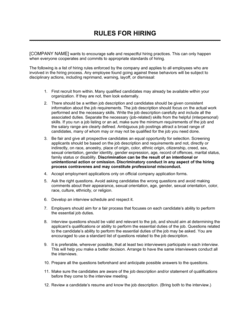
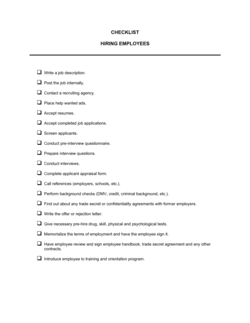
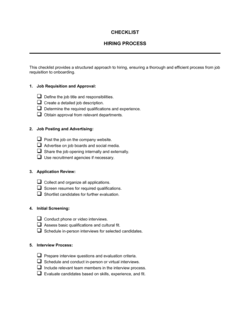
Purpose and scope, equal opportunity commitment, job requisition and approval process, job posting standards, candidate sourcing and screening guidelines, interview structure and evaluation criteria, background check and reference check procedures, offer and negotiation guidelines, and onboarding handoff steps.

What is a Hiring Policy?

A Hiring Policy is an internal operational document that defines the standardized process a company follows to recruit, evaluate, select, and onboard new employees. It covers every stage from the initial job requisition and internal posting through candidate screening, structured interviews, background checks, offer approval, and the handoff to onboarding β€” establishing consistent rules that every manager and HR team member is expected to follow. Unlike an employment contract, which governs the relationship with a specific individual after hiring, a hiring policy governs how all hiring decisions are made before any individual is selected.

Why You Need This Document

Without a written hiring policy, recruitment practices vary by manager, by department, and by how busy the team is at the time β€” producing wildly inconsistent candidate experiences, pay equity disparities between comparable roles, and selection decisions that cannot be defended if challenged. The legal exposure is concrete: when a rejected candidate files an EEOC complaint, the first thing an investigator requests is your documented process. If none exists, the absence itself becomes evidence. Beyond compliance, inconsistent hiring drives poor hire quality, increases time-to-fill, and creates the internal pay equity gaps that compound into costly correction programs down the line. This template gives you a defensible, actionable process you can put in place in hours β€” not weeks β€” and adapt as your team grows.

Which variant fits your situation?

If your situation is…Use this template
Documenting the full HR function for a growing companyEmployee Handbook
Setting rules for employee conduct once hiredCode of Conduct Policy
Defining terms of employment for a new hireEmployment Contract
Onboarding a new employee after hiring is completeEmployee Onboarding Checklist
Sourcing contractors rather than employeesIndependent Contractor Agreement
Managing performance after the hirePerformance Review Template
Documenting the promotion or transfer processJob Promotion Letter

Common mistakes to avoid

❌ No internal posting requirement

Why it matters: Posting externally without an internal period signals to current employees that advancement opportunities bypass them, driving avoidable turnover among your strongest performers.

Fix: Require a minimum 5-business-day internal posting for all non-confidential roles and track whether internal candidates were given genuine consideration.

❌ Unstructured interviews with no scorecard

Why it matters: Without a common scoring rubric, interviewers compare incompatible impressions β€” and selection decisions reflect personal affinity rather than job-related qualifications, increasing bias exposure.

Fix: Require each interviewer to rate candidates against predefined competencies on a 1–5 scale and submit the scorecard within 24 hours of the interview.

❌ Running background checks before a conditional offer

Why it matters: Ban-the-box laws in over 35 US states and cities prohibit or restrict criminal history inquiries before a conditional offer is extended, and violations carry significant fines.

Fix: Sequence background checks after a conditional written offer is made and clearly state that the offer is contingent on satisfactory results.

❌ Allowing salary negotiation outside approved bands

Why it matters: Ad hoc exceptions to approved compensation ranges compound into systemic pay equity disparities that become expensive to correct and expose the company to pay discrimination claims.

Fix: Require VP or Finance approval for any offer above the approved band midpoint and document the business justification for every exception.

The 9 key sections, explained

Purpose and scope

Equal opportunity and non-discrimination commitment

Job requisition and approval process

Job posting and advertising standards

Candidate sourcing and screening

Interview process and evaluation

Background and reference checks

Offer, negotiation, and approval

Onboarding handoff

How to fill it out

  1. 1

    Customize the purpose and scope section

    Replace all placeholder company names and define which employee categories and locations the policy covers. Confirm whether it applies to contractors and temporary workers as well as direct hires.

    πŸ’‘ Scope decisions made here cascade through every other section β€” a policy that says 'all hires' needs interview and background check procedures that work for contractors too.

  2. 2

    Confirm your equal opportunity and protected-class list

    Start with federal protected classes, then add state and local protected characteristics for every jurisdiction where you hire. Review your legal counsel's list or an employment law resource for your operating states.

    πŸ’‘ If you hire in California, New York, or Illinois, your protected-class list will be materially longer than the federal minimum β€” omissions create real liability.

  3. 3

    Define your requisition approval chain

    Map the specific titles required to approve new and backfill positions β€” typically the hiring manager's direct manager and a Finance or budget owner. Set a target turnaround time for approval.

    πŸ’‘ Cap the approval chain at two levels for roles below director. Three or more approval layers slow time-to-fill and cause candidates to accept competing offers.

  4. 4

    Set internal posting requirements

    Define the number of business days a role must be posted internally before external advertising begins, and specify any roles exempt from the internal posting requirement.

    πŸ’‘ Five business days is a common standard. Exempt roles typically include confidential replacements and C-suite searches.

  5. 5

    Build your standard interview structure

    Define the number of rounds, who participates in each, whether a skills assessment is required, and the scorecard format interviewers must use. Tie each round to specific competencies from the job description.

    πŸ’‘ Limit interview panels to three people. More than three introduces scheduling drag and rarely adds decision quality.

  6. 6

    Set background check scope by role category

    Group roles into two or three tiers based on access level β€” standard, financial authority, and sensitive data β€” and specify what each tier requires. Name the approved vendor.

    πŸ’‘ Document your adverse-action process alongside the background check scope. A defined process is required under the Fair Credit Reporting Act for US employers.

  7. 7

    Define compensation approval thresholds

    Enter the specific title or level required to approve offers at the midpoint, between midpoint and maximum, and above the approved band. Link this section to your current compensation structure or salary bands document.

    πŸ’‘ Revisit these thresholds annually β€” compensation bands shift with market data, and stale approval thresholds push managers to seek exceptions rather than follow the process.

  8. 8

    Assign onboarding ownership and deadlines

    Name the specific teams responsible for each pre-start task β€” IT provisioning, I-9 completion, benefits enrollment, workspace setup β€” and set a deadline for each relative to the start date.

    πŸ’‘ A shared onboarding checklist linked from this policy prevents tasks from falling through the gap between HR and the hiring manager.

Frequently asked questions

What is a hiring policy?

A hiring policy is an internal document that defines how a company recruits, evaluates, selects, and onboards new employees. It sets the rules for job posting, candidate screening, interview structure, background checks, offer approval, and onboarding handoff. Its purpose is to make hiring decisions consistent, legally defensible, and aligned with the company's compensation and culture standards.

Why does a company need a formal hiring policy?

Without a formal policy, hiring decisions depend entirely on individual manager judgment β€” which produces inconsistent candidate experiences, pay equity problems, and legal exposure when protected-class candidates are rejected without documented, job-related reasons. A written policy gives managers a clear process to follow, gives HR a basis to intervene when steps are skipped, and provides an audit trail if a hiring decision is ever challenged.

At what company size should you implement a hiring policy?

Most employment law advisors recommend formalizing hiring practices by the time a company reaches 15 employees β€” the threshold at which Title VII, the ADA, and other federal anti-discrimination statutes apply in the US. In practice, companies benefit from a written policy even earlier: by the time you have 10 employees and multiple managers making independent hiring decisions, inconsistency and bias risk are already present.

What is the difference between a hiring policy and an employee handbook?

A hiring policy covers only the pre-employment phase β€” requisition through onboarding. An employee handbook is a comprehensive document governing all aspects of the employment relationship: conduct, benefits, performance, leave, and discipline. The hiring policy is typically incorporated by reference into the handbook as a standalone exhibit or linked appendix.

Does a hiring policy need to address internal candidates?

Yes. A complete hiring policy specifies whether open roles must be posted internally first, how long the internal posting period runs, whether internal candidates go through the same interview process as external ones, and how internal offers interact with existing compensation structures. Omitting internal mobility rules creates inconsistent treatment that undermines employee trust and retention.

What background check rules should a hiring policy address?

The policy should specify which roles require which checks, which vendor is approved, when in the process checks are initiated (after a conditional offer in most US jurisdictions), how adverse results trigger an individualized assessment, and how the company provides the required pre-adverse-action notice under the Fair Credit Reporting Act. State rules vary significantly β€” California, New York, and Massachusetts each have additional requirements beyond the federal baseline.

How often should a hiring policy be reviewed and updated?

Review the policy at least annually, and also whenever there is a significant change in applicable employment law, a new operating location in a different jurisdiction, a material change in hiring volume, or feedback from an audit or discrimination complaint. The pay transparency and salary-range disclosure laws enacted in California, Colorado, New York, and Illinois between 2021 and 2023 are a recent example of changes that required immediate policy updates.

Should hiring managers or only HR be responsible for following the policy?

Both. HR owns the policy and is responsible for training, compliance monitoring, and record-keeping. Hiring managers are responsible for following the requisition, interview, and offer approval steps within their authority. Policies that assign all responsibility to HR consistently fail in practice because managers make most selection decisions and will default to informal behavior without clear personal accountability written into the document.

How this compares to alternatives

vs Employee Handbook

An employee handbook is a comprehensive reference document covering all aspects of employment β€” conduct, benefits, leave, and discipline. A hiring policy focuses exclusively on the pre-employment phase from requisition to onboarding. Most companies embed the hiring policy as a section or appendix within the handbook rather than distributing it as a standalone document to all staff.

vs Job Description Template

A job description defines the duties, qualifications, and reporting structure for a single role. A hiring policy governs the process used to fill any role β€” how requisitions are approved, how candidates are screened, and how offers are extended. The job description is an input to the hiring process; the hiring policy is the process itself.

vs Employment Contract

An employment contract is a binding legal agreement between the employer and a specific hired individual, covering compensation, IP, confidentiality, and termination. A hiring policy is an internal operational document that governs how the company conducts recruitment before any individual is selected. The contract activates after the policy's process concludes.

vs Onboarding Checklist

An onboarding checklist is a task-level tool for preparing a specific new hire's first day and first 30 days. A hiring policy defines at a higher level who is responsible for onboarding activities and what standards they must meet. The checklist operationalizes the onboarding section of the hiring policy for each individual hire.

Industry-specific considerations

Technology / SaaS

Defines technical assessment rounds, remote-hire onboarding workflows, and equity compensation disclosure requirements during the offer process.

Healthcare

Incorporates credentialing and licensure verification as mandatory pre-start conditions, with OIG exclusion list checks required for any role billing to federal programs.

Professional Services

Addresses lateral hire conflicts of interest, client non-solicitation confirmations from prior employers, and reference check protocols for client-facing roles.

Retail / Hospitality

Handles high-volume hourly hiring with streamlined screening steps, variable-schedule disclosure at the offer stage, and faster onboarding timelines to match rapid start dates.

Template vs pro β€” what fits your needs?

PathBest forCostTime
Use the templateCompanies under 100 employees building a standardized hiring process for the first timeFree2–4 hours to customize and distribute
Template + professional reviewCompanies hiring across multiple US states or internationally, or those facing an EEO audit$300–$800 for an employment attorney review3–5 business days
Custom draftedEnterprise HR departments with complex approval hierarchies, union environments, or federal contractor status$1,500–$4,000 for a custom policy suite2–4 weeks

Glossary

Job Requisition
A formal internal request to open a new or backfill position, typically requiring manager and budget approval before recruitment begins.
Job Description
A written document specifying the title, duties, required qualifications, reporting structure, and compensation range for an open role.
Sourcing
The proactive activities used to identify and attract candidates β€” including job boards, employee referrals, LinkedIn, and recruitment agencies.
Structured Interview
An interview format in which every candidate is asked the same predetermined questions and evaluated against the same scoring rubric.
Background Check
A third-party verification of a candidate's criminal record, employment history, education credentials, and in some roles, credit history.
Equal Employment Opportunity (EEO)
The legal principle that hiring decisions must be based on job-related qualifications and not on protected characteristics such as race, gender, age, or religion.
Offer Letter
A written document extending employment to a selected candidate, stating the role, start date, compensation, and any conditions of the offer.
Candidate Scorecard
A standardized evaluation form interviewers complete after each candidate meeting, rating responses against predefined competencies.
Internal Mobility
The policy practice of posting open roles internally first and giving current employees the opportunity to apply before external recruiting begins.
Probationary Period
A defined initial employment period β€” typically 30 to 90 days β€” during which the new hire's performance is formally assessed before confirmation of permanent status.

Part of your Business Operating System

This document is one of 3,000+ business & legal templates included in Business in a Box.

  • Fill-in-the-blanks β€” ready in minutes
  • 100% customizable Word document
  • Compatible with all office suites
  • Export to PDF and share electronically

Create your document in 3 simple steps.

From template to signed document β€” all inside one Business Operating System.
1
Download or open template

Access over 3,000+ business and legal templates for any business task, project or initiative.

2
Edit and fill in the blanks with AI

Customize your ready-made business document template and save it in the cloud.

3
Save, Share, Send, Sign

Share your files and folders with your team. Create a space of seamless collaboration.

Save time, save money, and create top-quality documents.

β˜…β˜…β˜…β˜…β˜…

"Fantastic value! I'm not sure how I'd do without it. It's worth its weight in gold and paid back for itself many times."

Managing Director Β· Mall Farm
Robert Whalley
Managing Director, Mall Farm Proprietary Limited
β˜…β˜…β˜…β˜…β˜…

"I have been using Business in a Box for years. It has been the most useful source of templates I have encountered. I recommend it to anyone."

Business Owner Β· 4+ years
Dr Michael John Freestone
Business Owner
β˜…β˜…β˜…β˜…β˜…

"It has been a life saver so many times I have lost count. Business in a Box has saved me so much time and as you know, time is money."

Owner Β· Upstate Web
David G. Moore Jr.
Owner, Upstate Web

Run your business with a system β€” not scattered tools

Stop downloading documents. Start operating with clarity. Business in a Box gives you the Business Operating System used by over 250,000 companies worldwide to structure, run, and grow their business.

Free Forever PlanΒ Β·Β No credit card required